In English grammar, Coaches or Coach’s or Coaches’: What’s the Difference? depends on the sentence and the meaning of each word form. Although coaches, coach’s, and coaches’ look similar, each serves a different purpose. Understanding these grammar rules helps you write clearly and choose the correct usage.
The standard rules become easier when you understand ownership and linguistic context. Use coaches when referring to multiple coaches, coach’s when something belongs to one coach, and coaches’ when something belongs to multiple coaches. The apostrophe and apostrophe s help identify the singular possessive and plural possessive forms.
This article will run you through these possessive rules with simple examples to help you avoid common mistakes in everyday writing. Focus on the meaning of each sentence to use every form properly and confidently.
Quick Answer:
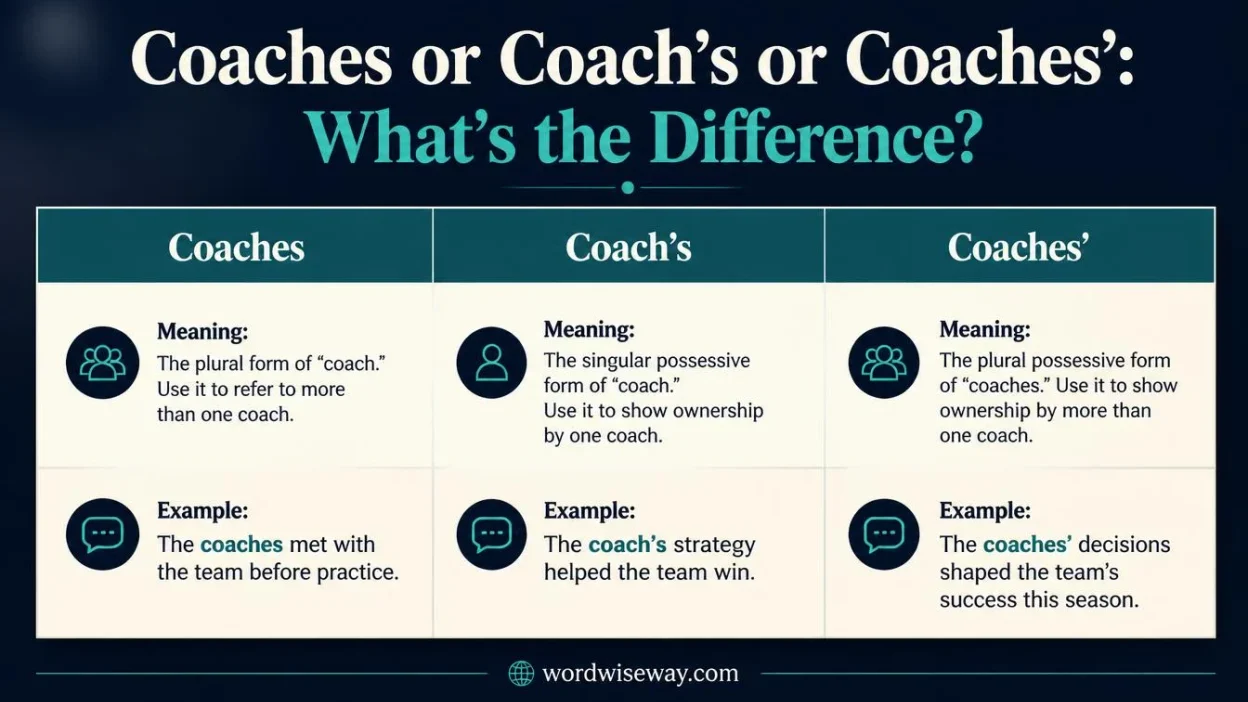
- Coaches: The plural form of coach. Use it when referring to two or more coaches. Example: The coaches attended the training session.
- Coach’s: The singular possessive form of coach. Use it when something belongs to or relates to one coach. Example: The coach’s instructions were clear.
- Coaches’: The plural possessive form of coach. Use it when something belongs to or relates to multiple coaches. Example: The coaches’ meeting starts at noon.
| Word | Grammatical function | Example |
| Coaches | Plural noun | The coaches arrived early. |
| Coach’s | Singular possessive | The coach’s office is upstairs. |
| Coaches’ | Plural possessive | The coaches’ offices are upstairs. |
The easiest rule to remember: Coaches means more than one coach, coach’s shows possession by one coach, and coaches’ shows possession by multiple coaches.
What Does Coaches Mean?
The word coaches is the regular plural form of coach. It refers to two or more people who train, guide, instruct, or prepare others for a particular activity.
For example, a basketball team might have an offensive coach, a defensive coach, and a head coach. When you refer to all three together, you can call them coaches.
The word can describe sports trainers, career advisers, fitness professionals, and other people who help others develop skills. Its meaning depends on the context, but its grammatical function remains the same.
When to Use Coaches in a Sentence
Use coaches when you mean multiple coaches without expressing ownership.
Consider these examples:
- The coaches discussed the team’s performance after the game.
- Several coaches attended the professional development workshop.
- The school hired two new coaches for its athletic program.
- Experienced coaches often help beginners build confidence.
- The coaches reviewed the players’ progress before the tournament.
In each example, coaches refers to more than one person. No apostrophe is necessary because the word simply identifies a group.
Here’s another useful example: “The coaches shared their opinions.”
The sentence tells you that several coaches shared their opinions. It doesn’t establish ownership of a particular object or place. Therefore, the plural form works perfectly.
Can Coaches Be a Verb?
Yes. Coaches can also function as a verb, depending on the sentence.
As a verb, coaches describes what one person does. It is the simple present form used with a third-person singular subject, such as he, she, or the trainer.
Examples include:
- She coaches the school’s volleyball team.
- Daniel coaches young athletes every weekend.
- The instructor coaches employees through difficult presentations.
- He coaches new managers on leadership skills.
Notice the difference between these two sentences:
- The coaches arrived before practice.
- The trainer coaches the team every afternoon.
In the first sentence, coaches is a plural noun. In the second, it is a verb describing an action.
Apostrophes don’t form ordinary plurals or third-person singular verbs. Use them only when the grammar requires an apostrophe, such as in a possessive form or contraction.
What Does Coach’s Mean?
The word coach’s is the singular possessive form of coach. It indicates that something belongs to, is associated with, or relates to one coach.
To form this possessive, start with the singular noun coach and add an apostrophe followed by s.
The pattern is straightforward:
coach + ’s = coach’s
For example, “The coach’s notebook contains the training schedule.”
The notebook belongs to or is associated with one coach. That’s why the singular possessive form is correct.
Possession doesn’t always mean legal ownership. The apostrophe can also express a relationship, responsibility, role, or connection.
Consider the phrase the coach’s decision. The decision isn’t a physical object that the coach owns. Instead, the possessive form identifies the person responsible for making it.
Examples of Coach’s in Sentences
Here are several examples that demonstrate how to use coach’s correctly.
- The coach’s advice helped the players prepare for the final.
- I left my water bottle in the coach’s office.
- The coach’s strategy changed the direction of the game.
- Everyone appreciated the coach’s patience during practice.
- The coach’s whistle fell beside the bench.
- We followed the coach’s instructions throughout the training session.
- The coach’s decision surprised several members of the team.
Each example connects a noun or responsibility to one coach.
For instance, coach’s strategy refers to the strategy of one coach. Similarly, coach’s instructions refers to instructions given by one coach, even though the noun instructions is plural.
That last example highlights an important point: the number of things owned doesn’t determine the number of owners.
One coach can have several notebooks, give multiple instructions, or develop numerous strategies. The possessive form remains coach’s because the owner is singular.
Does Coach’s Always Show Ownership?
Not exactly. It can express a broader relationship between a coach and something connected to the person.
For example:
- The coach’s responsibility includes monitoring player progress.
- The coach’s experience helped the team handle pressure.
- The coach’s arrival marked the beginning of practice.
- The coach’s approval was necessary before the players could leave.
These phrases don’t describe physical ownership. Instead, they show responsibility, experience, timing, or authorization associated with one coach.
This broader use of possessives is common in English. A possessive noun can identify who performs an action, who makes a decision, or who holds a particular role.
Is Coach’s a Contraction?
The spelling coach’s can also represent a contraction of coach is in informal writing, although context usually makes the meaning clear.
For example:
“The coach’s ready for the game.”
Here, coach’s means coach is. The sentence is a conversational way to say that the coach is ready.
However, in “The coach’s uniform is ready,” the same spelling expresses possession. The uniform belongs to or is associated with one coach.
Compare the two examples:
| Sentence | Meaning of coach’s |
| The coach’s ready. | The coach is ready. |
| The coach’s uniform is ready. | The uniform belongs to or is associated with the coach. |
In formal writing, contractions such as coach’s for coach is are less common. When clarity matters, writing the coach is ready can prevent confusion.
What Does Coaches’ Mean?
The word coaches’ is the plural possessive form of coach. Use it when something belongs to, relates to, or is associated with two or more coaches.
To form the plural possessive, first make the noun plural by adding s. Then place the apostrophe after that final letter.
The pattern looks like this:
coach + s + ’ = coaches’
For example, “The coaches’ meeting begins at 10 a.m.”
This sentence refers to a meeting associated with multiple coaches. The apostrophe follows the final s because coaches is already plural.
English generally follows this pattern for regular plural nouns ending in s. For example, players’ uniforms, teachers’ lounge, and managers’ decisions use the same apostrophe placement.
Examples of Coaches’ in Sentences
The following sentences show how coaches’ works in different contexts.
- The coaches’ meeting lasted nearly two hours.
- The coaches’ office is located beside the gym.
- The coaches’ strategies differed throughout the tournament.
- The school displayed the coaches’ awards in the hallway.
- The coaches’ recommendations helped improve the training program.
- The coaches’ schedules were updated before the new season.
- The coaches’ feedback helped the athletes identify areas for improvement.
In every example, the possessive form refers to multiple coaches.
Notice that coaches’ meeting doesn’t tell you how many meetings took place. It tells you that the meeting is associated with multiple coaches.
Similarly, coaches’ schedules indicates that several coaches have schedules. The possessive form identifies the owners, while the noun following it identifies what belongs to them.
Can Coaches’ Refer to Shared Ownership?
Yes. You can use coaches’ when several coaches share something or when something relates to the group collectively.
For example:
“The coaches’ office contains a shared calendar.”
The sentence indicates that the office is associated with multiple coaches. It doesn’t necessarily establish that they legally own the building or its contents.
Other examples include:
- The coaches’ lounge offers a place to prepare for upcoming games.
- The coaches’ agreement established common training standards.
- The coaches’ workshop covered new teaching methods.
- The coaches’ committee reviewed applications for the vacant position.
However, shared ownership isn’t required in every case. A plural possessive can also describe separate items associated with different members of a group.
For instance, “The coaches’ cars were parked outside.”
This sentence could refer to cars owned by individual coaches. The cars don’t need to be shared.
The apostrophe identifies the plural owners, not whether they share the same object.
Does Coaches’ Require a Plural Noun After It?
No. The noun following coaches’ can be singular or plural.
Compare these examples:
- The coaches’ office needs new furniture.
- The coaches’ offices need new furniture.
In the first sentence, office is singular. Multiple coaches may use one shared office, or the office may be associated with the group.
In the second sentence, offices is plural. The coaches may have separate offices.
Both sentences use the plural possessive correctly. The difference lies in the number of offices, not the number of coaches.
Key Differences
The most reliable way to distinguish these forms is to examine what the sentence means. Ask yourself whether you’re identifying several coaches, describing something associated with one coach, or describing something associated with multiple coaches.
| Feature | Coaches | Coach’s | Coaches’ |
| Basic meaning | More than one coach | One coach’s possession or relationship | Multiple coaches’ possession or relationship |
| Grammatical function | Plural noun; can also be a verb | Singular possessive; can also be a contraction | Plural possessive |
| Apostrophe | None | Before the final s | After the final s |
| Example phrase | Coaches arrive | Coach’s office | Coaches’ office |
| Example sentence | The coaches arrived early. | The coach’s office is open. | The coaches’ office is open. |
The difference becomes especially clear when you compare similar sentences.
Example one:
– The coaches reviewed the schedule.
This sentence identifies the people who reviewed the schedule. It doesn’t express possession.
Example two:
– The coach’s schedule was updated.
This sentence refers to the schedule of one coach.
Example three:
– The coaches’ schedule was updated.
This sentence refers to a schedule associated with multiple coaches. It could be one shared schedule.
Only the apostrophe placement changes between the last two forms, but that small difference changes the number of people associated with the schedule.
Coach’s Meeting vs. Coaches’ Meeting
These phrases illustrate why apostrophe placement matters.
A coach’s meeting is a meeting associated with one coach. Depending on the context, it might be a meeting the coach attends, leads, or organizes.
A coaches’ meeting is a meeting associated with multiple coaches. It could involve planning, sharing training methods, or discussing team performance.
Consider this short scenario:
A school employs one head coach who meets with the principal every Monday. The school might describe that appointment as the coach’s meeting.
If the school gathers its basketball, soccer, and volleyball coaches for a planning session, it might call the event the coaches’ meeting.
The number of meetings isn’t the deciding factor. The number of coaches associated with the meeting is what matters.
Coach’s Equipment vs. Coaches’ Equipment
The same principle applies to equipment.
- Coach’s equipment: Equipment associated with one coach.
- Coaches’ equipment: Equipment associated with multiple coaches.
Suppose a coach keeps a whistle, clipboard, and stopwatch in a personal bag. You could describe these items as the coach’s equipment.
Now imagine that several coaches use a shared collection of training cones, timers, and practice boards. You could refer to these items as the coaches’ equipment.
In real writing, the context may leave ownership open to interpretation. Nevertheless, the apostrophe still tells readers whether the possessive refers to one coach or several.
When to Use Coaches, Coach’s, or Coaches’
You don’t need to memorize complicated grammar terminology to choose the right form. Instead, identify the role the word plays in your sentence.
Use the following steps as a practical guide.
Step one: Identify the number of coaches.
Are you referring to one coach or multiple coaches? If you mean more than one, coaches is the usual plural form.
Step two: Determine whether you’re expressing possession or a relationship.
If you’re simply talking about several coaches, don’t add an apostrophe. If you’re connecting something to a coach or a group of coaches, a possessive form may be necessary.
Step three: Place the apostrophe correctly.
For one coach, write coach’s. For multiple coaches, write coaches’.
Here’s how these rules work across different settings.
| Situation | Correct form | Example |
| Several sports trainers attend practice. | Coaches | The coaches arrived at 8 a.m. |
| One trainer gives instructions. | Coach’s | The coach’s instructions were helpful. |
| Several trainers share a meeting room. | Coaches’ | The coaches’ meeting room is upstairs. |
| One trainer leads a program. | Coach’s | The coach’s program starts next month. |
| Multiple trainers develop a shared plan. | Coaches’ | The coaches’ plan includes additional practice. |
| One person trains a team. | Coaches | She coaches the school team. |
The final row shows why checking the whole sentence matters. In that example, coaches is a verb rather than a plural noun or possessive.
A Practical Case Study: Choosing the Correct Form
Imagine a school preparing for its annual sports tournament. Three coaches supervise different teams, and the school publishes a notice about their activities.
The notice contains three sentences:
- The coaches will meet after lunch.
- The head coach’s office will remain open.
- The coaches’ training plan includes additional practice sessions.
Each form has a distinct job.
In the first sentence, coaches identifies several people. The second sentence connects an office to one head coach. The third sentence connects a training plan to multiple coaches.
Now imagine changing the first sentence to “The coaches’ will meet after lunch.” That version is incorrect because the sentence doesn’t identify anything belonging to the coaches. It simply refers to the people who will meet.
Likewise, writing “The coaches office will remain open” leaves out the apostrophe needed to mark the singular possessive in the second sentence.
The lesson is simple: choose the grammatical form that matches the meaning, not the form that looks familiar.
Common Mistakes
Even experienced writers sometimes place apostrophes incorrectly. Most mistakes happen when writers confuse a plural noun with a possessive noun or forget to identify the owner.
Adding an Apostrophe to Coaches When You Only Mean a Plural
Incorrect: The coach’s arrived early for practice.
Correct: The coaches arrived early for practice.
The first sentence uses the singular possessive form, which doesn’t fit the intended meaning. The second sentence correctly identifies multiple coaches.
Remember that ordinary plural nouns don’t need apostrophes. Write coaches, teachers, and players when you simply mean more than one person.
Using Coach’s for Multiple Coaches
Incorrect: The coach’s discussed their plans after the game.
Correct: The coaches discussed their plans after the game.
The corrected sentence uses the plural noun because several coaches are performing the action.
However, if the sentence refers to something associated with multiple coaches, the plural possessive may be necessary.
For example: “The coaches’ plans changed after the game.”
Here, coaches’ is correct because the plans are associated with multiple coaches.
Using Coaches’ for One Coach
Incorrect: The coaches’ whistle fell beside the bench.
Correct: The coach’s whistle fell beside the bench.
If one coach owns or uses the whistle, the singular possessive is appropriate. The plural possessive would suggest a connection to multiple coaches.
Placing the Apostrophe Before the S in a Plural Possessive
Incorrect: The coach’s meeting begins at noon. (Incorrect if the meeting involves multiple coaches.)
Correct: The coaches’ meeting begins at noon.
The first version refers to one coach. The second refers to multiple coaches.
When a regular plural noun already ends in s, place the apostrophe after that letter to form the possessive.
Forgetting That Context Can Change the Meaning
Consider these two sentences:
- The coach’s team won the tournament.
- The coaches’ team won the tournament.
The first sentence associates the team with one coach. The second associates it with multiple coaches.
Both forms can be grammatically correct, depending on the intended meaning. Grammar isn’t just about spelling; it also helps readers understand relationships between people and things.
How to Remember the Difference
A simple memory trick can help you choose the correct spelling without stopping to analyze every grammatical detail.
Coaches = a group.
The word has no apostrophe because it simply refers to multiple coaches.
Example: The coaches arrived together.
Coach’s = one coach.
The apostrophe comes before the final s to show a singular possessive.
Example: The coach’s bag is on the bench.
Coaches’ = multiple coaches.
The apostrophe comes after the s because the plural noun already ends with that letter.
Example: The coaches’ bags are on the bench.
Think of the apostrophe as a small signpost. Its position helps readers identify the relationship between the noun and the words that follow it.
A Quick Practice Exercise
Choose the correct form for each sentence.
- The (coaches / coach’s / coaches’) arrived before the players.
- The (coaches / coach’s / coaches’) office belongs to the head coach.
- The (coaches / coach’s / coaches’) meeting includes all three trainers.
- She (coaches / coach’s / coaches’) the school basketball team.
- The (coaches / coach’s / coaches’) equipment was stored in a shared room.
Answers and explanations
- Coaches: The sentence refers to multiple people.
- Coach’s: The office is associated with one head coach.
- Coaches’: The meeting involves multiple coaches.
- Coaches: The word functions as a verb describing what she does.
- Coaches’: The equipment is associated with multiple coaches.
These examples cover the three main grammatical forms and show why sentence meaning matters.
Which Is Correct?
The standard plural possessive form is coaches’, not coaches’s.
Regular plural nouns that already end in s generally form their possessives by adding an apostrophe after the existing s. This rule applies to coaches, players, teachers, and many other regular plurals.
Compare these examples:
| Incorrect form | Correct form |
| The coaches’s office | The coaches’ office |
| The players’s uniforms | The players’ uniforms |
| The teachers’s lounge | The teachers’ lounge |
| The managers’s decisions | The managers’ decisions |
The reason is straightforward. The word coaches already contains the plural ending. Adding another s after the apostrophe isn’t the standard way to form its possessive.
However, don’t apply this rule blindly to every plural noun. Irregular plurals that don’t end in s usually form their possessives by adding ’s.
For example:
- The children’s playground is nearby.
- The men’s changing room is downstairs.
- The women’s team won the championship.
These examples follow a different pattern because children, men, and women don’t end in s.
Singular and Plural Possession
The difference between coach’s and coaches’ becomes easier to understand when you compare the owner in each sentence.
| Singular possessive | Plural possessive |
| The coach’s office | The coaches’ office |
| The coach’s decision | The coaches’ decision |
| The coach’s strategy | The coaches’ strategy |
| The coach’s responsibilities | The coaches’ responsibilities |
| The coach’s schedule | The coaches’ schedule |
Each pair changes the number of people associated with the noun. The noun following the possessive can remain singular or plural.
For example, the coach’s responsibilities refers to the responsibilities of one coach. Meanwhile, the coaches’ responsibilities refers to responsibilities associated with multiple coaches.
Similarly, the coaches’ decision may refer to a decision made collectively by several coaches. It doesn’t necessarily mean that each coach made a separate decision.
The apostrophe identifies the owner or associated group. The following noun tells you what the possessive refers to.
Is Coaches Ever Possessive Without an Apostrophe?
In standard English, coaches without an apostrophe is generally a plural noun or a verb. It doesn’t normally function as a possessive form.
Consider these examples:
- The coaches arrived at the stadium.
- Our school coaches several youth teams.
- The coaches’ equipment is in the storage room.
The first sentence uses coaches as a plural noun. The second uses coaches as a verb. The third uses coaches’ as a plural possessive.
If you want to express possession, you generally need the apostrophe. Leaving it out can change the sentence’s meaning or make the intended relationship unclear.
For example, “The coaches office is closed” doesn’t use the standard possessive spelling. If the office belongs to or is associated with one coach, write the coach’s office. If it is associated with multiple coaches, write the coaches’ office.
Context determines which possessive form fits.
Read More: United States’ or United States’s? The Correct Possessive Form
FAQs
1. What Is the Difference Between Coaches, Coach’s, and Coaches’?
Coaches means more than one coach. Coach’s shows that something belongs to one coach, while coaches’ shows ownership by multiple coaches.
2. Is Coaches’ Correct Grammar?
Yes, coaches’ is grammatically correct when something belongs to two or more coaches. The apostrophe comes after the s because the noun is plural.
3. When Should I Use Coach’s in a Sentence?
Use coach’s when referring to something owned by or associated with one coach. For example, The coach’s whistle is on the table.
4. Is Coaches Singular or Plural?
Coaches is the plural form of coach. It refers to two or more people who train athletes, guide teams, or teach specific skills.
5. Where Does the Apostrophe Go in Coaches’?
Place the apostrophe after the s in coaches’. This form indicates that something belongs to multiple coaches, as in The coaches’ meeting starts at noon.
6. What Is the Plural Possessive Form of Coach?
The plural possessive form is coaches’. First, change coach to its plural form, coaches, and then add an apostrophe after the final s.
7. Is It Coach’s Team or Coaches’ Team?
Both forms are correct, but their meanings differ. Coach’s team refers to one coach’s team, while coaches’ team indicates a team associated with multiple coaches.
8. Does Coaches’ Need Another S After the Apostrophe?
No, coaches’ does not need another s after the apostrophe. The plural noun already ends in s, so the apostrophe alone indicates possession.
9. How Can I Remember the Difference Between Coach’s and Coaches’?
Remember that coach’s refers to one coach, while coaches’ refers to multiple coaches. Check whether the owner is singular or plural before placing the apostrophe.
10. What Are Common Mistakes When Using Coach’s and Coaches’?
A common mistake is using coach’s for multiple coaches or coaches’ for one coach. Identify the number of owners first, then apply the correct possessive rule.
Conclusion
Understanding the difference between coaches, coach’s, and coaches’ makes English writing clearer and more accurate. Although these forms look similar, each has a different meaning. Coaches refers to more than one coach, while coach’s shows ownership by one coach. Meanwhile, coaches’ indicates that something belongs to multiple coaches.
The easiest way to remember these grammar rules is to identify the owner before using an apostrophe. If one coach owns something, write coach’s. If several coaches share ownership, use coaches’. When you simply mean more than one coach, write coaches without an apostrophe. These small differences can help you avoid common punctuation mistakes.
With regular practice, choosing the correct possessive form becomes much easier. Pay attention to the meaning of each sentence, check whether the noun is singular or plural, and place the apostrophe accordingly. Once you understand these simple possessive rules, you can use all three forms confidently in everyday writing.