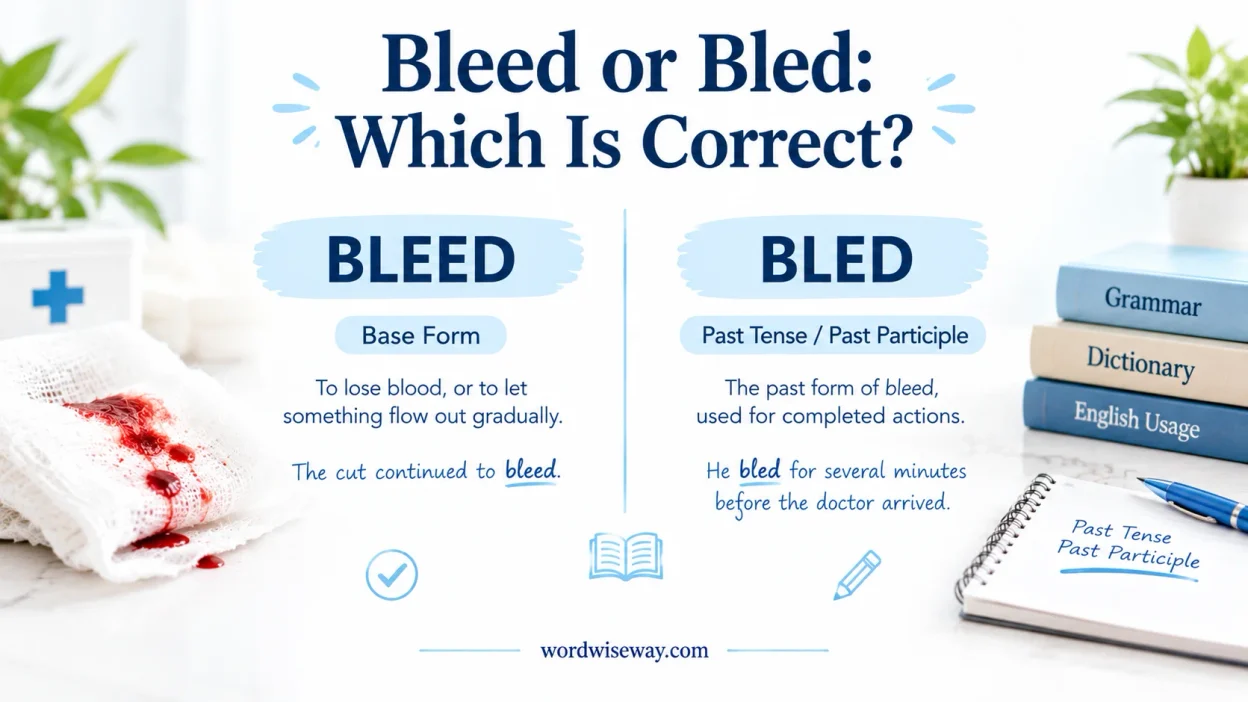
Bleed or Bled: Correct Spelling, Meaning, and Usage becomes easier when you remember one simple rule: bleed is the present form, while bled is the past form of the same irregular verb. Use bleed for something happening now, and bled for something that already happened.
For example, “The cut may bleed” describes a possible action, while “The cut bled yesterday” describes a past action. The bleeding form uses the -ing form to show an action happening now and continuing. This helps English learners avoid confusion when choosing the correct verb form.
Unlike simple verbs such as walk and walked, bleed doesn’t follow the usual -ed pattern. Understanding its grammar, meaning, usage, and sentence structures helps you avoid common grammar mistakes in writing, speaking, emails, schoolwork, and social media posts with confidence.
Quick Answer:
Bleed is the base form of the verb. Bled is both the simple past tense and the past participle of bleed. Oxford lists the principal forms as bleed, bleeds, bled, and bleeding, with bled serving as both the past simple and past participle.
| Word | Grammatical role | When to use it | Example |
| bleed | Base form | Present, infinitives, and after modal verbs | The cut may bleed. |
| bleeds | Third-person singular | Present tense with he, she, or it | The wound bleeds easily. |
| bled | Simple past | A completed past action | The wound bled yesterday. |
| bled | Past participle | Perfect constructions | The wound has bled before. |
| bleeding | Present participle | Continuous constructions | The wound is bleeding. |
The easiest rule is straightforward:
- Now or generally → bleed / bleeds
- Completed past action → bled
- After has, have, or had → bled
- After can, could, may, might, should, or will → bleed
- After “to” → bleed
Cambridge also identifies bled as both the past tense and past participle of bleed.
What Does “Bleed” Mean?
Bleed is a verb that commonly means to lose blood from the body. You can use it when describing a person or animal that has blood coming from an injury or another part of the body.
For example:
- My finger tends to bleed when the skin cracks.
- Some wounds bleed more than others.
- The cut may bleed for a while.
The word also has several non-literal meanings. English often takes a concrete physical action and gives it a figurative life of its own. Bleed is a good example.
Bleed Can Describe Spreading Color
When ink, paint, or another color spreads beyond its intended boundary, you can use bleed.
For example:
- The ink may bleed through thin paper.
- Dark colors can bleed into lighter ones.
- The paint started to bleed across the wet surface.
Cambridge specifically includes this meaning for color, ink, and paint spreading beyond an edge or into another color.
Bleed Can Describe Losing Money or Resources
The verb can also describe a continuing financial loss.
For example:
- The company continues to bleed money.
- High operating costs can bleed a business of its resources.
In business English, Cambridge records bleed as meaning to lose a large amount of money or cause someone or something to lose it.
Bleed Has Technical Uses
You may also encounter bleed in technical contexts. For example, you can bleed a closed system such as a radiator or brake system by removing air or liquid so the system works correctly.
The meaning changes with context, but the grammar doesn’t. Whether you’re talking about blood, ink, money, or a technical system, bleed still follows the same verb pattern.
What Does “Bled” Mean?
Bled is the simple past tense and past participle of bleed. Cambridge explicitly lists both grammatical functions.
You use bled when an action happened in the past.
For example:
- The cut bled after the accident.
- His nose bled during the game.
- The ink bled into the surrounding area.
You also use bled after auxiliary verbs such as has, have, and had.
For example:
- The wound has bled before.
- The paper has bled in the past.
- The injury had bled for several minutes.
So, bled doesn’t represent a separate verb. It’s simply one of the grammatical forms of bleed.
The Main Grammar Difference
The most important distinction between bleed and bled is tense and grammatical construction.
Think of bleed as the verb’s basic engine. Bled is the form that takes over when English grammar places the action in the past or requires the past participle.
Bleed as the Base Form
Use bleed when the grammar calls for the base form.
This happens in several common situations.
After “to”:
- The wound began to bleed.
- The cut continued to bleed.
- He didn’t want the injury to bleed again.
After modal verbs:
- The cut may bleed.
- The wound could bleed again.
- The injury might bleed.
- The area should not bleed for long.
Modal verbs take the base form, not the past form. Therefore, may bleed is correct while may bled is incorrect.
Bled as the Simple Past
Use bled when you’re describing a completed action in the past.
For example:
- The wound bled yesterday.
- His nose bled during the match.
- The ink bled onto the next page.
- The pipe bled air during the repair.
Notice how the surrounding context places the action in the past.
Words such as yesterday, earlier, last night, previously, and a few minutes ago often make the past meaning obvious.
Bled as a Past Participle
Here’s where things get especially useful. Bled also functions as the past participle.
That means you use it with perfect-tense auxiliary verbs.
Present perfect:
- The wound has bled before.
- Several pages have bled through.
- The system has bled air.
Past perfect:
- The wound had bled before treatment began.
- The ink had bled through the paper.
The pattern is simple:
has/have/had + bled
Not:
has/have/had + bleed
Bleed, Bled, and Bleeding: Complete Verb Forms
Understanding all the major forms makes bleed or bled much easier to handle.
| Verb form | Example | Function |
| bleed | I bleed easily. | Base form |
| bleeds | The wound bleeds easily. | Third-person singular present |
| bled | The wound bled yesterday. | Simple past |
| bled | The wound has bled before. | Past participle |
| bleeding | The wound is bleeding. | Present participle |
Oxford’s verb table confirms these forms and identifies bled as both the past simple and past participle.
Why “Bleed” Is an Irregular Verb
Many English verbs form the past tense by adding -ed.
For example:
- walk → walked
- clean → cleaned
- open → opened
Bleed doesn’t follow that pattern.
Its past form is bled, not bleeded.
So:
- bleed → bled ✓
- bleed → bleeded ✗
That’s why learners need to remember bled as an irregular form rather than trying to create the past tense mechanically.
When to Use “Bleed”
Knowing the situations where bleed belongs can prevent most mistakes.
Use Bleed for General or Present Situations
Use bleed when you’re describing something that happens generally or as a present fact.
For example:
- Some injuries bleed heavily.
- This type of paper can bleed ink.
- The valve may bleed air.
With he, she, or it, use bleeds in the simple present:
- His nose bleeds easily.
- The wound bleeds whenever it is disturbed.
- The printer’s ink bleeds on cheap paper.
The distinction matters because bleed and bleeds are different present-tense forms.
Use Bleed After Modal Verbs
Modal verbs require the base form.
Common examples include:
- can
- could
- may
- might
- shall
- should
- will
- would
Therefore:
- The wound can bleed.
- The color might bleed.
- The system could bleed air.
- The ink will bleed through the paper.
Never change bleed to bled after a modal.
Use Bleed After “To”
The infinitive uses to + base verb.
Therefore:
- The cut started to bleed.
- The paper is likely to bleed ink.
- The system needs to bleed properly.
This construction provides another reliable clue. When to introduces the infinitive, choose bleed, not bled.
When to Use “Bled”
The word bled has two major grammatical jobs.
Use Bled for Completed Past Actions
If the action happened in the past and you’re treating it as a completed event, use bled.
Compare:
- The cut bleeds easily.
- The cut bled yesterday.
The first sentence describes a general or present tendency. The second places a specific event in the past.
Here’s another pair:
- The ink bleeds when the paper gets wet.
- The ink bled across the page when the paper got wet.
The tense changes because the time relationship changes.
Use Bled With Perfect Tenses
Perfect tenses require a form of have, followed by the past participle.
Because bled is the past participle of bleed, the correct constructions are:
- has bled
- have bled
- had bled
Examples:
- The wound has bled several times.
- The pages have bled into one another.
- The pipe had bled air before the technician arrived.
This pattern is worth remembering because it appears constantly in everyday English.
Use Bled in Past-Participle Constructions
A past participle doesn’t always stand alone. It can work with auxiliary verbs to create different grammatical structures.
For example:
- The patient had bled before help arrived.
- The company has bled money for months.
- The color had bled beyond the border.
The surrounding auxiliary verb tells you that bled is functioning as a past participle rather than simply as a standalone past-tense verb.
Common Mistakes
Most mistakes happen when writers apply a regular-verb pattern to an irregular verb or overlook an auxiliary verb.
| Incorrect | Correct | Why |
| He bleed yesterday. | He bled yesterday. | A completed past action requires bled. |
| She has bleed before. | She has bled before. | Has requires the past participle. |
| He can bled easily. | He can bleed easily. | A modal takes the base form. |
| They had bleed earlier. | They had bled earlier. | Had requires the past participle. |
| The wound bleeded yesterday. | The wound bled yesterday. | Bleed is irregular. |
| Did it bled? | Did it bleed? | Did takes the base form. |
The last example deserves special attention.
When did already carries the past tense, the main verb returns to its base form. English doesn’t normally mark the same past tense twice.
That’s why you say:
Did the wound bleed?
Not:
Did the wound bled?
Different Sentence Structures
The surrounding words often reveal the correct form before you even think about the meaning.
| Sentence structure | Correct form | Example |
| Simple present | bleed / bleeds | Some cuts bleed easily. |
| Simple past | bled | The cut bled yesterday. |
| Future with will | bleed | The wound may bleed again. |
| Modal construction | bleed | It could bleed. |
| Infinitive | bleed | It began to bleed. |
| Present perfect | bled | It has bled before. |
| Past perfect | bled | It had bled earlier. |
| Present continuous | bleeding | It is bleeding now. |
| Question with did | bleed | Did it bleed? |
| Negative with did | bleed | It didn’t bleed. |
This table exposes an important pattern: grammar often determines the form more reliably than the meaning alone.
Examples
Examples become especially helpful when the two forms appear side by side.
Present vs. Past
- The wound bleeds easily.
- The wound bled yesterday.
Modal vs. Past
- The wound might bleed again.
- The wound bled earlier.
Infinitive vs. Past
- The cut began to bleed.
- The cut bled for several minutes.
Perfect vs. Simple Past
- The injury has bled before.
- The injury bled yesterday.
Color and Ink
The distinction isn’t limited to blood.
- The ink can bleed through thin paper.
- The ink bled through the paper yesterday.
- The color has bled into the surrounding area.
Oxford also records bleed for the spreading of one area of color into another.
Financial Meaning
The same grammatical rule works with figurative financial uses:
- The business continues to bleed money.
- The business bled money last year.
- The business has bled money for months.
Cambridge’s Business English entry recognizes this use of bleed for losing substantial amounts of money.
Bleed or Bled in Questions and Negative Sentences
Questions with did create one of the most common traps.
Because did already marks the sentence as past tense, the main verb uses its base form.
Correct:
- Did the wound bleed?
- Did the paint bleed?
- Did the pipe bleed air?
Incorrect:
- Did the wound bled?
- Did the paint bled?
- Did the pipe bled air?
The same rule applies to negative sentences containing didn’t:
- The wound didn’t bleed.
- The ink didn’t bleed.
- The system didn’t bleed properly.
Here, didn’t carries the past-tense meaning. The main verb stays in its base form.
Bleed vs. Bled in Figurative and Technical Uses
The meanings may change, but the grammatical rules stay firmly in place.
For example, bleed can describe color spreading:
The red ink may bleed into the blue area.
If that event happened yesterday, use bled:
The red ink bled into the blue area.
With the present perfect, use bled again:
The red ink has bled into the blue area.
The same transformation works with financial language:
- The company continues to bleed money.
- The company bled money last year.
- The company has bled money for several years.
Oxford records several meanings of bleed, including losing blood, removing air or liquid from a system, forcing someone to pay money, and spreading from one area into another.
So don’t let the meaning distract you from the grammar. The verb’s forms remain consistent.
A Simple Memory Trick
If you’re stuck between bleed and bled, look at the word immediately before the verb.
Look for “Can, Could, May, Might, Should, Will”
Choose bleed.
- can bleed
- could bleed
- may bleed
- might bleed
- should bleed
- will bleed
Look for “Has, Have, Had”
Choose bled.
- has bled
- have bled
- had bled
Look for “Did” or “Didn’t”
Choose bleed.
- did bleed
- didn’t bleed
Look for a Direct Past-Time Reference
If you’re describing a completed action without an auxiliary verb, choose bled.
- yesterday → bled
- last night → bled
- earlier → bled
- a few minutes ago → bled
This isn’t a substitute for understanding grammar, but it’s a handy mental shortcut when you’re writing quickly.
Read More: Stem or Steam: Meaning, Usage, and Difference
FAQs
Is bleed the present tense of bled?
Yes. Bleed is the base and present form, while bled is the simple past and past participle.
Is bled the correct past tense of bleed?
Yes. Bled is the correct past form of bleed. You shouldn’t use “bleeded” in standard English.
Should I use bleed or bled for yesterday?
Use bled when talking about yesterday or another completed past event. For example, “My finger bled yesterday.”
Can I use bleed for something happening now?
Yes. Use bleed for the present, depending on the sentence structure. For example, “My finger may bleed.”
What does bleeding mean?
Bleeding is the -ing form of bleed. It usually describes an action that is happening or continuing.
Why is bleed an irregular verb?
Bleed is irregular because its past form changes to bled instead of following the regular -ed pattern.
Is “I bleed yesterday” grammatically correct?
No. Because yesterday refers to a completed past action, the correct sentence is “I bled yesterday.”
Is “The cut is bleeding” correct?
Yes. Bleeding works with “is” to describe an action happening now.
What is the difference between bleed and bled?
Bleed refers to the present or base form, while bled refers to the past. The correct choice depends on the tense of your sentence.
How can I remember when to use bleed and bled?
Think of the time reference: today or now = bleed, while yesterday or before = bled. Practicing short examples can make the difference easier to remember.
Conclusion
Choosing between bleed and bled becomes much easier once you focus on time. Bleed is the base and present form, while bled is the past form of this irregular verb. If something happens now or may happen, use bleed. If it happened before, use bled.
The bleeding form adds another useful option when an action is happening or continuing. Remember that bleed doesn’t follow the regular -ed pattern like walk and walked. Instead, its past form changes to bled, which is why phrases such as “I bled yesterday” are correct.
With a little practice, you can use these forms naturally in everyday speaking and writing. Keep the time of the action in mind, check the sentence structure, and you’ll avoid common mistakes. Once this small difference clicks, choosing the correct form feels far less confusing.

Amelia Sanders has spent 14 years in Harvard University’s English Department, helping students navigate literary analysis, interpretive theory, and narrative techniques. Her academic pursuits center on 18th-century British prose, romantic poetry, diasporic writing, and digital editing exploring how textual choices influence cultural perspectives. Amelia has spoken at major international meetings and contributed essays to respected academic volumes, demonstrating her dedication to thoughtful scholarship and effective teaching.