Louis’ or Louis’s: Meaning, Difference and Usage explores an English grammar problem involving the possessive form of a name ending in S.
Understanding Louis’s meaning, Louis’ meaning, Louis’s usage, and Louis’ usage helps explain name ownership, name possession, ownership, and possession. Both forms express similar meanings, but their usage depends on accepted grammatical rules and style guides.
Learning possessive nouns, singular possessive forms, possessive names, singular names, and proper nouns improves language learning and written English. Correct apostrophe usage, spelling rules, punctuation, and English punctuation help writers understand the difference and discover which is best. These details provide a definitive answer for everyday writing.
The main difference involves apostrophe placement and whether you keep the S or add an additional S after the apostrophe after S. The possessive apostrophe, possessive spelling, possessive construction, and possessive endings follow apostrophe rules.
However, grammar conventions, writing rules, and writing conventions may vary between style guides. Checking reliable grammar guidance helps maintain standard English, correct grammar, and the correct possessive form.
Understanding S-ending names, name possessives, names and apostrophes, grammatical differences, usage differences, grammatical choice, and the final S makes applying possessive grammar rules easier.
Quick Answer:
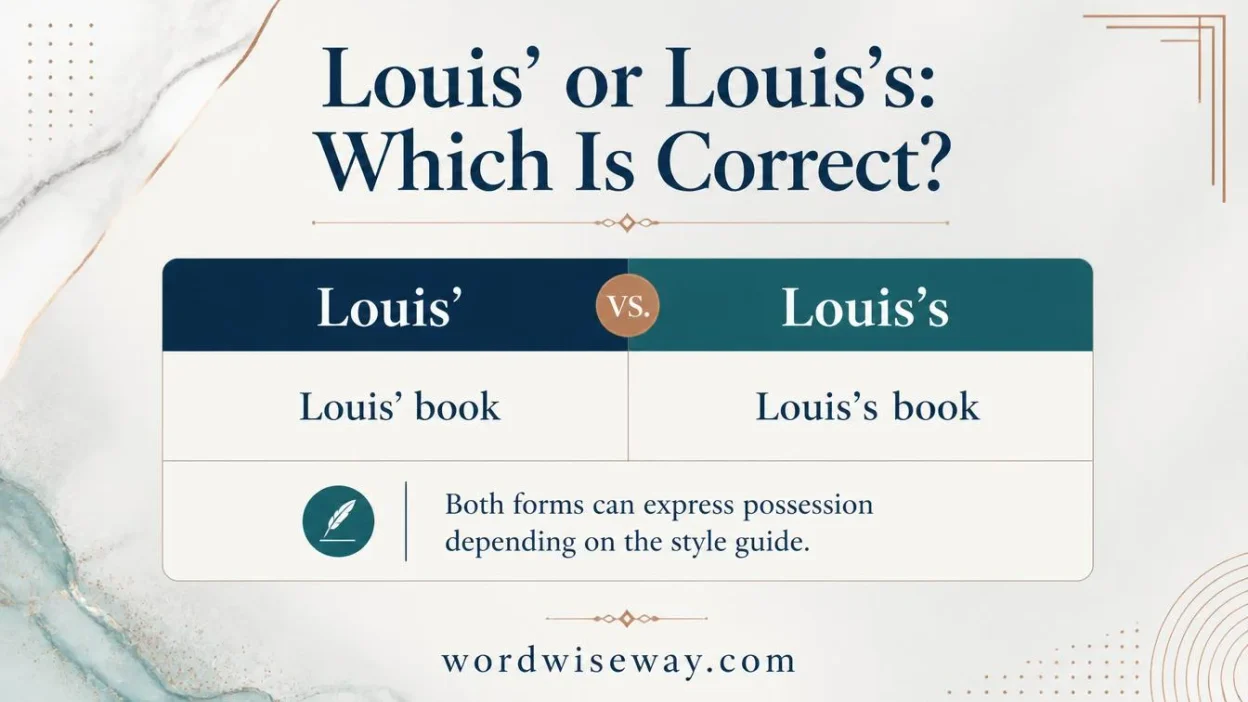
Both Louis’ and Louis’s are accepted possessive forms of the singular name Louis. However, your preferred form depends on the style guide you follow.
- Louis’s: Adds apostrophe plus s to the singular name. The Chicago Manual of Style generally follows this approach for singular proper names ending in s.
- Louis’: Adds only an apostrophe. The Associated Press style generally uses this approach for singular proper names ending in s.
Consider these examples:
- Louis’s jacket is hanging by the door.
- Louis’ jacket is hanging by the door.
Both sentences indicate that the jacket belongs to Louis. The difference lies in the spelling convention, not the ownership.
Easy rule to remember: Follow your required style guide. If you don’t have one, choose a form that suits your writing and use it consistently.
What Does Louis’ Mean?
Louis’ is a possessive form of the singular name Louis. Writers use it to show that something belongs to, relates to, or is associated with a person named Louis.
This form adds only an apostrophe after the final s. It follows a convention used by several style guides for singular proper names ending in s.
For example, consider this sentence:
Louis’ bicycle is parked outside.
The sentence tells you that the bicycle belongs to Louis. The apostrophe marks the possessive relationship without adding another s to the spelling.
Examples of Louis’ in Sentences
Here are several examples showing how this form works in everyday writing.
- Louis’ jacket was left in the classroom.
- The teacher praised Louis’ project during the presentation.
- We visited Louis’ house after school.
- Louis’ decision surprised his teammates.
- The manager discussed Louis’ responsibilities during the meeting.
Each example connects Louis to an object, an action, or a responsibility. The apostrophe signals that relationship.
When Is Louis’ the Preferred Form?
The form Louis’ is appropriate when your chosen style guide calls for an apostrophe alone after singular names ending in s.
For example, the Associated Press Stylebook generally follows this convention for singular proper names. Newspaper writers and editors who follow AP style may therefore choose Louis’ office instead of Louis’s office.
However, this preference doesn’t make Louis’s grammatically incorrect. It simply reflects a different editorial rule.
What Does Louis’s Mean?
Louis’s is another possessive form of the singular name Louis. It adds an apostrophe followed by another s, following the general rule that many style guides apply to singular nouns and names.
For example:
Louis’s bicycle is parked outside.
This sentence has the same basic meaning as Louis’ bicycle is parked outside. Both identify Louis as the person associated with the bicycle.
The Chicago Manual of Style recommends adding apostrophe plus s to singular proper names ending in s. Its guidance includes examples such as James’s and Iris’s.
Examples of Louis’s in Sentences
The following examples demonstrate how to use this form naturally.
- Louis’s jacket was hanging behind the classroom door.
- The teacher praised Louis’s project for its clear explanation.
- We visited Louis’s house during the summer holidays.
- Louis’s decision changed the direction of the discussion.
- The manager reviewed Louis’s responsibilities before assigning the new task.
Notice that the extra s doesn’t change the basic meaning. It follows the chosen spelling convention for singular possessives.
When Is Louis’s the Preferred Form?
Use Louis’s when your required style guide recommends adding apostrophe plus s to singular names ending in s.
This approach appears in the Chicago Manual of Style and other editorial conventions. It’s common in book publishing, edited prose, and academic writing that follows a style requiring the additional s.
If you’re writing an essay, check your instructor’s requirements before choosing a form. For a book, article, or professional document, follow the publication’s house style.
Louis’ vs. Louis’s: Key Differences
The difference between Louis’ and Louis’s concerns spelling conventions rather than the basic meaning of possession.
Both forms can identify something connected to Louis. The choice depends on the editorial rules governing your writing.
| Feature | Louis’ | Louis’s |
| Grammatical function | Singular possessive | Singular possessive |
| Spelling | Adds an apostrophe | Adds apostrophe plus s |
| Basic meaning | Belonging to Louis | Belonging to Louis |
| Chicago style | Generally not preferred | Preferred |
| AP style | Generally preferred | Generally not preferred |
| Example | Louis’ desk | Louis’s desk |
Do Louis’ and Louis’s Mean the Same Thing?
Yes. In ordinary possessive sentences, both forms communicate the same basic relationship.
Compare these examples:
- Louis’ phone rang during the meeting.
- Louis’s phone rang during the meeting.
Both sentences indicate that the phone belongs to Louis. Neither form automatically changes the meaning, ownership, or grammatical role of the sentence.
The important distinction is consistency. If a publication follows AP style, use its preferred form. If it follows Chicago style, use the form that Chicago recommends.
Why Do Both Forms Exist?
English has more than one established convention for forming possessives of singular names ending in s. Different style guides developed different preferences, and both forms remain in use.
The extra s can also make the possessive pattern easier to recognize because it follows the familiar structure used with many singular nouns. The apostrophe-only form avoids adding another letter to the name.
Neither convention should be treated as universally correct for every publication. The appropriate choice depends on the writing rules you’re expected to follow.
Grammar Rules for Forming the Possessive of Louis
Understanding the general rules for possessive nouns makes this choice easier. First, determine whether Louis is singular or plural. Then apply the appropriate possessive convention.
The Rule for Adding Only an Apostrophe
Under the apostrophe-only convention, a singular proper name ending in s takes an apostrophe after the final letter.
The pattern looks like this:
- Original name: Louis
- Possessive form: Louis’
- Example: Louis’ notebook is on the desk.
This convention is associated with AP style for singular proper names ending in s. It allows writers to mark possession without adding another letter to the name.
However, don’t assume that every noun ending in s follows this rule. Singular common nouns, such as boss, often take apostrophe plus s under standard conventions: the boss’s office.
The Rule for Adding ’s
Under the apostrophe-plus-s convention, add ’s to the original singular name, even if the name already ends in s.
Follow these steps:
- Original name: Louis
- Add apostrophe plus s: Louis’s
- Example: Louis’s notebook is on the desk.
The Chicago Manual of Style follows this approach for singular proper names ending in s. It applies the rule regardless of the number of syllables in the name.
This pattern also works with names such as James and Chris when the selected style guide uses apostrophe plus s.
Examples include:
- James’s backpack
- Chris’s computer
- Louis’s notebook
The extra s belongs to the possessive spelling. It doesn’t turn Louis into a plural noun.
How Major Style Guides Treat Louis’ and Louis’s
Style guides provide consistent rules for writing, editing, and publishing. Their recommendations can differ even when they address the same grammatical construction.
| Style guide | General approach for a singular name ending in s | Example with Louis |
| Chicago Manual of Style | Add apostrophe plus s | Louis’s |
| Associated Press Stylebook | Generally add an apostrophe only | Louis’ |
| MLA Handbook | Generally add apostrophe plus s | Louis’s |
These are general patterns, not substitutes for checking a specific edition or institutional rule. If you’re preparing a document for a particular publication, use its current guidance.
The main lesson is simple: choose the form that matches your style guide instead of mixing conventions.
When to Use Louis’ in a Sentence
Use Louis’ when your chosen writing convention calls for an apostrophe alone after a singular proper name ending in s. This form appears in publications that follow AP style.
The following examples show how it works in different contexts.
Ownership: Louis’ laptop needs a software update.
Relationships: Louis’ brother is studying engineering.
Places: Louis’ apartment is near the university.
Work: Louis’ presentation covers the company’s new project.
Decisions: Louis’ recommendation helped the team choose a suitable solution.
In each example, Louis’ connects the name to something associated with that person. The word following the possessive doesn’t determine whether you need an extra s. Your chosen style convention does.
Avoid Inconsistent Possessive Forms
Imagine you’re writing an article about Louis and his new business. You use Louis’ business in the introduction, Louis’s office in the second section, and Louis’ employees in the conclusion.
Although readers can understand all three phrases, switching between forms without a reason creates an inconsistent style.
Choose one convention and apply it throughout the article. If you’re editing an existing document, check every occurrence of the name to ensure the spelling stays consistent.
When to Use Louis’s in a Sentence
Use Louis’s when your writing follows a convention that adds apostrophe plus s to singular proper names ending in s.
Here are some practical examples.
Ownership: Louis’s laptop needs a software update.
Relationships: Louis’s brother is studying engineering.
Places: Louis’s apartment is near the university.
Work: Louis’s presentation covers the company’s new project.
Decisions: Louis’s recommendation helped the team choose a suitable solution.
Each sentence expresses the same kind of relationship as its Louis’ counterpart. The spelling follows a different convention, but the underlying grammar remains the same.
Why Louis’s Works Well in General Writing
When no specific style guide applies, Louis’s is a reasonable choice because it follows the familiar singular possessive pattern of adding ’s.
Consider these examples:
- The child’s toy became the child’s favorite toy.
- The teacher’s desk became the teacher’s desk.
- Louis’s notebook became Louis’s notebook.
The pattern is straightforward for many singular nouns, including proper names under this convention. However, some words and established expressions follow different rules, so don’t apply the pattern blindly to every word ending in s.
Louis’ or Louis’s in Different Writing Contexts
The right choice can depend on where and why you’re writing. A school essay, newspaper article, and fictional story may follow different editorial requirements.
Louis’ or Louis’s in Academic Writing
Academic writing often follows a recognized style guide. Your instructor, university, or department may specify Chicago, MLA, APA, or another set of editorial rules.
For example, a student writing under a convention that uses apostrophe plus s would write:
Louis’s research examines how students learn new languages.
A student following an apostrophe-only convention for singular proper names ending in s would write:
Louis’ research examines how students learn new languages.
Both forms can express the intended relationship. The important thing is to follow the required rules throughout the assignment.
Before submitting your work, check your institution’s style requirements. Don’t assume that every academic discipline uses the same convention.
Louis’ or Louis’s in Business and Professional Writing
Business documents benefit from consistent punctuation because several people may review, edit, or publish the same material.
Suppose a company prepares a report about Louis, its project manager. The report might include sentences such as:
- Louis’ report summarizes the quarterly results.
- Louis’s report summarizes the quarterly results.
- Louis’ responsibilities include scheduling meetings.
- Louis’s responsibilities include scheduling meetings.
Either possessive form can communicate the intended meaning. However, a company should select a house style and apply it consistently across reports, presentations, and internal documents.
This small editorial decision makes documents look more polished and prevents unnecessary corrections during review.
Louis’ or Louis’s in Creative Writing
Fiction writers can use either form, depending on their preferred style and the conventions of their publisher.
For example:
Louis’s old notebook contained a map of the town.
Alternatively:
Louis’ old notebook contained a map of the town.
Both sentences establish a relationship between Louis and the notebook. Neither version changes the basic plot or the reader’s understanding.
If you’re writing a novel, consistency matters more than switching between forms for variety. An editor may also apply the publisher’s preferred style before publication.
Common Mistakes
Possessive apostrophes can be confusing, especially when a name already ends in s. Fortunately, a few common mistakes are easy to avoid.
Treating One Form as Universally Incorrect
One of the most common mistakes is assuming that only Louis’ or only Louis’s can be correct.
In reality, established style guides differ in their recommendations. Chicago generally uses Louis’s, while AP generally uses Louis’ for a singular proper name ending in s.
The solution is to identify your required convention before editing the sentence.
Confusing Singular and Plural Possessives
A singular possessive refers to one owner. A plural possessive refers to multiple owners.
Compare the following examples:
| Form | Meaning | Example |
| Louis’s | Something belonging to Louis, using the apostrophe-plus-s convention | Louis’s desk is near the window. |
| Louis’ | Something belonging to Louis, using the apostrophe-only convention | Louis’ desk is near the window. |
| Louises | The plural of Louis when referring to multiple people with that name | Two Louises joined the club. |
| Louises’ | Something belonging to multiple people named Louis | The Louises’ table was reserved. |
The final example assumes that Louises is the chosen plural form for multiple people sharing the name. The apostrophe follows the plural s to show joint or shared possession.
Remember that Louis’ isn’t automatically plural just because it ends with an apostrophe after s. It can be singular possessive under the appropriate convention.
Omitting the Apostrophe
Writing Louis book when you mean a book belonging to Louis generally fails to mark the intended possessive relationship.
Use the appropriate form instead:
- Louis’ book
- Louis’s book
Without the apostrophe, the sentence may read like a missing possessive marker or an awkward descriptive construction.
Adding an Apostrophe When There’s No Possession
Not every mention of Louis needs an apostrophe. Use the possessive form only when the grammar calls for it.
Compare these sentences:
- Correct: Louis arrived before lunch.
- Correct: Louis’s arrival surprised everyone.
- Incorrect for the intended meaning: Louis’ arrived before lunch.
The first sentence uses Louis as the subject. The second uses the possessive form to describe the arrival associated with Louis. The third incorrectly adds a possessive marker to the subject.
Assuming Pronunciation Determines the Spelling
Writers sometimes decide between Louis’ and Louis’s by asking whether they hear an extra s sound. Pronunciation can vary, but it doesn’t replace the spelling rules established by a style guide.
When editing formal writing, choose the form according to the applicable convention rather than relying solely on how the phrase sounds.
Examples in Sentences
The best way to understand a grammar rule is to see it in context. The following table compares both possessive forms across common situations.
| Context | Louis’ | Louis’s |
| Personal belongings | Louis’ keys were on the counter. | Louis’s keys were on the counter. |
| Education | Louis’ assignment received high marks. | Louis’s assignment received high marks. |
| Home | Louis’ house has a small garden. | Louis’s house has a small garden. |
| Decisions | Louis’ decision surprised his colleagues. | Louis’s decision surprised his colleagues. |
| Work | Louis’ report needs another revision. | Louis’s report needs another revision. |
| Family | Louis’ sister lives nearby. | Louis’s sister lives nearby. |
Each pair communicates the same basic relationship. The appropriate spelling depends on the convention used in the document.
A Practical Editing Example
Imagine you’re preparing a short article about Louis’s work on a school science project.
Your first draft says:
Louis’ experiment produced interesting results. Louis’s notes helped explain the changes. Later, Louis’ teacher reviewed the findings.
The meaning is clear, but the possessive spelling changes without an apparent reason.
If your chosen style uses apostrophe plus s, revise the passage to read:
Louis’s experiment produced interesting results. Louis’s notes helped explain the changes. Later, Louis’s teacher reviewed the findings.
If your chosen style uses an apostrophe alone for singular proper names ending in s, keep Louis’ consistent instead.
This simple edit demonstrates an important principle: consistency improves the quality of writing without changing its meaning.
How to Choose the Correct Form of Louis’ or Louis’s
You don’t need to memorize every style guide to make the right choice. Follow a few practical steps.
Check the required style guide. If your instructor, publisher, or employer specifies a style, use its possessive rules.
Apply the rule consistently. Don’t alternate between Louis’ and Louis’s without a clear editorial reason.
Consider your audience. Academic publications, newspapers, and book publishers may have different preferences.
Use a consistent default when no rules are provided. Louis’s follows the Chicago-style approach, while Louis’ follows the AP-style approach for singular proper names ending in s.
Proofread every occurrence. Search your document for both forms to catch accidental inconsistencies.
A quick review can save you from unnecessary grammar corrections and make your writing more professional.
Read More: Coaches or Coach’s or Coaches’: What’s the Difference?
FAQs
Is Louis’ grammatically correct?
Yes. Louis’ is an accepted possessive form under conventions that add only an apostrophe to singular proper names ending in s. AP style generally follows this approach.
Is Louis’s grammatically correct?
1. Is Louis’ or Louis’s the Correct Possessive Form?
Both Louis’ and Louis’s can be correct possessive forms. The choice depends on the style guide you follow. Many style guides prefer Louis’s for singular names, even when they end in S. Others allow Louis’ to avoid adding another S. Choose one form and use it consistently throughout your writing.
2. What Does Louis’s Mean?
Louis’s shows that something belongs to a person named Louis. For example, “Louis’s jacket is on the chair” means the jacket belongs to Louis. The apostrophe and additional S create the possessive form of the singular proper noun.
3. What Does Louis’ Mean?
Louis’ also expresses ownership or possession. For example, “Louis’ jacket is on the chair” communicates the same meaning as “Louis’s jacket is on the chair.” The difference lies in spelling rather than meaning, and both forms appear in English writing.
4. Why Do Some Writers Use Louis’s Instead of Louis’?
Some writers follow grammatical rules that add apostrophe-S to singular nouns, including names ending in S. Under this approach, Louis becomes Louis’s. This form also makes the possessive relationship clear to readers who expect the additional S.
5. When Should You Use Louis’ in a Sentence?
Use Louis’ when your chosen style guide permits or prefers an apostrophe without an additional S after a name ending in S. Some publications follow this convention to keep possessive spellings shorter. Always check the relevant writing rules before deciding which form to use.
6. Do Louis’ and Louis’s Have Different Meanings?
No, they generally have the same meaning. Both forms indicate that something belongs to Louis. Their difference concerns punctuation and spelling conventions, not ownership itself. The surrounding sentence usually makes the intended meaning clear.
7. How Do You Make Other Names Ending in S Possessive?
The same question applies to names such as James, Charles, and Thomas. Depending on the style guide, you may write James’s or James’, Charles’s or Charles’, and Thomas’s or Thomas’. Follow the same convention for comparable names throughout your document.
8. Does Louis’s Follow Standard English Grammar Rules?
Yes. Many widely used English style guides accept or recommend adding apostrophe-S to singular proper names ending in S. However, standard English also includes established conventions that omit the additional S. The appropriate choice depends on the style guide and context.
9. What Is the Difference Between a Possessive Apostrophe and a Regular Apostrophe?
A possessive apostrophe indicates ownership or a relationship between things. In Louis’s book, it shows that the book belongs to Louis. An apostrophe can also indicate omitted letters in contractions, such as “it’s” for “it is.” These uses serve different grammatical purposes.
10. How Can You Remember the Correct Possessive Form of Louis?
Start by identifying Louis as a singular proper noun. Then check your preferred style guide to determine whether it requires Louis’s or permits Louis’. Apply that rule consistently to other singular names ending in S. This simple habit helps you avoid spelling inconsistencies and improve your English punctuation.
Conclusion
Choosing between Louis’ and Louis’s can feel confusing, but the main difference comes down to spelling conventions rather than meaning. Both forms show ownership and can communicate the same idea.
The form you choose depends on the grammar rules and style guide you follow. Understanding possessive nouns, apostrophe placement, and singular names ending in S makes these decisions much easier. Once you learn the basic rule, you can apply it to other names without second-guessing every sentence.
In most cases, Louis’s is a suitable choice because many widely used style guides add apostrophe-S to singular proper names, even when they already end in S. However, Louis’ is also accepted by some style guides and publications.
Neither form changes the meaning of the sentence, so consistency matters more than switching between spellings. If you’re writing an academic paper, blog post, or professional document, check the relevant style guide before deciding which possessive form to use.
Ultimately, improving your English grammar comes from understanding the rules and applying them consistently. Remember that Louis is a singular name, and the apostrophe indicates possession. Whether you write Louis’ book or Louis’s book, readers will generally understand that the book belongs to Louis.
Choose the form that matches your preferred writing conventions, maintain that choice throughout your work, and you’ll handle similar possessive spelling questions with greater confidence.

Evelyn Shaw has spent 14 years at Yale University’s English Department, leading students through close readings, genre studies, and interpretive methodologies. Her scholarly interests include Renaissance drama, gothic fiction, feminist literary criticism, and archival research and examining how texts generate meaning across historical periods. Evelyn has presented at major academic conferences and published essays in peer-reviewed journals, reflecting her passion for rigorous analysis and student-centered learning.