When asking Shrank or Shrunk: Which Is Correct? and Usage, many English learners feel confused about the verb shrink and its verb forms. Both describe something becoming smaller, but the difference depends on tense and sentence structure.
Shrank is the simple past, so it describes something that became smaller in the past tense. Shrunk is the past participle and is commonly used with helping verbs. It can also work as an adjective. Learning these basic verb forms step by step makes the correct usage easier.
For real-life examples, you might hear “My shirt shrank in the wash,” while “My shirt has shrunk” uses shrunk correctly. These simple rules help native speakers and learners avoid common mistakes, confusion, and mixing up these tricky words.
The article clears up their correctness with practical examples and usage tips for different audiences, showing exactly which form sounds right.
Quick Answer
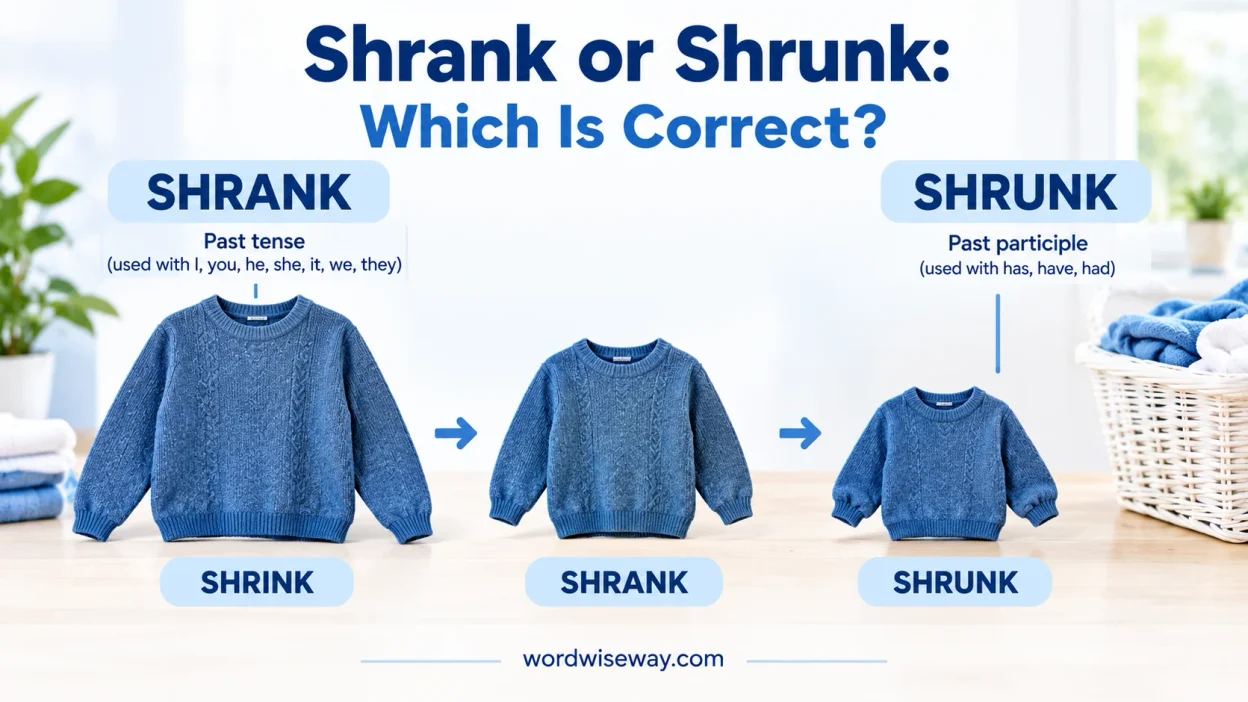
Shrank is traditionally used as the simple past form of shrink, while shrunk is used as the past participle.
For example:
- The sweater shrank in the dryer.
- The sweater has shrunk in the dryer.
The first sentence uses shrank for a completed past event. The second uses shrunk with has to form the present perfect.
| Word | Common grammatical role | Example |
| shrink | Base form | Clothes can shrink in hot water. |
| shrank | Simple past | My sweater shrank yesterday. |
| shrunk | Past participle | My sweater has shrunk. |
| shrunk | Also recorded as simple past in American English | The sweater shrunk yesterday. |
Cambridge lists shrank as the past simple form and shrunk as the past participle. Its American English entry also records shrunk as both a past-tense and past-participle form.
So, if you’re writing carefully in standard American English, “it shrank” is a clear choice for the simple past. “It has shrunk” is the natural choice when you need the past participle.
What Does Shrank Mean?
Shrank describes something that became smaller at a specific point or during a completed period in the past. It is the traditional simple past form of shrink.
Think of it as a straightforward past-action form:
Something shrank.
The word can describe physical objects, quantities, businesses, distances, populations, opportunities, or even abstract concepts.
For example:
- The shirt shrank after one hot wash.
- The lake shrank during the dry season.
- The company’s market share shrank last year.
- Our budget shrank after several unexpected expenses.
- The gap between the two measurements shrank considerably.
The important point is that shrank doesn’t need an auxiliary verb such as has or had.
Shrank as the Simple Past of Shrink
English has many irregular verbs that change their internal vowel when they move into the past.
Consider:
- sing → sang → sung
- drink → drank → drunk
- begin → began → begun
- shrink → shrank → shrunk
This pattern explains why shrinked isn’t the standard past form. The verb belongs to a group whose past forms developed through older English verb patterns.
Cambridge’s irregular-verb table lists shrink → shrank → shrunk alongside other irregular verbs such as sing → sang → sung and sink → sank → sunk.
When to Use Shrank
Use shrank when you simply want to place the shrinking action in the past.
Words such as these often make the time frame especially obvious:
- yesterday
- last week
- last month
- last year
- earlier
- previously
- during the summer
- after the wash
For example:
Yesterday:
The sweater shrank after I washed it.
Last year:
The company’s customer base shrank last year.
During a particular period:
The pond shrank considerably during the drought.
Notice how naturally shrank works when the sentence focuses on a completed past event.
What Does Shrunk Mean?
Shrunk is the past participle of shrink. You commonly see it after auxiliary verbs such as has, have, and had.
Examples include:
- The sweater has shrunk.
- The sweater had shrunk before I noticed.
- The market has shrunk considerably.
- The available space has shrunk over time.
Here, shrunk helps form a perfect tense. The auxiliary verb carries the tense while shrunk supplies the participle.
That’s why these two sentences have slightly different structures:
The shirt shrank.
The shirt has shrunk.
Both describe a reduction in size. The grammar, however, isn’t identical.
Shrunk as the Past Participle
A past participle often appears with an auxiliary verb.
The most common patterns are:
has + shrunk
The population has shrunk.
have + shrunk
Their profits have shrunk.
had + shrunk
The fabric had shrunk before they measured it.
This structure lets you connect a past change with another time or situation.
For example, compare:
- The company shrank in 2024.
- The company has shrunk significantly since 2024.
The first sentence points to a completed past period. The second emphasizes a change that connects the past with the present.
Can Shrunk Work Without Has, Have, or Had?
Yes. This is where the topic gets more interesting.
American English usage allows shrunk as a simple past form as well as a past participle. Cambridge’s American Dictionary explicitly records shrunk as both simple past and past participle.
Therefore, you may encounter:
The shirt shrunk in the wash.
This sentence is common and understandable in American English.
However, if you’re choosing the clearest traditional distinction for formal writing, shrank is the simple past form:
The shirt shrank in the wash.
Meanwhile:
The shirt has shrunk in the wash.
uses shrunk as the past participle.
This distinction gives you a reliable editing rule without pretending that actual American usage is completely uniform.
Grammar Comparison
The easiest way to understand shrank vs. shrunk is to look at the surrounding sentence.
| Form | Role | Example | Why it works |
| shrink | Base form | Wool can shrink in hot water. | Used for the basic verb form |
| shrank | Simple past | The wool shrank yesterday. | Describes a completed past action |
| shrunk | Past participle | The wool has shrunk. | Works with has in the perfect tense |
| shrunk | Past participle | The wool had shrunk already. | Works with had in the past perfect |
| shrunk | American simple past usage | The wool shrunk yesterday. | Recorded as a past-tense variant in American English |
A useful test is to look for an auxiliary verb.
If you write has, have, or had, shrunk usually follows:
- has shrunk
- have shrunk
- had shrunk
If you’re describing a straightforward completed past event, shrank is the traditional simple past choice:
- It shrank.
- The market shrank.
- The shirt shrank.
Shrank or Shrunk in American English
American English adds an important wrinkle to this spelling question.
Traditional grammar references commonly teach:
shrink → shrank → shrunk
That gives you a neat pattern:
- Present: I shrink.
- Past: I shrank.
- Past participle: I have shrunk.
However, American English dictionaries also recognize shrunk as a simple past form. Cambridge’s American entry lists the past tense as shrank and shrunk, while identifying shrunk as the past participle too.
That means sentences such as these can appear in American English:
- The sweater shrank in the dryer.
- The sweater shrunk in the dryer.
For careful writing, shrank remains a useful choice when you specifically need the simple past. It makes the traditional tense distinction immediately visible to the reader.
At the same time, calling every use of shrunk in the simple past “wrong” would ignore documented American usage.
Shrank or Shrunk in a Sentence?
Context makes the difference much clearer.
Correct Examples With Shrank
The sweater shrank in the dryer.
This describes a completed event in the past.
The company’s revenue shrank during the recession.
Here, the verb describes a reduction that occurred during a completed period.
The distance between the two points shrank after the adjustment.
The sentence places the change firmly in the past.
The puddle shrank under the afternoon sun.
The physical size of the puddle became smaller.
Our available storage space shrank after the software update.
The verb doesn’t have to describe clothing or physical objects. It can describe quantities and resources too.
Correct Examples With Shrunk
The sweater has shrunk.
The present perfect connects the past change with the current situation.
The company has shrunk considerably since its peak.
The company is smaller now than it was previously.
The budget had shrunk before the project began.
The past perfect shows that one past event happened before another past event.
Their customer base has shrunk over the past decade.
The change began in the past and remains relevant to the present.
The available space has shrunk to just a few inches.
Here, shrunk works naturally with has.
Common Incorrect Patterns
Some mistakes happen because writers treat every form of the verb as interchangeable.
Less clear:
The sweater has shrank.
Better:
The sweater has shrunk.
After has, use the past participle shrunk.
Another common problem appears when writers use shrinked:
Incorrect:
The fabric shrinked after washing.
Correct:
The fabric shrank after washing.
Also correct:
The fabric has shrunk after washing.
The verb is irregular, so adding -ed doesn’t create the standard forms.
Why Do People Confuse Shrank and Shrunk?
The confusion is understandable because both forms describe the same basic action.
The difference isn’t primarily about meaning. It’s largely about grammatical function.
Compare these pairs:
| Simple past | Perfect tense |
| The shirt shrank. | The shirt has shrunk. |
| The lake shrank. | The lake has shrunk. |
| The market shrank. | The market has shrunk. |
| The budget shrank. | The budget has shrunk. |
The meaning stays closely connected. The sentence structure changes.
English creates similar confusion with other irregular verbs:
| Base | Simple past | Past participle |
| sing | sang | sung |
| drink | drank | drunk |
| begin | began | begun |
| sink | sank | sunk |
| shrink | shrank | shrunk |
You wouldn’t normally write “I have sang” or “I have drank.” The same grammatical principle helps with shrink:
I shrank.
I have shrunk.
Once you spot that pattern, the choice becomes much less slippery.
Shrink, Shrank, and Shrunk: Complete Verb Forms
The verb shrink has several forms that appear in different grammatical situations.
| Verb form | Example |
| shrink | Some fabrics shrink when heated. |
| shrinks | Cotton shrinks under certain conditions. |
| shrinking | The shrinking fabric changed shape. |
| shrank | The fabric shrank yesterday. |
| shrunk | The fabric has shrunk. |
The present participle shrinking also appears frequently:
- The market is shrinking.
- The sweater is shrinking.
- The gap is shrinking.
- The available supply is shrinking.
These forms shouldn’t be mixed simply because they come from the same verb. Each one has a specific grammatical job.
An Important Meaning Beyond Size
The verb shrink doesn’t only mean “become physically smaller.”
It can also describe a reduction in quantity, scale, importance, influence, or scope.
For example:
- The company’s profits shrank.
- The audience shrank.
- The budget shrank.
- The population shrank.
- The market has shrunk.
- The amount of available space has shrunk.
Cambridge defines shrink as becoming smaller or making something smaller and gives examples involving clothing, company profits, costs, and populations.
There’s also another meaning: shrink can describe moving away from something frightening or unpleasant.
For example:
The child shrank away from the noise.
That meaning uses the same verb but describes withdrawal rather than physical reduction. Cambridge lists this separate sense as well.
This distinction matters because context determines what shrink means.
Easy Memory Trick
Here’s the quickest way to remember the traditional distinction:
It shrank.
It has shrunk.
If you’re describing a simple past action, think shrank.
If you’re using has, have, or had, think shrunk.
Quick Memory Formula
Past action:
shrank
Perfect tense:
has/have/had + shrunk
For example:
- My jeans shrank.
- My jeans have shrunk.
- My jeans had shrunk before I tried them on.
There’s your tiny grammar compass. 🧭
A Practical Case Study
Imagine someone washes a wool sweater in very hot water.
Before washing, the sweater fits perfectly. After washing, it becomes noticeably smaller.
You could describe the event in several ways.
Simple past:
The sweater shrank in the wash.
This focuses on the completed event.
Present perfect:
The sweater has shrunk in the wash.
This emphasizes the current result. The sweater is smaller now.
Past perfect:
The sweater had shrunk before I realized what happened.
This places the shrinking before another past event.
The underlying event stays the same. The tense changes the relationship between that event and the surrounding time.
That’s the real key to shrank vs. shrunk.
Is Shrank or Shrunk Correct?
Both are legitimate forms of shrink, but their traditional grammatical roles differ.
Use shrank when you need the simple past:
The shirt shrank after washing.
Use shrunk as the past participle:
The shirt has shrunk after washing.
In American English, shrunk can also function as a simple past form, which is why you’ll encounter both shrank and shrunk in real usage.
For formal or careful writing, following the traditional shrink → shrank → shrunk pattern gives readers a clear and familiar distinction.
Read More: Color or Die: Complete Roblox Guide, Gameplay, and Codes
FAQs
Is “shrank” a correct word?
Yes, shrank is the simple past form of shrink. Use it when describing something that became smaller in the past. For example, “The sweater shrank after washing.”
Is “shrunk” a correct word?
Yes, shrunk is also a correct form of shrink. It is commonly used as a past participle with helping verbs such as “has,” “have,” or “had.” For example, “The sweater has shrunk.”
What is the past tense of “shrink”?
The simple past tense of shrink is shrank. You can use it when an action happened at a specific or understood time in the past.
What is the past participle of “shrink”?
The past participle is shrunk. It normally appears with a helping verb, as in “The fabric has shrunk” or “The jeans had shrunk.”
Should I say “the shirt shrank” or “the shirt shrunk”?
Say “the shirt shrank” when using the simple past. Say “the shirt has shrunk” when using the present perfect. The correct choice depends on the sentence structure.
Can “shrunk” be used without a helping verb?
Yes, shrunk can sometimes function as an adjective. For example, you can describe something as “a shrunk sweater.” However, in standard verb usage, shrunk commonly appears with a helping verb.
Why do people confuse “shrank” and “shrunk”?
The confusion comes from the fact that shrink is an irregular verb. Its forms do not follow the usual pattern of simply adding “-ed,” so learners often mix up shrank and shrunk.
Is “shrank” used for something that became smaller?
Yes. Shrank directly describes an action that happened in the past. For example, “The cotton shirt shrank in the dryer” tells you that the shirt became smaller.
Can I use “shrunk” when talking about clothes?
Yes. Shrunk is commonly used when discussing clothes that have become smaller. For example, “My favorite T-shirt has shrunk after several washes.”
What is an easy way to remember “shrank” and “shrunk”?
Think of shrank as the simple past and shrunk as the past participle. A quick check is to look for helping verbs such as has, have, or had. If one appears, shrunk will often be the appropriate form.
Conclusion
The difference between shrank and shrunk becomes much easier once you recognize their roles in a sentence. Shrank is the simple past form of shrink, while shrunk is generally used as the past participle. Both forms describe something becoming smaller, but they belong to different grammatical structures.
A useful way to remember the distinction is to check what comes before the verb. If you are simply describing something that happened in the past, shrank usually fits: “The sweater shrank in the wash.” When a helping verb such as “has,” “have,” or “had” appears, shrunk is normally the form you need: “The sweater has shrunk.”
Once you practice these forms in everyday sentences, choosing between them should feel far more natural. Instead of guessing based on which word sounds familiar, look at the tense and sentence structure. With a little practice, shrank and shrunk stop being confusing irregular forms and become easy parts of your everyday English.

Evelyn Shaw has spent 14 years at Yale University’s English Department, leading students through close readings, genre studies, and interpretive methodologies. Her scholarly interests include Renaissance drama, gothic fiction, feminist literary criticism, and archival research and examining how texts generate meaning across historical periods. Evelyn has presented at major academic conferences and published essays in peer-reviewed journals, reflecting her passion for rigorous analysis and student-centered learning.