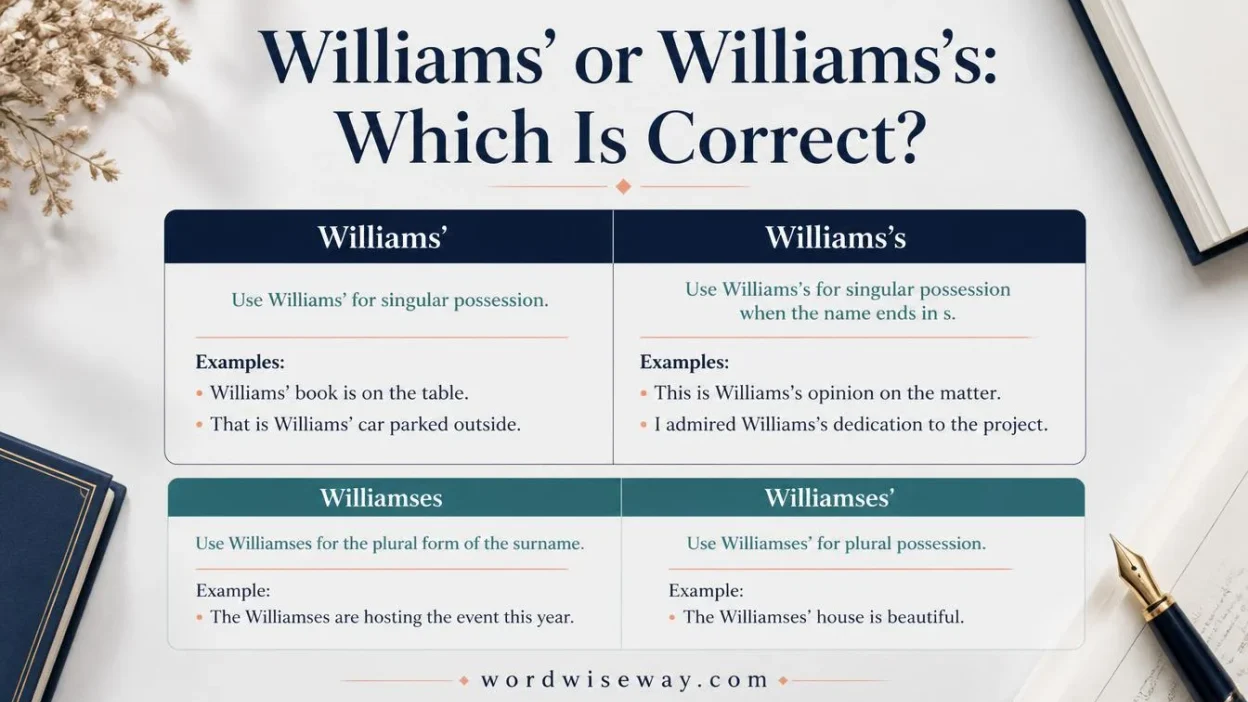
Williams’ or Williams’s: Meaning, Difference and Usage explains why both forms are accepted in English grammar. The correct choice depends on the style guide you follow.
Both Williams’ and Williams’s show possession for names ending in S. The apostrophe marks ownership, while the second form adds apostrophe s. For example, “Williams’ book” and “Williams’s book” both mean that the book belongs to Williams. These possessive forms follow different punctuation rules.
The AP Stylebook recommends Williams’, while the Chicago Manual of Style and Microsoft Manual of Style recommend Williams’s. These style differences do not change the meaning. Check your required guide before writing, and follow its rules consistently. This approach helps maintain correct usage, grammatical accuracy, and consistent writing throughout your work.
Quick Answer:
Both Williams’ and Williams’s can express singular possession when the owner’s surname is Williams. The main difference comes from the style guide you follow.
- Williams’s: Used by style guides that generally add apostrophe plus s to singular names ending in s.
- Williams’: Used by style guides that recommend adding only an apostrophe after certain singular names ending in s.
- Williams: The surname without an apostrophe. Use it when you simply identify someone by that name rather than express possession.
- Williamses’: The possessive form of the plural surname Williamses, referring to something owned by a family or multiple people named Williams.
| Form | Meaning | Example |
| Williams | The surname itself | Williams teaches English. |
| Williams’s | Singular possession | Williams’s laptop is new. |
| Williams’ | Alternative singular possessive | Williams’ laptop is new. |
| Williamses | Plural surname | The Williamses live nearby. |
| Williamses’ | Plural possession | The Williamses’ house has a garden. |
The easiest rule to remember: Follow your required style guide. If no guide applies, choose one accepted possessive form and use it consistently throughout your writing.
What Is the Difference Between Williams’ and Williams’s?
The difference between Williams’ and Williams’s comes down to punctuation conventions rather than a fundamental difference in meaning. Both forms can indicate that something belongs to one person whose surname is Williams.
For example, consider these two sentences:
- Williams’s presentation impressed the audience.
- Williams’ presentation impressed the audience.
Both sentences indicate that the presentation belongs to a person named Williams. The first follows the convention of adding ’s to a singular name ending in s. The second follows the convention of adding only an apostrophe.
Neither sentence automatically becomes incorrect simply because it uses one form instead of the other. The important consideration is the writing standard governing the document.
Williams’s: The Singular Possessive Form
Williams’s is the singular possessive form used by many major style guides. It consists of the surname Williams followed by an apostrophe and another s.
This convention follows a straightforward principle: To make a singular noun possessive, add ’s, even when the noun already ends in s.
For example:
- Williams’s office overlooks the main street.
- The coach praised Williams’s performance.
- Williams’s research focuses on renewable energy.
- I borrowed Williams’s notebook during class.
- The company recognized Williams’s contribution to the project.
In each example, the name identifies one person who owns something, performs an action, or receives credit for an achievement.
The final s in Williams does not prevent you from adding ’s. Instead, the additional ending marks possession according to the chosen grammatical convention.
Pronunciation matters, too. Many speakers pronounce Williams’s with an extra syllable at the end. The possessive ending sounds like the final syllable in classes. However, pronunciation can vary with the speaker and the context.
When your style guide requires Williams’s, use that form even if the surname already ends in s. The result may look slightly unusual at first, but it follows an established editorial rule.
Williams’: An Alternative Singular Possessive Form
Williams’ is another accepted way to indicate singular possession when a name ends in s. Instead of adding another s, this convention places the apostrophe after the existing final letter.
For example:
- Williams’ office overlooks the main street.
- The coach praised Williams’ performance.
- Williams’ research focuses on renewable energy.
- I borrowed Williams’ notebook during class.
- The company recognized Williams’ contribution to the project.
These examples communicate the same basic ownership relationships as the corresponding sentences with Williams’s.
Some editors prefer this form because it avoids adding another s to a surname that already ends with that letter. Other editors follow the general singular possessive rule and require Williams’s instead.
Neither preference means that the other form is universally wrong. The distinction reflects different editorial conventions.
One practical point is worth remembering: Do not choose between these forms randomly. If you use Williams’ in one section and Williams’s in another to express the same type of possession, your writing may look inconsistent unless a specific reason explains the difference.
Williams vs. Williams’ vs. Williams’s
A small punctuation change can alter the grammatical function of a name. Understanding what each form communicates makes it easier to select the correct version.
| Form | Grammatical function | Example |
| Williams | Identifies a person or family surname | Williams submitted the report. |
| Williams’s | Shows singular possession | Williams’s report contains three charts. |
| Williams’ | Shows singular possession in certain styles | Williams’ report contains three charts. |
| Williamses | Identifies multiple people with the surname | The Williamses attended the meeting. |
| Williamses’ | Shows plural possession | The Williamses’ report contains three charts. |
Notice the difference between Williams’ report and the Williamses’ report. The first can refer to a report belonging to one person named Williams. The second refers to a report belonging to multiple people with that surname.
The surrounding sentence usually makes the intended meaning clear.
What Do Major Style Guides Say About Williams’ and Williams’s?
Different editorial authorities use different rules for singular names ending in s. These differences explain why you may see both forms in books, newspapers, academic publications, and professional documents.
Rather than assuming one spelling works in every situation, check the rules associated with your intended audience.
The Chicago Manual of Style: Williams’s
The Chicago Manual of Style generally recommends adding ’s to singular nouns and names, including proper names that end in s.
Under this convention, Williams’s is the preferred singular possessive form.
Examples include:
- Williams’s argument changed the discussion.
- Williams’s bicycle was parked outside.
- Williams’s chapter explains the historical background.
Chicago’s approach follows the general singular possessive pattern. The spelling of the name does not, by itself, remove the need for the possessive ending.
This convention is commonly relevant to book publishing, long-form editorial work, and other writing that follows Chicago style. Always check the edition and any house-specific rules that apply to your project.
Associated Press Style: Williams’
The Associated Press (AP) generally uses an apostrophe without an additional s for singular proper names ending in s. Under this convention, Williams’ is the preferred form.
For example:
- Williams’ statement appeared in the report.
- Williams’ career spans several decades.
- Williams’ decision surprised the team.
This approach creates a consistent editorial pattern for names ending in s. It is especially relevant to news writing and publications that follow AP style.
However, don’t assume every newspaper or news organization follows AP rules without exceptions. Publications can establish their own house styles.
Other Style Guides and Academic Writing
Other organizations, universities, publishers, and professional associations may follow different conventions. Some use Chicago-style possessives, while others prefer the apostrophe-only form for names ending in s.
For example, a university assignment might require a particular academic style guide. A newspaper article might follow AP conventions, while a book manuscript might follow Chicago.
Use this checklist when deciding which rule applies:
- Check the assignment instructions or publication requirements.
- Look for the section covering possessive forms of singular names.
- Follow any stated exceptions for names ending in s.
- Apply the selected rule consistently throughout the document.
- Ask an editor or instructor if the requirements remain unclear.
The goal isn’t to memorize every style guide. It’s to identify the standard that governs your writing and apply it accurately.
When Should You Use Williams’s?
Use Williams’s when your chosen style guide forms singular possessives by adding ’s to names ending in s. This form is also a practical choice when you want to follow a widely used convention and no competing house style applies.
The name must refer to one person, and the sentence must express possession or another possessive relationship.
Consider these common situations.
Ownership: Williams’s car needs new tires.
This sentence identifies a car belonging to one person named Williams.
Professional work: Williams’s article examines the effects of climate change.
The possessive form connects the article to its author.
Personal achievements: Williams’s victory inspired the entire team.
Here, the possessive form links the victory to the person who achieved it.
Family relationships: Williams’s daughter starts college this fall.
The sentence identifies a family relationship involving one person named Williams.
Opinions and ideas: Williams’s explanation helped the students understand the problem.
The possessive form connects the explanation to its source.
In all these cases, Williams’s functions as a singular possessive. The choice does not depend on whether the object is physical, such as a car, or abstract, such as an idea.
Examples of Williams’s in Everyday Writing
The following examples show how the form works in different contexts.
- Education: Williams’s essay received excellent feedback.
- Business: Williams’s proposal includes a detailed budget.
- Sports: Williams’s serve helped secure the victory.
- Technology: Williams’s software update fixed the problem.
- Research: Williams’s findings support the original hypothesis.
- Personal life: Williams’s family arrived before dinner.
Each sentence refers to one person named Williams. The apostrophe and additional s mark the possessive relationship.
A useful editing trick is to replace the name temporarily with a familiar singular noun. For instance, the student’s essay uses the ordinary singular possessive ending. If your chosen style applies the same rule to singular names ending in s, Williams’s essay follows that pattern.
When Should You Use Williams’?
Use Williams’ when your chosen style guide calls for an apostrophe alone after a singular proper name ending in s. AP style is a familiar example of this convention.
The form can express ownership, authorship, relationships, and associations. Its grammatical purpose remains the same as Williams’s in contexts where both are accepted.
Examples include:
- Williams’ car needs new tires.
- Williams’ article examines the effects of climate change.
- Williams’ victory inspired the entire team.
- Williams’ daughter starts college this fall.
- Williams’ explanation helped the students understand the problem.
The apostrophe indicates the possessive relationship even though the spelling does not add another s.
Examples of Williams’ in Professional Writing
The apostrophe-only form frequently appears in editorial settings that follow this convention.
- Education: Williams’ essay received excellent feedback.
- Business: Williams’ proposal includes a detailed budget.
- Sports: Williams’ serve helped secure the victory.
- Technology: Williams’ software update fixed the problem.
- Research: Williams’ findings support the original hypothesis.
- Personal life: Williams’ family arrived before dinner.
These examples demonstrate why context and consistency matter more than the visual appearance of an individual word.
If a publication consistently uses Williams’, switching to Williams’s halfway through the article can distract readers and suggest an editing oversight. Following one convention makes the text easier to maintain and review.
Singular and Plural Possession
One of the most important distinctions involves the number of owners. A singular possessive refers to one owner, while a plural possessive refers to two or more owners.
The surname Williams creates a common source of confusion because it already ends in s. However, the plural form and the possessive form follow different rules.
Singular Possession: One Person Named Williams
When one person has the surname Williams, use the possessive form required by your style guide.
Both Williams’s and Williams’ can express singular possession.
Compare these sentences:
- Williams’s phone is ringing.
- Williams’ phone is ringing.
Both sentences can describe one person’s phone. The difference lies in the editorial convention rather than the number of owners.
The sentence does not become plural simply because the surname ends in s. The name Williams can refer to one individual, just as the surname Jones can.
Remember: A final s in a surname doesn’t automatically make the name plural.
Plural Possession: The Williamses
When referring to two or more people with the surname Williams, the usual plural form is Williamses.
To form the plural, add -es to the surname. This makes the plural ending easier to distinguish from the original name.
Examples:
- The Williamses live across the street.
- The Williamses attended the graduation ceremony.
- Several Williamses participated in the family reunion.
These sentences refer to multiple people. No apostrophe is necessary because the surname is plural but does not express possession.
To indicate that something belongs to the family or group, place the apostrophe after the plural ending.
For example:
- The Williamses’ house needs a new roof.
- The Williamses’ children attend the same school.
- The Williamses’ garden contains several fruit trees.
In each example, the apostrophe follows the final s in Williamses. This placement indicates that the plural group owns something or has a possessive relationship with it.
Singular vs. Plural Possessive Examples
| Intended meaning | Correct form | Example |
| One person named Williams | Williams | Williams arrived early. |
| Something belonging to one Williams, Chicago-style convention | Williams’s | Williams’s car is outside. |
| Something belonging to one Williams, apostrophe-only convention | Williams’ | Williams’ car is outside. |
| Multiple people named Williams | Williamses | The Williamses arrived early. |
| Something belonging to multiple Williamses | Williamses’ | The Williamses’ car is outside. |
The last example assumes that the group shares ownership of the car. If each person owns a separate car, the sentence needs a different construction to express that meaning clearly.
Common Mistakes With Williams Possessives
Several errors occur when writers confuse a plural surname with a singular possessive.
Mistake: Using an apostrophe to make the surname plural
Incorrect for an ordinary plural surname: The William’s arrived early.
Correct: The Williamses arrived early.
The apostrophe in William’s usually indicates possession by one person named William or forms a contraction in another context. It does not correctly pluralize the surname Williams.
Mistake: Using Williams’ when you mean multiple family members
If you mean an entire family named Williams, the Williams’ house can be ambiguous or incorrect under conventional plural formation rules.
A clearer form is the Williamses’ house. It explicitly identifies the plural family name and then marks possession.
Mistake: Adding the possessive ending twice
Avoid constructions such as Williams’s’s report. The standard singular possessive form is Williams’s, not a form with two possessive endings.
Mistake: Mixing style conventions
Using Williams’s in one paragraph and Williams’ in another may create an inconsistency if both refer to singular possession under the same style rules.
Choose the required convention and apply it throughout the document.
How to Use Williams’ and Williams’s in Sentences
Examples become more useful when you examine the relationship each possessive form expresses. The following comparisons demonstrate how to use the forms naturally in everyday and professional writing.
| Context | Williams’s example | Williams’ example |
| Ownership | Williams’s keys are missing. | Williams’ keys are missing. |
| Education | Williams’s thesis explores language development. | Williams’ thesis explores language development. |
| Business | Williams’s contract expires in June. | Williams’ contract expires in June. |
| Sports | Williams’s record impressed the commentators. | Williams’ record impressed the commentators. |
| Research | Williams’s study examined sleep patterns. | Williams’ study examined sleep patterns. |
The two columns use alternative conventions for singular possession. The correct column for your document depends on its required style.
Case Study: Editing a School Assignment
Imagine a student writing an essay about a researcher named Williams. The assignment requires Chicago style.
The student writes:
Williams’ research offers a new explanation for the results.
The sentence clearly communicates the intended meaning. However, it doesn’t follow Chicago’s usual convention for singular proper names ending in s.
A revision would read:
Williams’s research offers a new explanation for the results.
Now the possessive form follows the required style.
Consider a second student writing a news report that follows AP style. The student writes:
Williams’s statement addressed the controversy.
Under the usual AP convention for singular proper names ending in s, the editor would revise the sentence to:
Williams’ statement addressed the controversy.
The lesson: Editing requires more than checking whether a sentence makes sense. You must also consider the rules governing the document.
Case Study: Writing About the Williams Family
Suppose a neighborhood newsletter describes a family with the surname Williams.
The writer drafts this sentence:
The Williams’ are hosting a summer gathering.
The intended meaning is clear, but the plural surname is incorrectly formed. An apostrophe does not make a surname plural.
The corrected sentence is:
The Williamses are hosting a summer gathering.
Now suppose the writer wants to describe the family’s home.
The Williamses’ home has a large backyard.
This sentence correctly uses the plural surname followed by the possessive apostrophe. The distinction is small, but it prevents confusion about who owns the property.
Is Williams’s Grammatically Correct?
Yes. Williams’s is a grammatically accepted singular possessive form under many established style conventions.
The form follows the common rule of adding ’s to a singular noun to show possession. That rule applies even when the noun or name already ends in s, provided the chosen style follows this convention.
Examples include:
- Williams’s appointment begins at noon.
- Williams’s manager approved the request.
- Williams’s book explores the history of language.
The extra s does not mean that the name refers to more than one person. It marks possession under the selected convention.
However, grammatical acceptability and editorial preference are not always identical. A publication following AP style will generally prefer Williams’ for singular possession, even though Williams’s appears in other accepted styles.
Therefore, don’t treat the additional s as a universal requirement. Check the style guide that applies to your writing.
Is Williams’ Grammatically Correct?
Yes. Williams’ is an accepted singular possessive form in styles that omit the additional s after certain names ending in s.
The apostrophe signals possession, while the surname identifies the owner.
For example:
- Williams’ office is on the second floor.
- Williams’ comments clarified the situation.
- Williams’ appointment was rescheduled.
Each sentence can refer to one person named Williams.
However, this form should not be confused with the plural possessive Williamses’. The two forms serve different grammatical purposes.
Compare:
- Williams’ office refers to an office belonging to one person named Williams, under an apostrophe-only convention.
- The Williamses’ office refers to an office belonging to multiple people with the surname Williams.
Both can be correct in their respective contexts. The number of owners and the required style determine which form you need.
How to Choose the Correct Form
Choosing the right form becomes straightforward when you follow a consistent process. Instead of relying on appearance alone, identify the owner and check your writing requirements.
Check Your Style Guide First
If your assignment, employer, editor, or publisher specifies a style guide, follow its possessive rules.
For example, Chicago generally uses Williams’s, while AP generally uses Williams’ for a singular proper name ending in s.
Don’t combine conventions simply because both forms look familiar.
Identify Whether the Owner Is Singular or Plural
Ask yourself whether the sentence refers to one person or several people.
- One person named Williams: Williams’s or Williams’, depending on style.
- Multiple people named Williams: Williamses.
- Something owned by multiple Williamses: Williamses’.
This step prevents the common mistake of using punctuation to form a plural surname.
Check Whether the Sentence Actually Shows Possession
Not every use of Williams requires an apostrophe.
For example:
- Williams teaches science.
- Williams won the award.
- The Williams family moved recently.
These sentences use the surname without expressing possession. Adding an apostrophe would change the grammatical structure without serving a purpose.
By contrast, Williams’s award or Williams’ award expresses a possessive relationship under the relevant singular convention.
Stay Consistent Throughout Your Writing
Once you select a convention, apply it throughout the document.
Consistency is especially important in long articles, academic assignments, reports, and manuscripts. A quick final search for Williams’ and Williams’s can help you identify places where the forms differ.
Before submitting your work, ask yourself:
- Does the document follow a specified style guide?
- Have I distinguished singular and plural possession?
- Did I form the plural surname correctly?
- Have I used the same convention consistently?
These checks take only a moment and can prevent avoidable punctuation errors.
Read More: Louis’ or Louis’s: Meaning, Difference and Usage
FAQs
What is the correct possessive form of Williams?
Both Williams’ and Williams’s are correct. The preferred form depends on the style guide you follow.
Is Williams’ grammatically correct?
Yes, Williams’ is grammatically correct. It follows the AP Stylebook’s recommendation for possessive names ending in S.
Is Williams’s grammatically correct?
Yes, Williams’s is correct. The Chicago Manual of Style and Microsoft Manual of Style use this form.
What is the difference between Williams’ and Williams’s?
Both forms show ownership. The difference comes from punctuation preferences in different style guides, not from their meaning.
Does AP style use Williams’ or Williams’s?
AP style recommends Williams’. This form is commonly used in journalism, news writing, and other publications that follow AP guidelines.
Does Chicago style prefer Williams’ or Williams’s?
The Chicago Manual of Style recommends Williams’s for singular proper names ending in S.
Should I write Williams’ book or Williams’s book?
Both phrases are correct. Choose the version that matches your required style guide, and use it consistently throughout your writing.
Do names ending in S always need apostrophe s?
No. The correct possessive form depends on the applicable style guide. Some guides add only an apostrophe, while others add apostrophe s.
Is Williams’ the plural form of Williams?
No. Williams’ can show possession, while Williams may be a surname or plural family name. Context determines its meaning.
How can I use Williams’ and Williams’s consistently?
Choose one style guide before writing. Follow its possessive rules throughout your article, essay, or document to maintain clear and consistent punctuation.
Conclusion
In the end, both Williams’ and Williams’s are correct possessive forms. They express the same idea of ownership, but their punctuation differs. Understanding this distinction helps you write clearly and avoid common grammar mistakes when using names that end in S.
Your choice mainly depends on the style guide you follow. The AP Stylebook recommends Williams’, while the Chicago Manual of Style and Microsoft Manual of Style recommend Williams’s. Neither form changes the meaning, so check your writing requirements before deciding which version to use.
The easiest way to remember this rule is to choose one style and apply it consistently. Whether you write Williams’ book or Williams’s book, your sentence can be grammatically correct. Consistent punctuation makes your writing easier to read and keeps your work aligned with the appropriate editorial standards.

Emma Smith has dedicated 14 years to Princeton University’s English Department, mentoring students in textual interpretation, literary movements, and critical frameworks. Her research explores Shakespearean drama, Victorian serial fiction, postcolonial narrative theory, and manuscript studies and probing how literary forms evolve across cultures and centuries. Emma has delivered lectures at international humanities congresses and published findings in distinguished academic journals, underscoring her commitment to scholarly depth and vibrant teaching.