Hookie or Hooky: Correct Spelling, Meaning, and Usage can confuse English learners and native speakers because both spellings have the same sound. The correct spelling in standard English is hooky, not hookie. This difference matters when you’re writing for different situations.
The common phrase play hooky is used in American English. Its meaning is to skip school, work, or another duty without permission. People may mistakenly write playing hookie because it matches how the word is spoken aloud, but playing hooky is the widely accepted form.
This usage appears in school writing, emails, blogs, social media posts, and everyday conversations. Because hooky is among slang terms and informal expressions, multiple spellings can cause confusion. A useful guide can explain where the word came from, its real-life writing, and the accepted form, helping you use it with confidence.
Quick Answer:
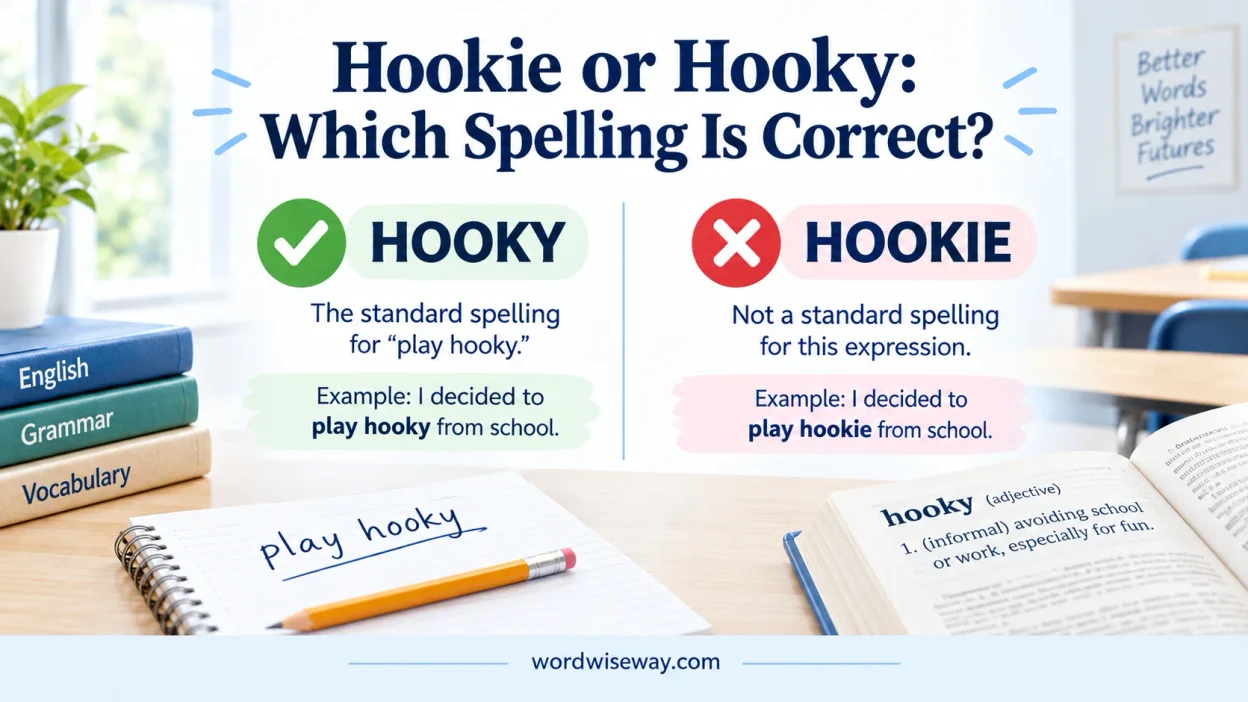
Hooky is the standard spelling for the informal expression play hooky. It means to stay away from school or work without permission. Major dictionaries including Cambridge and Oxford list hooky, while Oxford and Cambridge also recognize hookey as an alternative form.
Hookie may appear in informal writing or as a name, username, or other context-specific spelling. However, it isn’t the standard spelling of the common expression play hooky.
| Spelling | Standard for “skip school/work”? | Meaning |
| Hooky | ✓ Yes | An unauthorized absence from school, work, or another obligation |
| Hookey | ✓ Alternative | Variant spelling of hooky |
| Hookie | ✗ No | Not the standard spelling for this expression |
So, if you’re deciding between hookie or hooky, remember the simple rule: use hooky for the expression about being absent without permission.
What Does Hooky Mean?
Hooky is an informal American English noun associated with an unauthorized absence from school or work. The expression most commonly appears in the phrase play hooky. Cambridge describes hooky as mainly US informal and defines play hooky as staying away from school or work without permission.
Oxford gives a narrower learner-dictionary definition, describing play hooky as staying away from school without permission. It also labels the expression informal and old-fashioned in its current dictionary entry.
The word can therefore carry a distinctly casual tone. Saying that someone played hooky doesn’t sound like formal attendance terminology. It sounds conversational and often carries a slightly playful flavor.
For example:
- Jake played hooky from school to go fishing.
- They played hooky and went to the concert.
- She admitted that she had played hooky from work.
- The students were caught playing hooky.
The exact activity doesn’t define hooky. The important idea is the intentional absence without permission.
What Does “Play Hooky” Mean?
Play hooky means deliberately staying away from school, work, or another expected obligation without permission.
The phrase traditionally centers on school. However, modern dictionary examples also show play hooky from work, so the expression isn’t restricted exclusively to students. Cambridge specifically includes both school and work in its definition.
Consider these two sentences:
Mia missed school because she was sick.
Mia played hooky because she wanted to spend the day at the beach.
The first sentence describes an absence that may have a legitimate reason. The second suggests a deliberate decision to skip an obligation.
That distinction matters because hooky isn’t simply another word for absent.
Is Hooky a Noun or an Adjective?
The hooky connected with play hooky is a noun. Dictionaries list it as such in this sense.
There is also another dictionary meaning of hooky as an adjective. In that separate sense, it can mean full of hooks or hook-shaped. Collins lists this meaning independently from the noun used in play hooky.
Cambridge also lists an adjective hooky meaning particularly pleasing and easy to remember when describing pop music. For example, a song can have a hooky chorus, meaning the chorus is catchy and memorable.
So context matters.
| Use of “hooky” | Part of speech | Meaning |
| play hooky | Noun | Stay away from school or work without permission |
| a hooky shape | Adjective | Hook-shaped or full of hooks |
| a hooky song | Adjective | Catchy and easy to remember |
These meanings share the same spelling but don’t represent the same word usage.
What’s the Difference?
The most important distinction is straightforward:
Hooky is the established spelling for the informal expression play hooky.
Hookie isn’t the standard spelling for that meaning.
That doesn’t mean every appearance of hookie on the internet is automatically a mistake. People create names, usernames, brands, nicknames, and other forms that don’t have to follow standard dictionary spelling. A proper name can have an unusual spelling without changing the spelling of an ordinary English word.
However, if you’re writing:
- play hookie
- played hookie from school
- playing hookie from work
you should normally change hookie to hooky.
Why Does “Hookie” Look Correct?
English spelling can be a maze with a few misleading signposts.
The pronunciation of hooky ends with an ee sound. That sound appears in many English words written with -y, -ie, or -ee. Because of that variation, writers may instinctively spell the word as hookie.
There’s another reason for the confusion: hookey is actually an established alternative spelling. Cambridge identifies hookey as an alternative form, while Oxford also lists it alongside hooky.
That means English has more than one documented spelling in this small corner of vocabulary:
- hooky: standard and widely recognized
- hookey: recognized alternative
- hookie: not the standard spelling for this expression
The middle form is especially important. Someone who remembers seeing hookey may accidentally produce hookie instead.
Hooky vs. Hookey vs. Hookie
These three spellings deserve a closer look because they’re easy to mix up.
| Word | Standard dictionary usage | Used for “play ___”? |
| Hooky | Yes | ✓ |
| Hookey | Yes, as an alternative spelling | ✓ |
| Hookie | Not the standard form for this meaning | ✗ |
Cambridge lists hooky as the main entry and notes hookey as an alternative. Oxford does the same.
So if you encounter play hookey, don’t assume it’s automatically a spelling error. It is a documented variant.
If you encounter play hookie, however, the standard correction is play hooky.
How to Use Hooky in a Sentence
The most natural construction is play hooky.
The verb changes tense while hooky stays the same:
| Tense | Example |
| Present | They play hooky sometimes. |
| Past | They played hooky yesterday. |
| Present continuous | They are playing hooky today. |
| Past continuous | They were playing hooky when the teacher called. |
| Perfect | They have played hooky before. |
| Infinitive | They decided to play hooky. |
Notice something important: you don’t normally change hooky into another form after play.
You write:
played hooky
not:
played hookies
and:
playing hooky
not:
playing hookie
The idiom keeps the noun hooky intact while the verb carries the tense.
Correct Examples With Hooky
Here are several natural examples:
- The students played hooky and spent the afternoon at the park.
- He played hooky from school last Friday.
- They were tempted to play hooky on the first warm day of spring.
- She admitted that she had played hooky from work.
- The boys got caught playing hooky.
- Have you ever heard the expression “play hooky”?
- He decided not to play hooky because he had an important test.
These examples also show why hooky usually appears with play rather than standing alone.
Is “Play Hooky” Formal or Informal?
Play hooky is informal. Cambridge labels the expression mainly US informal, while Oxford also marks it as informal and old-fashioned.
That register affects where you should use it.
Casual situations
The phrase works naturally in:
- Everyday conversation
- Informal messages
- Fictional dialogue
- Personal writing
- Casual articles
- Conversational storytelling
Formal situations
A formal document may benefit from more precise wording, such as:
- be absent without permission
- miss school without authorization
- be absent from work without authorization
- skip school when a less formal but clearer phrase fits
For example, a school attendance report would usually say unauthorized absence rather than played hooky.
That isn’t because hooky is wrong. It’s because register matters.
Hooky vs. Skipping School
Skip school and play hooky overlap in meaning, but they aren’t identical in tone.
Skip school is plain and direct. Play hooky is more idiomatic and distinctly informal.
Compare these:
Daniel skipped school yesterday.
Daniel played hooky yesterday.
Both sentences communicate an intentional absence. The second sounds more conversational.
Cambridge specifically notes that British English uses play truant for this concept.
| Expression | Typical meaning | Tone |
| play hooky | Stay away from school or work without permission | Informal, mainly US |
| skip school | Deliberately not attend school | Informal/neutral |
| play truant | Stay away from school without permission | British English |
| be absent without permission | Miss an expected obligation without authorization | Formal |
The best choice depends on your audience and the variety of English you’re using.
Is Hooky an American English Word?
Yes. Hooky is mainly associated with US English, particularly in the expression play hooky. Cambridge labels it “mainly US informal,” while Collins describes it as mainly US, Canadian, and New Zealand usage.
British English commonly uses play truant instead.
This difference becomes useful when you’re writing for an international audience. If your article targets American English, play hooky is a natural expression. If you’re writing specifically for British readers, play truant may sound more familiar.
Where Did the Word Hooky Come From?
The exact origin isn’t completely settled.
Dictionary sources give a likely connection with the older phrase hook it, meaning to escape or make off. Dictionary.com dates the relevant hooky usage to the mid-19th century and describes this origin as a possibility rather than an absolute certainty.
Collins similarly gives 1840–50 as the period for the American noun and says it may have developed as an alteration of hook it, meaning to escape or make off.
That uncertainty is worth preserving. Word origins sometimes leave footprints rather than fingerprints.
A reliable explanation therefore looks like this:
Hooky emerged in American English in the 19th century, probably in connection with the idea of escaping or leaving.
The phrase eventually became associated with unauthorized absence from school and later extended naturally to other obligations, including work.
Is Hookie a Correct Spelling?
For the meaning to skip school or work without permission, hookie isn’t the standard spelling.
The standard form is:
hooky
A documented alternative is:
hookey
So these sentences follow standard usage:
- She played hooky from school.
- He played hookey from school.
But this spelling isn’t the standard choice:
- She played hookie from school.
The distinction becomes especially useful when proofreading. If you see hookie in an ordinary sentence about skipping school, hooky is the correction to make.
Common Mistakes
Several mistakes tend to appear because the word sounds simpler than it looks.
Writing Hookie Instead of Hooky
Incorrect: They played hookie from school.
Correct: They played hooky from school.
Assuming Hookey Is Always Wrong
Hookey is actually recognized as an alternative spelling by major dictionaries.
So correcting every instance of hookey to hooky isn’t necessary if you’re discussing documented English variants. However, hooky is the safer standard form for general American English writing.
Treating Every Absence as Hooky
Being absent doesn’t automatically mean someone played hooky.
A student who stays home because of illness isn’t necessarily playing hooky. The expression normally carries the idea of staying away without permission.
Using Hooky in Formal Attendance Language
A sentence such as “The employee played hooky” can sound casual or humorous. In an official attendance record, unauthorized absence would be much more precise.
A Simple Memory Trick
Here’s an easy way to remember the spelling:
Hook + y = hooky
Think of the word hook first. Then add -y.
hook → hooky
You don’t need to insert an extra i.
If the sentence means someone intentionally stayed away from school or work, remember:
Play hooky.
Not:
Play hookie.
If you encounter hookey, that’s different. It’s a recognized alternative spelling, even though hooky is the more straightforward standard form.
Quick Comparison
| Feature | Hooky | Hookie |
| Standard spelling for play hooky | ✓ | ✗ |
| Means an unauthorized absence | ✓ | ✗ |
| Used in American English | ✓ | Not as the standard idiom |
| Appears in dictionaries for this meaning | ✓ | Not as the standard form |
| Common phrase | play hooky | play hookie is nonstandard |
| Recommended in ordinary writing | Yes | No |
There is also hookey, which dictionaries recognize as an alternative spelling of hooky.
Is Hooky a Real Word?
Yes. Hooky is a real English word with established dictionary entries.
In its best-known sense, it refers to an unauthorized absence from school, work, or another obligation and usually appears in play hooky. Cambridge and Oxford both document this usage.
The word also has other documented meanings. Cambridge lists an adjective meaning particularly catchy or memorable when describing music. Collins separately records an adjective meaning full of hooks or hook-shaped.
That makes hooky a useful example of how one spelling can carry multiple meanings depending on context.
Is Hookie a Word?
Hookie isn’t the standard spelling of the common expression about skipping school or work.
It may appear in names, usernames, informal creations, or other context-specific uses. However, those appearances don’t establish it as the standard spelling of play hooky.
For ordinary English writing, choose hooky.
If you are referring to the documented alternative spelling, hookey is the form recognized by major dictionaries.
Read More: Openning or Opening: Correct Spelling, Meaning, and Usage
FAQs
Is Hookie or Hooky the Correct Spelling?
Hooky is the standard spelling used in English. Hookie is a common misspelling that can appear because both forms sound similar.
What Does Hooky Mean?
Hooky means avoiding school, work, or another responsibility without permission. It’s usually used in the phrase play hooky.
What Does Play Hooky Mean?
Play hooky means deliberately staying away from school, work, or another duty when you’re expected to attend.
Is Hooky an American English Word?
Yes. Hooky is commonly used in American English, particularly in casual speech and informal writing.
Why Do People Spell Hooky as Hookie?
People often write hookie because the extra “e” seems to match the word’s pronunciation. Sound-based spelling can cause this kind of mistake.
Is Playing Hooky Correct?
Yes, playing hooky is grammatically correct. It describes the act of being absent from school, work, or another obligation without permission.
Can Hooky Be Used in Formal Writing?
Hooky is generally informal, so it may not fit formal documents. In formal writing, phrases such as skipping school or being absent without permission may be more suitable.
What Is the Difference Between Hookie and Hooky?
The main difference is spelling. Hooky is the accepted spelling, while hookie is generally treated as an incorrect variation.
Is Hooky a Slang Term?
Yes. Hooky is an informal slang term. You’ll commonly see it in casual conversations, stories, blogs, and other relaxed forms of writing.
How Can I Remember the Correct Spelling of Hooky?
A simple way to remember it is to focus on the phrase play hooky. When you use this familiar expression, remember that hooky has no extra “e.”
Conclusion
The difference between hookie and hooky may look small, but the spelling matters when you want clear and accurate English. Hooky is the accepted form, while hookie usually appears as a spelling mistake caused by the similar sound.
The phrase play hooky is mainly used in American English to describe skipping school, work, or another responsibility without permission. Since it’s an informal expression, you’ll mostly find it in casual conversations, stories, blogs, and everyday writing.
Once you remember hooky without the extra “e,” the confusion becomes much easier to avoid. Whether you’re checking school writing, preparing a blog, or simply improving your English, using the correct spelling helps your writing look polished and confident.

Amelia Sanders has spent 14 years in Harvard University’s English Department, helping students navigate literary analysis, interpretive theory, and narrative techniques. Her academic pursuits center on 18th-century British prose, romantic poetry, diasporic writing, and digital editing exploring how textual choices influence cultural perspectives. Amelia has spoken at major international meetings and contributed essays to respected academic volumes, demonstrating her dedication to thoughtful scholarship and effective teaching.