Can You Start a Sentence With “While”? Grammar and Examples explains how to use while at the beginning of a sentence. You might be surprised to learn that English grammar has no strict rules against starting sentences with particular words. Although schools sometimes teach this common myth, you can use many different words when the context is correct.
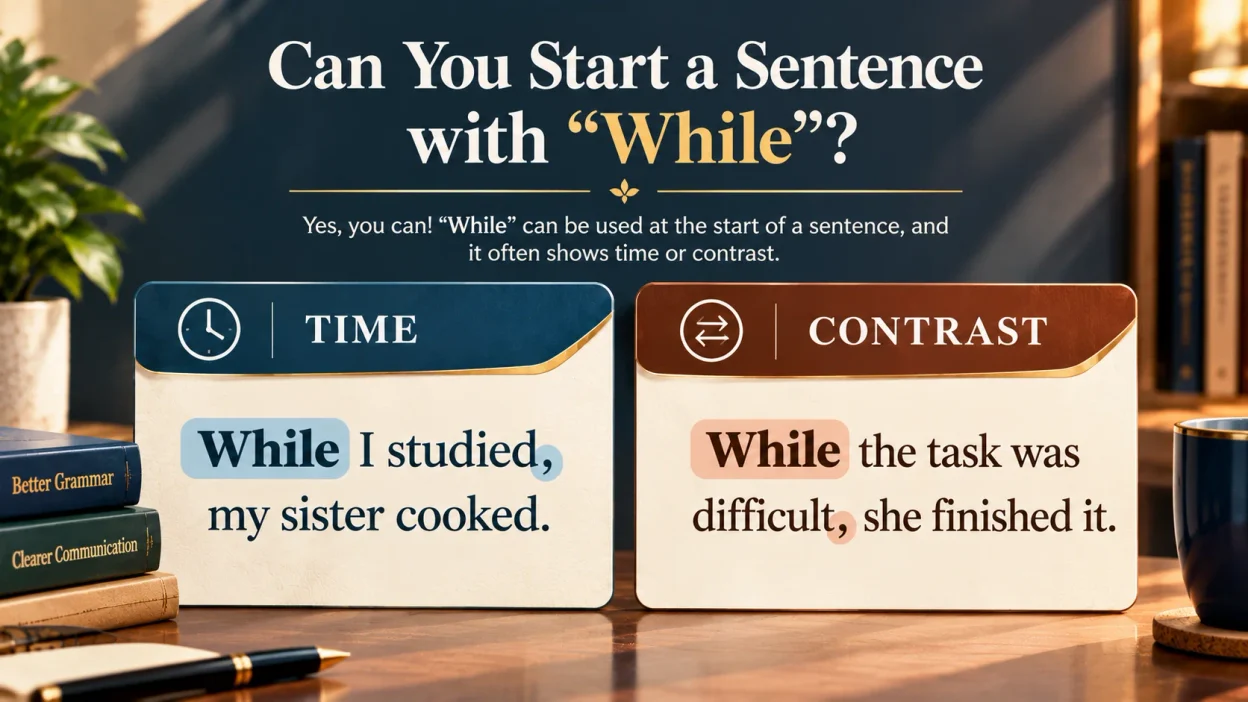
When you start a sentence with while, you usually introduce a dependent clause. This clause can describe something happening at the same time as something else. For example, “While I studied, my brother watched television.” The word while connects these two related actions and helps readers understand their timing.
While can also express contrast between two situations. For example, “While the task was difficult, she completed it on time.” This sentence shows that something happened despite another condition. Both uses are grammatically correct when you arrange clauses carefully and apply proper punctuation.
Quick Answer:
Yes, you can start a sentence with “while.” It is a subordinating conjunction that introduces a dependent clause. This clause usually explains when something happens or contrasts two ideas.
When “while” begins a sentence, place a comma after the introductory dependent clause when it comes before the main clause.
Correct: While I prepared dinner, my sister set the table.
Incorrect: While I prepared dinner my sister set the table.
The first example uses a comma to separate the introductory clause from the main clause. The second example needs that punctuation for standard written English.
You can also use “while” to express contrast.
Example: While some students prefer studying alone, others enjoy group discussions.
Remember that “while” does not make a sentence incorrect simply because it appears at the beginning. The sentence structure and punctuation determine whether your writing is grammatically sound.
What Does “While” Mean at the Beginning of a Sentence?
The word “while” has two common uses. It can describe actions happening at the same time or introduce a contrast between two statements.
Understanding these meanings helps you choose the right sentence structure.
1. “While” Shows Two Actions Happening at the Same Time
Use “while” when two actions overlap in time. One action may continue as another begins or takes place.
For example:
- While I was reading, the phone rang.
- While Mom cooked dinner, Dad washed the dishes.
- While the students completed their assignments, the teacher checked their work.
- While we waited for the bus, we discussed our weekend plans.
In each sentence, “while” connects two related events. It helps readers understand that the actions happened during the same period.
This use is especially helpful when describing routines, stories, daily activities, and events.
2. “While” Introduces a Contrast
You can also begin a sentence with “while” when you want to compare two different situations, opinions, or characteristics.
For example:
- While Sarah enjoys winter, her brother prefers summer.
- While the first proposal focuses on cost, the second emphasizes quality.
- While online classes offer flexibility, traditional classrooms provide face-to-face interaction.
- While the product is affordable, its features are limited.
Here, “while” does not primarily describe time. Instead, it highlights a difference between two ideas.
This use is common in essays, reports, discussions, and analytical writing because it allows you to compare information without creating separate, disconnected sentences.
Grammar Rules for Starting a Sentence With “While”
Although beginning a sentence with “while” is acceptable, you should follow a few basic grammar rules.
Rule 1: Begin With a Dependent Clause
When “while” introduces a clause, that clause usually cannot stand alone as a complete sentence in this structure.
A dependent clause contains a subject and a verb but relies on another clause to complete the thought.
Example:
While the children played outside, their parents prepared lunch.
The dependent clause is “While the children played outside.” It introduces the situation but does not express the complete message independently.
The main clause, “their parents prepared lunch,” completes the sentence.
Compare it with this example:
Incorrect: While the children played outside.
This is a sentence fragment when it is intended as a complete sentence. Readers may wonder what happened while the children played.
Correct: While the children played outside, their parents prepared lunch.
Always check whether your opening clause connects to a complete main clause.
Rule 2: Use a Comma After the Introductory Clause
When an introductory dependent clause beginning with “while” comes before the main clause, place a comma after it.
Correct examples:
- While the rain continued, we stayed indoors.
- While I understand your concern, I disagree with your conclusion.
- While the software is easy to use, it lacks several advanced features.
- While she practiced every day, her confidence gradually improved.
The comma marks the end of the introductory clause and helps readers follow the sentence.
You do not need to count words or make the clause a certain length before using a comma. In standard writing, a comma generally separates an introductory dependent clause from the main clause.
Rule 3: Make Sure the Two Clauses Connect Logically
A sentence may follow the punctuation rules but still sound confusing if its ideas do not fit together.
Awkward: While the flowers were beautiful, the train arrived at noon.
The sentence combines two unrelated observations. Unless the context explains their connection, readers may struggle to understand why they appear together.
Better: While the flowers were beautiful, the arrangement was too expensive.
The contrast is clear because both clauses discuss the same arrangement.
For time-related uses, the actions should have a reasonable relationship.
Clear: While I waited for the doctor, I read a magazine.
Both actions happen during the same period, so the relationship is easy to understand.
Rule 4: Choose the Correct Meaning
Before using “while,” decide whether you mean “during the time that” or “although” or “whereas.”
For example:
- Time: While I exercised, my friend prepared breakfast.
- Contrast: While I prefer tea, my sister prefers coffee.
The first sentence describes simultaneous activities. The second compares two preferences.
Knowing your intended meaning helps you write sentences that sound natural and communicate your message accurately.
Examples of Sentences That Start With “While”
The best way to understand this grammar rule is to see how it works in different situations.
Everyday Conversation Examples
You can use “while” at the beginning of ordinary sentences without sounding overly formal.
- While I cleaned my room, my brother organized his books.
- While we waited for our food, we talked about school.
- While you were sleeping, someone called.
- While she walked to the store, she listened to music.
- While I like chocolate, I don’t eat it every day.
These sentences show that “while” works naturally in conversations, messages, and informal writing.
Academic Writing Examples
In academic writing, “while” can introduce comparisons, qualifications, and explanations.
- While the experiment supported the original hypothesis, further research is necessary.
- While both studies examined student performance, they used different methods.
- While the evidence suggests a positive relationship, it does not establish causation.
- While online learning improves flexibility, some students experience limited interaction.
- While the results are promising, the sample size remains relatively small.
These examples demonstrate how “while” helps you present balanced arguments and acknowledge different aspects of a topic.
Professional Writing Examples
You can also begin sentences with “while” in emails, reports, proposals, and workplace documents.
- While we appreciate your feedback, we cannot implement every suggestion.
- While the current system meets basic requirements, it needs several improvements.
- While the team completed the first phase, the final review remains unfinished.
- While your proposal has several strengths, the budget requires further discussion.
- While we recognize the delay, we expect the project to remain on schedule.
In professional settings, this structure can help you communicate disagreement or limitations politely.
Creative Writing Examples
Writers often use “while” to establish a setting, develop characters, or describe simultaneous events.
- While the city slept, a quiet storm gathered over the hills.
- While Emma searched the attic, Daniel waited near the staircase.
- While the sun disappeared behind the mountains, the village lights began to glow.
- While the old clock ticked softly, he considered his next decision.
This structure can establish timing and atmosphere without requiring several short sentences.
When Should You Put a Comma After “While”?
Comma placement depends on how you structure the sentence.
When “While” Begins the Sentence
Use a comma after the introductory dependent clause.
Correct: While the meeting continued, several employees reviewed the report.
The comma separates “While the meeting continued” from “several employees reviewed the report.”
When “While” Appears in the Middle
When the dependent clause follows the main clause, you generally do not need a comma if “while” introduces a time relationship and the sentence flows naturally.
Example: I listened to music while I cleaned my room.
The sentence is clear without a comma.
However, a comma may be appropriate when the clause expresses a strong contrast or when the writer wants to emphasize the interruption or distinction.
Example: I enjoy working independently, while my colleague prefers collaborating with a team.
The comma helps emphasize the comparison between the two preferences.
Quick Comma Comparison
| Sentence | Correct? | Explanation |
| While I studied, my brother played games. | ✓ Yes | The introductory clause ends with a comma. |
| I studied while my brother played games. | ✓ Yes | The time clause follows the main clause naturally. |
| While I studied my brother played games. | ✗ No | The introductory clause needs a comma. |
| While the plan is affordable, it lacks flexibility. | ✓ Yes | The comma separates the introductory contrast clause. |
| I enjoy reading, while my sister enjoys painting. | ✓ Yes | The comma emphasizes the contrast. |
The central rule is simple: when a dependent clause beginning with “while” comes first, separate it from the main clause with a comma.
“While” vs. “Although” vs. “Whereas”
These three words can introduce contrasting ideas, but they do not always serve exactly the same purpose.
“While” Shows Time or Contrast
“While” is flexible because it can describe simultaneous actions or differences.
Time: While I prepared lunch, my sister watered the plants.
Contrast: While I prefer quiet places, my friend enjoys crowded events.
Use it when the surrounding context makes the intended meaning clear.
“Although” Expresses Contrast or Concession
“Although” introduces an idea that contrasts with the main clause or might seem surprising in light of it.
Example: Although the weather was cold, we went for a walk.
The cold weather might have discouraged the walk, but the people went anyway.
You can also begin a sentence with it:
Although the assignment was challenging, she completed it before the deadline.
Unlike “while,” “although” does not normally describe two actions occurring simultaneously.
“Whereas” Emphasizes a Comparison
“Whereas” is useful when you want to highlight a difference between two people, things, or situations.
Example: Whereas the first model uses less energy, the second model offers greater processing power.
This word often appears in formal, academic, and analytical writing.
Comparison Table
| Word | Main Purpose | Example |
| While | Time or contrast | While I cooked, my brother cleaned. |
| Although | Contrast or concession | Although it rained, we continued walking. |
| Whereas | Direct comparison | Whereas Mia prefers tea, Noah prefers coffee. |
Choose the word that best expresses your intended relationship. Replacing every instance of “while” with “although” or “whereas” can change the meaning of your sentence.
Common Mistakes
Understanding the rule is helpful, but recognizing common errors will make your writing stronger.
Mistake 1: Writing a Sentence Fragment
Incorrect: While I was studying for my exam.
This clause introduces a situation but does not complete the thought.
Correct: While I was studying for my exam, my friend prepared flashcards.
A dependent clause needs a main clause when it is used in this way.
Mistake 2: Forgetting the Comma
Incorrect: While the teacher explained the lesson the students took notes.
Correct: While the teacher explained the lesson, the students took notes.
The comma helps readers identify where the introductory clause ends.
Mistake 3: Using “While” When You Mean “Because”
Confusing: While I missed the bus, I arrived late.
If you mean that missing the bus caused you to arrive late, “because” is clearer.
Better: Because I missed the bus, I arrived late.
“While” usually indicates time or contrast. It is not the best choice when you need to express a direct cause-and-effect relationship.
Mistake 4: Creating an Unclear Contrast
Awkward: While the library is quiet, the book is interesting.
These ideas do not naturally contrast with each other.
Better: While the library is quiet, the nearby café is usually noisy.
The revised sentence compares two related environments.
Mistake 5: Repeating “While” Too Often
Beginning several consecutive sentences with the same word can make your writing feel repetitive.
Repetitive:
While the team planned the project, the manager reviewed the budget. While the designers created mockups, the developers tested the software. While the deadline approached, everyone worked harder.
Improved:
While the team planned the project, the manager reviewed the budget. The designers created mockups as developers tested the software. As the deadline approached, everyone worked harder.
The revised version keeps the meaning while creating more variety.
Mistake 6: Confusing “While” With “A While”
“While” and “a while” have different grammatical functions.
- While: While I waited, I checked my messages.
- A while: I waited for a while before checking my messages.
In the first example, “while” functions as a conjunction. In the second, “a while” is a noun phrase referring to a period of time.
Recognizing this difference can help you avoid errors in both formal and informal writing.
Can You Start a Sentence With “While” in Formal Writing?
Yes. Beginning a sentence with “while” is acceptable in formal writing when the structure and meaning are appropriate.
You can use it in essays, research papers, business reports, professional emails, and academic discussions.
For example:
While the findings indicate a positive trend, additional evidence is needed to confirm the conclusion.
This sentence acknowledges a result while recognizing a limitation. Such balanced wording is useful in academic and professional communication.
However, make sure the meaning remains clear. If “while” could refer to either time or contrast, consider revising the sentence or choosing a more precise word.
For example:
Potentially unclear: While the company expanded, profits declined.
This sentence could describe events happening simultaneously or suggest a contrast between expansion and declining profits. The intended meaning may be clear from context, but you can remove ambiguity when necessary.
Clearer time relationship: During the period when the company expanded, its profits declined.
Clearer contrast: Although the company expanded, its profits declined.
Good formal writing does not require avoiding “while.” It requires choosing words that communicate your meaning accurately.
Can You Start Two Consecutive Sentences With “While”?
Yes, grammar does not prohibit beginning consecutive sentences with “while.” However, repeated sentence openings may make a paragraph sound monotonous.
Consider this example:
While the researchers collected data, the assistants organized the results. While the assistants checked the figures, the researchers prepared the report.
Both sentences are grammatically correct. Still, the repeated structure may feel mechanical.
You can improve the paragraph by varying the openings:
While the researchers collected data, the assistants organized the results. After checking the figures, the assistants helped prepare the report.
You do not need to avoid repetition at all costs. Repeated openings can create rhythm or emphasis in creative writing. In most informational writing, though, varied sentence structures improve readability.
How to Rewrite Sentences That Begin With “While”
Sometimes you may want to revise a sentence for clarity, variety, or a more precise meaning.
Here are several useful examples.
Example 1: Change the Sentence Order
Original: While I cooked dinner, my brother set the table.
Revised: My brother set the table while I cooked dinner.
Both sentences are correct. The first emphasizes the cooking activity, while the second places the main clause first.
Example 2: Replace “While” With “Although”
Original: While the instructions were complicated, we finished the task.
Revised: Although the instructions were complicated, we finished the task.
“Although” makes the contrast more explicit.
Example 3: Replace “While” With “During”
Original: While the meeting, everyone took notes.
Corrected: During the meeting, everyone took notes.
Use “during” before a noun phrase when you want to refer to a period or event. In this example, “while” is incorrect because it needs a clause in the intended construction.
Example 4: Clarify the Relationship Between Events
Original: While I finished my homework, my friend called.
Possible revision: While I was finishing my homework, my friend called.
The revised sentence more clearly describes a call that occurred during the ongoing activity.
Example 5: Make a Contrast More Direct
Original: While the first phone is affordable, the second phone has a better camera.
Revised: The first phone is affordable, whereas the second has a better camera.
Both versions are correct. The revised sentence uses “whereas” to emphasize the comparison.
When revising, preserve the original meaning. A sentence should not become more complicated simply to sound formal.
Tips for Using “While” Correctly
Keep these practical suggestions in mind whenever you use “while” at the beginning of a sentence.
- Identify the meaning: Decide whether you are describing time or expressing contrast.
- Check the clause: Make sure the introductory clause connects to a complete main clause.
- Add the comma: Place a comma after the introductory dependent clause.
- Check the relationship: Ensure the two ideas connect logically.
- Avoid ambiguity: Rewrite the sentence if readers might misunderstand your meaning.
- Vary your openings: Use different sentence structures when repeated openings become distracting.
- Read the sentence aloud: Listen for awkward phrasing or an unclear connection between ideas.
These habits will help you write clear sentences without worrying about an imaginary rule against starting with “while.”
Read More: What Does “Scrub” Mean in Slang? Definition,and Usage
FAQs
1. Can you start a sentence with “while”?
Yes, you can start a sentence with while. It’s grammatically correct when you use it to introduce a dependent clause that expresses time or contrast. For example, “While I cooked dinner, my sister set the table.”
2. What does “while” mean at the beginning of a sentence?
At the beginning of a sentence, while usually connects two related ideas. It can show that two actions happen at the same time or that two situations contrast with each other.
3. Should you use a comma after a sentence starting with “while”?
Yes, you generally use a comma after an introductory dependent clause beginning with while. For example, “While the rain continued, we stayed indoors.” The comma separates the opening clause from the main clause.
4. Can “while” show contrast instead of time?
Yes, while can show contrast between two situations. For example, “While Emma enjoys reading, her brother prefers painting.” The sentence highlights their different interests rather than actions happening simultaneously.
5. Is starting a sentence with “while” a grammar mistake?
No, starting a sentence with while is not a grammar mistake. The confusion often comes from outdated classroom advice or misunderstandings about conjunctions. What matters is how you structure the sentence.
6. What is a dependent clause beginning with “while”?
A dependent clause contains a subject and a verb but cannot usually stand alone as a complete sentence. For example, “While the children played” leaves the reader waiting for the main idea. You can complete it by writing, “While the children played, their parents prepared lunch.”
7. Can you use “while” at the beginning of a formal sentence?
Yes, while works well in academic writing, professional emails, and formal reports. For example, “While the results were encouraging, further research is necessary.” This structure presents a balanced and clear argument.
8. Can you begin consecutive sentences with “while”?
Yes, but using while at the beginning of several consecutive sentences can make your writing repetitive. Try varying your sentence structures and using other suitable transitions when they express your intended meaning accurately.
9. What is the difference between “while” and “although” at the beginning of a sentence?
While can express time or contrast, whereas although primarily introduces contrast or an unexpected result. For example, “While I studied, he cooked” describes simultaneous actions. “Although I was tired, I studied” presents a contrast.
10. How can you make a sentence starting with “while” clearer?
Keep the opening clause short, place a comma after it when appropriate, and follow it with a complete main clause. For example, “While the team prepared, the coach reviewed the plan.” Clear clauses help readers understand your meaning without confusion.
Conclusion
In conclusion, starting a sentence with “while” is perfectly acceptable in English grammar. You can use it to introduce an action happening at the same time as another event or to highlight a contrast between two situations. The key is understanding what you want to express and choosing the right sentence structure.
Remember to follow “while” with a dependent clause and connect it to a complete main clause. When the introductory clause comes first, place a comma after it to make your meaning clear. For example, “While the weather was cold, we enjoyed our walk.” This simple structure works well in everyday conversations, school assignments, and formal writing.
Don’t let the common myth about starting sentences with certain words limit your writing. English offers flexibility, and “while” is a useful word when you want to connect ideas naturally. Focus on clarity, correct punctuation, and the relationship between your clauses. With regular practice, you’ll find it easier to write sentences that sound natural and follow standard grammar rules.

Evelyn Shaw has spent 14 years at Yale University’s English Department, leading students through close readings, genre studies, and interpretive methodologies. Her scholarly interests include Renaissance drama, gothic fiction, feminist literary criticism, and archival research and examining how texts generate meaning across historical periods. Evelyn has presented at major academic conferences and published essays in peer-reviewed journals, reflecting her passion for rigorous analysis and student-centered learning.