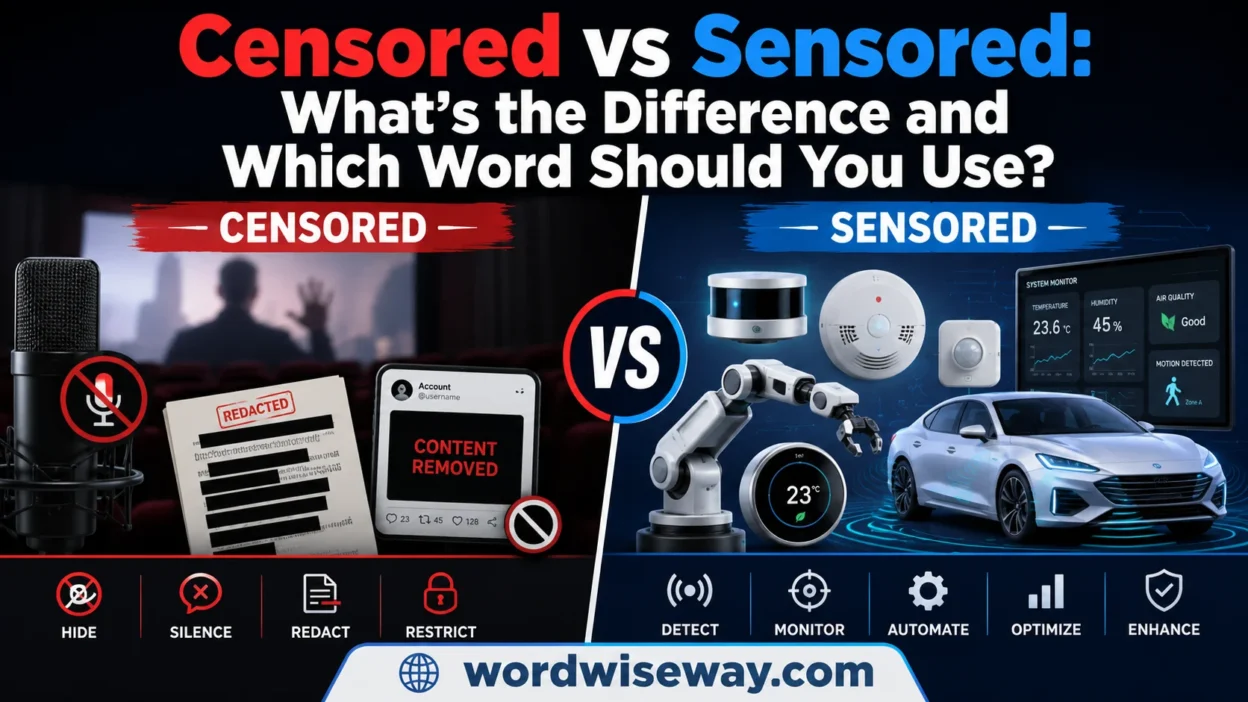
In contrast, sensored relate to sensors, measurement devices, and modern technology used for detection and automation. A sensor acts as a digital or mechanical detector that tracks motion, environmental changes, and system activity. You see these in cameras, security systems, smart locks, lights, and industrial monitoring tools.
They play a key role in accuracy, workflow efficiency, scheduling systems, and automation processes. From time management tools to booking platforms, sensors help improve precision and reduce human error in both personal and professional environments.
Another common source of confusion is censure, which is a noun and verb linked to strong disapproval or formal criticism. It is used in legal, political, and academic contexts when someone or something is publicly judged or condemned. Unlike censor, which means to remove or restrict content, censure focuses on expressing disapproval. Meanwhile, sensored stays tied to detection technology, not opinion or judgment.
Understanding these differences helps improve writing accuracy, strengthens vocabulary use, and avoids common language mistakes in both formal and casual communication.
Censored vs Sensored at a Glance
If you’re in a hurry, here’s the simplest explanation.
Censored relates to removing, suppressing, blocking, or restricting information.
Sensored relates to sensors, detection devices, monitoring systems, and automated measurements.
Quick Difference
| Word | Meaning |
| Censored | Restricted, edited, hidden, or removed content |
| Sensored | Equipped with or monitored by sensors |
| Common Contexts | Media, government, publishing, social media |
| Technical Contexts | Engineering, robotics, electronics, healthcare |
Side-by-Side Comparison Table
| Feature | Censored | Sensored |
| Primary Meaning | Content restriction | Sensor-equipped system |
| Root Word | Censor | Sensor |
| Common Industries | Media, journalism, publishing | Engineering, technology, healthcare |
| Frequency of Use | Very common | Relatively uncommon |
| Typical Audience | General public | Technical professionals |
| Example | The movie was censored. | The device is sensored for temperature monitoring. |
| Associated Concepts | Speech control, editing, suppression | Detection, measurement, automation |
Quick Memory Rule
Think of it this way:
- Censored = Content
- Sensored = Sensors
One letter changes everything.
What Does Censored Mean?
The word censored comes from the verb censor, which means to examine and suppress material considered objectionable, harmful, sensitive, or inappropriate.
When something is censored, part of it is hidden, removed, edited, blocked, or restricted before reaching an audience.
Definition of Censored
A simple definition:
Censored means having content removed, altered, restricted, or hidden by an authority, organization, publisher, or platform.
The restriction may involve:
- Language
- Images
- Political opinions
- Sensitive information
- Religious content
- Violent material
- Adult content
Origin and Etymology of Censored
The word traces its roots to the Latin term censor.
In ancient Rome, a censor was a public official responsible for supervising public morality and maintaining records of citizens.
Over time, the word evolved to describe anyone who reviews and restricts information before publication.
Today, censorship exists in nearly every form of communication.
How Censored Is Used in Everyday English
You encounter censorship more often than you might realize.
Examples include:
- Television programs that mute profanity
- Social media posts removed for policy violations
- Books banned from libraries
- News reports edited before broadcasting
- Online videos restricted by age
The word appears frequently in discussions about free speech, media regulation, and public information.
Common Examples of Censored Content
News Media
Governments and media organizations sometimes remove information for national security reasons.
For example:
- Military operations
- Intelligence reports
- Classified documents
Certain details may be censored before publication.
Television and Movies
Most people first encounter censorship through entertainment.
Examples include:
- Muted swear words
- Blurred nudity
- Removed scenes
- Edited dialogue
A television network might censor a movie to meet broadcasting standards.
Books and Literature
Throughout history, many books have faced censorship.
Reasons include:
- Political criticism
- Religious disagreements
- Explicit content
- Social controversy
Some works later become celebrated classics despite initial bans.
Social Media Platforms
Modern censorship often occurs online.
Platforms may remove content that violates rules involving:
- Hate speech
- Harassment
- Misinformation
- Graphic violence
- Copyright infringement
Whether such actions qualify as censorship remains a topic of ongoing debate.
Example Sentences Using Censored
Here are several correct examples:
- The interview was heavily censored before broadcast.
- Several scenes were censored from the film.
- The government censored the publication.
- His social media post was censored after violating platform policies.
- The documentary was censored in multiple countries.
Notice how each example involves information being restricted or removed.
Read More: Baby vs Babies: Grammar Rules, Meanings and Real Examples
What Does Sensored Mean?
Unlike censored, the word sensored belongs primarily to technical and engineering fields.
It originates from the noun sensor.
Definition of Sensored
A practical definition is:
Sensored means equipped with sensors or monitored through sensors.
A sensor is a device that detects and responds to environmental changes.
Those changes may include:
- Temperature
- Motion
- Light
- Pressure
- Sound
- Humidity
- Distance
When equipment contains such devices, engineers may describe it as sensored.
Is Sensored a Real Word?
Yes.
Many people assume “sensored” is simply a misspelling of “censored.”
That’s not always true.
While less common in everyday English, sensored is a legitimate word used in technical documentation, engineering reports, robotics research, and industrial systems.
However, because the word appears infrequently outside specialized fields, many readers mistake it for a spelling error.
Origin and Technical Meaning
The word developed from sensor, a term widely used in electronics and measurement technology.
As automated systems became more sophisticated, engineers needed terminology to describe machines equipped with monitoring devices.
That’s where sensored entered technical vocabulary.
For example:
- Sensored motors
- Sensored control systems
- Sensored robotics platforms
- Sensored manufacturing equipment
Industries That Use the Word Sensored
Engineering
Modern engineering relies heavily on sensors.
Machines constantly collect information about:
- Performance
- Speed
- Temperature
- Mechanical stress
Engineers often describe these systems as sensored.
Electronics
Smart electronics depend on sensors to function correctly.
Examples include:
- Smartphones
- Smart watches
- Tablets
- Security systems
Many components operate through sensored technology.
Robotics
Robots require environmental awareness.
Sensors help them:
- Avoid obstacles
- Detect movement
- Measure distances
- Track locations
Without sensors, most advanced robotics would be impossible.
Automotive Technology
Modern vehicles contain dozens of sensors.
These monitor:
- Tire pressure
- Engine performance
- Fuel efficiency
- Parking distance
- Collision risks
Today’s cars are highly sensored systems.
Healthcare
Medical technology relies heavily on sensors.
Examples include:
- Heart monitors
- Blood oxygen devices
- Smart insulin systems
- Patient monitoring equipment
These devices continuously gather critical information.
Smart Homes
Many household devices now use sensors.
Examples include:
- Motion detectors
- Smart thermostats
- Security cameras
- Automated lighting
These technologies create intelligent living environments.
Example Sentences Using Sensored
Here are correct uses of sensored:
- The robot uses a sensored navigation system.
- The factory installed sensored equipment for safety monitoring.
- The vehicle employs sensored braking technology.
- Engineers tested the sensored motor under heavy loads.
- The smart building uses sensored climate controls.
Notice that every example involves detection, measurement, or monitoring.
Censored vs Sensored: Key Differences Explained
Although only one letter separates these words, their meanings belong to entirely different worlds.
Difference in Meaning
Censored involves controlling information.
Sensored involves detecting information.
One hides information.
The other gathers information.
That distinction alone eliminates most confusion.
Difference in Usage
Censored commonly appears in:
- News articles
- Political discussions
- Social media debates
- Entertainment reviews
- Legal conversations
Sensored appears in:
- Engineering manuals
- Technical reports
- Robotics research
- Electronics documentation
- Industrial publications
Difference in Context
Context provides the easiest clue.
Ask yourself:
Is the sentence discussing content restrictions or sensor technology?
If it involves blocked information, use censored.
If it involves detection devices, use sensored.
Difference in Frequency
Censored appears vastly more often in general English.
Most dictionaries, news sites, and educational materials use the word regularly.
Sensored remains largely confined to technical environments.
As a result, many readers encounter censored thousands of times before ever seeing sensored.
Why Do People Confuse Censored and Sensored?
Several factors contribute to the confusion.
Similar Pronunciation
In casual speech, the words sound extremely similar.
Many speakers barely distinguish the vowel sounds.
As a result, listeners often assume they’re interchangeable.
Similar Spelling
Only one letter differs.
Compare them:
- Censored
- Sensored
That tiny visual difference causes frequent typing mistakes.
Autocorrect Issues
Spellcheck tools don’t always catch the error.
Why?
Because both words exist.
A spelling checker sees two valid words and assumes nothing is wrong.
Limited Exposure to Technical Vocabulary
Most people encounter censored regularly.
Few encounter sensored.
When readers see sensored, they often assume it’s a typo even when used correctly.
When to Use Censored
Use censored whenever information, speech, images, or content are restricted.
Content Removal or Restriction
Examples include:
- Deleted comments
- Edited videos
- Blocked websites
- Removed articles
All involve censorship.
Government and Legal Contexts
Governments may censor:
- Classified information
- Sensitive documents
- National security materials
This remains one of the most recognized forms of censorship.
Media and Entertainment Contexts
Movies, television, radio, and streaming platforms regularly censor content to comply with regulations or audience guidelines.
Examples include:
- Blurred visuals
- Muted language
- Edited scenes
- Restricted broadcasts
Online Platforms and Social Networks
Social media companies frequently remove content that violates community guidelines.
Whether viewed as moderation or censorship, the correct word remains censored.
When to Use Sensored
Use sensored when discussing systems, devices, machines, or technologies that rely on sensors to collect information from their surroundings.
Unlike censorship, which limits information, sensored systems are designed to gather more information.
Devices Equipped With Sensors
Many modern devices contain sensors that help them operate accurately and efficiently.
Examples include:
- Smartphones
- Fitness trackers
- Smart thermostats
- Digital cameras
- Weather stations
These products constantly collect data from their environment.
For example:
The sensored weather station recorded temperature changes throughout the day.
Automated Monitoring Systems
Factories, warehouses, and industrial facilities use sensored systems to monitor equipment performance.
Common applications include:
- Machine temperature monitoring
- Vibration analysis
- Pressure tracking
- Safety compliance monitoring
These systems help prevent failures before they occur.
Industrial Equipment
Modern manufacturing depends heavily on sensors.
A sensored production line can:
- Detect defects automatically
- Monitor production speed
- Track inventory movement
- Improve workplace safety
Without sensors, many advanced manufacturing processes would require significantly more manual oversight.
Smart Home Technology
Smart homes have become a perfect example of sensored environments.
Examples include:
| Device | Sensor Function |
| Smart Thermostat | Measures temperature |
| Motion Detector | Detects movement |
| Smart Doorbell | Detects visitors |
| Smoke Detector | Detects smoke particles |
| Security Camera | Detects activity |
These devices respond automatically based on sensor data.
Automotive Safety Systems
Modern vehicles contain dozens of sensors.
Many safety features rely entirely on sensor technology.
Examples include:
- Blind-spot monitoring
- Adaptive cruise control
- Lane departure warnings
- Automatic emergency braking
- Parking assistance
A modern vehicle is essentially a network of interconnected sensored systems working together.
Censored vs Sensored in Real Sentences
One of the best ways to master these words is to see them in context.
Correct Examples
Censored
- The broadcaster censored several offensive words.
- The article was censored before publication.
- The government censored sensitive information.
- The platform censored content that violated its policies.
- The documentary was censored in multiple regions.
Sensored
- The drone uses a sensored navigation system.
- Engineers developed a sensored robotic arm.
- The factory installed sensored safety equipment.
- The vehicle operates through sensored control systems.
- The laboratory tested sensored monitoring devices.
Incorrect Examples
Incorrect:
The movie was sensored due to explicit language.
Correct:
The movie was censored due to explicit language.
Incorrect:
The government sensored political criticism.
Correct:
The government censored political criticism.
Incorrect:
The robot was censored with infrared detectors.
Correct:
The robot was sensored with infrared detectors.
How One Word Changes the Meaning
Consider these two sentences:
The video was censored.
This means content was removed or restricted.
Now compare:
The video system was sensored.
This means the system contains sensors.
The meanings are completely unrelated.
That’s why choosing the correct word matters.
Common Mistakes Writers Make
Many grammar mistakes happen because people recognize a word visually but don’t fully understand its meaning.
The censored vs sensored confusion is a perfect example.
Using Sensored Instead of Censored
This is by far the most common mistake.
Many writers assume sensored means filtered or restricted.
It doesn’t.
Whenever content is removed, hidden, edited, or blocked, the correct word is censored.
Assuming Sensored Means “Filtered”
A filtered image is not automatically a sensored image.
Likewise, a restricted article is not sensored.
Remember:
- Filtering modifies information.
- Censorship restricts information.
- Sensors detect information.
Each concept serves a different purpose.
Confusing Technical and Media Contexts
Context usually reveals the correct choice.
Ask yourself:
Am I discussing content or technology?
If you’re discussing:
- Speech
- News
- Movies
- Books
- Social media
Use censored.
If you’re discussing:
- Electronics
- Automation
- Robotics
- Sensors
- Monitoring systems
Use sensored.
Proofreading Tips to Avoid Errors
Before publishing any piece of writing:
Check the Subject
If the sentence discusses media or communication, censored is usually correct.
Look for Sensor-Related Terms
Words like these often indicate sensored:
- Detection
- Monitoring
- Robotics
- Automation
- Electronics
- Measurement
Read the Sentence Aloud
Many errors become obvious when spoken naturally.
Use Context Rather Than Spellcheck
Spellcheck won’t always catch the mistake because both words are valid English terms.
Memory Trick to Remember the Difference
A simple memory aid can eliminate confusion permanently.
The “C” in Censored = Content Control
Think:
Censored = Content Control
Both words start with C.
When information is controlled, restricted, hidden, or removed, use censored.
Examples:
- Censored movie
- Censored article
- Censored speech
- Censored website
The “Sensor” in Sensored = Detection Technology
The word sensored literally contains the word sensor.
Think:
Sensored = Sensor Technology
Examples:
- Sensored vehicle
- Sensored robot
- Sensored machine
- Sensored monitoring system
Key Insights
- Censored means content has been restricted, removed, edited, or hidden.
- Sensored relates to sensors, detection, measurement, and monitoring technology.
- The easiest memory trick is “Censored = Content” and “Sensored = Sensor.”
- Censored is common in everyday English, especially in media, publishing, government, and social media.
- Sensored is uncommon and mainly appears in technical or engineering contexts.
- In general writing, sensor-equipped or sensor-based may sound more natural than sensored.
- Censured is a different word that means strongly criticized or formally condemned.
- Spellcheck may not catch the confusion because censored and sensored can both be valid words.
- Always use context to determine which word fits the sentence.
- If information is being restricted, use censored; if a system is using sensors, use sensored or sensor-equipped.
My Personal Experience
As an English language specialist, I have seen how easily learners and writers confuse words that look or sound almost identical. Censored and sensored are a good example. When reviewing articles, assignments, and online content, I have noticed that writers sometimes choose a word based on its spelling or pronunciation without checking its meaning in context.
In my experience, the easiest way to resolve this confusion is to focus on the root word and context. When a sentence discusses restricted, edited, or removed information, censored is the appropriate choice. When it discusses sensors, detection, or monitoring technology, the meaning changes completely. I encourage learners to identify what the sentence is actually describing before relying on spellcheck or pronunciation.
I have also found that technical vocabulary requires extra care because some terms are uncommon in everyday English. Sensored may appear in specialized technical writing, but alternatives such as sensor-equipped, sensor-based, or equipped with sensors can often make the meaning clearer to a wider audience. Paying attention to usage, audience, and context helps writers produce clearer and more precise English.
Quick Recap
| Use This Word | When Talking About |
| Censored | Content restrictions |
| Censored | Edited movies |
| Censored | Blocked websites |
| Censored | Removed social posts |
| Sensored | Sensor-equipped devices |
| Sensored | Robotics |
| Sensored | Smart technology |
| Sensored | Monitoring systems |
One Rule to Remember Forever
If information is being restricted, use censored.
If information is being detected, use sensored.
That’s the entire difference.
Master that distinction and you’ll never confuse these words again.
Practice:
Test your understanding by choosing censored or sensored in each sentence.
- The television network ______ several scenes before broadcasting the movie.
- The robot uses a ______ navigation system to detect obstacles.
- The newspaper article was heavily ______ before publication.
- Engineers installed ______ equipment to monitor temperature and pressure.
- The platform ______ the post because it violated its content policies.
- The factory uses ______ machines to detect production errors.
- Several words were ______ from the interview.
- The vehicle relies on ______ technology for parking assistance.
Answers
- censored
- sensored
- censored
- sensored
- censored
- sensored
- censored
- sensored
Quick Practice Tip
Before choosing an answer, identify what the sentence describes. If it involves restricting or removing content, choose censored. If it involves sensors, detection, or monitoring technology, choose sensored.
FAQs
1. What is the easiest way to remember censored and sensored?
Remember the root words. Censored comes from censor and relates to controlling or restricting content. Sensored comes from sensor and relates to detection, measurement, or monitoring.
2. Is censored only used for movies and television?
No. Censored can describe restricted material in books, newspapers, websites, social media posts, interviews, documents, and other forms of communication. The key idea is that some information has been limited, removed, or altered.
3. Does sensored mean the same thing as filtered?
No. Sensored relates to the use of sensors, while filtered means that something has been separated, screened, or modified. Although both terms can involve processing information, they describe different processes.
4. Is sensor-equipped better than sensored?
In many situations, yes. Sensor-equipped, sensor-based, or equipped with sensors may sound more natural and clearer to general readers. Sensored is relatively uncommon and is more likely to appear in specialized technical writing.
5. Can a document be sensored?
Generally, no, if you mean that someone removed or restricted information. In that situation, censored is the correct word. A document can be connected to a sensor system, but that is a different meaning.
6. What does censored mean in social media?
On social media, censored can describe content that has been blocked, removed, hidden, edited, or restricted. However, platforms may use terms such as content moderation or content removal for these actions.
7. What types of devices can be described as sensored?
Technical writing may use sensored for equipment that incorporates sensors, such as robots, vehicles, industrial machines, monitoring systems, and automated devices. In general-audience writing, sensor-equipped may be easier to understand.
8. Why does spellcheck sometimes accept both words?
Spellcheck systems recognize dictionary words rather than always understanding the meaning of a sentence. Since censored and sensored can both occur as words, a basic spellchecker may not identify the wrong choice when the spelling itself is valid.
9. Which word should I use for restricted information?
Use censored. For example, you can say, “The report was censored before publication” because the sentence describes information being restricted or removed.
10. What is the quickest way to choose between censored and sensored?
Ask yourself what is happening. If someone is restricting content, use censored. If a device is detecting or measuring something with sensors, use sensored or, often more naturally, sensor-equipped.
Conclusion
Although censored and sensored differ by only one letter, they describe completely different ideas. Censored belongs to the world of communication and content control, where information may be removed, edited, hidden, or restricted. You may encounter it when discussing movies, books, news reports, websites, government documents, or social media content.
Sensored, on the other hand, connects to sensors and technical systems that detect or measure changes in their surroundings. It may appear in engineering, robotics, automotive technology, manufacturing, and other specialized fields. However, because it is uncommon in general English, expressions such as sensor-equipped or sensor-based may provide greater clarity for everyday readers.
The simplest way to remember the distinction is to focus on the root word: censor → censored and sensor → sensored. If something is being restricted, choose censored. If a machine or system uses sensors for detection or measurement, choose sensored or a clearer alternative such as sensor-equipped. Keeping the context in mind will help you avoid this common spelling and vocabulary confusion.

Amelia Sanders has spent 14 years in Harvard University’s English Department, helping students navigate literary analysis, interpretive theory, and narrative techniques. Her academic pursuits center on 18th-century British prose, romantic poetry, diasporic writing, and digital editing exploring how textual choices influence cultural perspectives. Amelia has spoken at major international meetings and contributed essays to respected academic volumes, demonstrating her dedication to thoughtful scholarship and effective teaching.