8 Words for Someone Who Follows the Rules helps you describe people who respect instructions, follow policies, and stick to established standards. Choosing the right term improves your vocabulary and makes everyday communication clearer.
A rule-follower values consistency, reliability, and fairness. However, some people follow rules so strictly that they struggle when circumstances change. Understanding their behavior helps you choose accurate words for different situations, including academic settings, workplace discussions, and casual conversations.
These eight useful words offer different ways to describe someone who follows rules. Each term has its own meaning and nuance, so context matters. Whether you’re writing professionally or speaking informally, the right word can improve clarity, strengthen your English usage, and help you communicate with greater confidence.
Quick Answer:
The most direct term for someone who follows rules is rule-abiding. However, several other words can describe this behavior, depending on the situation.
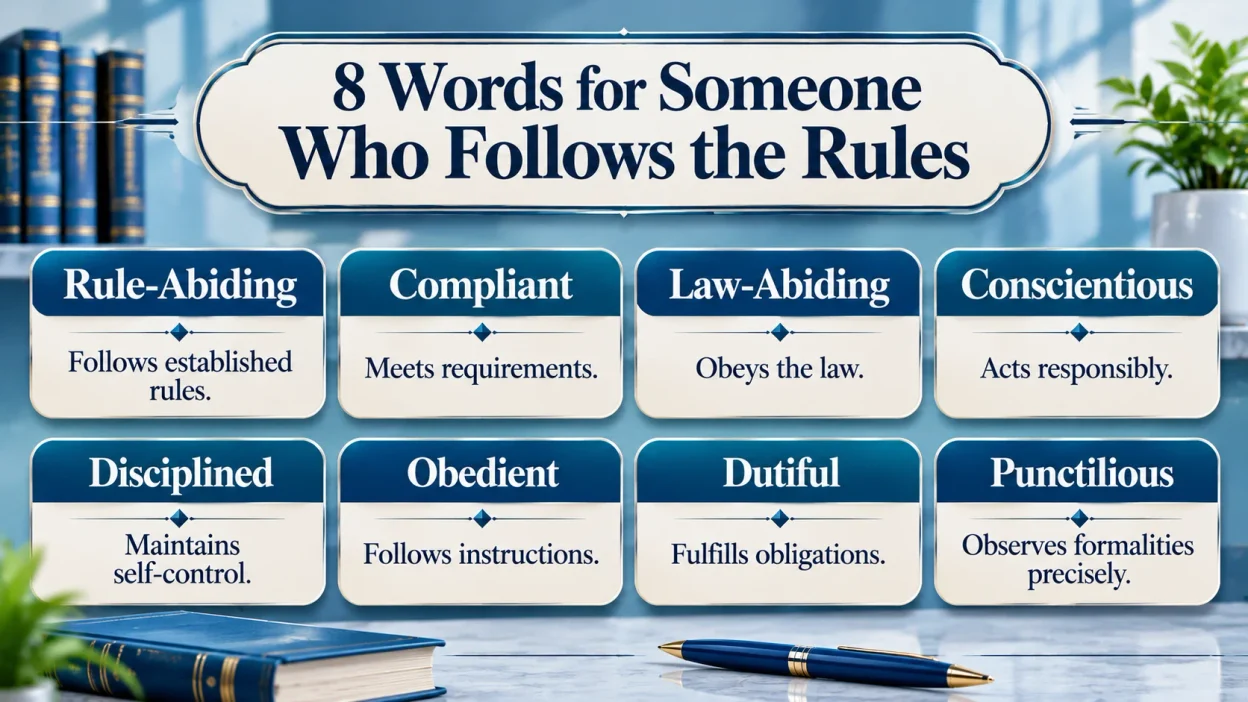
- Rule-abiding: Someone who follows established rules.
- Compliant: Someone who meets requirements or follows instructions.
- Law-abiding: Someone who obeys the law.
- Conscientious: Someone who takes responsibilities seriously and tries to do things correctly.
- Disciplined: Someone who controls their behavior and follows routines or standards consistently.
- Obedient: Someone who follows instructions from an authority figure.
- Dutiful: Someone who fulfills their duties and obligations.
- Punctilious: Someone who pays close attention to rules, formalities, and proper conduct.
The best word depends on the behavior you want to emphasize. Use rule-abiding for general rule-following, conscientious for responsible behavior, and punctilious for strict attention to formal details.
What Does It Mean to Be Someone Who Follows the Rules?
A person who follows rules respects established expectations and acts according to specific guidelines. These guidelines might come from laws, schools, workplaces, families, or social settings.
However, following rules doesn’t always mean behaving the same way. One person might follow instructions because they believe the rules are important. Another might comply because their job requires it. Someone else may carefully observe every procedure because they value accuracy and order.
Consider these examples:
- A driver who observes traffic laws is law-abiding.
- An employee who follows safety procedures is compliant.
- A student who completes assigned duties responsibly is conscientious.
- A person who maintains a consistent routine is disciplined.
Each description captures a different aspect of rule-following. Understanding these differences helps you choose words that fit the person’s actions, motivations, and circumstances.
Eight Words for Someone Who Follows the Rules
Rule-Abiding
Rule-abiding describes someone who follows established rules, regulations, or standards. It’s one of the clearest expressions when you want to describe a person’s behavior without suggesting a particular motivation.
A rule-abiding person respects the expectations that apply to a situation. These expectations might come from a classroom, workplace, community, or organized activity.
For example, a student who follows examination instructions and respects classroom policies can be described as rule-abiding.
The term doesn’t necessarily mean the person follows every rule without question. It simply indicates that they generally respect and observe the applicable rules.
Example sentences:
- Maria is a rule-abiding student who follows classroom policies.
- The organization expects all employees to maintain a rule-abiding approach to workplace conduct.
- A rule-abiding citizen respects the regulations that govern public behavior.
When should you use it?
Choose rule-abiding when you need a straightforward, neutral description of someone who follows rules. It’s suitable for everyday conversations, professional writing, and discussions about conduct.
Related terms include law-abiding, compliant, and obedient. However, these words aren’t interchangeable in every situation.
Compliant
Compliant describes someone who acts according to requirements, instructions, standards, or regulations.
The word appears frequently in workplaces, legal settings, healthcare administration, and regulated industries. For example, a company might need to remain compliant with applicable safety regulations.
A compliant person meets the requirements placed on them. However, the word doesn’t necessarily reveal whether they agree with those requirements or follow them willingly.
Imagine an employee who wears required protective equipment because company policy demands it. The employee is compliant with the safety policy, regardless of their personal opinion about the rule.
Example sentences:
- The employee remained compliant with the company’s safety requirements.
- Students must be compliant with the examination instructions.
- The business reviewed its procedures to ensure regulatory compliance.
When should you use it?
Use compliant when the emphasis falls on meeting a specific requirement or following an established standard.
In everyday conversation, it can sometimes sound formal or suggest that someone simply follows instructions. In professional settings, however, it’s often the most precise choice.
Compliant vs. rule-abiding: A rule-abiding person generally respects rules, while a compliant person meets particular requirements. The first describes broader behavior; the second often emphasizes a specific obligation.
Law-Abiding
Law-abiding describes someone who obeys the law and respects legal requirements.
Although laws are rules, not all rules are laws. A classroom policy, workplace dress code, or household routine may be a rule without being a legal requirement.
This distinction makes law-abiding especially useful when discussing public conduct, citizenship, and legal responsibilities.
For example, someone who follows traffic laws and respects applicable legal restrictions can be described as law-abiding. The term doesn’t automatically tell you whether that person follows every informal rule or organizational policy.
Example sentences:
- A law-abiding citizen respects the laws that apply to their conduct.
- The campaign encouraged residents to become informed and law-abiding members of the community.
- He has always tried to live as a responsible, law-abiding individual.
When should you use it?
Choose law-abiding when you specifically mean that someone obeys the law.
It’s not the best substitute for rule-abiding when you’re describing someone who follows classroom instructions or workplace procedures. Those situations involve rules that may have nothing to do with the law.
Law-abiding vs. rule-abiding: The key difference is scope. Law-abiding refers to legal requirements, while rule-abiding also covers nonlegal rules and guidelines.
Conscientious
Conscientious describes someone who takes their responsibilities seriously and tries to perform their duties carefully and correctly.
Unlike obedient, this word emphasizes a person’s sense of responsibility. A conscientious individual doesn’t simply complete tasks because someone demands it. They also care about doing their work properly and meeting their obligations.
For example, a conscientious employee checks their work, follows relevant procedures, and takes responsibility for mistakes. Their approach reflects care and reliability rather than mere obedience.
A conscientious person may follow rules because they understand their purpose. However, conscientiousness doesn’t mean blindly accepting every instruction.
Example sentences:
- She is a conscientious employee who follows procedures and checks her work carefully.
- A conscientious student completes assignments responsibly and respects academic expectations.
- His conscientious approach helps the team maintain consistent standards.
When should you use it?
Use conscientious when you want to emphasize responsibility, care, and a commitment to doing things properly.
It’s particularly suitable for describing students, employees, professionals, and people who take their obligations seriously.
Conscientious vs. compliant: A compliant person meets a requirement, while a conscientious person takes their responsibilities seriously. Someone can demonstrate both qualities, but neither word automatically guarantees the other.
Disciplined
Disciplined describes someone who exercises self-control and consistently follows rules, routines, or standards.
Discipline often involves maintaining good habits even when doing so requires effort. A disciplined person may follow a schedule, practice regularly, or resist distractions to achieve a goal.
This quality can help someone follow rules without needing constant supervision. For example, a student who studies according to a planned schedule demonstrates discipline through consistent action.
Discipline isn’t limited to obedience. It also involves managing your own behavior and staying committed to responsibilities.
Example sentences:
- The disciplined athlete follows a training schedule consistently.
- She is disciplined enough to complete her assignments before relaxing.
- A disciplined team follows established procedures during demanding situations.
When should you use it?
Choose disciplined when someone follows rules, routines, or standards consistently through self-control.
The word works well in educational, professional, athletic, and personal contexts.
Disciplined vs. obedient: An obedient person follows instructions from an authority figure. A disciplined person can regulate their own behavior, even when nobody is watching.
Obedient
Obedient describes someone who follows instructions, commands, or requests from a person or authority figure.
The word commonly appears in discussions about children, students, pets, and relationships involving authority. For instance, a child who follows a parent’s reasonable instructions may be described as obedient.
However, obedient can carry different connotations depending on the situation. Sometimes it praises cooperation and respect. In other contexts, it may suggest that someone follows instructions without exercising much independent judgment.
For that reason, the surrounding context matters.
Example sentences:
- The student was obedient and followed the teacher’s instructions.
- The dog remained obedient during its training session.
- Employees are expected to follow lawful instructions from their supervisors.
When should you use it?
Use obedient when the central idea is following instructions from someone who has authority.
If you want to emphasize personal responsibility rather than obedience, conscientious may communicate your meaning more accurately.
Obedient vs. compliant: Obedience usually emphasizes following an authority figure’s instructions. Compliance emphasizes meeting a requirement, standard, or condition.
Dutiful
Dutiful describes someone who fulfills their duties and responsibilities because they recognize an obligation to do so.
A dutiful person takes their commitments seriously. They may carry out family responsibilities, complete professional tasks, or meet civic obligations even when the work isn’t particularly enjoyable.
Unlike obedient, which focuses on following instructions, dutiful emphasizes fulfilling a responsibility.
For example, an employee who consistently completes assigned responsibilities may be dutiful. The same description could apply to someone who reliably cares for family members or honors important commitments.
Example sentences:
- She is a dutiful employee who completes her responsibilities on time.
- He remained dutiful in carrying out his assigned responsibilities.
- A dutiful team member supports the group’s goals and fulfills their commitments.
When should you use it?
Choose dutiful when someone follows rules or expectations because they take their obligations seriously.
The word often sounds more formal than responsible. It can also suggest a strong sense of duty, loyalty, or commitment.
Dutiful vs. conscientious: Both words suggest responsibility. However, dutiful emphasizes fulfilling obligations, while conscientious highlights careful and responsible performance.
Punctilious
Punctilious describes someone who pays very close attention to rules, formalities, etiquette, and proper conduct.
It’s a more formal and less common word than rule-abiding or obedient. It often describes people who carefully observe procedures, conventions, and small details.
Imagine an event coordinator who checks seating arrangements, follows the required protocol, and ensures that every formal detail meets expectations. You could describe that person as punctilious.
The word can express admiration for precision. However, it can also suggest excessive concern with minor formalities when the context supports that interpretation.
Example sentences:
- The punctilious administrator followed every required procedure.
- She was punctilious about observing professional etiquette.
- His punctilious attention to formal requirements helped the ceremony run smoothly.
When should you use it?
Use punctilious when you want to emphasize strict attention to rules, etiquette, or formal details.
It’s especially useful in formal writing and descriptions of professional or ceremonial conduct.
Punctilious vs. meticulous: A punctilious person pays particular attention to rules, formalities, and proper conduct. A meticulous person pays close attention to details more generally, including details that have nothing to do with rules.
Comparison Table
The following table summarizes the main differences so you can choose the right word quickly.
| Word | Main meaning | Best context | Example phrase |
| Rule-abiding | Follows established rules | General behavior | A rule-abiding student |
| Compliant | Meets requirements | Workplace policies and regulations | A compliant employee |
| Law-abiding | Obeys the law | Legal and civic conduct | A law-abiding citizen |
| Conscientious | Acts responsibly and carefully | Work and personal duties | A conscientious professional |
| Disciplined | Maintains self-control and consistency | Habits, study, and training | A disciplined learner |
| Obedient | Follows instructions or commands | Authority-based relationships | An obedient student |
| Dutiful | Fulfills obligations | Work and personal responsibilities | A dutiful team member |
| Punctilious | Observes rules and formalities precisely | Etiquette and formal procedures | A punctilious administrator |
Although these terms overlap, each emphasizes something different. Choosing the right one makes your writing more accurate and helps readers understand the behavior you’re describing.
How to Choose the Right Word for Someone Who Follows the Rules
The easiest way to select the right word is to identify what kind of rule-following you mean. Ask yourself whether the person respects general rules, follows instructions, fulfills responsibilities, or pays close attention to details.
Use the following examples as a practical guide.
- For general rule-following: Choose rule-abiding. It communicates the idea directly without adding unnecessary assumptions.
- For meeting official requirements: Choose compliant. This works particularly well for workplace policies, regulations, and procedures.
- For obeying laws: Choose law-abiding. It specifically identifies respect for legal requirements.
- For responsible behavior: Choose conscientious. It emphasizes care, accountability, and attention to duties.
- For self-control and consistency: Choose disciplined. It fits people who maintain routines and standards independently.
- For following someone’s instructions: Choose obedient. It highlights the relationship between the person giving instructions and the person following them.
- For fulfilling obligations: Choose dutiful. It emphasizes commitment to responsibilities.
- For observing formalities precisely: Choose punctilious. It suits situations involving etiquette, protocol, and strict procedural details.
Real-World Examples: Choosing the Right Word
Consider how the same general behavior can call for different descriptions depending on the circumstances.
Example: A student in the classroom
A student listens to the teacher, follows classroom instructions, and respects school policies.
- Obedient emphasizes following the teacher’s instructions.
- Rule-abiding emphasizes respecting classroom rules.
- Conscientious emphasizes taking school responsibilities seriously.
Each description can be correct, but the best choice depends on the point you want to make.
Example: An employee at work
An employee follows safety requirements, completes assigned tasks, and checks their work carefully.
- Compliant emphasizes meeting workplace requirements.
- Conscientious emphasizes careful, responsible work.
- Dutiful emphasizes fulfilling assigned responsibilities.
These descriptions focus on different aspects of the employee’s behavior.
Example: A person following a daily routine
Someone studies at the same time each day, completes planned tasks, and maintains consistent habits.
- Disciplined emphasizes self-control.
- Conscientious emphasizes responsibility.
- Rule-abiding may fit if the person is following a particular set of established rules.
In this situation, disciplined is often the most natural choice because the behavior depends on consistency and self-management.
Example: An event organizer
An organizer follows the required protocol and checks every formal detail before an important ceremony.
- Punctilious emphasizes close attention to formalities.
- Conscientious emphasizes careful performance of responsibilities.
- Compliant emphasizes meeting specific event requirements.
The most precise description depends on whether you want to highlight formal accuracy, responsibility, or compliance.
Positive and Negative Connotations of Words for Rule-Followers
Not every word describing someone who follows rules carries the same tone. Some emphasize responsibility and self-control, while others focus on obedience or meeting requirements.
Understanding these differences helps you avoid unintended meanings.
Words With Generally Positive Associations
Conscientious often praises someone who acts carefully and takes responsibilities seriously. It suggests that the person cares about doing a good job.
Disciplined commonly describes someone who manages their behavior and maintains consistent habits. It can be especially positive when discussing learning, training, or long-term goals.
Dutiful emphasizes reliability and commitment. It can describe someone who fulfills important responsibilities even when those responsibilities require effort.
These words work well when you want to praise a person’s conduct rather than simply state that they follow instructions.
Words That Depend on Context
Compliant can describe someone who meets important safety or legal requirements. However, it can also suggest that the person follows demands without much personal input.
Obedient may praise cooperation in a suitable context. In other situations, it may suggest excessive dependence on authority.
Punctilious can express admiration for precision and respect for formal standards. It may also imply unnecessary rigidity when someone focuses excessively on minor formalities.
Rule-abiding and law-abiding are generally straightforward descriptions. They identify the rules someone follows without automatically revealing that person’s motivation or personality.
The important distinction is that following rules doesn’t tell you everything about a person. Their judgment, motivation, and behavior in different circumstances also matter.
What Is the Difference Between Following Rules and Following Orders?
Following rules and following orders are related, but they aren’t identical.
Rules establish general expectations that apply to particular situations. Orders are instructions given by someone, often within a relationship involving authority.
For example, a workplace safety policy may require every employee to wear protective equipment. Following that policy demonstrates compliance with a rule.
If a supervisor tells an employee to put on the required equipment, following that instruction demonstrates obedience to an order.
The same action can demonstrate both qualities.
Here are the main distinctions:
- Following rules: Respecting established guidelines and expectations.
- Following orders: Carrying out instructions from someone who gives them.
- Meeting requirements: Satisfying a stated condition or standard.
- Fulfilling duties: Completing responsibilities associated with a role or commitment.
- Practicing self-discipline: Managing your own behavior to maintain consistent standards.
These distinctions matter because someone can be disciplined without needing instructions from another person. Likewise, someone can follow an order without necessarily being conscientious in other areas.
What Is the Opposite of Someone Who Follows the Rules?
The opposite depends on the behavior you want to describe. Several words express different forms of failing to follow rules or instructions.
| Word | Meaning | Example |
| Noncompliant | Not meeting a requirement or standard | The process was noncompliant with the stated requirements. |
| Disobedient | Refusing or failing to follow instructions | The disobedient student ignored the teacher’s instructions. |
| Rule-breaking | Violating an established rule | The organization investigated repeated rule-breaking. |
| Unruly | Difficult to control or manage | The unruly crowd ignored requests to remain orderly. |
| Undisciplined | Lacking consistent self-control or discipline | His undisciplined approach made it difficult to maintain a routine. |
These words aren’t exact substitutes for one another.
For instance, noncompliant is particularly useful when discussing requirements. Disobedient emphasizes instructions or authority, while undisciplined focuses on a lack of self-control or consistency.
Choose the term that describes the actual behavior rather than making a broader judgment about someone’s character.
Read More: Starting a Sentence With “During”: Comma Rules Explained
FAQs
1. What do you call someone who always follows the rules?
You can call someone who always follows the rules a rule-follower, rule-abiding person, or law-abiding individual. The best term depends on whether they follow workplace policies, social expectations, or laws.
2. What is another word for a rule-follower?
Some alternatives include compliant, obedient, disciplined, conscientious, and dutiful. Each word describes a slightly different quality, so choose one that matches the person’s behavior.
3. What does it mean to be rule-abiding?
Being rule-abiding means respecting established rules, following instructions, and behaving within accepted limits. A rule-abiding person usually understands the importance of fairness, order, and responsibility.
4. Is being a rule-follower a good thing?
Yes, following rules can promote fairness, safety, and trust. However, good judgment also matters because some situations require people to question outdated or unreasonable rules.
5. What is the difference between obedient and compliant?
Obedient describes someone who follows instructions from an authority figure. Compliant means acting according to rules, requests, or requirements, often in professional or official settings.
6. What word describes someone who follows rules carefully at work?
Conscientious, disciplined, or compliant may fit someone who follows workplace policies carefully. A conscientious employee also pays attention to responsibilities and tries to do their work properly.
7. What do you call someone who follows rules too strictly?
You might describe such a person as rigid, inflexible, or overly strict. These terms suggest that someone prioritizes rules even when adapting would be reasonable.
8. Is disciplined the same as obedient?
Not exactly. A disciplined person manages their behavior and follows standards through self-control. An obedient person generally follows instructions given by someone else.
9. How can I describe someone who follows rules without sounding negative?
Use words such as responsible, conscientious, dependable, or principled. These terms emphasize positive qualities instead of suggesting that someone follows rules without thinking independently.
10. Which word is best for someone who respects rules and procedures?
Conscientious works well when someone carefully fulfills their responsibilities. Compliant is more suitable when you want to emphasize following specific policies, regulations, or procedures.
Conclusion
Choosing the right word for someone who follows the rules depends on their actions, attitude, and situation. Words like disciplined, obedient, compliant, and conscientious may seem similar, but each describes a different quality. Understanding these differences helps you express your thoughts clearly without making someone’s behavior sound better or worse than it is.
When describing a person at work, in school, or during everyday conversations, consider what you want to emphasize. Are they responsible, respectful, dependable, or simply careful about following instructions? A thoughtful word choice makes your writing more accurate and helps readers understand the person you’re describing.
Expanding your vocabulary isn’t just about learning new words. It’s about knowing when and how to use them naturally. Keep these eight terms in mind, notice how people use them in real conversations, and practice including them in your own sentences. With time, you’ll find it easier to communicate your ideas clearly and confidently.

Emma Smith has dedicated 14 years to Princeton University’s English Department, mentoring students in textual interpretation, literary movements, and critical frameworks. Her research explores Shakespearean drama, Victorian serial fiction, postcolonial narrative theory, and manuscript studies and probing how literary forms evolve across cultures and centuries. Emma has delivered lectures at international humanities congresses and published findings in distinguished academic journals, underscoring her commitment to scholarly depth and vibrant teaching.