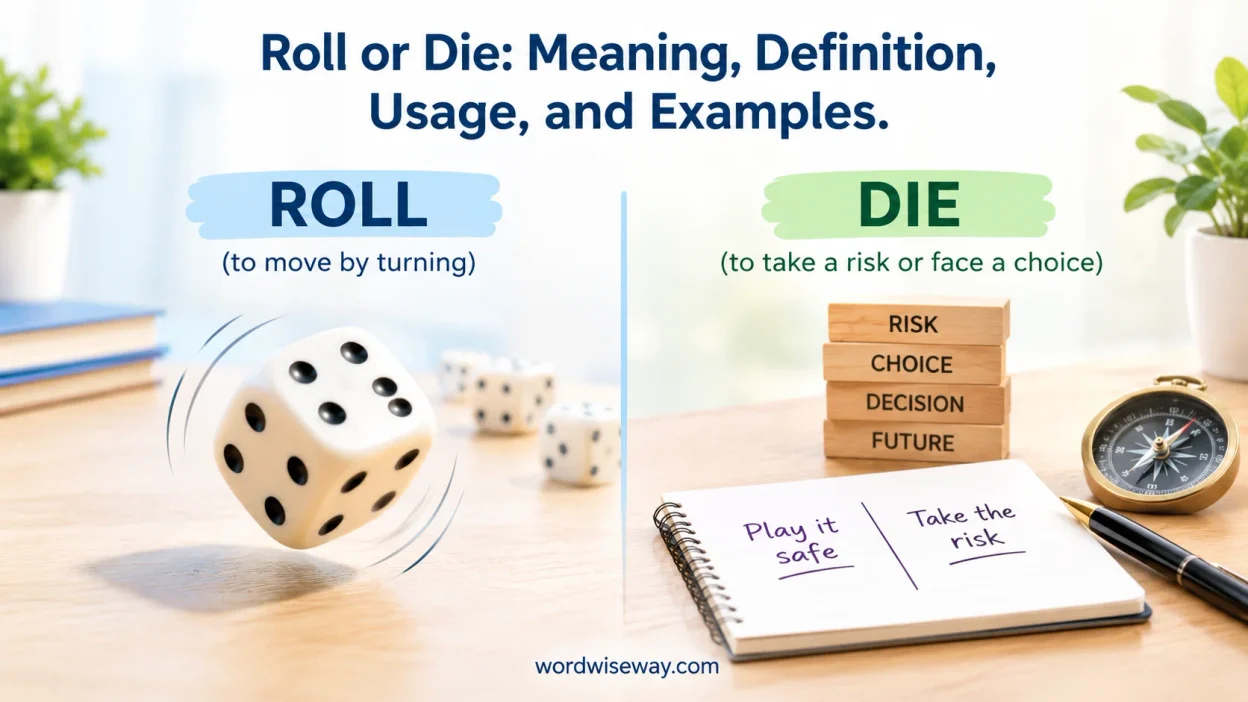
The roll or die phrase is an attention-grabbing expression with different meanings depending on the context. Its definition and usage often appear in gaming, game chats, videos, and street slang. It can describe taking a chance, risk-taking, or continuing to play under pressure.
On social media, captions, memes, and motivational quotes, the phrase can symbolize confidence, go all in energy, or a risk-related decision. Some users search this keyword because they think it is a typo, while others connect it with deep ideas about survival. Its modern slang use can create confusion.
A simple guide can help you learn its origin, history, spelling, trends, and common mistakes. The right examples show correct usage in daily writing and online communication. Understanding the situation helps you use the phrase correctly.
Quick Answer:
“Roll or Die” generally expresses a high-stakes choice: take the chance, make the move, or accept the consequences. The phrase can also use wordplay involving a die, which is one numbered cube used in games.
The word roll has several meanings. In gaming, it can mean throwing or moving a die to produce a random result. Oxford lists roll as a verb meaning to throw dice in a game, while it also uses the word for turning over and over or moving smoothly.
The word die creates another layer of meaning. As a verb, it means to stop living. As a noun, however, a die is one of the small numbered cubes used in games. Dice is traditionally the plural form. Cambridge also notes this singular-plural distinction in its discussion of game vocabulary.
So, depending on the context, “Roll or Die” can suggest:
- Take the chance or face the consequences.
- Make the move instead of hesitating.
- Roll a die and accept whatever result appears.
- Embrace uncertainty in a dramatic or playful way.
- Use wordplay involving roll, die, and dice.
The phrase isn’t as fixed or universally established as expressions such as “do or die” or “roll the dice.” Context matters.
What Does “Roll” Mean in “Roll or Die”?
The word roll carries several meanings in English, which makes it particularly flexible in this expression.
Roll as a Verb
In its most basic sense, roll means to move by turning over and over. A ball can roll across a floor, a wheel can roll along a road, and a bottle can roll off a table.
Cambridge defines this sense as causing something to move by turning over and over or from side to side.
For example:
The ball began to roll down the hill.
However, roll can describe more than physical movement. English speakers also use it in gaming, transportation, sound, production, and many idiomatic expressions.
Roll as a Gaming Term
In games involving dice, roll means to throw or cast the die or dice so that they produce a result.
For example:
Roll the die and move your piece according to the number.
Here, roll describes the action while die identifies the object being rolled.
Oxford specifically gives roll the gaming sense of throwing dice and provides examples involving rolling a die and moving around a board.
That distinction helps explain one possible interpretation of “Roll or Die.”
Roll as a Symbol of Taking a Chance
The phrase can also take on a figurative meaning. Because dice produce uncertain results, rolling them has become closely associated with risk, uncertainty, and chance.
That’s why English speakers can use dice-related language metaphorically. Someone might describe a difficult decision as a gamble or say that a person is willing to take a chance.
In “Roll or Die,” this association can give the phrase an intense, all-or-nothing flavor without requiring a literal reference to death.
What Does “Die” Mean in “Roll or Die”?
The word die deserves special attention because it has two completely different meanings.
Die as a Verb
As a verb, die means to stop living. This is the meaning most readers notice first.
When used figuratively in a dramatic expression, however, the word can suggest extreme consequences rather than literal death.
For example, phrases such as “do or die” use die to emphasize that a situation feels extremely important or urgent.
That doesn’t mean every expression containing die describes a real-life life-or-death situation.
Die as a Noun
A die is also a noun.
In traditional gaming terminology:
- One die = one numbered cube
- Two or more dice = multiple numbered cubes
For example:
Roll the die.
And:
Roll the dice.
This distinction explains why “roll” and “die” can naturally appear together in gaming language.
The relationship between die and dice can confuse learners because the plural form doesn’t follow the usual pattern of simply adding -s. Cambridge specifically identifies die as the singular form of dice in its discussion of game terminology.
Meaning Explained by Context
The phrase doesn’t have one universal interpretation. The surrounding words usually tell you which meaning the writer intends.
In Casual Conversation
In casual speech, “Roll or Die” can function as a dramatic way to encourage action.
Someone might use it humorously when a decision involves uncertainty:
We’ve planned everything we can. Roll or die.
Here, the phrase doesn’t necessarily describe physical danger. Instead, it emphasizes that the person has reached the point where they must make a choice.
In Gaming
Gaming provides one of the most straightforward interpretations.
If a game involves a die, roll describes the action of throwing it. The result then determines what happens next.
For example:
It’s your turn. Roll or die.
Depending on the particular game or conversation, the phrase might be a playful modification of ordinary dice terminology rather than a standard gaming rule.
It’s important not to treat “Roll or Die” as the official name of a universal game mechanic. Different games can use different terminology.
In Risk-Taking Situations
The phrase can also describe a willingness to accept uncertainty.
Imagine someone has reached a difficult decision. They don’t know exactly what will happen, but they decide to move forward anyway. “Roll or Die” can capture that dramatic attitude.
The underlying idea becomes:
Make the move. Accept the uncertainty. Live with the result.
That figurative interpretation connects naturally with the broader association between dice and chance.
In Pop Culture and Informal Language
Short expressions with strong rhythm often work well in informal culture because they’re easy to remember.
“Roll or Die” has that punchy structure. Two short words create a sharp contrast, while the repeated or construction makes the choice sound immediate.
However, context remains crucial. A phrase appearing in a song, caption, game, video, or slogan might carry a specialized meaning that differs from an ordinary dictionary interpretation.
Is “Roll or Die” a Phrase, Idiom, or Slogan?
Calling “Roll or Die” a traditional idiom requires some caution.
An idiom normally has an established meaning that isn’t completely predictable from its individual words. Common examples include expressions such as “break the ice” and “hit the nail on the head.”
“Roll or Die” doesn’t have the same universally fixed status.
Instead, it can function as:
- An informal expression
- A dramatic slogan
- A playful phrase
- A gaming-related expression
- A figurative statement about risk or uncertainty
This distinction matters because you shouldn’t assume that every short, memorable phrase qualifies as a standard English idiom.
Roll or Die vs. Roll the Dice
These expressions overlap in the idea of chance, but they aren’t identical.
| Expression | Meaning | Typical Tone |
| Roll or Die | Take the chance or face the consequences | Dramatic or playful |
| Roll the Dice | Take a chance despite uncertainty | Figurative or informal |
| Do or Die | Succeed or face extremely serious consequences | Dramatic |
| All or Nothing | There is little or no middle ground | Direct and emphatic |
| Take a Chance | Accept some uncertainty or risk | Neutral and common |
“Roll the dice” has a clearer established figurative use. It can describe making a decision when the outcome remains uncertain.
Oxford also recognizes roll as a noun for the act of rolling a die.
By contrast, “Roll or Die” sounds more stylized. Its meaning often comes from the speaker’s intended wordplay and surrounding context.
Roll or Die vs. Do or Die
These two expressions look remarkably similar, but they aren’t interchangeable.
“Do or die” is an established expression that communicates extreme determination or urgency. It suggests that someone must succeed because the alternative is unacceptable.
“Roll or die” adds the idea of rolling, which can connect to movement, dice, chance, or risk.
Compare these examples:
This is a do-or-die moment for the team.
This sentence emphasizes urgency and the need to succeed.
We made our choice. Now we roll or die.
This version emphasizes action, uncertainty, and consequences.
The shared word die gives both expressions a dramatic edge. The word roll changes the imagery and possible meaning.
Examples of “Roll or Die” in a Sentence
The best way to understand an unusual expression is to see how context changes its meaning.
Example 1: A Risky Decision
We’ve considered every option. Now it’s roll or die.
Here, the speaker uses the phrase figuratively to emphasize a difficult decision.
Example 2: A Gaming Context
Your turn is next, so roll the die.
This sentence uses roll and die in their straightforward gaming meanings.
Example 3: A Dramatic Slogan
Roll or die, because hesitation won’t change the outcome.
Here, the phrase works as an emphatic slogan rather than literal instructions.
Example 4: A Playful Expression
We packed the car and picked the destination. Roll or die!
This use is intentionally dramatic and informal. The speaker is emphasizing spontaneity rather than describing actual danger.
Example 5: A Figurative Choice
She knew the plan could fail, but she decided to roll or die.
In this context, the expression communicates determination to accept an uncertain outcome.
Is “Roll or Die” Grammatically Correct?
Yes, “Roll or Die” can work grammatically as an imperative-style expression, slogan, or phrase.
However, it isn’t necessarily a complete sentence in every context.
The structure uses or to connect two alternatives:
Roll + or + die
The first word can function as a command, while the second presents the contrasting alternative.
This compressed structure is common in slogans and informal expressions. English often leaves out words when the intended meaning remains clear from context.
For example:
- Fight or flee.
- Sink or swim.
- Do or die.
- Live and learn.
These expressions rely on compact structures to create rhythm and impact.
Common Misunderstandings
Does “Roll or Die” Always Refer to Death?
No.
The word die can have a literal meaning, but expressions often use dramatic language figuratively. In “Roll or Die,” the intended meaning depends on the surrounding context.
Does “Roll” Always Refer to Dice?
No.
Roll has many meanings. It can describe physical movement, turning, traveling, producing a sound, and rolling dice.
Therefore, you shouldn’t automatically assume that every use of roll refers to a game.
Is “Die” the Same as “Dice”?
Not exactly.
In traditional usage, die is singular and dice is plural.
| Singular | Plural |
| One die | Two dice |
| Roll the die | Roll the dice |
| A single die | Several dice |
Modern everyday speech sometimes uses dice as both singular and plural. However, die remains the traditional singular form.
Is “Roll or Die” Always Serious?
No.
The phrase can sound dramatic, playful, ironic, or motivational depending on how someone uses it.
That’s one reason context matters so much.
When Should You Use “Roll or Die”?
Use “Roll or Die” when an informal, dramatic tone fits the situation.
It can work in:
- Casual conversations
- Creative writing
- Gaming-related discussions
- Humorous captions
- Informal slogans
- Figurative discussions about uncertainty
- Situations where a punchy expression suits the tone
For formal writing, however, a clearer expression often works better.
Instead of writing:
The company decided to roll or die.
You might write:
The company decided to take the risk despite the uncertainty.
The second sentence communicates the intended idea directly.
When Should You Avoid “Roll or Die”?
Avoid the phrase when your audience might misunderstand its intended meaning.
Formal academic writing, professional reports, and technical documents usually benefit from precise language. A figurative phrase can introduce unnecessary ambiguity.
You should also avoid assuming that readers know a particular cultural or pop-culture use of the expression.
When clarity matters more than style, explain the actual idea.
For example:
The decision involved accepting considerable uncertainty.
That sentence leaves little room for confusion.
A Simple Way to Remember “Roll or Die”
Think of the phrase as having two layers.
The first layer is literal word meaning:
roll → move or throw something
die → stop living or a single gaming cube
The second layer is figurative meaning:
roll → take the chance
die → face serious consequences
That layered meaning gives the expression its punch.
Key Facts
- Roll can describe movement and the action of throwing dice.
- Die can function as both a verb and a noun.
- A die is traditionally one numbered gaming cube.
- Dice is traditionally the plural of die.
- Roll or Die can have a literal or figurative interpretation.
- The phrase is highly dependent on context.
- It isn’t as firmly established as “do or die.”
- “Roll the dice” has a clearer connection with chance and uncertainty.
- Informal expressions can use dramatic language without describing literal events.
- Formal writing usually benefits from a more precise explanation.
Read More: Gross or Net: What Is the Difference?
FAQs
What does “roll or die” mean?
“Roll or die” usually means taking a serious chance and accepting whatever result follows. The exact meaning depends on where you see the phrase.
Is “roll or die” a slang expression?
Yes. “Roll or die” is commonly used as modern slang. You may encounter it in gaming, social media, captions, memes, and casual conversations.
What does “roll or die” mean in gaming?
In gaming, it can describe making a risky move, taking a chance, or continuing to play despite pressure. Its meaning can vary between games and communities.
Is “roll or die” related to survival?
Sometimes. In certain contexts, the phrase can suggest survival, determination, or facing a difficult situation without backing down.
Does “roll or die” mean “go all in”?
It can. In motivational or casual use, “roll or die” may express the energy of committing fully to a decision instead of playing it safe.
Can “roll or die” show confidence?
Yes. Someone may use the phrase to symbolize confidence, courage, or a willingness to accept risk while pursuing a goal.
Is “roll or die” appropriate for social media captions?
It can work well in informal captions, memes, and posts. However, its dramatic tone may not fit professional or formal writing.
Is “roll or die” a typo?
No. “Roll or die” is an intentional phrase, not normally a spelling mistake or typo. Its unusual wording can cause confusion for people who have never seen it before.
How can I use “roll or die” correctly?
First, consider the context and intended meaning. You can use it when discussing a risky choice, strong commitment, gaming situation, or determined attitude.
Where might I see the phrase “roll or die”?
You might find “roll or die” in game chats, videos, street slang, motivational quotes, social media posts, memes, and other forms of online communication.
Conclusion
“Roll or die” is a flexible phrase that can express risk, confidence, commitment, or determination. Its meaning depends on the context. In gaming, it may describe a risky move, while in social media or casual speech, it can show an all-in attitude.
The phrase has become common in gaming, memes, videos, captions, and online communication. It doesn’t always refer to literal danger or survival. Often, people use it simply to describe taking a chance and accepting the result.
Understanding the context is the easiest way to understand “roll or die.” Once you know how the phrase is being used, you can recognize its intended meaning and use it naturally in daily writing or casual conversations.