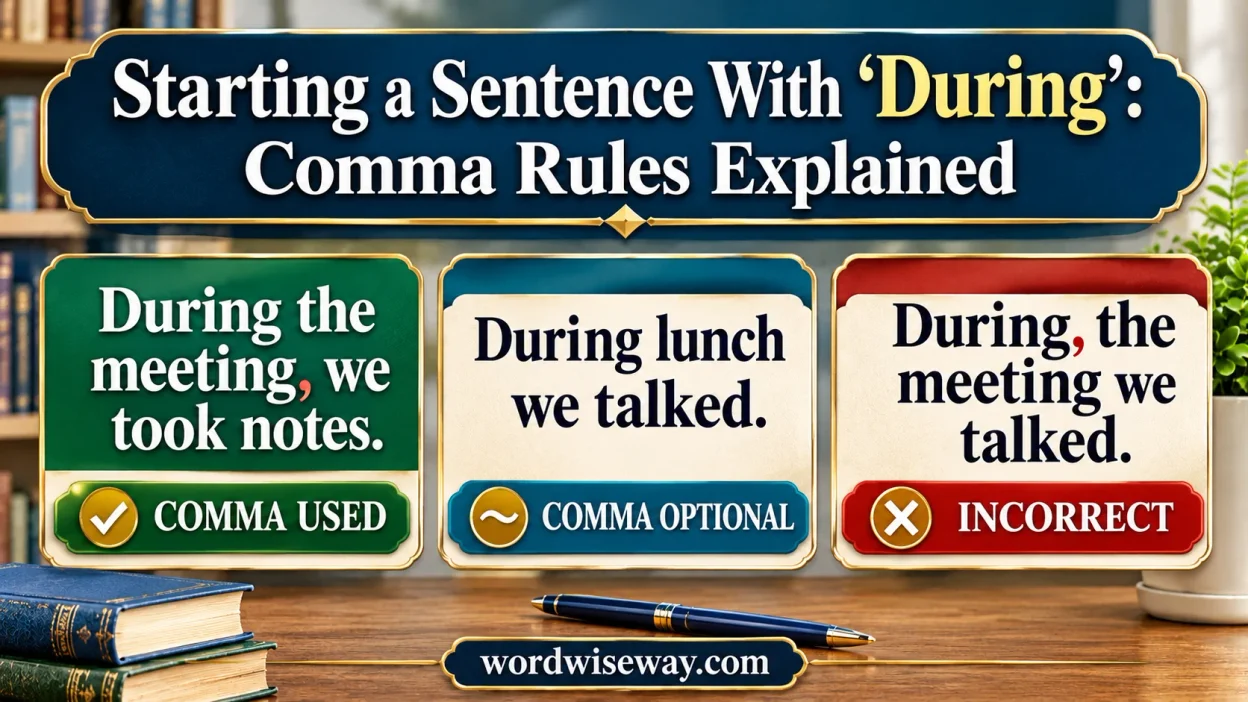
Starting a Sentence With “During”: Comma Rules Explained helps you understand when a comma belongs after an introductory phrase. When “during” begins a sentence, it introduces a time-related detail before the main idea. For example, “During the meeting, we discussed the new plan.” The comma follows the complete introductory phrase, not the word “during” itself. Correct comma placement depends on sentence length, structure, and readability.
Use a comma when a long introductory phrase or remaining clause makes the sentence difficult to follow. For instance, “During the lengthy training session that covered essential safety procedures, employees learned how to respond to emergencies.” The comma separates the opening detail from the main clause.
However, short sentences may not need one. “During lunch we talked” can read naturally without a comma. Generally, consider how the sentence flows. If a comma improves clarity and separates ideas, use it. If the sentence is short and clear, leaving it out may be acceptable, depending on your chosen writing style.
Quick Answer:
Yes, you can start a sentence with “during.” The word is a preposition that introduces a noun or noun phrase referring to a period or event.
Use a comma after the complete introductory phrase when it improves clarity, especially when the phrase is long. A comma is often helpful after short introductory phrases, too, but it isn’t always required.
Examples:
| Sentence | Comma guidance |
| During the meeting, everyone took notes. | The comma separates the introductory phrase from the main clause. |
| During the summer, we visit our grandparents. | The comma creates a natural pause after the introductory phrase. |
| During lunch we discussed the project. | The comma may be omitted because the opening phrase is short and clear. |
| During the final meeting of the semester, students presented their research. | The comma helps readers identify the end of the longer introductory phrase. |
The key rule: Don’t place a comma immediately after “during.” Keep the preposition connected to the noun phrase that follows it, then decide whether a comma belongs after the complete introductory phrase.
What Does “During” Mean in a Sentence?
“During” as a Preposition of Time
“During” tells readers that something happens within a particular period or event. It connects an action to a time frame without stating exactly when that action begins or ends.
For example:
- During the summer, the children visited their grandparents.
- During the examination, everyone remained quiet.
- During the ceremony, the principal announced the winners.
- During the night, temperatures dropped considerably.
In each example, “during” introduces a noun phrase that identifies a period or event. The phrase provides background information before the sentence explains what happened.
This structure makes “during” especially useful when you want to establish a time frame before presenting the main action.
Consider this example:
During the final week of the semester, students completed their research projects.
The opening phrase identifies a specific period. The main clause then tells readers what the students did during that time.
How “During” Differs From “While”
“During” and “while” both relate events to time, but they follow different grammatical patterns.
During generally takes a noun or noun phrase. While introduces a clause containing a subject and a verb.
| Using “during” | Using “while” |
| During the lesson, the teacher explained the topic. | While the lesson was in progress, the teacher explained the topic. |
| During my vacation, I visited several museums. | While I was on vacation, I visited several museums. |
| During the meeting, the manager reviewed the budget. | While the manager was leading the meeting, the team reviewed the budget. |
Notice the difference in the words following each expression. “During the lesson” is a prepositional phrase, whereas “while the lesson was in progress” is a dependent clause.
This distinction matters because you cannot simply replace “while” with “during” without adjusting the sentence.
Incorrect: During I was studying, my friend called.
Correct: While I was studying, my friend called.
Also correct: During my study session, my friend called.
The corrected examples preserve the intended meaning while following standard English grammar.
Comma Rules for Sentences That Begin With “During”
The main punctuation question concerns where the introductory phrase ends and the main clause begins. Once you identify those two parts, comma placement becomes much easier.
Use a Comma After a Long Introductory Phrase
A comma generally belongs after a long introductory prepositional phrase. It helps readers recognize where the opening information ends and the main statement begins.
For example:
- During the final meeting of the semester, the students presented their research findings.
- During the long journey through the mountains, we stopped several times to rest.
- During the unexpected interruption of the morning session, the organizers rearranged the schedule.
- During the first few weeks of the new academic year, teachers introduced students to their coursework.
Each introductory phrase contains several words and provides context for the main clause. Without a comma, readers may need an extra moment to identify the sentence’s structure.
The comma acts as a small signpost. It separates the background information from the central message without changing the sentence’s meaning.
A useful guideline is to examine the entire introductory phrase rather than counting words mechanically. Longer phrases, especially those containing several details, usually benefit from a comma.
A Comma Is Often Optional After a Short Introductory Phrase
Short introductory phrases do not always need commas. When the phrase is brief and the sentence remains clear, writers may omit the punctuation.
Consider these examples:
- During lunch, we discussed our plans.
- During lunch we discussed our plans.
- During winter, the days become shorter.
- During winter the days become shorter.
Both versions of each sentence can be acceptable in ordinary writing. The comma creates a slight pause, while omitting it allows the sentence to flow more directly.
However, optional punctuation does not mean every choice works equally well in every context. A comma may improve readability, even when the sentence does not strictly require one.
For example, a short phrase can become confusing when the following words create an unexpected interpretation. In such cases, a comma can help readers understand the intended structure.
The safest approach is to consider clarity first, then follow the punctuation conventions appropriate for your writing.
Follow the Required Comma Style in Formal Writing
Formal writing often favors clear, consistent punctuation. Academic papers, professional reports, and published articles may use commas after introductory phrases even when those phrases are relatively short.
For example:
During the first experiment, researchers recorded the temperature at regular intervals.
The comma separates the introductory time phrase from the main clause. It also helps readers process the sentence quickly.
If your teacher, editor, or organization follows a particular style guide, apply its rules consistently. Some styles favor commas after most introductory phrases, while others omit them after short, uncomplicated phrases.
Neither approach requires you to add a comma immediately after “during.” The punctuation belongs after the complete introductory phrase.
Do Not Insert a Comma Between “During” and Its Object
One of the most common mistakes is placing a comma immediately after “during.” This separates the preposition from the noun phrase it introduces.
Incorrect: During, the meeting we discussed the results.
Correct: During the meeting, we discussed the results.
The words “the meeting” complete the prepositional phrase. A comma cannot interrupt that grammatical connection without creating an error.
Here are additional examples:
- Incorrect: During, the examination students remained silent.
- Correct: During the examination, students remained silent.
- Incorrect: During, the school holidays our family traveled abroad.
- Correct: During the school holidays, our family traveled abroad.
Remember that the comma separates the introductory phrase from the main clause. It does not separate “during” from the words that complete its meaning.
When Should You Omit the Comma After an Opening “During” Phrase?
Although introductory commas often improve readability, they are not always necessary. Understanding when you can omit one helps you avoid cluttering otherwise simple sentences.
When the Introductory Phrase Is Short and Clear
A brief time expression can connect naturally to the main clause without a comma.
Examples include:
- During class students should listen carefully.
- During lunch we talked about our plans.
- During winter many birds migrate to warmer regions.
- During summer the local park attracts more visitors.
Each sentence begins with a short phrase that readers can understand immediately. The absence of a comma does not create confusion.
You can also include commas in these examples:
- During class, students should listen carefully.
- During lunch, we talked about our plans.
- During winter, many birds migrate to warmer regions.
- During summer, the local park attracts more visitors.
These versions remain correct. The choice depends on your preferred style and the rhythm you want to create.
When the Introductory Phrase Contains Multiple Details
An introductory phrase becomes harder to process when it includes several connected pieces of information. In that situation, a comma usually makes the sentence easier to follow.
Compare these examples:
Without a comma: During the first week of our intensive summer training program participants learned the basic procedures.
With a comma: During the first week of our intensive summer training program, participants learned the basic procedures.
The second sentence makes the transition into the main clause clearer. The introductory phrase is long enough that readers benefit from a visible boundary.
This principle applies even when the sentence is grammatically correct without the comma. Good punctuation helps readers understand your writing efficiently.
When a Comma Would Interrupt an Extremely Short Sentence
Very short introductory phrases sometimes flow naturally into the main clause.
For example:
- During class we read.
- During lunch we talked.
- During winter it snows.
These sentences are easy to understand without additional punctuation. Adding a comma is still possible, but it may create a pause that the writer does not need.
For longer sentences, however, the balance often changes. A phrase that works smoothly in a three-word main clause may need punctuation when the sentence contains several more details.
The practical rule: Omit a comma only when the sentence remains clear and your chosen style permits it.
Common Mistakes
Even experienced writers sometimes confuse introductory punctuation with the underlying grammar. These common mistakes are easy to correct once you understand the sentence structure.
Treating Every Opening “During” Phrase the Same Way
Not every sentence beginning with “during” has the same punctuation needs.
Compare:
- During class we took notes.
- During the final lesson of the semester, we reviewed every major topic.
The first sentence contains a short introductory phrase. The second contains a longer one that benefits from a comma.
Automatically adding or removing commas without examining the sentence can make your writing less consistent. Instead, identify the complete introductory phrase and consider how clearly it connects to the main clause.
Placing the Comma Too Early
A comma should not divide a preposition from its object.
Incorrect: During, the school assembly students received certificates.
Correct: During the school assembly, students received certificates.
The noun phrase “the school assembly” belongs directly after “during.” The comma follows the entire phrase.
Confusing “During” With “While”
The words express related ideas, but their grammatical functions differ.
Incorrect: During I was cooking, the phone rang.
Correct: While I was cooking, the phone rang.
Also correct: During dinner, the phone rang.
The first sentence incorrectly uses “during” before a clause. The other two use the appropriate grammatical structures.
Using “During” Without a Clear Time Period or Event
“During” normally introduces a noun phrase that identifies a period or event. If that phrase is missing or incomplete, the sentence may sound unnatural.
For example:
Incorrect: During, we discussed the results.
Correct: During the meeting, we discussed the results.
Also correct: During the discussion, we reviewed the results.
The corrected versions identify the event that provides the time frame. This information allows readers to understand when the action occurred.
Confusing the Introductory Phrase With the Main Clause
A comma should separate the introductory phrase from the main clause when the sentence calls for one. However, it should not divide the subject from its verb.
Incorrect: During the meeting, the manager, explained the new policy.
Correct: During the meeting, the manager explained the new policy.
The first comma correctly separates the introductory phrase. The second comma incorrectly separates the subject, “the manager,” from its verb, “explained.”
A useful editing habit is to locate the main subject and verb before checking the punctuation. This helps you avoid inserting commas where they do not belong.
Starting a Sentence With “During” in Different Types of Writing
The same basic grammar applies across writing styles, but the level of formality can influence punctuation choices. Understanding your audience helps you choose a consistent approach.
Academic Writing
Academic writing often uses introductory time phrases to explain when experiments, observations, or events occurred. Commas help readers distinguish this background information from the main statement.
Examples:
- During the first phase of the experiment, researchers collected samples.
- During the observation period, participants recorded their daily activities.
- During the final examination, students answered questions about the assigned readings.
In research papers, clarity matters more than creating an artificial pause. Use commas after introductory phrases when they improve readability, and follow any punctuation requirements provided by your instructor or publication.
Professional and Business Writing
In workplace communication, “during” helps establish when meetings, tasks, and other events take place. Clear punctuation makes schedules, reports, and updates easier to understand.
Examples:
- During Monday’s meeting, the team reviewed its progress.
- During the final quarter, the department introduced several changes.
- During the training session, employees practiced the new procedures.
These sentences use commas to separate introductory time phrases from their main clauses. This pattern is especially useful in reports containing longer phrases or detailed information.
Creative and Informal Writing
Creative writing allows more flexibility in sentence rhythm. A short introductory phrase may flow directly into the main clause without a comma.
For example:
- During summer we explored the countryside.
- During the storm, rain tapped against the windows.
- During those quiet evenings we often shared stories.
The choice can affect how a sentence sounds. A comma may create a slight pause, while omitting it can keep the narrative moving.
However, flexibility does not mean ignoring grammar. Your sentence should remain clear, and punctuation should support the reading experience rather than distract from it.
“During” at the Beginning vs. in the Middle of a Sentence
The position of “during” affects whether you need a comma. An introductory time phrase often takes a comma, while the same phrase at the end of a sentence usually does not.
Starting a Sentence With “During”
When “during” begins a sentence, the phrase usually provides background information before the main clause.
Examples:
- During the storm, the electricity went out.
- During the presentation, the speaker answered questions.
- During the school holidays, the family visited relatives.
The comma marks the end of the introductory phrase. It helps readers move from the time frame to the main action.
Using “During” in the Middle or at the End of a Sentence
When a time phrase appears after the main clause, you generally do not need a comma.
Examples:
- The electricity went out during the storm.
- The speaker answered questions during the presentation.
- The family visited relatives during the school holidays.
In each sentence, the time phrase follows the main statement naturally. A comma would usually interrupt the flow without adding useful information.
Compare the two structures:
| Introductory phrase | Ending phrase |
| During the storm, the electricity went out. | The electricity went out during the storm. |
| During the presentation, the speaker answered questions. | The speaker answered questions during the presentation. |
| During the holidays, the family traveled abroad. | The family traveled abroad during the holidays. |
Both structures communicate the same basic information. The opening version emphasizes the time frame first, while the ending version presents the main action before adding its timing.
How Sentence Position Affects Comma Placement
A comma does not belong after every occurrence of “during.” Its placement depends on the phrase’s function and position.
Consider this sentence:
The students reviewed their notes during the final lesson.
The phrase “during the final lesson” appears at the end, so no comma is necessary.
Now move the phrase to the beginning:
During the final lesson, the students reviewed their notes.
The comma separates the introductory phrase from the main clause.
This simple change illustrates why you should evaluate the whole sentence rather than treating “during” as a word that always requires a comma.
“During” vs. Other Time Expressions at the Beginning of a Sentence
English has several expressions that establish when something happens. Although they share a similar purpose, their grammatical structures can differ.
| Opening expression | Example | Comma guidance |
| During | During the meeting, we reviewed the schedule. | A comma often helps after the introductory phrase. |
| Before | Before class, I checked my email. | A comma may follow a short phrase, depending on clarity and style. |
| After | After dinner, we went for a walk. | A comma commonly separates the introductory phrase. |
| In | In the morning, the streets were quiet. | A comma can improve readability. |
| While | While I was studying, my phone rang. | A comma typically follows the introductory dependent clause. |
| Throughout | Throughout the semester, students completed weekly assignments. | A comma often separates the longer introductory phrase. |
The distinction between phrases and clauses is especially important when comparing “during” and “while.”
During the lecture, the students took notes.
“During the lecture” is a prepositional phrase containing a noun phrase.
While the lecturer explained the topic, the students took notes.
“While the lecturer explained the topic” is a dependent clause containing a subject and verb.
Both expressions can establish a time relationship, but they cannot always replace each other without changing the sentence structure.
Practical Examples:
Examples make punctuation rules easier to apply. The following sentences show how introductory phrase length and sentence structure affect comma placement.
Examples That Use a Comma
These sentences use commas after introductory phrases to improve clarity.
- During the interview, she answered every question confidently.
- During the first week of school, students learned the classroom rules.
- During the unexpected power outage, the team continued working offline.
- During the final stages of the project, the designers reviewed every detail.
- During the long journey across the countryside, we stopped at several small towns.
- During the annual science exhibition, students demonstrated their experiments.
In each case, the comma marks the end of the introductory phrase. The main clause follows with the central statement.
Examples That Omit the Comma
These examples use short, clear introductory phrases. Omitting the comma is acceptable in styles that allow it.
- During lunch we discussed our plans.
- During winter the days become shorter.
- During class students should listen carefully.
- During summer many families travel.
- During the break we reviewed our notes.
- During practice the team worked on its technique.
You can also include commas in these sentences if your preferred style calls for them. The important point is to remain consistent and avoid confusion.
Examples With Incorrect Punctuation
Reviewing incorrect sentences can help you recognize errors when editing your own work.
| Incorrect sentence | Corrected sentence | Explanation |
| During, the conference we met several experts. | During the conference, we met several experts. | Keep the preposition connected to its object. |
| During I was driving, it started raining. | While I was driving, it started raining. | Use “while” before a clause. |
| During the meeting we discussed, the budget. | During the meeting, we discussed the budget. | Do not separate the verb from its object. |
| During the first week of training participants learned the procedures. | During the first week of training, participants learned the procedures. | The longer introductory phrase benefits from a comma. |
| During the ceremony, the principal, announced the winners. | During the ceremony, the principal announced the winners. | Do not separate the subject from its verb. |
Notice that these mistakes involve more than one punctuation issue. Some misuse commas, while others use the wrong grammatical structure.
When proofreading, check both the grammar and the punctuation. A comma cannot fix an incorrectly constructed phrase.
Read More: Stole or Stolen: Difference, Meaning, Rules, and Examples
FAQs
1. Can You Start a Sentence With “During”?
Yes, you can start a sentence with “during.” It introduces a time-related phrase that explains when an event happens. For example, “During the storm, we stayed indoors.”
2. Do You Always Need a Comma After “During”?
No, you don’t always need a comma after “during.” The comma usually follows the complete introductory phrase, not the word “during” itself. Sentence length and readability can help you decide whether to use one.
3. Where Does the Comma Go When a Sentence Starts With “During”?
Place the comma after the complete introductory phrase when it helps separate that detail from the main clause. For example, “During the final exam, everyone worked quietly.” The comma comes after “exam,” not immediately after “during.”
4. Can You Start a Short Sentence With “During” Without a Comma?
Yes, some short sentences read naturally without a comma. For example, “During lunch we chatted.” However, follow your chosen style guide and use a comma if it improves clarity.
5. Is “During the Meeting, We Discussed the Plan” Correct?
Yes, this sentence is grammatically correct. The introductory phrase “During the meeting” explains when the discussion happened. The comma separates the introductory phrase from the main clause.
6. What Is an Introductory Phrase Beginning With “During”?
An introductory phrase beginning with “during” provides information about the timing of an event. For example, “During the school holidays, we visited our grandparents.” The phrase sets the scene before the main idea.
7. Does Sentence Length Affect Comma Placement After “During”?
Yes, sentence length can influence comma placement. A long introductory phrase may benefit from a comma because it helps readers identify where the main clause begins. Shorter sentences may remain clear without one.
8. What Happens If You Put a Comma Immediately After “During”?
A comma immediately after “during” is usually incorrect when the word introduces a phrase that continues beyond it. For example, write “During the afternoon, we studied,” rather than “During, the afternoon we studied.”
9. Should You Use a Comma After “During” in Formal Writing?
In formal writing, use a comma after the complete introductory phrase when standard punctuation conventions call for one. For example, “During the annual conference, researchers presented their findings.” Consistency and readability matter more than adding commas automatically.
10. How Can You Check Whether a Sentence Starting With “During” Needs a Comma?
Read the sentence aloud and identify the introductory phrase and main clause. If a comma makes the separation clearer, include it. For example, “During the long journey across the country, we stopped several times.” For shorter sentences, check your preferred style guide when uncertain.
Conclusion:
Starting a sentence with “during” is a simple way to tell readers when something happens. The tricky part is knowing where to place the comma. Remember that the comma usually comes after the complete introductory phrase, not immediately after “during.” For example, “During the afternoon, we finished our assignments” uses a comma to separate the opening detail from the main clause.
However, not every sentence needs a comma. A short, clear sentence may read naturally without one, while a longer introductory phrase often benefits from a pause. Consider the sentence structure, the length of the introductory phrase, and how easily readers can follow your meaning. These small details help you make better punctuation choices without relying on rigid rules for every sentence.
Ultimately, good punctuation makes your writing easier to understand. When you start a sentence with “during,” check whether a comma improves the flow between the introductory phrase and the main idea. If it does, use one. If the sentence remains clear without it, consult your preferred style guide for guidance. With practice, you’ll recognize these patterns more naturally and write clearer, more polished sentences.

Evelyn Shaw has spent 14 years at Yale University’s English Department, leading students through close readings, genre studies, and interpretive methodologies. Her scholarly interests include Renaissance drama, gothic fiction, feminist literary criticism, and archival research and examining how texts generate meaning across historical periods. Evelyn has presented at major academic conferences and published essays in peer-reviewed journals, reflecting her passion for rigorous analysis and student-centered learning.