Jist or Gist: Correct Spelling, Meaning, and Correct Usage can seem confusing because some words are spelled differently but sound similar when spoken.
These homophone pairs may even sound exactly the same, although they can have different meanings. In the English language, such words often create confusion for language learners and new writers. Their unfamiliar forms can also cause inexperienced writers to make mistakes in writing, especially when they try to sound clear and concise for an audience.
The pair jist and gist is easy to tell apart once you know the simple trick. Gist is the correct word to use when you mean the main point, central idea, or essential meaning of something. Jist isn’t the standard English spelling. Figuring out which form belongs in a particular situation becomes easier when you take a closer look at how each word is used.
These confused words show why paying attention to spelling matters. Although their sound may seem the same, their written forms aren’t interchangeable. Knowing the reason behind the difference can help you use gist correctly each time. This small distinction keeps your writing clear and concise, while also helping you avoid misusing a familiar-sounding word.
Quick Answer:
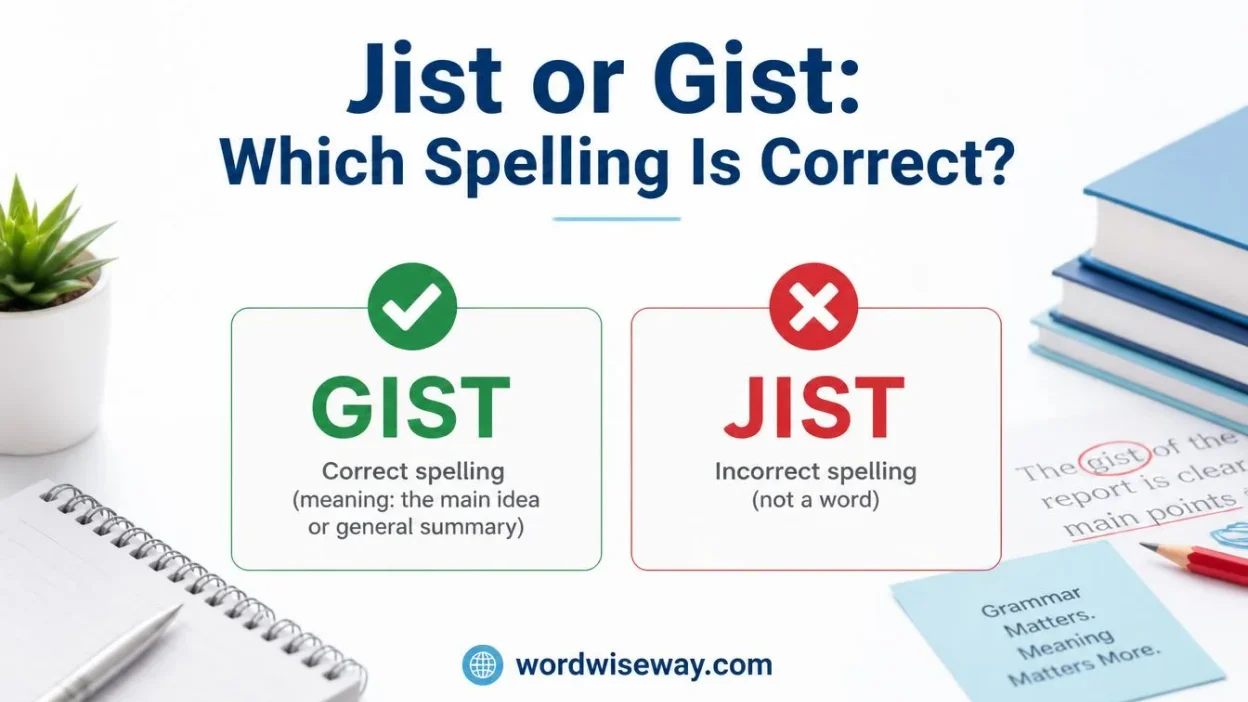
Gist is the correct spelling when you mean the main point, central idea, or essential meaning of something.
Jist is generally an incorrect spelling of gist. Although gist begins with the letter g, it has a soft sound, which makes it sound like it begins with j.
| Word | Standard spelling? | Meaning |
| Gist | ✓ Yes | The main point or essential meaning |
| Jist | ✗ No, in this meaning | Usually a misspelling of gist |
For example:
I didn’t read the entire report, but I understand the gist.
Here, gist means the central idea of the report.
A useful rule is simple: If you mean “the main point,” spell it gist.
Gist Meaning
What Does Gist Mean?
Gist means the main point, central idea, or most important meaning of something.
You might understand the gist of a conversation without remembering every sentence. Likewise, you can understand the gist of a long article without memorizing every fact, example, or supporting argument.
Think of a long explanation as a large puzzle. The gist is the picture you can recognize once you see how the important pieces fit together.
For example:
- “What was the gist of the meeting?”
- “I didn’t understand every detail, but I got the gist.”
- “Can you give me the gist of the story?”
- “She explained the gist of the proposal.”
In each sentence, gist refers to the essential idea rather than every individual detail.
Gist in Different Contexts
The word gist appears in many everyday situations. You can use it when talking about spoken information, written material, instructions, discussions, or arguments.
Conversation:
“I missed part of their conversation, but I caught the gist.”
Article:
“The article explains the gist of the new policy in its opening section.”
Book:
“You don’t need to remember every chapter to understand the gist of the story.”
Meeting:
“Here’s the gist of today’s meeting: the project deadline has changed.”
Instructions:
“I didn’t memorize the instructions, but I understand the gist.”
Argument:
“She disagreed with his conclusion, but she understood the gist of his argument.”
The common thread is always the same: gist identifies what matters most in the overall message.
Gist as a Noun
How Gist Works in a Sentence
In modern English, gist normally functions as a noun. It often appears with the preposition of.
One of the most common structures is:
the gist of + noun
Examples include:
- “the gist of the article”
- “the gist of the conversation”
- “the gist of the argument”
- “the gist of the message”
- “the gist of the story”
You can also use gist without an immediately following noun.
For example:
I didn’t understand every detail, but I got the gist.
The expression get the gist is especially common in everyday English. It means that you understand the general meaning or central point of something.
Examples of Gist as a Noun
Here are several natural examples:
- “Can you tell me the gist of the email?”
- “I listened to the presentation and got the gist.”
- “The teacher explained the gist of the chapter.”
- “She gave me the gist of what happened.”
- “After reading the first few pages, I understood the gist.”
- “He couldn’t remember every detail, but he knew the gist.”
- “What’s the gist of your proposal?”
- “The report gives readers the gist without overwhelming them with technical details.”
These examples show why gist works so well in ordinary communication. It lets you talk about the heart of an explanation without suggesting that you know every detail.
Is Jist a Word?
Jist as a Misspelling
When someone writes jist while meaning “the main point,” they’re usually making a spelling mistake.
The confusion is understandable because gist has a soft g sound. In English, the letter g doesn’t always have the same pronunciation. Before certain vowels, it can produce a sound associated with the letter j.
That’s why gist can sound as though it begins with a “j” sound even though its spelling begins with g.
The pronunciation, however, doesn’t change the spelling.
So if you write:
“I understand the jist.”
the standard spelling is:
“I understand the gist.”
When You Should Use Gist Instead
Whenever you mean the main point or essential meaning, use gist.
| Incorrect | Correct |
| I got the jist of the story. | I got the gist of the story. |
| What’s the jist of this message? | What’s the gist of this message? |
| She explained the jist of the argument. | She explained the gist of the argument. |
| I know the jist of what happened. | I know the gist of what happened. |
The key is to connect the meaning directly with the spelling: main point = gist.
Why Is Gist Spelled With a G?
English spelling often preserves forms that aren’t obvious from pronunciation alone. Gist provides a good example of why spelling and sound don’t always line up neatly.
The g in gist has a soft pronunciation. That sound can make the word seem as though it should begin with j.
Consider other familiar words with a soft g sound:
- giant
- genuine
- ginger
- gesture
- gym
The letter g can represent different sounds depending on the letters around it. Therefore, hearing the sound at the beginning of gist isn’t enough to determine its spelling.
This is why spelling gist as jist based only on pronunciation leads you astray.
Key Difference
The difference between gist and jist is straightforward when the intended meaning is “the main point.”
| Feature | Gist | Jist |
| Spelling | ✓ Standard | ✗ Usually incorrect |
| Meaning | Main point or essential meaning | No standard use for this intended meaning |
| Common phrase | get the gist | get the jist is a misspelling |
| Example | “I got the gist.” | “I got the jist.”✗ |
The important point isn’t merely that one spelling contains g and the other contains j. The standard English word for this meaning is gist.
If you’re writing an email, essay, article, report, or school assignment, gist is the form you should use.
How to Use Gist Correctly
Common Expressions With Gist
Several expressions appear frequently with gist.
Get the gist means to understand the main idea.
“I read the article quickly and got the gist.”
The gist of introduces the central idea of something.
“The gist of the discussion was that the schedule needed to change.”
Catch the gist means to understand the main meaning, especially when information moves quickly.
“The speaker talked quickly, but I caught the gist.”
Understand the gist emphasizes comprehension.
“You don’t need to memorize every detail to understand the gist.”
Give someone the gist means to tell someone the essential information.
“Give me the gist before I read the full report.”
These phrases are useful because they let you distinguish overall understanding from complete knowledge.
Gist in Everyday Writing
You can use gist in texts, emails, schoolwork, workplace communication, and casual conversations.
For example, imagine that a friend asks what happened during a two-hour meeting. You don’t need to repeat every comment. You could say:
“The gist is that the deadline moved to Friday and everyone agreed to the new plan.”
That sentence gives the important information without turning a short answer into a transcript.
In academic writing, however, choose your wording based on precision. Gist works well when discussing the broad meaning of a passage. Summary may work better when you need to describe several important points in an organized way.
Gist vs. Similar Words
Gist vs. Summary
Gist and summary overlap, but they aren’t always identical.
A summary usually condenses information by presenting the main points of a longer piece of content. A gist focuses more strongly on the central meaning or overall point.
For example:
“Give me the gist of the movie.”
This asks for the basic idea of what the movie is about.
“Write a summary of the movie.”
This usually asks for a more structured account of the important events or ideas.
A summary can therefore contain several major points, while the gist may be captured in just one broad statement.
Gist vs. Main Idea
Main idea is very close to gist.
When a teacher asks for the main idea of a paragraph, the goal is to identify what the paragraph primarily communicates. When someone asks for the gist of a conversation, the goal is also to identify its central meaning.
The difference often comes down to context and style. Main idea is especially common in reading and education. Gist sounds natural in both spoken and written everyday English.
Gist vs. Essence
Essence can mean the fundamental nature or most important quality of something.
For example:
“The essence of the argument is fairness.”
Gist generally points to the main meaning or point of an explanation, conversation, text, or argument.
Although these words sometimes overlap, gist is often more conversational.
Gist vs. Point
Point is another close alternative.
Consider:
“What’s the gist of the article?”
and:
“What’s the point of the article?”
The first asks for the article’s central idea or overall meaning. The second can ask about its purpose, argument, or reason for existing.
Context determines whether the two words can replace each other naturally.
Common Mistakes
Spelling Gist as Jist
This is the most common mistake.
Incorrect: “I got the jist.”
Correct: “I got the gist.”
The pronunciation makes the error tempting. Standard spelling still requires g.
Treating Gist as Every Detail
The gist isn’t a complete inventory of everything someone said.
If a 20-minute explanation contains ten important details, the gist might be one or two sentences capturing the central message.
For example:
“The gist of the presentation was that the company will change its schedule next month.”
That doesn’t claim the sentence contains every detail from the presentation. It identifies its central point.
Confusing Gist With a Full Summary
A gist can be extremely brief. A summary generally provides more information.
If someone asks for the gist of a five-page article, they probably don’t expect five pages back. They want the central idea.
Misusing “Gist Of”
The construction the gist of is perfectly natural.
Examples:
- “the gist of the story”
- “the gist of the conversation”
- “the gist of the report”
- “the gist of the argument”
You can also use gist in expressions such as get the gist and catch the gist.
How to Remember the Correct Spelling
A simple memory trick can make the spelling stick:
Gist = General Idea or main point.
The word gist begins with G, just like general and general idea.
You can also remember the phrase:
Get the gist.
That common expression gives you a reliable spelling pattern. Once you associate the phrase with the correct g, jist starts looking out of place.
Gist Examples in Sentences
The following examples show how naturally gist fits into different situations.
Conversation Examples
- “I missed the beginning, but I got the gist.”
- “Can you give me the gist of what they discussed?”
- “She spoke quickly, so I only caught the gist.”
Reading Examples
- “After reading the introduction, I understood the gist of the article.”
- “The first paragraph gives readers the gist of the argument.”
- “You can understand the gist without knowing every technical term.”
Meeting Examples
- “What’s the gist of today’s meeting?”
- “I’ll send you the gist of the discussion.”
- “The gist was that the deadline needs to move.”
Story Examples
- “He told me the gist of the story.”
- “I know the gist, but I haven’t heard all the details.”
- “The trailer gives you the gist of the story without revealing everything.”
Instruction Examples
- “I didn’t memorize the instructions, but I understand the gist.”
- “She explained the gist of the process before we started.”
A Quick Case Study: Understanding Gist in Real Life
Imagine that your class discusses a large project for thirty minutes. Your teacher explains the deadline, required materials, grading criteria, presentation format, and submission process.
Later, a classmate asks, “What did the teacher say?”
Repeating every sentence would be unnecessary. Instead, you might explain:
“The gist is that we need to complete the project by Friday and present it next week.”
That sentence doesn’t include every instruction. It captures the central message.
This example shows the practical difference between gist and detail. The gist gives you the big picture. Details fill in the smaller pieces.
Facts
- Gist is a noun in its standard modern use.
- It refers to the main point or essential meaning of something.
- Jist is generally a misspelling when used with this intended meaning.
- Get the gist is a common English expression.
- The gist of is a common grammatical construction.
- The initial sound of gist can contribute to the spelling confusion.
- Gist doesn’t necessarily include every supporting detail.
- Summary, main idea, essence, and point can overlap with gist, although their meanings aren’t always identical.
Read More: Assure vs. Ensure: Meaning, Difference, and Correct Usage
FAQs
Is “jist” a correct English word?
No. Jist is generally considered a misspelling of gist in standard English.
What does “gist” mean?
Gist means the main point, central idea, or essential meaning of something.
Why do people write “jist” instead of “gist”?
People often write jist because the two forms can sound alike when spoken, especially in fast or casual speech.
Is “gist” pronounced with a J sound?
Yes. Although gist begins with the letter G, the G has a soft sound, so the word sounds like it begins with a J sound.
Can “jist” be used in formal writing?
It’s best to avoid jist in formal writing. Use gist when you want the standard spelling.
Is gist a noun or a verb?
Gist is primarily used as a noun. It refers to the essential point or meaning of something.
Can I use “gist” when summarizing something?
Yes. You can use gist when describing the central idea of a conversation, article, explanation, message, or story.
Are “gist” and “jist” homophones?
In ordinary English pronunciation, they sound the same. However, gist is the standard spelling, while jist is usually a misspelling.
How can I remember the correct spelling of gist?
Remember that the correct form starts with G: gist. Think of the phrase “get the gist” to reinforce the spelling.
What is the easiest way to avoid this spelling mistake?
When you mean the main idea or essential point, always choose gist. Checking the spelling before publishing can also prevent this common mistake.
Conclusion
Choosing between jist and gist becomes straightforward once you recognize that only one is the standard spelling. Gist is the correct word when you want to describe the main point, central idea, or essential meaning of something. Although jist may appear in casual writing, it isn’t the accepted spelling for standard English.
The confusion mainly comes from pronunciation. Gist has a soft G sound, so it sounds like it begins with a J. That can make jist seem logical when you’re writing from memory. Still, pronunciation shouldn’t determine the spelling. When you’re discussing the key idea of an article, conversation, message, or explanation, gist is the form to choose.
Once you remember gist, this common spelling problem becomes much easier to avoid. Whether you’re writing an email, preparing an assignment, or creating an article, using the correct form keeps your message polished and easy to understand. If you mean the main point, stick with gist.

Emma Smith has dedicated 14 years to Princeton University’s English Department, mentoring students in textual interpretation, literary movements, and critical frameworks. Her research explores Shakespearean drama, Victorian serial fiction, postcolonial narrative theory, and manuscript studies and probing how literary forms evolve across cultures and centuries. Emma has delivered lectures at international humanities congresses and published findings in distinguished academic journals, underscoring her commitment to scholarly depth and vibrant teaching.