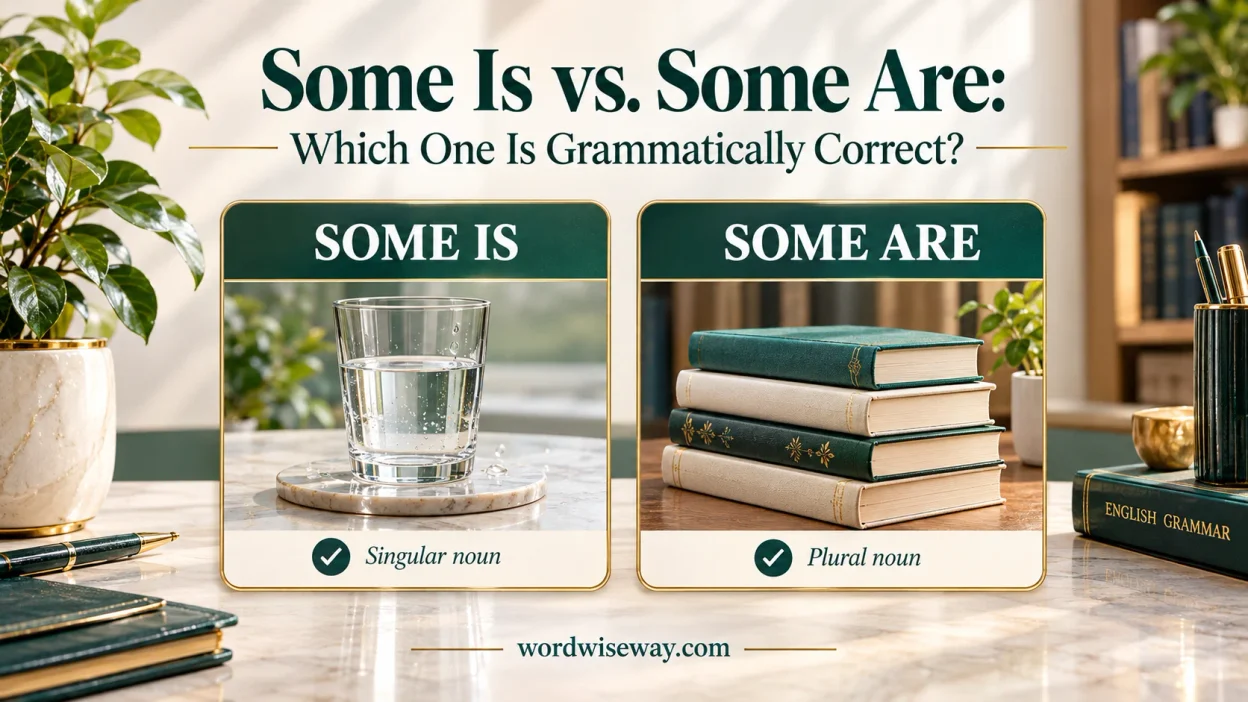
In Some Is vs. Some Are: Which One Is Grammatically Correct?, English grammar shows that verb choice depends on the noun and its linguistic context.The word some can describe a singular word or a plural word, depending on what it refers to.
For example, “Some of the water is cold” uses a singular verb because water is uncountable, while “Some of the books are missing” uses a plural verb because books are plural. These examples demonstrate how using some correctly depends on subject-verb agreement and verb agreement, two important grammatical rules in the English language.
To understand phrase differences, look at how each sentence works instead of treating some as automatically singular or plural. The phrases some is and some are can both be grammatically correct, depending on the noun and meaning.
This word usage highlights the importance of grammatical correctness and correct usage when writing an article or other text. By using the word some in different examples, you can understand the differences between phrases and choose the appropriate verb according to the noun being described.
Quick Answer:
Both some is and some are are grammatically correct. The right choice depends on whether some refers to an uncountable amount, a singular idea, or multiple countable items.
- Use some is when some refers to an uncountable quantity or a singular thing.
- Use some are when some refers to multiple people, animals, or countable objects.
| Expression | When to Use It | Example |
| Some is | An uncountable quantity or singular reference | Some of the water is cold. |
| Some are | Multiple countable things or people | Some of the glasses are dirty. |
| Some of it is | A portion of a singular or uncountable thing | Some of it is missing. |
| Some of them are | Several people or countable things | Some of them are missing. |
The easiest rule to remember: Identify what some represents, then choose the verb that agrees with that noun or reference.
What Does Some Is Mean?
The expression some is appears when the word some represents an amount of something uncountable or refers to a singular idea. In these situations, the verb is agrees with the singular or uncountable meaning.
Consider this sentence: Some of the milk is spoiled.
Milk is an uncountable noun in this context. You generally don’t count milk as individual units unless you specify containers, glasses, or bottles. Therefore, is is the appropriate verb.
The same principle applies to information, money, furniture, and other nouns that typically describe quantities rather than separate countable items.
Some Is With Uncountable Nouns
Uncountable nouns describe substances, materials, concepts, or collections that English speakers don’t ordinarily count as individual units. These nouns usually take singular verbs, even when they refer to a substantial amount.
For example:
- Some water is leaking from the pipe.
- Some information is incorrect.
- Some money is missing from the drawer.
- Some furniture is damaged.
- Some rice is still cooking.
- Some advice is worth following.
In each sentence, some refers to an amount of an uncountable noun. The singular verb is agrees with that noun.
Notice that the amount doesn’t determine the verb. Even if a large quantity of water is leaking, the sentence still uses is because water remains uncountable in this context.
However, English allows many nouns to function as countable or uncountable depending on their meaning. For instance, coffee is generally uncountable when referring to a substance, but two coffees can refer to two servings. The intended meaning matters.
Some Is When Referring to a Portion
Sometimes, some identifies part of a larger amount rather than the entire quantity. When that amount is uncountable, is usually remains correct.
Consider these examples:
- Some of the soup is too salty.
- Some of the paint is still wet.
- Some of the bread is stale.
- Some of the sand is unusually dark.
Each sentence focuses on a portion of a substance. The speaker isn’t counting individual bowls of soup, cans of paint, loaves of bread, or piles of sand. Instead, the speaker describes part of an uncountable amount.
The same structure works with the pronoun it:
- Some of it is broken.
- Some of it is useful.
- Some of it is already finished.
Here, it represents something singular or uncountable. The verb is agrees with that reference.
Some Is With Singular Ideas or References
The expression some is can also appear when the surrounding context establishes a singular or uncountable reference. However, writers should distinguish a genuinely singular reference from a plural group.
For example:
Some of the work is complete.
The noun work is uncountable here, so the sentence uses is.
Similarly:
Some of the damage is visible.
The word damage describes an uncountable condition or amount. The singular verb is appropriate.
Compare those sentences with:
Some of the tasks are complete.
The noun tasks is plural and countable. Therefore, the verb changes to are.
This distinction shows why you should examine the meaning and grammatical role of the noun rather than automatically attaching a particular verb to some.
What Does Some Are Mean?
The expression some are is appropriate when some refers to multiple people, animals, objects, or other countable items. The plural verb are agrees with the plural reference.
For example:
Some of the students are absent.
The word students identifies multiple countable people. Since the sentence refers to some members of that group, are is the correct verb.
You can use the same structure with books, chairs, questions, buildings, and many other plural nouns.
Some Are With Plural Countable Nouns
Countable nouns name things you can count individually. Their plural forms commonly take are when they function as the subject or determine subject-verb agreement.
Consider these examples:
- Some books are missing from the shelf.
- Some apples are too ripe.
- Some questions are difficult.
- Some employees are working remotely.
- Some windows are open.
- Some solutions are more practical than others.
Each sentence refers to multiple individual items or people. The plural verb are matches that meaning.
A useful trick is to replace some with a clearer plural phrase. For instance, some books are missing can become several books are missing. Since several books is clearly plural, the correct verb becomes easier to recognize.
Some Are When Referring to People
English frequently uses some to describe part of a group of people. In this case, some can function as a pronoun without repeating the noun.
For example:
- Some are ready to leave.
- Some are waiting outside.
- Some are interested in the proposal.
- Some are still learning the process.
These sentences are complete when the context makes the intended group clear.
Imagine a teacher asking whether the students have finished their assignments. A student might answer, “Some are finished, but others need more time.” The implied reference is to the students or their work, depending on the exact context.
For clarity, writers can include the noun when necessary:
- Some students are finished with their assignments.
- Some assignments are finished, but others remain incomplete.
The noun helps readers understand precisely what some represents.
Some Are When the Noun Appears Earlier
Writers often use some to avoid repeating a noun. This is common in conversation, explanations, and comparisons.
For example:
“Several packages arrived this morning. Some are damaged.”
The second sentence remains clear because packages appeared in the first sentence. The word some refers to multiple packages, so are is correct.
Here are additional examples:
- I bought several notebooks. Some are lined, while others are blank.
- We interviewed ten candidates. Some are experienced, and others are beginners.
- The store received new shoes. Some are available in different colors.
In each example, the earlier noun establishes the meaning of some. The verb follows the implied plural noun.
Key Differences Between Some Is and Some Are
The main difference between some is and some are comes from subject-verb agreement. English verbs change according to the grammatical number of the subject or the noun that controls agreement.
The word some doesn’t automatically determine whether the verb should be singular or plural. Instead, the noun or reference associated with it usually provides the answer.
| Feature | Some Is | Some Are |
| Typical reference | Uncountable amount | Multiple countable items |
| Verb form | Singular | Plural |
| Example noun | Information | Documents |
| Example sentence | Some information is missing. | Some documents are missing. |
| Portion example | Some of the cake is left. | Some of the cookies are left. |
| Pronoun example | Some of it is useful. | Some of them are useful. |
The Difference Between Amount and Number
One of the most useful distinctions in English grammar is the difference between an amount and a number.
An amount usually refers to something uncountable. A number refers to individual items that you can count.
For example:
- Some sugar is needed for the recipe.
- Some sugar cubes are needed for the recipe.
The first sentence treats sugar as an uncountable substance. The second sentence counts individual cubes. That change affects the noun and the verb.
Consider another pair:
- Some luggage is missing.
- Some suitcases are missing.
Luggage is uncountable in standard English, while suitcases is plural and countable. Therefore, the first sentence uses is, and the second uses are.
Remember that meaning matters more than the physical size or quantity of something. A large amount of luggage still takes is, while two missing suitcases take are.
Why the Noun Matters More Than the Word Some
Writers sometimes assume that some must always take a plural verb because it often refers to several things. That assumption overlooks its use with uncountable nouns.
For example:
- Some equipment is expensive.
- Some machines are expensive.
Both sentences are correct, but the nouns follow different grammatical patterns.
Equipment is generally uncountable, so it takes is. Machines is a plural countable noun, so it takes are.
The same contrast appears in these examples:
- Some evidence is convincing.
- Some witnesses are convincing.
- Some clothing is expensive.
- Some jackets are expensive.
Once you identify the noun, the correct verb becomes much easier to choose.
When to Use Some Is vs. Some Are
Choosing between the two expressions becomes straightforward when you follow a short process. Rather than memorizing every possible example, focus on the noun or reference behind some.
Identify What Some Refers To
First, ask yourself what some represents in the sentence. Is it an amount of a substance, a portion of an uncountable concept, or several individual things?
For example:
Some of the cheese is moldy.
The word cheese refers to an uncountable substance in this sentence. Therefore, is is appropriate.
Now consider:
Some of the cheese slices are moldy.
Here, slices identifies individual countable items. The verb changes to are.
The subject’s meaning determines the agreement. That is the central principle behind this grammar rule.
Check Whether the Noun Is Countable
Next, determine whether the noun is countable or uncountable in the sentence.
Uncountable nouns commonly include:
- Information
- Advice
- Furniture
- Equipment
- Traffic
- Research
- Bread
- Water
Plural countable nouns commonly include:
- Ideas
- Reports
- Tables
- Vehicles
- Students
- Questions
- Bottles
- Opportunities
These lists are useful starting points, but context can change how some nouns function. For example, chicken can refer to meat as an uncountable noun or individual birds as countable nouns.
Compare:
- Some chicken is left in the refrigerator.
- Some chickens are in the yard.
The first sentence refers to meat. The second refers to individual birds.
Replace Some With a Clearer Expression
If you’re still unsure, replace some with a phrase that makes the intended meaning clearer.
For instance:
Some of the water is dirty.
Replace some of the water with a portion of the water. The sentence still uses is.
Now consider:
Some of the bottles are empty.
Replace some of the bottles with several bottles. The plural verb are remains correct.
This technique works especially well when editing sentences that contain several nouns or lengthy descriptions.
Some Is vs. Some Are in Different Contexts
The basic grammar rule remains the same across everyday conversation, academic writing, and professional communication. However, the surrounding context may affect how clearly the reader understands the reference.
Some Is vs. Some Are in Everyday Conversation
Informal conversations often leave out nouns because both speakers already know what they’re discussing.
For example:
“Is there any juice left?”
“Yes, some is still in the fridge.”
The reply uses is because some refers to juice, an uncountable noun.
Now imagine a different conversation:
“Are there any oranges left?”
“Yes, some are still in the fridge.”
Here, some refers to multiple oranges. The plural verb are is correct.
Both replies sound natural because the question establishes the intended reference.
Some Is vs. Some Are in Academic Writing
Academic writing often discusses quantities, evidence, research, observations, and results. Choosing the correct verb helps keep these explanations precise.
For example:
- Some evidence is consistent with the hypothesis.
- Some observations are consistent with the hypothesis.
- Some research is still needed.
- Some studies are still needed.
Notice the difference between research and studies. The former is generally uncountable, while the latter is plural and countable.
Writers should also avoid assuming that a technical or academic subject automatically requires formal-sounding grammar. Standard subject-verb agreement still applies.
Some Is vs. Some Are in Professional Writing
Professional communication frequently uses these expressions when discussing budgets, documents, equipment, tasks, or employees.
Examples include:
- Some funding is available for the project.
- Some invoices are overdue.
- Some equipment is ready for delivery.
- Some deliveries are scheduled for Friday.
These sentences show how the same principle works across different business situations.
If a sentence feels awkward, identify the noun that follows of or the noun implied by the context. This simple check often reveals the correct verb.
Common Mistakes
Even experienced writers can make mistakes when they focus on the word some instead of its meaning. Understanding a few common errors can help you catch them during proofreading.
Using Is With Plural Countable Nouns
Incorrect: Some of the students is absent.
Correct: Some of the students are absent.
The noun students refers to multiple people. Therefore, the verb must be plural.
Another example:
Incorrect: Some of the chairs is broken.
Correct: Some of the chairs are broken.
Whenever the reference is to multiple countable items, use the appropriate plural verb.
Using Are With Uncountable Nouns
Incorrect: Some of the furniture are damaged.
Correct: Some of the furniture is damaged.
In standard English, furniture is an uncountable noun. You can count individual pieces of furniture, but the noun itself generally takes a singular verb.
Similarly:
Incorrect: Some advice are helpful.
Correct: Some advice is helpful.
To count these things, use expressions such as pieces of furniture or pieces of advice.
Assuming Some Always Takes a Plural Verb
Incorrect: Some information are incorrect.
Correct: Some information is incorrect.
The mistake happens when writers treat some as though it always refers to multiple countable objects. In reality, it can refer to an uncountable amount.
Compare:
- Some information is incorrect.
- Some facts are incorrect.
Both sentences express a similar idea, but information is uncountable, while facts is plural and countable.
Choosing the Verb Based on the Nearest Noun
Longer sentences can make agreement harder because several nouns may appear close together.
Consider:
Some of the boxes near the storage room are empty.
The verb are agrees with boxes, not room. The word room appears closer to the verb in the sentence, but it isn’t the noun that determines agreement.
A useful editing habit is to locate the main subject before selecting the verb. Descriptive phrases may add detail, but they don’t change the subject’s grammatical number.
Confusing Some of It With Some of Them
The expressions some of it and some of them refer to different kinds of things.
- Some of it is missing.
- Some of them are missing.
Use it for a singular or uncountable reference. Use them for plural people or countable items.
For example, if you’re discussing a shipment of equipment, some of it is missing is appropriate. If you’re discussing individual tools, some of them are missing works naturally.
Example Sentences
Paired examples make the difference easier to recognize. Each pair describes a related situation but uses a different noun or reference.
| Some Is | Some Are | Why the Verb Changes |
| Some water is cold. | Some bottles are cold. | Water is uncountable; bottles are plural. |
| Some bread is stale. | Some sandwiches are stale. | Bread is uncountable; sandwiches are countable. |
| Some information is outdated. | Some reports are outdated. | Information is uncountable; reports are plural. |
| Some furniture is damaged. | Some chairs are damaged. | Furniture is uncountable; chairs are plural. |
| Some of it is useful. | Some of them are useful. | It is singular or uncountable; them is plural. |
| Some of the work is complete. | Some of the tasks are complete. | Work is uncountable; tasks are plural. |
| Some rice is ready. | Some rice grains are ready. | Rice is uncountable; grains are countable. |
| Some money is missing. | Some coins are missing. | Money is uncountable; coins are plural. |
Example Sentences With Some Is
Here are additional examples that show how some is works naturally in context.
- Some of the coffee is still hot.
- Some of the homework is unfinished.
- Some of the information is difficult to understand.
- Some of the paint is drying.
- Some of the land is protected.
- Some of the traffic is caused by construction.
- Some of the food is ready to serve.
- Some of the damage is difficult to repair.
Each example uses is because the relevant noun is uncountable in that context.
Example Sentences With Some Are
The following sentences use are because some refers to plural countable items or people.
- Some of the guests are arriving late.
- Some of the questions are unclear.
- Some of the files are corrupted.
- Some of the trees are losing their leaves.
- Some of the workers are taking a break.
- Some of the photographs are blurry.
- Some of the roads are closed.
- Some of the answers are correct.
In every example, the implied or stated reference includes multiple countable things.
A Practical Case Study: Choosing the Right Verb
Imagine a restaurant manager preparing a short report after a busy lunch service. The manager needs to describe food supplies, kitchen equipment, and customer orders.
The first draft contains these sentences:
- Some of the rice are overcooked.
- Some of the plates is dirty.
- Some of the equipment are unavailable.
- Some of the orders is delayed.
At first glance, the sentences look similar. However, each one requires attention to the noun.
The corrected report reads:
- Some of the rice is overcooked.
- Some of the plates are dirty.
- Some of the equipment is unavailable.
- Some of the orders are delayed.
Why do the verbs change?
Rice and equipment are uncountable nouns in these examples, so they take singular verbs. Plates and orders are plural countable nouns, so they take plural verbs.
This example demonstrates a practical proofreading method: find the noun represented by some, decide whether it is singular or plural in context, and select the matching verb.
Read More: 5 Ways to Describe the Sound of Rain
FAQs
What Is the Difference Between Some Is and Some Are?
The difference depends on whether some refers to an uncountable noun or a plural countable noun. Use “some is” with uncountable nouns and “some are” with plural countable nouns.
Is Some Is Grammatically Correct?
Yes, “some is” is grammatically correct when some refers to an uncountable noun or a singular amount. For example, “Some of the milk is missing.”
Is Some Are Grammatically Correct?
Yes, “some are” is correct when some refers to plural countable nouns. For example, “Some of the students are absent.”
Should I Use Some Is or Some Are With Money?
Use “some is” when referring to money as an amount. For example, “Some of the money is gone.” Money is generally treated as an uncountable noun.
Do We Say Some of the Water Is or Some of the Water Are?
The correct phrase is “some of the water is.” Water is an uncountable noun, so it takes a singular verb in this construction.
Do We Say Some of the People Is or Some of the People Are?
The correct phrase is “some of the people are.” People is plural, so it takes the plural verb are.
Does the Word Some Always Take a Plural Verb?
No, some does not always take a plural verb. The correct verb depends on the noun that follows it and the meaning of the sentence.
How Does Subject-Verb Agreement Affect Some Is and Some Are?
Subject-verb agreement ensures that the verb matches the subject. Use is for uncountable nouns and are for plural countable nouns when they follow this construction.
Can Some Be Used With Both Countable and Uncountable Nouns?
Yes, some can be used with both types of nouns. For example, “some apples are fresh” uses a plural countable noun, while “some juice is left” uses an uncountable noun.
What Is the Easiest Way to Remember Some Is vs. Some Are?
Look at the noun after some of the. If it is uncountable, use is. If it is plural and countable, use are. For example, “some rice is ready” and “some plates are clean.”
Conclusion
Choosing between some is and some are becomes easier when you understand the noun you’re talking about. The word some can refer to an uncountable amount or several individual things, so the verb depends on the meaning of your sentence. For example, “Some of the milk is fresh” is correct, while “Some of the apples are fresh” uses the plural verb.
Remember that subject-verb agreement is the key to making the right choice. Use is when some refers to an uncountable noun, such as water, money, or information. Use are when it refers to plural countable nouns, such as books, students, or flowers. These simple examples can help you recognize the difference without memorizing complicated grammar rules.
With regular practice, you’ll find it easier to use both phrases naturally in your writing and everyday conversations. Whenever you’re unsure, identify the noun and determine whether it is uncountable or plural. This small step can improve your English grammar, strengthen your sentence structure, and help you communicate your ideas more clearly.

Evelyn Shaw has spent 14 years at Yale University’s English Department, leading students through close readings, genre studies, and interpretive methodologies. Her scholarly interests include Renaissance drama, gothic fiction, feminist literary criticism, and archival research and examining how texts generate meaning across historical periods. Evelyn has presented at major academic conferences and published essays in peer-reviewed journals, reflecting her passion for rigorous analysis and student-centered learning.