Understanding Grew or Grown: Difference, Meaning, Rules, and Examples helps you learn irregular verbs, past tense forms, and correct English writing. The verb grow changes depending on the tense and sentence structure. Although grew and grown share the same root, they follow different grammatical rules. Knowing their meanings makes everyday writing clearer and more accurate.
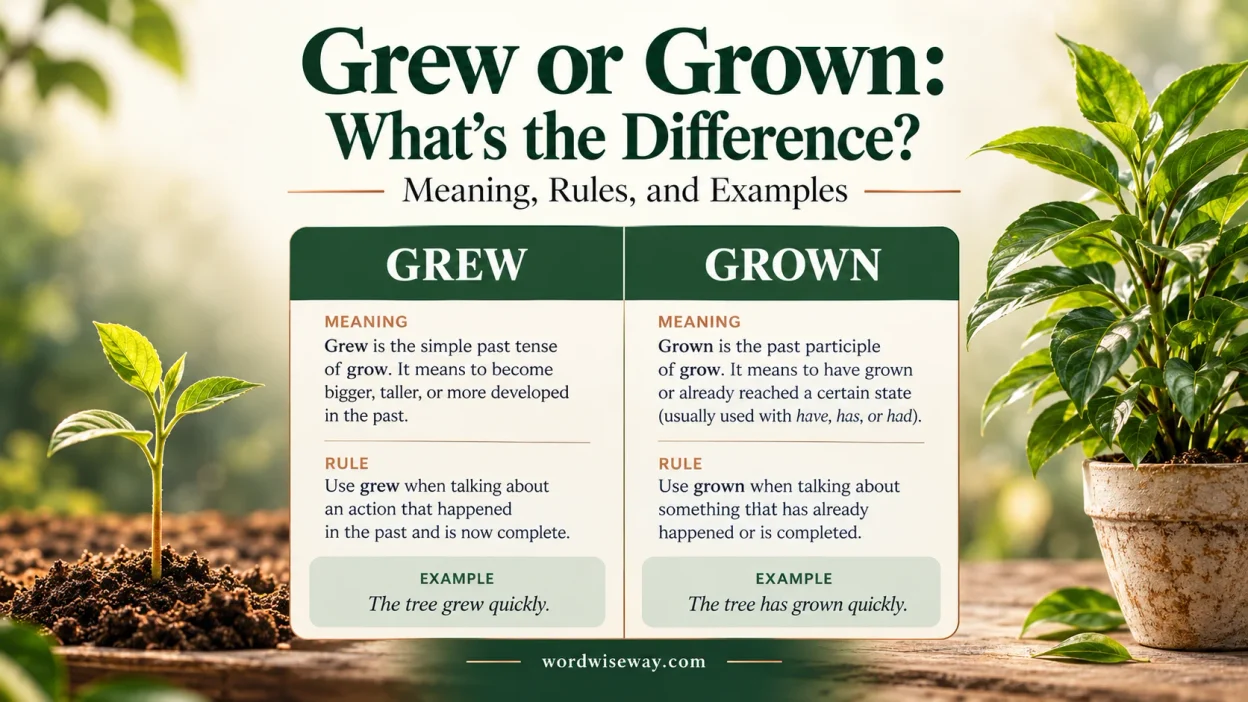
Grew is the simple past tense of grow. Use it to describe something that developed or increased in the past. For example, “The plant grew quickly.” Here, grew works independently as the main verb without an auxiliary verb. It describes a completed action or change that happened earlier.
Grown is the past participle of grow and usually needs a helping verb, such as has, have, or had. For example, “The plant has grown quickly.” Understanding auxiliary verbs, verb conjugation, and tense formation helps you choose the correct form. These simple rules improve sentence construction, grammatical accuracy, and English writing skills.
Quick Answer:
Grew is the simple past tense of grow. Use it to describe an action or change that happened in the past.
Grown is the past participle of grow. It usually appears with helping verbs such as has, have, had, or forms of be. It can also describe something that has reached a particular stage of development.
| Word | Verb form | When to use it | Example |
| Grew | Simple past tense | To describe a past action or change | The tree grew quickly. |
| Grown | Past participle | With helping verbs in perfect tenses | The tree has grown quickly. |
| Grown | Past participle | In passive constructions | The vegetables were grown locally. |
| Grown | Adjectival use | To describe development or maturity | The fully grown tree provides shade. |
The easiest rule to remember is this: use grew for the simple past and grown in perfect tenses. However, grown also appears in passive constructions and adjective phrases, so the entire sentence matters.
What Does Grew Mean?
Grew is the simple past tense of the irregular verb grow. It describes something that increased, developed, changed, or became larger at an earlier time.
Unlike regular verbs that form their past tense by adding -ed, grow changes its spelling. Its simple past form is grew, not growed.
For example:
- The baby grew taller during the summer.
- Their small business grew into a successful company.
- My interest in astronomy grew after that lesson.
- The population grew steadily over several years.
- The grass grew quickly after the rain.
In each sentence, grew describes a development that took place in the past. It can refer to physical size, emotional change, business expansion, or numerical increases.
When to Use Grew in a Sentence
Use grew when you want to describe a past event without using a perfect-tense helping verb. It works as the main verb in a simple past sentence.
Consider this example:
The company grew rapidly in 2024.
The sentence tells readers that the company’s growth happened during a specific period in the past. You don’t need has or had because the simple past form already expresses the action.
You can use grew in several contexts.
Physical growth: Use it when living things increase in size or develop.
- The sunflower grew taller than the fence.
- My younger brother grew several inches last year.
Business and financial growth: Use it to describe increases in size, sales, reach, or activity.
- The family business grew through word-of-mouth recommendations.
- Online sales grew during the holiday season.
Emotional and personal development: Use it when describing changes in feelings, confidence, or understanding.
- She grew more comfortable speaking in public.
- His confidence grew after several successful presentations.
Numbers and quantities: Use it when an amount or measurement increased.
- The audience grew from 200 to 500 people.
- Demand for electric vehicles grew over the decade.
Notice that grew doesn’t always mean becoming physically larger. It can also describe gradual changes in relationships, knowledge, popularity, and other abstract qualities.
Example Sentences With Grew
The following examples show how grew works in different situations.
| Example sentence | Meaning |
| The oak tree grew near the river. | The tree developed over time. |
| Their friendship grew stronger. | Their relationship improved. |
| The city grew rapidly after the new highway opened. | The city expanded. |
| Her curiosity grew after the experiment. | Her interest increased. |
| The company grew its customer base. | The company expanded the number of customers it served. |
| The child grew tired after the long walk. | The child gradually became tired. |
Grammar tip: Grew can describe a change in condition, not just an increase in size. In the sentence The sky grew dark, the word describes a transition from one condition to another.
Can You Use Grew Without a Helping Verb?
Yes. In a simple past sentence, grew can stand as the main verb without a helping verb.
For example:
- The flowers grew beautifully.
- The crowd grew restless.
- Her knowledge grew with experience.
However, questions and negative sentences follow a different pattern. When you use did or didn’t, the main verb returns to its base form, grow.
- Correct: Did the plant grow quickly?
- Incorrect: Did the plant grew quickly?
- Correct: The plant didn’t grow much.
- Incorrect: The plant didn’t grew much.
Why? The helping verb did already marks the sentence as past tense. Adding grew would mark the past twice.
What Does Grown Mean?
Grown is the past participle of the irregular verb grow. It describes growth or development within certain grammatical structures, especially perfect tenses and passive constructions.
The three main forms of grow are:
| Base form | Simple past | Past participle |
| Grow | Grew | Grown |
These forms aren’t interchangeable. You can say The plant grew yesterday or The plant has grown considerably. However, you can’t replace grown with grew in the second sentence without creating a grammatical error.
For example:
- The children have grown considerably.
- The crops had grown before the harvest began.
- These apples are grown in a nearby orchard.
- The puppy is almost fully grown.
Each sentence uses grown differently. The first two use perfect tenses, the third uses passive voice, and the fourth uses grown to describe the puppy’s development.
When to Use Grown in a Sentence
Use grown when the sentence calls for a past participle rather than the simple past tense. Three common patterns can help you recognize the correct form.
Present perfect tense: has grown or have grown
The present perfect connects an earlier action or change with the present. It often describes development that has continued over time or has a result that matters now.
Examples:
- The tree has grown considerably since spring.
- Our business has grown over the past five years.
- The children have grown more independent.
- Interest in the subject has grown recently.
Use has grown with third-person singular subjects, such as he, she, it, and singular nouns. Use have grown with I, you, we, they, and plural nouns.
Past perfect tense: had grown
The past perfect describes an action or change that happened before another past event.
Examples:
- The plants had grown tall before winter arrived.
- By the time we returned, the puppy had grown considerably.
- The company had grown rapidly before the market changed.
The word had marks the past perfect construction, so the verb must appear as grown, not grew.
Passive voice: is grown, was grown, or will be grown
Passive constructions focus on the person or thing affected by an action rather than the person performing it.
Examples:
- Rice is grown in many parts of Asia.
- These vegetables were grown without synthetic pesticides.
- The seedlings will be grown indoors before planting.
In these sentences, grown follows a form of be. The construction tells readers what happens to the plants or crops.
Example Sentences With Grown
Here are more examples showing how grown fits into different sentence structures.
| Example | Grammatical use |
| She has grown more confident. | Present perfect |
| They have grown several varieties of tomatoes. | Present perfect |
| The tree had grown beyond the garden wall. | Past perfect |
| The wheat was grown on a family farm. | Passive voice |
| The child is nearly grown. | Adjectival use |
| These plants can be grown in containers. | Passive construction with a modal verb |
Remember: Grown doesn’t automatically require has or have. Passive constructions and adjective phrases can use it with other words. The important thing is to match the verb form to the sentence structure.
Key Differences at a Glance
The main difference between grew and grown is their grammatical role. Both describe growth, but each belongs in a different structure.
| Feature | Grew | Grown |
| Verb form | Simple past | Past participle |
| Typical structure | Subject + grew | Subject + helping verb + grown |
| Perfect tenses | Not used as the past participle | Used with has, have, or had |
| Passive voice | Not used as the past participle | Used with forms of be |
| Example | The garden grew quickly. | The garden has grown quickly. |
Compare these pairs:
- Grew: The business grew during the first year.
- Grown: The business has grown since its launch.
Both sentences describe business growth. The first places the action in a completed past period. The second uses the present perfect to connect earlier growth with the present.
Here’s another pair:
- Grew: Her confidence grew after the training.
- Grown: Her confidence has grown after months of practice.
The first describes a past change. The second presents the change as relevant to the present, although has grown over the past few months would be a more natural choice for a continuing period.
A Simple Comparison in Context
Imagine you planted a small tree in your backyard three years ago.
You might say, The tree grew quickly last spring. This sentence describes growth during a particular past period.
Today, you could say, The tree has grown considerably. This sentence emphasizes its development up to the present.
If you described the planting process, you might write, The tree was grown in a nursery before we planted it. Here, grown appears in a passive construction.
The situation changes, and the verb form changes with it.
Grew vs. Grown in Different Verb Tenses
Understanding the verb forms becomes easier when you see how they work across common tenses. The helping verb often provides the clearest clue.
Simple Past: Grew
Use grew for an action or change that happened in the past. You can mention a specific time or leave the time understood from context.
Examples:
- The plant grew five inches last month.
- The market grew steadily during the summer.
- His interest in science grew throughout school.
- The crowd grew larger as the concert approached.
The simple past works especially well with time expressions such as yesterday, last year, in 2023, and two months ago.
Compare these sentences:
- Correct: The company grew rapidly last year.
- Incorrect: The company grown rapidly last year.
The second sentence lacks the grammatical structure required for grown. If you’re describing a simple past action, choose grew.
Present Perfect: Has Grown and Have Grown
The present perfect combines has or have with the past participle grown.
Use this tense when earlier growth has a connection to the present. It can describe an accumulated change, a recent development, or an experience without specifying a finished past time.
Examples:
- The garden has grown since we added compost.
- Our team has grown significantly this year.
- You have grown more patient with experience.
- The trees have grown taller over the last decade.
The subject determines which helping verb you need.
| Subject | Correct form | Example |
| He | Has grown | He has grown taller. |
| She | Has grown | She has grown more confident. |
| It | Has grown | It has grown considerably. |
| I | Have grown | I have grown more independent. |
| You | Have grown | You have grown more experienced. |
| We | Have grown | We have grown closer. |
| They | Have grown | They have grown rapidly. |
Avoid has grew and have grew. Both combinations are incorrect in standard English because has and have require the past participle in this tense.
Past Perfect: Had Grown
Use had grown when one event happened before another event in the past. This structure helps readers understand the order of events.
For example:
By the time the gardener returned, the plants had grown considerably.
The plants developed before the gardener returned. The past perfect makes that sequence clear.
More examples include:
- The children had grown taller before the family reunion.
- Demand had grown before the company expanded production.
- Her confidence had grown by the time she gave her first speech.
A useful way to check the sentence is to identify the two past events. If you need to show that one happened earlier, had grown may be appropriate.
Remember that you don’t need the past perfect every time you mention two past events. Use it when the earlier timing matters or needs clarification.
Passive Voice: Is Grown, Was Grown, and Will Be Grown
Passive voice shifts attention toward the object or result of an action. In these constructions, grown follows a form of be.
Consider these examples:
- Coffee is grown in suitable tropical climates.
- The corn was grown on the family’s farm.
- The seedlings will be grown in a greenhouse.
- These herbs can be grown indoors.
The sentences focus on the crops or plants rather than the people growing them.
Compare the active and passive versions:
| Active voice | Passive voice |
| Farmers grow rice in the region. | Rice is grown in the region. |
| The gardener grew the tomatoes. | The tomatoes were grown by the gardener. |
| The nursery will grow the seedlings. | The seedlings will be grown by the nursery. |
Neither voice is automatically better. Choose active voice when the person performing the action matters. Use passive voice when the product, process, or result deserves more attention.
Grew Up vs. Grown Up
The expressions grew up and grown up share the verb grow, but their grammatical forms and meanings differ.
Grew up is the simple past form of the phrasal verb grow up. It commonly describes childhood, upbringing, or the process of becoming more mature.
Examples:
- I grew up in a small town.
- She grew up surrounded by books.
- They grew up playing soccer together.
- He grew up to become a teacher.
In these examples, grew up describes a past experience or development.
Grown up can appear in several ways. As the past participle of grow up, it appears in perfect tenses. As an adjective, grown-up often describes an adult or something associated with adulthood.
Examples:
- She has grown up since we last met.
- The children have grown up quickly.
- He’s a grown-up now.
- They discussed grown-up responsibilities.
Notice the hyphen in grown-up when it functions as a compound noun or adjective in these examples. When the words form a verb phrase, as in has grown up, no hyphen is needed.
Grown Up vs. Fully Grown
These expressions also serve different purposes.
Grown up often relates to maturity or adulthood, especially in everyday conversation. Fully grown usually emphasizes that a person, animal, or plant has reached its mature size or stage of physical development.
Examples:
- My cousin has grown up since high school.
- The puppy is fully grown now.
- The fully grown oak tree shades the patio.
You wouldn’t normally say the fully grew tree. The adjective phrase requires grown, which describes the tree’s developed state.
Common Mistakes
Even experienced writers sometimes mix up grew and grown, especially when a sentence contains several verbs. Most mistakes happen when the writer overlooks the helping verb or chooses the wrong tense.
Using Grown Without the Correct Verb Structure
Incorrect: She grown taller last year.
Correct: She grew taller last year.
The sentence describes a completed past event, so the simple past form grew is correct. The word grown needs an appropriate grammatical structure.
However, grown can appear without a helping verb when it functions as an adjective or part of an adjectival phrase.
For example: The fully grown plants filled the garden.
Using Grew After Has, Have, or Had
Incorrect: The plant has grew quickly.
Correct: The plant has grown quickly.
The present perfect requires has or have followed by the past participle. The same rule applies to had grown in the past perfect.
More corrections:
- Incorrect: She have grew more confident.
- Correct: She has grown more confident.
- Incorrect: The tree had grew before winter.
- Correct: The tree had grown before winter.
Remember that the subject also determines whether you need has or have.
Using Grew After Did or Didn’t
Incorrect: Did the flowers grew overnight?
Correct: Did the flowers grow overnight?
When did appears in a question, the main verb takes its base form. The same rule applies to negative sentences containing didn’t.
- Correct: Did the business grow last year?
- Correct: The business didn’t grow last year.
- Incorrect: The business didn’t grew last year.
The helping verb already marks the past tense. You don’t need to mark it again on the main verb.
Confusing Grown With an Adjective
Incorrect: The fully grew tree provides shade.
Correct: The fully grown tree provides shade.
Here, grown describes the tree’s developed state. The word grew cannot serve that grammatical function in this phrase.
Another example:
- Correct: The children have grown into confident adults.
- Correct: The children are grown.
- Incorrect: The children have grew into confident adults.
The first sentence uses the present perfect. The second uses grown to describe a state of maturity.
How to Remember the Difference
You don’t need to memorize dozens of rules to choose the right word. Start with the sentence structure, then check what the sentence means.
Use This Three-Step Rule
Step one: Check whether the sentence describes a simple past action.
If it does, grew is usually correct.
Example: The plant grew rapidly last month.
Step two: Look for a helping verb.
If the sentence uses has, have, or had to form a perfect tense, choose grown.
Example: The plant has grown rapidly.
Step three: Check whether the sentence uses passive voice or an adjective.
If the structure calls for a past participle, use grown.
Examples:
- The plant was grown in a greenhouse.
- The plant is fully grown.
A useful memory phrase is: “It grew yesterday; it has grown today.”
The phrase highlights the difference between a simple past event and growth connected to the present. It’s a helpful starting point, although the correct choice always depends on the full sentence.
A Quick Decision Guide
| If your sentence contains… | Choose… | Example |
| A simple past action | Grew | The plant grew yesterday. |
| Has or have in the present perfect | Grown | The plant has grown. |
| Had in the past perfect | Grown | The plant had grown. |
| A form of be in a passive construction | Grown | The plant was grown indoors. |
| An adjective describing maturity | Grown | The plant is fully grown. |
| Did or didn’t before the main verb | Grow | Did the plant grow? |
A Practical Example: Grew or Grown in Everyday Writing
Imagine you’re writing a short report about a community garden.
Your first sentence reads:
The garden grew rapidly last spring.
This sentence works because grew describes a change that occurred during a past period.
Next, you write:
The garden has grown considerably since volunteers added new planting beds.
Here, has grown connects the garden’s earlier development with its current condition.
Finally, you write:
Several vegetables were grown organically in the garden.
This sentence uses the passive construction were grown to focus on the vegetables and how they were cultivated.
The three sentences describe the same garden, but each emphasizes something different.
The lesson: Don’t choose grew or grown simply because both words describe development. Choose the form that fits the verb structure and the meaning you want to convey.
Practice Exercises
Test your understanding by choosing the correct word for each sentence. Pay attention to the helping verbs and time expressions.
Fill in the Blanks
- The young tree _____ five feet last year. (grew/grown)
- Our business has _____ steadily since its launch. (grew/grown)
- The vegetables were _____ in a nearby farm. (grew/grown)
- Had the children _____ tired before dinner? (grew/grown)
- Did the flowers _____ well in the new soil? (grew/grown)
- The puppy is almost fully _____. (grew/grown)
- Her confidence _____ after several presentations. (grew/grown)
- The crops had _____ before the heavy rain arrived. (grew/grown)
- The company didn’t _____ as quickly as expected. (grew/grown)
- The plants have _____ taller since spring. (grew/grown)
Answers and Explanations
| No. | Answer | Explanation |
| 1 | Grew | Simple past tense with a finished time expression. |
| 2 | Grown | Present perfect with has. |
| 3 | Grown | Past participle in a passive construction. |
| 4 | Grown | Past perfect with had. |
| 5 | Grow | Base form after did. |
| 6 | Grown | Adjectival use describing maturity. |
| 7 | Grew | Simple past describing a completed change. |
| 8 | Grown | Past perfect with had. |
| 9 | Grow | Base form after didn’t. |
| 10 | Grown | Present perfect with have. |
Questions five and nine include grow rather than grew or grown. This distinction matters because did and didn’t take the base form of the main verb.
Read More: Given vs. Gave: Difference, and Correct Usage
FAQs
What Is the Difference Between Grew and Grown?
Grew is the simple past tense of grow, while grown is its past participle. Use grew for a past action and grown with helping verbs to form perfect tenses.
Is Grew the Past Tense of Grow?
Yes, grew is the simple past tense of grow. For example, “The flowers grew beautifully last spring.” It describes an action or change that happened in the past.
Is Grown a Past Tense or Past Participle?
Grown is the past participle of grow. It usually appears with helping verbs, such as has, have, or had, as in “The tree has grown taller.”
Can You Use Grown Without a Helping Verb?
Yes, grown can appear without a helping verb in certain structures, including adjectives and reduced phrases. For example, “The grown children visited their parents.” However, it generally needs an auxiliary verb to form a perfect tense.
Should I Say Has Grew or Has Grown?
Use has grown, not has grew. The verb following has must use its past participle form. For example, “My little brother has grown taller this year.”
Is It Correct to Say I Grew Up or I Grown Up?
I grew up is correct when describing a completed past experience. For example, “I grew up in a small town.” You can also say “I have grown up,” depending on the intended meaning and context.
What Are Some Examples of Grew in Sentences?
Here are three natural examples:
- The company grew rapidly last year.
- My interest in science grew over time.
- The children grew excited about the trip.
Each sentence describes a change that happened in the past.
What Are Some Examples of Grown in Sentences?
Here are three examples showing how grown works:
- The plants have grown considerably.
- She had grown more confident by graduation.
- The business has grown into a successful company.
The helping verbs make the sentences grammatically complete.
Is Grew or Grown Correct With the Word Has?
Grown is correct after has when forming the present perfect tense. For example, “The garden has grown beautifully.” Remember this pattern: has grown, have grown, and had grown.
How Can I Remember When to Use Grew or Grown?
Remember this simple rule: grew stands alone as the simple past, while grown usually pairs with a helping verb in perfect tenses. Compare “The tree grew” with “The tree has grown.” Practicing these sentence patterns will help you choose the correct form naturally.
Conclusion
Choosing between grew and grown becomes easier when you understand their roles in English grammar. Both words come from the verb grow, but they serve different purposes in a sentence. Grew describes a past action, while grown is the past participle used with helping verbs to form perfect tenses. Learning this difference helps you avoid common grammar mistakes.
Remember the simple rule: say “The plant grew quickly” when describing a past event, but use “The plant has grown quickly” when forming the present perfect tense. Pay attention to auxiliary verbs, sentence structure, and the intended meaning whenever you choose between these forms. A few clear examples and regular practice can strengthen your understanding of irregular verbs.
Whether you are writing school assignments, emails, stories, or everyday messages, using grew and grown correctly makes your English clearer and more natural. Keep practicing with different subjects and sentence patterns to build confidence. Once you recognize how these verb forms work, choosing the right one becomes a much easier part of your writing.

Emma Smith has dedicated 14 years to Princeton University’s English Department, mentoring students in textual interpretation, literary movements, and critical frameworks. Her research explores Shakespearean drama, Victorian serial fiction, postcolonial narrative theory, and manuscript studies and probing how literary forms evolve across cultures and centuries. Emma has delivered lectures at international humanities congresses and published findings in distinguished academic journals, underscoring her commitment to scholarly depth and vibrant teaching.