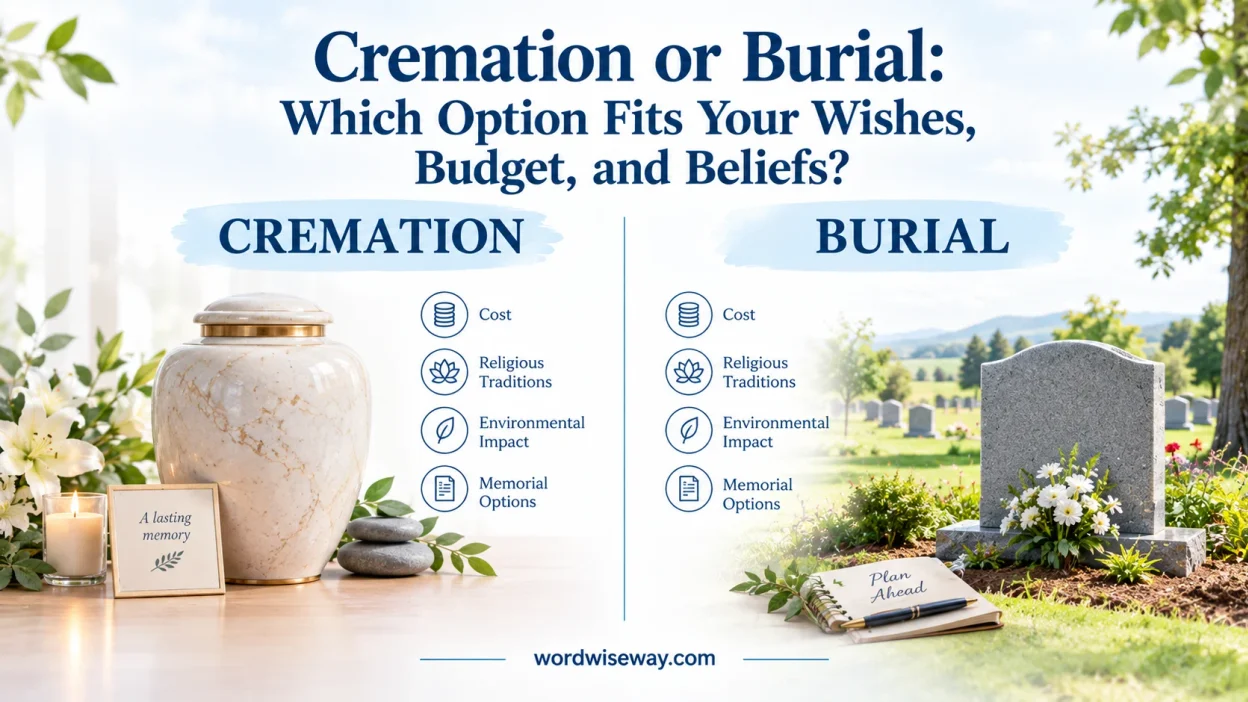
Cremation or Burial: Which Option Fits Your Wishes, and Beliefs? is a personal choice that can become one of the biggest decisions families make after a loved one dies. Both cremation and burial are common ways to care for remains after death.
Burial places the body in the ground, usually in a cemetery, while cremation uses heat to create ashes. The differences can involve costs, traditions, religious views, personal meanings, environmental impact, and other emotional factors.
A helpful guide should explain the process, meaning, history, examples, trends, and practical advice in simple terms. Cremation may be less expensive and more flexible, while burial may support tradition, religion, or visiting a physical grave. Families can consider their beliefs, budget, values, and circumstances when choosing an option.
Quick Answer:
Cremation turns the body into cremated remains through a controlled high-temperature process. The remains can later be kept, buried, placed in a columbarium, or handled in another way permitted by local law and the family’s traditions.
Burial places the body in a grave, mausoleum, or another approved resting place. It creates a permanent physical location where relatives and friends can visit and remember the deceased.
| Factor | Cremation | Burial |
| What happens to the body? | It undergoes cremation and becomes cremated remains | It is placed in a grave or other approved burial space |
| Permanent location | Optional | Usually a cemetery, mausoleum, or other burial site |
| Funeral service | Can happen before or after cremation | Usually occurs before or during burial |
| Cemetery required? | Not necessarily | Usually required for cemetery burial |
| Common cost structure | Cremation fee, provider services, urn, optional memorial or interment | Funeral services, casket, cemetery space, burial fees, marker and other expenses |
| Scheduling | Often provides flexibility for a later memorial | Often tied more closely to cemetery and funeral scheduling |
| Religious acceptance | Depends on the faith | Accepted by many religious traditions |
| Land use | Generally less permanent land is needed if remains aren’t interred | Requires a permanent burial or entombment space |
| Memorial options | Urn, niche, grave, memorial site, permitted scattering | Grave, mausoleum, cemetery memorial |
| Environmental considerations | Energy use and emissions from cremation | Land use, materials, cemetery maintenance, and possible embalming |
Neither choice automatically fits every family. The better approach is to compare the complete arrangements, not just one funeral-home fee.
What Is Cremation?
Cremation is a method of final disposition in which intense heat reduces the body to bone fragments. The fragments are then processed into a form commonly called cremated remains.
Despite the everyday term “ashes,” cremated remains aren’t simply ordinary fireplace ash. They consist primarily of processed bone fragments after the cremation process.
The process normally involves several stages:
- Identification and authorization
- Transfer and preparation of the deceased
- Placement in the cremation chamber
- Cremation
- Cooling and processing of remaining bone fragments
- Placement of the cremated remains in a container
- Return or transfer of the remains to the authorized family or representative
The exact procedures vary by jurisdiction and crematory.
Direct Cremation vs. Cremation With a Funeral
Direct cremation generally means the body is cremated without a formal viewing or visitation involving the body. A memorial service can still take place later.
A more traditional arrangement can include visitation, a funeral ceremony, transportation, preparation, and cremation afterward. The family can therefore have many of the rituals associated with a traditional funeral while still choosing cremation.
The Federal Trade Commission explains that direct cremation normally doesn’t involve embalming or a viewing. It also notes that funeral providers offering direct cremation must make an alternative container available instead of requiring a traditional casket.
What Happens to Cremated Remains?
Once cremation finishes, the processed remains are placed in an urn or another suitable container.
Families may then choose from several options, depending on local law, cemetery rules, and religious requirements:
- Keep the urn at home
- Place the remains in a cemetery
- Use a columbarium niche
- Bury the urn
- Hold a memorial ceremony
- Scatter the remains where legally permitted
- Divide remains among family members where appropriate and lawful
This flexibility can be important for families who live in different cities or countries. It can also make memorial planning less tied to a particular cemetery.
Still, flexibility doesn’t mean there are no rules. Laws governing cremated remains vary considerably by location, especially for scattering on public land, waterways, or other restricted areas.
What Is Burial?
Burial places the body in an approved resting place, most commonly a cemetery grave. Some families instead choose entombment in a mausoleum or another above-ground structure.
A traditional burial may include:
- Transportation of the deceased
- Preparation
- Optional embalming
- Viewing or visitation
- Funeral service
- Cemetery arrangements
- Casket
- Grave preparation
- Burial or interment
- Grave marker or monument
Burial can also be much simpler.
What Is Direct Burial?
Direct burial generally means the body is buried shortly after death without a formal viewing or visitation. A memorial service may happen later.
The FTC describes direct burial as an arrangement that usually doesn’t involve viewing or visitation. It can therefore avoid some services associated with a full traditional funeral.
That distinction matters because “burial” doesn’t automatically mean an elaborate funeral.
Cost
Money can become a major part of the decision, especially when families compare complete funeral arrangements rather than individual prices.
In the United States, NFDA’s 2023 national data showed these median funeral-home costs:
| Arrangement | 2023 U.S. median |
| Funeral with viewing and burial | $8,300 |
| Funeral with viewing and cremation | $6,280 |
| Direct burial with container supplied by family | $2,995 |
| Direct burial with container supplied by funeral home | $3,720 |
| Direct cremation with container supplied by family | $2,645 |
| Direct cremation with container supplied by funeral home | $2,750 |
| Metal burial casket | $2,500 |
| Alternative cremation container | $160 |
| Urn | $295 |
These are U.S. median figures from NFDA’s 2023 General Price List study. They aren’t universal prices, and the study excludes some cemetery and cash-advance expenses.
Why Cremation Can Cost Less
Cremation can reduce expenses when a family chooses a simple arrangement without a traditional viewing, expensive casket, or cemetery plot.
For example, direct cremation can remove several costs associated with a conventional funeral. The family might then arrange a modest memorial gathering at a later date.
However, cremation isn’t automatically inexpensive.
A family can choose an elaborate funeral before cremation, purchase a ceremonial casket or rental casket, hold a formal service, buy a premium urn, and later purchase cemetery interment. The final bill can climb quickly.
Why Burial Costs Vary
Burial often involves expenses that cremation doesn’t necessarily require:
- Cemetery plot
- Grave opening and closing
- Casket
- Outer burial container where required by the cemetery
- Headstone or marker
- Embalming when selected or required for the arrangement
- Funeral service
- Transportation
- Cemetery maintenance or related fees
The FTC advises consumers to request itemized pricing and compare the individual goods and services they actually want.
What About Embalming?
Embalming is often misunderstood.
In the United States, federal law does not require routine embalming for every death. State and local rules can differ, and particular circumstances may create preservation requirements. Funeral homes may also have policies connected to public viewing.
The FTC specifically states that embalming generally isn’t necessary or legally required when a body is buried or cremated shortly after death. It also explains that funeral providers cannot misrepresent embalming as legally required when it isn’t.
That makes this an important question to ask:
“Is embalming legally required in this situation, or is it required by the funeral home’s policy for the service we’ve selected?”
Those aren’t necessarily the same thing.
Environmental Impact of Cremation vs. Burial
Environmental comparisons aren’t as simple as saying one method is always greener.
Cremation uses energy and produces emissions. The equipment must generate and maintain substantial heat during the process.
Burial uses land and materials. Depending on the arrangement, it can involve a casket, burial container, cemetery infrastructure, landscaping, long-term maintenance, and transportation.
The environmental picture changes again when families consider natural or green burial, which can reduce some conventional materials and practices.
Therefore, anyone comparing cremation and burial for environmental reasons should look beyond labels.
Environmental Factors in Cremation
Consider:
- Energy consumption
- Fuel source
- Air emissions
- Crematory equipment
- Transportation
- Urn materials
- Whether the remains are later interred
Environmental Factors in Burial
Consider:
- Land use
- Cemetery maintenance
- Casket materials
- Outer burial containers
- Embalming practices
- Transportation
- Landscaping and irrigation
- Long-term cemetery infrastructure
A useful comparison asks which specific arrangement is being considered, rather than comparing cremation with an imagined version of burial.
Religious and Cultural Beliefs Matter
For many families, this decision isn’t primarily financial. It may already be shaped by religious law, family tradition, or cultural practice.
Christianity and Cremation
Christian views vary between denominations and traditions.
For example, the Catholic Church permits cremation under specified circumstances but continues to express a preference for burial. The United States Conference of Catholic Bishops states that burial remains the Church’s preferred practice and provides specific guidance for the respectful treatment and interment of cremated remains.
That means a Catholic family considering cremation should discuss the arrangement with its parish or diocese rather than assuming that every cremation arrangement follows Catholic funeral practice.
Islam and Burial
Islamic funeral traditions generally place strong importance on burial of the deceased and prescribe specific rites surrounding death and burial.
Because religious practice can vary by community and legal setting, Muslims planning funeral arrangements should consult a knowledgeable local imam or Islamic authority about the applicable religious requirements.
Judaism and Burial
Traditional Jewish practice places strong importance on burial. However, Jewish communities differ in their interpretations and practices, so families should consult their rabbi when questions arise.
Hinduism and Cremation
Cremation has longstanding significance in many Hindu traditions. Funeral customs can vary according to region, community, family tradition, and religious school.
Buddhism and Funeral Practices
Buddhist funeral customs differ widely across countries and traditions. Both cremation and burial occur in Buddhist communities, so the family’s specific tradition matters.
The broader lesson is simple: check religious requirements before making irreversible arrangements.
Funeral and Memorial Services Can Accompany Either Choice
Choosing cremation doesn’t mean giving up a funeral.
A family can hold:
- A viewing followed by cremation
- A funeral service followed by cremation
- A memorial service after cremation
- A graveside ceremony for an urn
- A religious funeral
- A private family gathering
Likewise, burial doesn’t require a large formal ceremony.
A family might choose direct burial followed by a simple memorial gathering weeks later.
This flexibility helps separate two decisions that people often treat as one:
How should the remains be handled?
How should the person’s life be remembered?
Those questions can have different answers.
Permanent Resting Place vs. Flexible Memorialization
A cemetery gives families something tangible: a specific place to visit.
For some people, that’s enormously meaningful. A grave can become a family landmark where anniversaries, holidays, and important milestones are remembered.
Cremation can offer a different kind of flexibility.
The remains may be placed in a cemetery, columbarium, or another lawful memorial location. If the family later moves, the memorial arrangement may be easier to change than a conventional burial plot.
Neither approach guarantees emotional closure. A physical place can help some families while another family may prefer a less traditional form of remembrance.
Cremation Urns vs. Burial Caskets
The container is another practical difference.
Choosing an Urn
When selecting an urn, consider:
- Size
- Material
- Durability
- Placement
- Cemetery or columbarium requirements
- Personalization
- Whether the urn will remain indoors or outdoors
An inexpensive urn can serve the practical purpose just as well as a decorative one if the family doesn’t need elaborate presentation.
Choosing a Casket
Casket prices can vary dramatically by material, design, construction, and retailer.
The FTC’s Funeral Rule requires covered funeral providers in the United States to provide price information and prohibits them from falsely claiming that a casket is legally required for direct cremation.
A family should therefore ask for the complete casket price list instead of choosing from only the models displayed in a showroom.
Legal and Practical Considerations
Funeral laws aren’t universal. They can vary by country, state, province, municipality, cemetery, and religious institution.
Before choosing cremation or burial, verify:
- Who can authorize the disposition
- Required permits
- Identification requirements
- Transportation rules
- Cemetery regulations
- Crematory requirements
- Rules governing cremated remains
- Restrictions on scattering
- Requirements for burial containers
- Religious requirements
In the United States, the FTC Funeral Rule gives consumers important protections when dealing with covered funeral providers. Providers must give consumers a General Price List and allow consumers to select the funeral goods and services they want, subject to limited exceptions.
The FTC also states that consumers can generally use an alternative container for direct cremation and that funeral providers cannot require a traditional casket for that service.
These federal protections don’t replace state or local law. They work alongside it.
Case Study: Choosing Cremation for Flexibility
Imagine a family whose relatives live in four different cities.
A traditional burial could still work, but arranging travel, a funeral, and cemetery services within a short period might create logistical pressure.
The family instead chooses cremation. They hold a small ceremony and arrange a larger memorial several weeks later when relatives can travel.
The key benefit in this scenario isn’t simply price. Scheduling flexibility becomes the deciding practical factor.
Case Study: Choosing Burial for a Permanent Memorial
Consider another family with several generations buried in the same cemetery.
The family values having one location where relatives can visit older generations and maintain a shared memorial tradition.
For them, burial provides continuity. The cemetery isn’t merely a place where remains are kept. It becomes part of the family’s history.
That doesn’t make burial universally preferable. It simply shows how family context can change the practical value of each option.
How to Decide Between Cremation and Burial
A thoughtful decision starts with the deceased person’s wishes.
If the person left written instructions, an advance directive, funeral plan, or other legally relevant document, those wishes should be considered alongside applicable law.
Then work through these questions:
What Did the Person Want?
Look for:
- Written funeral instructions
- Advance planning documents
- Conversations with family
- Religious instructions
- Prearranged funeral contracts
Don’t assume that relatives automatically want the same arrangement the deceased would have chosen.
What Does the Family Need?
Consider:
- Where relatives live
- Whether family members want a cemetery to visit
- Religious ceremonies
- Travel requirements
- Future relocation
- Who will maintain the memorial
What Can the Family Afford?
Compare the total package, not one advertised price.
Ask for itemized costs covering:
- Funeral-home services
- Cremation or burial
- Casket or urn
- Cemetery
- Interment
- Transportation
- Memorial service
- Grave marker
- Other required fees
What Type of Memorial Feels Meaningful?
Some families want a grave with a headstone.
Others want a small urn, a columbarium niche, a memorial gathering, or another lawful form of remembrance.
There isn’t one universal definition of a meaningful memorial.
Questions to Ask a Funeral Home
Before signing anything, ask direct questions.
- What does the quoted price include?
- Which charges are mandatory?
- Which services are optional?
- Is embalming required by law or only by policy?
- Is transportation included?
- Is the cremation fee included?
- Is the urn included?
- Is a cemetery fee included?
- Are opening and closing fees separate?
- Is a burial vault required by the cemetery?
- Can the family provide its own casket or urn?
- What identification procedures are used?
- What happens to the cremated remains after the cremation?
- Can the family hold a service before or after cremation?
- What local laws apply to scattering or burial?
In the United States, asking for a General Price List is particularly useful because it lets consumers see itemized prices rather than relying solely on a bundled package.
Common Misconceptions
“Cremation Means You Can’t Have a Funeral”
False.
A funeral, religious service, viewing, or memorial can accompany cremation. The timing simply changes depending on the family’s arrangement.
“Burial Always Costs More”
Not necessarily.
A simple direct burial can cost less than an elaborate cremation service. Costs depend on what the family purchases.
“Cremation Is Always Better for the Environment”
That’s too broad.
Cremation has energy and emissions considerations. Burial has land, material, maintenance, and transportation considerations. Natural burial adds another variable to the comparison.
“Embalming Is Always Required”
No.
Requirements depend on the jurisdiction and circumstances. In the United States, federal law doesn’t impose routine embalming for every death.
“Cremated Remains Must Be Kept at Home”
No.
Depending on local rules and religious requirements, cremated remains may be buried, placed in a columbarium, or handled in other lawful ways.
“A Casket Is Required for Cremation”
Not for direct cremation under the FTC’s U.S. Funeral Rule.
Covered funeral providers offering direct cremation must make alternative containers available.
A Practical Comparison
| If your priority is… | Options worth exploring |
| Scheduling flexibility | Cremation, especially direct cremation |
| A permanent cemetery location | Burial or cemetery interment of cremated remains |
| Traditional family cemetery customs | Burial |
| A later memorial gathering | Cremation or direct burial |
| Religious requirements | Follow the specific faith’s guidance |
| Lower-cost arrangements | Compare direct cremation and direct burial |
| Minimal funeral services | Direct cremation or direct burial |
| A physical grave to visit | Burial |
| Flexibility about the final location | Cremation, where legally permitted |
| Natural burial practices | Green or natural burial |
This table isn’t a ranking. It simply connects common priorities with arrangements that may address them.
Cremation or Burial for Preplanning
Preplanning can prevent a difficult situation from becoming a guessing game for relatives.
A basic plan should document:
- Preferred disposition
- Religious requirements
- Funeral or memorial preferences
- Cemetery preferences
- Important contacts
- Existing contracts
- Relevant legal documents
- Budget expectations
If a funeral plan has already been purchased, review the contract carefully. Prices, services, transfer provisions, and refund rules can vary.
Most importantly, tell the people who may need to act on the instructions. A beautifully written plan doesn’t help much if nobody knows where it is.
Read More: Sweet or Sweat: Correct Spelling, Meaning, and Usage
FAQs
What is the main difference between cremation and burial?
Cremation uses high heat to reduce human remains to ashes, while burial places the body in a grave, usually within a cemetery. The choice can involve religious, cultural, emotional, environmental, and financial considerations.
Is cremation usually less expensive than burial?
Cremation can cost less than a traditional burial because it may avoid some expenses connected with a cemetery plot, grave opening, and burial service. However, prices vary depending on the services and arrangements selected.
Do religious beliefs affect the choice between cremation and burial?
Yes. Different religions and religious communities have their own teachings and traditions concerning the handling of human remains. Families often consider these beliefs before making arrangements.
Can a family visit a place after cremation?
Yes. Depending on the arrangements, ashes may be kept in an urn, placed in a memorial location, or handled according to the person’s wishes and applicable rules. Families can create a meaningful place for remembrance.
Does burial always require a cemetery?
Not necessarily. Burial laws and available options differ by location. In many cases, however, families use cemeteries because they provide established spaces for graves, visitation, and memorial services.
Which option has a greater environmental impact?
Neither option has the same environmental footprint in every situation. Cremation involves energy use and emissions, while burial can involve land use, burial materials, cemetery maintenance, and other factors.
Can personal wishes determine whether someone is cremated or buried?
Personal wishes can be an important part of the decision. Families may also need to consider religious beliefs, local laws, available services, costs, and any instructions the person left before death.
What factors should a family consider before choosing?
A family can consider beliefs, traditions, costs, environmental concerns, emotional needs, location, available services, and the wishes of the deceased. Discussing these points early can make the process clearer.
Is cremation becoming more popular?
Cremation has become more common in many places, although patterns differ between countries, regions, religions, and communities. Social attitudes, costs, available options, and changing traditions can all influence these trends.
How can I decide between cremation and burial?
Start by looking at the person’s wishes, family beliefs, religious or cultural traditions, budget, and the type of remembrance the family wants. Comparing the practical details of each option can help you make an informed decision.
Conclusion
Choosing between cremation or burial isn’t simply a matter of comparing services. It can reflect a person’s beliefs, family traditions, religious values, emotional needs, and wishes for remembrance. Each option has its own process and practical considerations, so understanding those details can make an otherwise difficult decision easier to discuss.
Cremation may offer flexibility in how ashes are remembered or handled, while burial provides a physical grave that families may choose to visit. Costs, environmental considerations, cultural expectations, and available arrangements can also shape the decision. What matters most is understanding what each choice involves before making arrangements.
A thoughtful decision starts with an honest conversation about personal wishes, family expectations, religion, and budget. Take time to compare the available options, ask questions, and consider the circumstances of everyone involved. When the practical details and personal values are both given proper attention, families can approach this important choice with greater clarity.

Emma Smith has dedicated 14 years to Princeton University’s English Department, mentoring students in textual interpretation, literary movements, and critical frameworks. Her research explores Shakespearean drama, Victorian serial fiction, postcolonial narrative theory, and manuscript studies and probing how literary forms evolve across cultures and centuries. Emma has delivered lectures at international humanities congresses and published findings in distinguished academic journals, underscoring her commitment to scholarly depth and vibrant teaching.