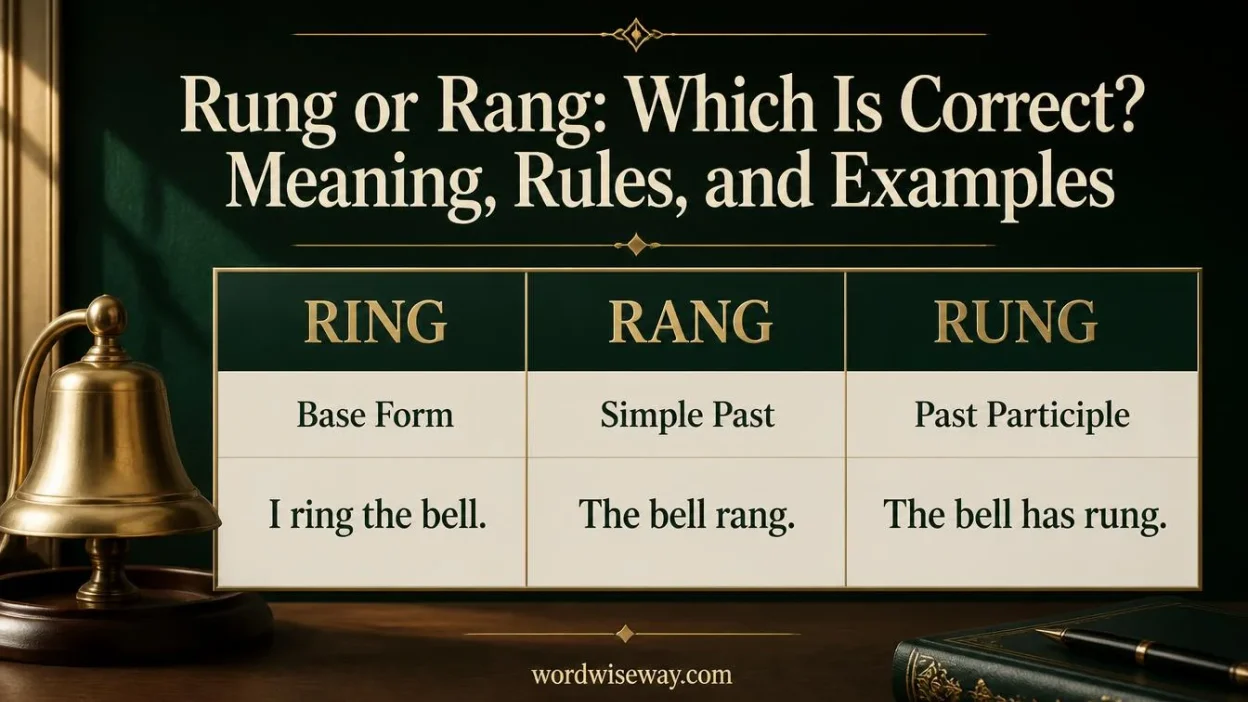
The article Rung or Rang: Correct Spelling, Meaning, Rules, and Examples explains the irregular verb ring in English grammar. Its word forms follow different spelling rules. The present tense is ring, the simple past tense is rang, and the past participle is rung.
These ring verb forms have different grammatical forms and usage. Understanding their meaning and correct spelling makes English verb tenses easier to learn. The grammar rules also help explain rang vs. rung and rung vs. rang without confusion.
The past tense of ring describes an earlier action. For example, “The phone rang yesterday” uses the simple past tense, while “The phone has rung” uses the past participle. These examples show how verb conjugation affects sentence structure and correct usage. During language learning, compare both forms to choose the right word and improve confidence in the English language.
Quick Answer:
Rang is the simple past tense of ring. Use it when describing an action that happened in the past.
- Correct: The telephone rang during dinner.
- Incorrect: The telephone rung during dinner.
Rung is the past participle of ring. Use it with helping verbs such as has, have, and had to form perfect tenses.
- Correct: The telephone has rung three times today.
- Incorrect: The telephone has rang three times today.
Here’s a quick comparison:
| Word | Verb form | Example |
| Ring | Base form | I ring the bell every morning. |
| Rang | Simple past | I rang the bell yesterday. |
| Rung | Past participle | I have rung the bell already. |
The easiest rule to remember: Use rang for the simple past and rung after has, have, or had in perfect-tense constructions.
What Does Rang Mean?
Rang is the simple past tense of ring. It describes an action that happened at an earlier time, such as a telephone making a sound or someone ringing a doorbell.
The verb ring often describes a clear, resonant sound. However, it can also describe other actions, including calling someone by telephone or sounding a bell to signal an event.
For example, you might say, “The school bell rang at noon.” The word rang tells the reader that the bell made its sound in the past.
Unlike regular verbs that form the past tense by adding -ed, ring changes its vowel. That’s why ringed isn’t the standard simple past form when you’re describing a bell or telephone making a sound.
When to Use Rang in a Sentence
Use rang when the main verb describes a completed past action. The sentence usually doesn’t need a helping verb before it.
Consider these examples:
- The alarm rang at six o’clock.
- My phone rang while I was studying.
- Someone rang the doorbell last night.
- The church bells rang across the village.
- The telephone rang twice before anyone answered.
In each sentence, rang describes an action that took place in the past. The surrounding words may identify when the action happened or provide more context.
Past-time expressions often appear with rang, although they aren’t required. Common examples include yesterday, last week, this morning, and a few minutes ago when referring to a completed event.
For instance, “The alarm rang a few minutes ago” uses the simple past because the ringing happened earlier.
Rang in Questions and Negative Sentences
Questions and negative sentences often confuse English learners because they require a helping verb.
When you use did or didn’t, the main verb returns to its base form, ring. Don’t use rang after did.
| Sentence type | Correct example | Incorrect example |
| Statement | The phone rang. | The phone rung. |
| Question | Did the phone ring? | Did the phone rang? |
| Negative | The phone didn’t ring. | The phone didn’t rang. |
| Negative question | Didn’t the phone ring? | Didn’t the phone rang? |
Why does this happen? The word did already marks the past tense. Adding rang would mark the past twice in the same verb construction.
Compare these sentences:
- Correct: Did the bell ring this morning?
- Correct: The bell rang this morning.
- Correct: The bell didn’t ring this morning.
The main verb changes according to the sentence structure. Once you recognize the role of did, choosing the right form becomes much easier.
Rang in Example Sentences
Here are more examples showing how rang works in everyday English.
- The alarm rang before sunrise.
- My phone rang during the meeting.
- The school bell rang at the end of class.
- Someone rang the front doorbell while we were eating.
- The church bells rang to announce the celebration.
- The telephone rang, but nobody answered.
- A warning bell rang throughout the building.
- The boxing bell rang to signal the end of the round.
Notice that rang stays the same regardless of the subject. You can use it with I, you, he, she, it, or a plural noun.
For example, both “The bell rang” and “The bells rang” are correct. The past-tense form doesn’t change to match a singular or plural subject.
What Does Rung Mean?
Rung is the past participle of ring. It usually appears with a helping verb to form perfect tenses or certain passive constructions.
A past participle is a verb form used in particular grammatical structures. Many regular verbs have past participles ending in -ed, such as played or finished. Irregular verbs follow their own patterns.
The verb ring follows this pattern:
- Base form: ring
- Simple past: rang
- Past participle: rung
For example, “She has rung the bell” is correct because has combines with the past participle rung. The sentence presents the ringing as an action connected to the present.
Compare that with “She rang the bell yesterday.” This sentence uses the simple past because it describes a completed event in the past.
When to Use Rung in a Sentence
Use rung when the grammatical structure calls for the past participle. The most common pattern involves has, have, or had.
Present perfect tense: has or have + rung
The present perfect connects a past action to the present in some way.
- She has rung the bell twice.
- I have rung the office telephone already.
- They have rung every customer on the list.
Past perfect tense: had + rung
The past perfect shows that an action happened before another past event.
- The bell had rung before we reached the classroom.
- She had rung twice before he answered.
- By the time I arrived, the alarm had rung.
These sentences place one action before another event or past reference point.
Passive constructions
The past participle can also appear in passive constructions.
- The bell was rung to announce the ceremony.
- The alarm had been rung before the doors opened.
- The warning bell was rung by the guard.
In these examples, the sentence focuses on the bell or alarm rather than the person performing the action.
One important detail: rung doesn’t always appear immediately after a helping verb. Other words can come between them, as in “She has already rung the bell.” The underlying grammatical pattern remains the same.
Rung in Example Sentences
These examples demonstrate how rung appears in different sentence structures.
- The telephone has rung three times today.
- I have rung the doorbell, but nobody has answered.
- She had rung the bell before the guests arrived.
- The alarm has rung every morning this week.
- The school bell had rung before the students entered the hallway.
- The bell was rung to begin the ceremony.
- The warning bell has been rung several times.
- By noon, the telephone had rung repeatedly.
Each sentence uses rung as a past participle. The helping verb or verb phrase determines the grammatical structure.
For example, has rung forms the present perfect, while had rung forms the past perfect. In was rung, the verb phrase uses the passive voice.
Remember that the presence of a past-time word doesn’t automatically require rang. The complete sentence structure determines which verb form you need.
Ring, Rang, and Rung: Understanding All Three Verb Forms
The clearest way to understand rung vs. rang is to learn the complete verb pattern. English has many irregular verbs that change their spelling rather than following the usual -ed pattern.
Ring belongs to the same broad group as sing and begin. These verbs change their vowel across different forms.
| Base form | Simple past | Past participle |
| Ring | Rang | Rung |
| Sing | Sang | Sung |
| Begin | Began | Begun |
| Drink | Drank | Drunk |
| Swim | Swam | Swum |
These patterns can help you remember the forms, although not every irregular verb follows exactly the same pattern.
Ring: The Base Form
Ring is the base form of the verb. You use it in the present tense, after modal verbs, and after certain helping verbs.
Examples include:
- I ring the bell every morning.
- She will ring you after work.
- Please ring the doorbell when you arrive.
- Did you ring the office?
- He doesn’t ring his friends very often.
Notice the last two examples. Both did and doesn’t take the base form ring rather than rang or rung.
You can also use ring as an instruction. For example, “Ring the bell before entering” gives someone a direct command.
Rang: The Simple Past Form
Rang describes an action that happened in the past. It works as the main verb without requiring has, have, or had.
Examples:
- The phone rang at midnight.
- We rang the bell before entering.
- The alarm rang during the storm.
Compare the first example with “The phone has rung at midnight.” The second sentence sounds unnatural in ordinary usage because the specific completed time expression at midnight usually calls for the simple past in this context.
A more natural present-perfect sentence would be “The phone has rung several times today,” where the time period can include the present.
Rung: The Past Participle
Rung appears in perfect tenses and passive constructions. It usually needs a helping verb to form these structures.
Examples:
- I have rung the bell.
- She had rung the office before lunch.
- The bell was rung at the ceremony.
The form doesn’t change according to the subject. You say “He has rung” and “They have rung,” not runged or rang after the helping verb.
A useful comparison is:
- Yesterday: The phone rang.
- Today, with present relevance: The phone has rung several times.
- Before another past event: The phone had rung before I entered.
The time and sentence structure work together to determine the correct form.
Key Differences at a Glance
Although rung and rang come from the same verb, they aren’t interchangeable in standard English grammar.
| Feature | Rang | Rung |
| Verb form | Simple past | Past participle |
| Main use | Describes a past action | Forms perfect tenses and passive constructions |
| Common pattern | Subject + rang | Subject + has/have/had + rung |
| Example | The alarm rang. | The alarm has rung. |
| Past perfect | Not used as the main verb form in this construction | The alarm had rung. |
| Common mistake | The alarm rung. | The alarm has rang. |
The distinction becomes clearer when you examine the helping verb.
“The alarm rang” is a complete simple past statement. However, “The alarm has rung” uses the present perfect, which requires the past participle.
You can remember the difference by asking yourself one question: Does the sentence need the simple past, or does its structure require a past participle?
If you need the simple past, use rang. If you need the past participle, use rung.
Common Mistakes
Even experienced writers occasionally mix up irregular verb forms, especially when speaking quickly. These common errors become easier to avoid once you understand the structure behind each sentence.
“I Have Rang” vs. “I Have Rung”
In standard American English, the usual correct form is “I have rung.”
The present perfect follows this structure:
Subject + have/has + past participle
Because rung is the past participle of ring, it belongs after have or has.
- Incorrect in standard American English: I have rang the bell.
- Correct: I have rung the bell.
- Correct: She has rung the bell.
You may encounter have rang in informal speech or regional varieties of English. However, have rung is the appropriate choice for standard formal writing and grammar exercises.
“The Phone Rung” vs. “The Phone Rang”
When describing a phone making a sound in the past, use rang.
- Incorrect in standard English: The phone rung at noon.
- Correct: The phone rang at noon.
The sentence uses the simple past, so it needs rang, not the past participle rung.
You can also write, “The phone had rung before noon.” In that sentence, had requires the past participle.
“Did You Rang?” vs. “Did You Ring?”
After did, use the base form of the main verb.
- Incorrect: Did you rang the bell?
- Correct: Did you ring the bell?
The same rule applies to other verbs:
- Did you sing? Not Did you sang?
- Did you begin? Not Did you began?
- Did you drink? Not Did you drank?
The helping verb already signals the past tense. The main verb stays in its base form.
“The Bell Has Rang” vs. “The Bell Has Rung”
Use rung after has when forming the present perfect.
- Incorrect in standard American English: The bell has rang.
- Correct: The bell has rung.
The rule doesn’t change just because the subject changes.
- The bell has rung.
- The bells have rung.
- The alarm has rung.
- The alarms have rung.
The helping verb agrees with the subject, while the past participle remains rung.
“Had Rang” vs. “Had Rung”
The past perfect uses had followed by a past participle.
- Incorrect: The alarm had rang before sunrise.
- Correct: The alarm had rung before sunrise.
Use this tense when you want to show that one past action happened before another past event.
For example, “The alarm had rung before I woke up” tells readers that the ringing occurred first. The phrase had rung establishes that sequence.
How to Remember the Difference
Irregular verbs can seem difficult at first, but a short pattern can make them easier to remember.
Ring → Rang → Rung
Think of the forms as three steps:
- Ring: The base form. “I ring the bell.”
- Rang: The simple past. “I rang the bell yesterday.”
- Rung: The past participle. “I have rung the bell.”
You can reinforce the pattern with familiar irregular verbs:
- Sing → sang → sung
- Begin → began → begun
- Drink → drank → drunk
These examples share a vowel-change pattern, making them useful memory aids.
A Simple Trick for Choosing Rang or Rung
Look at the words surrounding the verb before making your choice.
Use rang when the sentence describes a past action without a perfect-tense helping verb.
Example: “The doorbell rang while I was cooking.”
Use rung when the sentence requires a past participle.
Example: “The doorbell has rung several times.”
Be careful, though. Not every helping verb takes rung. For instance, did requires the base form ring, as in “Did the doorbell ring?”
The trick works best when you identify the complete verb phrase rather than choosing a word based only on the sentence’s time reference.
Practice Exercises:
Now it’s time to put the rule into practice. Fill in each blank with ring, rang, or rung.
- The telephone _____ during dinner last night.
- She has _____ the bell three times.
- Did you _____ the doorbell this morning?
- The alarm had _____ before I woke up.
- My phone _____ while I was driving yesterday.
- They have already _____ the school bell.
- He didn’t _____ the bell before entering.
- The warning bell was _____ by the guard.
- By the time we arrived, the telephone had _____ twice.
- I usually _____ the bell when I visit my neighbor.
Answers and Explanations
| No. | Answer | Explanation |
| 1 | Rang | Simple past with a completed past-time reference. |
| 2 | Rung | The present perfect requires a past participle. |
| 3 | Ring | Use the base form after did. |
| 4 | Rung | The past perfect uses had + past participle. |
| 5 | Rang | Describes a past action. |
| 6 | Rung | The present perfect uses have + past participle. |
| 7 | Ring | Use the base form after didn’t. |
| 8 | Rung | The passive construction uses the past participle. |
| 9 | Rung | The past perfect uses had + past participle. |
| 10 | Ring | The simple present describes a regular habit. |
If you missed a few answers, focus on the helping verbs first. They often provide the clearest clue about which form the sentence needs.
Read More: WYM Meaning in Text: Definition, Real Examples and Best Reply
FAQs
What Is the Difference Between Rung and Rang?
Rang is the simple past tense of ring, while rung is its past participle. For example, “The bell rang” describes a past action, while “The bell has rung” uses a helping verb.
Is Rang or Rung the Correct Spelling?
Both rang and rung are correct spellings. The right choice depends on the sentence and the tense you need.
Is Rung the Past Tense of Ring?
No, rang is the simple past tense of ring. Rung is the past participle, which usually appears with helping verbs such as has, have, or had.
How Do You Use Rang in a Sentence?
Use rang when describing an action that happened in the past. For example, “My phone rang during dinner.”
How Do You Use Rung in a Sentence?
Use rung with a helping verb to describe a completed action. For example, “Someone has rung the doorbell twice.”
Is It Correct to Say “The Bell Has Rang”?
No, the standard grammatical form is “The bell has rung.” After has, use the past participle rung, not rang.
Is It Correct to Say “The Phone Rung Yesterday”?
No, the correct sentence is “The phone rang yesterday.” The simple past tense does not require a helping verb in this sentence.
What Are the Three Forms of the Verb Ring?
The three main forms are ring, rang, and rung. Use ring for the present tense, rang for the simple past, and rung as the past participle.
Why Are Ring, Rang, and Rung Irregular Verbs?
These forms do not follow the usual pattern of adding -ed to make the past tense. Instead, the vowel changes from i to a to u.
How Can I Remember When to Use Rang or Rung?
Remember this simple rule: rang stands alone for a simple past action, while rung usually follows has, have, or had. Practicing a few sentences each day can help you remember the difference.
Conclusion:
Choosing between rung or rang becomes much easier when you understand how each word works. Rang describes an action that happened in the past, while rung is the past participle used with helping verbs such as has, have, and had. These small differences make a big impact on correct English grammar.
The easiest way to remember the rule is to look at the sentence. You can say, “The phone rang last night,” or “The phone has rung three times.” Both sentences are correct because each verb form fits its grammatical purpose. Reading examples aloud and writing your own sentences can help you build confidence.
Whether you’re improving your writing, studying grammar, or learning English as a second language, practicing ring, rang, and rung will help you avoid common mistakes. Keep the three forms in mind, pay attention to helping verbs, and choose the word that fits your sentence.