Families or Family’s: Correct Spelling, Meaning, and Usage explains the difference between these confusing words in English.
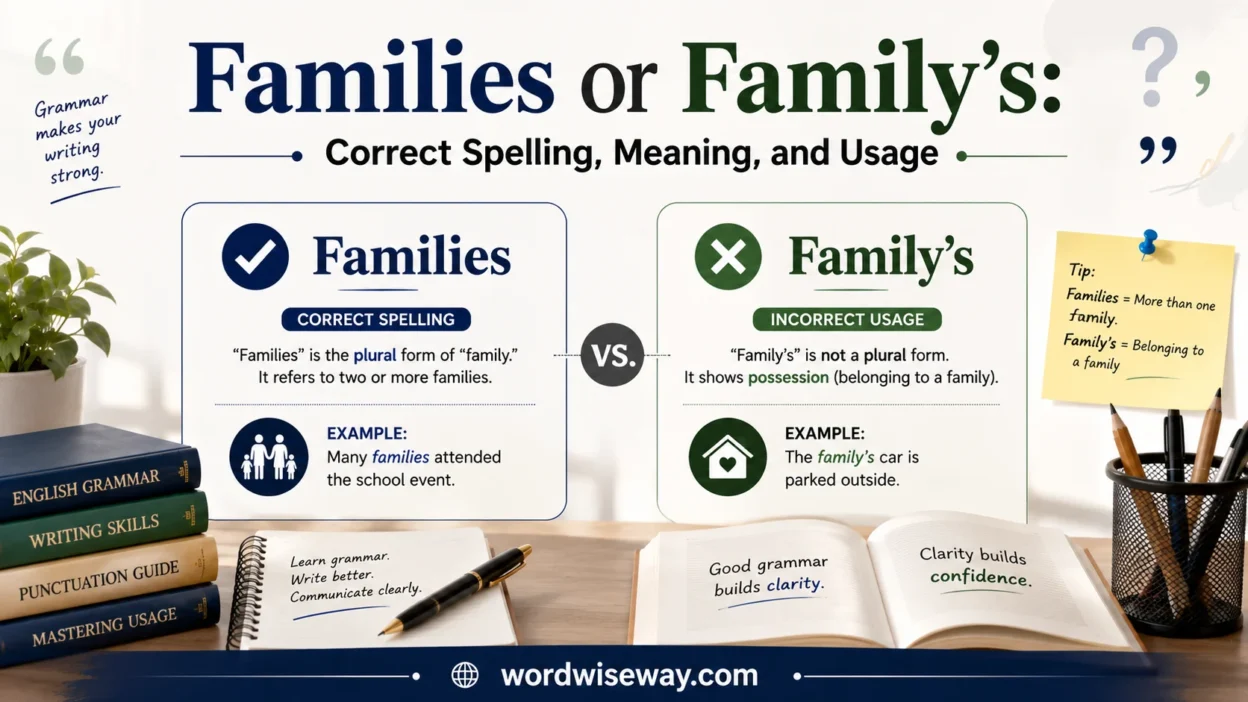
Many students, writers, and English learners face this spelling dilemma while writing. Families is the plural form of family, meaning more than one family, while family’s shows ownership or belonging. The spelling rules follow a simple pattern where a consonant before y changes the word ending, creating families, not familys.
This guide provides clear examples and helpful tips to understand these related forms. Learning these grammar rules improves sentence structure, formal writing, and English usage.
With practice, you can confidently avoid common mistakes and use the correct spellings in everyday communication, emails, and documents.
Quick Answer:
✅ Families = Use it when talking about more than one family (plural form).
Example: Many families joined the event.
✅ Family’s = Use it when showing ownership or belonging of one family (possessive form).
Example: My family’s home is beautiful.
❌ Familys = Incorrect spelling. The plural of family changes y to i and adds es.
📌 Remember: Multiple groups = families | Belonging = family’s. Use this simple rule to avoid spelling mistakes every time.
Families or Family’s: Which One Is Correct? The Core Idea
Let’s clear the fog right away.
These words are not interchangeable.
They serve completely different purposes:
- Family → one group
- Families → more than one group
- Family’s → something belongs to one family
- Families’ → something belongs to multiple families
That tiny apostrophe is not decoration. It signals ownership, not quantity.
A quick quote to lock it in:
“An apostrophe shows possession, not plural form.”
Once you understand that, the confusion starts to fade fast.
Why “Families or Family’s” Confuses So Many Writers
English loves exceptions, but this confusion comes from pattern overload.
Here’s what usually happens:
- People learn that “’s” can show possession
- They then overapply it to plurals
- They assume more words need apostrophes for “style”
- Fast typing leads to guessing instead of checking
On top of that, spoken English hides punctuation completely. You hear “families” and “family’s” the same way, even though they behave differently in writing.
So the mistake feels natural, even when it’s wrong.
“Families” Explained (Plural Form Without Apostrophe)
What “Families” Means
The word families simply means more than one family.
No ownership. No possession. Just counting groups.
Think of it like this:
- One family = a single unit
- Multiple families = several units
Correct Usage Examples
- Families gather in the park every Sunday
- Many families moved into the new housing project
- Different families celebrate traditions in unique ways
Common Mistake
A very common error looks like this:
- ❌ Familys (incorrect spelling)
- ❌ Family’s (wrong use for plural)
Simple Rule
If you are only talking about quantity, never use an apostrophe.
👉 Just add -ies
“Family’s” Explained (Singular Possessive Form)
What “Family’s” Means
Now we enter ownership territory.
Family’s means something belongs to one family.
Structure:
family + ’s = possession
Real Examples
- The family’s house is near the river
- I visited the family’s new restaurant
- The family’s tradition is celebrated every year
Easy Way to Think About It
Ask yourself:
Does this belong to one family?
If yes, use family’s.
Common Confusion Trap
Many writers mistakenly think:
- “Family’s” means more than one family
That is incorrect.
The apostrophe does not make things plural. It signals ownership.
“Families’” Explained (Plural Possessive Form)
What “Families’” Means
This form is used when something belongs to multiple families.
Structure:
families + ’ = shared possession
Notice something important here:
The apostrophe moves to the end.
Real Examples
- The families’ opinions were divided
- The park is designed for the families’ gatherings
- The families’ homes were affected by the flood
Why This Form Matters
This version appears often in:
- Community projects
- Housing developments
- School districts
- Public infrastructure
It shows shared ownership across groups.
Families vs Family’s vs Families’ (Clear Comparison Table)
| Word | Type | Meaning | Example |
| Family | Singular noun | One group | The family is at home |
| Families | Plural noun | More than one group | Families live here |
| Family’s | Singular possessive | Belonging to one family | The family’s car is new |
| Families’ | Plural possessive | Belonging to multiple families | Families’ needs vary |
This table alone solves most confusion instantly.
A Simple Grammar Truth That Changes Everything
Here’s the core rule:
Apostrophes show possession, not plural form.
Once you internalize this, English becomes far more predictable.
Let’s test it:
- Dog → Dogs (more than one dog)
- Dog’s → one dog owns something
- Dogs’ → multiple dogs own something
Now apply the same logic:
- Family → Families
- Family’s → one owns something
- Families’ → many own something
Same system. Different words.
Why People Keep Mixing Up Families or Family’s
There are four main reasons this error spreads:
1. Speed Writing
People type fast and skip grammar checks.
2. Social Media Habits
Platforms often reward speed over accuracy.
3. Overgeneralized Rules
Learners think:
“Add ’s for everything related to ownership”
4. Visual Similarity
“Families” and “family’s” look almost identical at a glance.
That’s enough to trick even careful readers.
Real-World Case Study: Grammar Error in Public Writing
Let’s look at a realistic scenario.
Case: Community Notice Board Error
A housing society posted:
❌ “All family’s are invited to the event”
What Went Wrong
Two issues:
- “Family’s” incorrectly used as plural
- Apostrophe misused for quantity instead of possession
Correct Version
✔ “All families are invited to the event”
Why It Matters
Small grammar mistakes like this can:
- Make communication look unprofessional
- Confuse readers
- Reduce credibility of institutions
Even a single apostrophe can change perception.
Quick Memory Tricks to Never Mix Them Up Again
Here are practical shortcuts you can actually use.
The Ownership Test
Replace the phrase with “belonging to.”
- If it works → use apostrophe
- If it doesn’t → no apostrophe
Example:
- The family’s car → the car belonging to the family ✔
- Families gathered → belonging doesn’t fit ✘
The Counting Rule
Ask:
Am I counting groups?
- Yes → families
- No → consider possession
The “S vs ’S” Shortcut
- Just “s” = plural
- Apostrophe + s = ownership
Simple. Clean. Reliable.
Common Mistakes and Fixes (Real Examples)
Here are real patterns people get wrong:
1
- ❌ Families’s house is big
- ✔ The family’s house is big
2
- ❌ Family’s are welcome here
- ✔ Families are welcome here
3
- ❌ The families opinion matters
- ✔ The families’ opinion matters
Practical Usage Guide for Writers
If you’re writing an essay, blog, or caption, use this checklist:
1: Identify quantity
- One family or many?
2: Check ownership
- Does something belong to them?
3: Choose correct form
- family
- families
- family’s
- families’
4: Read it out loud
If it sounds awkward, recheck apostrophe placement.
Why Mastering This Improves Your Writing
This may feel like a small detail, but it has real impact.
Correct usage helps you:
- Write more clearly
- Look more professional
- Avoid misunderstanding
- Build stronger communication habits
Grammar is not decoration. It’s clarity engineering.
Quick Recap: Families or Family’s: Which One Is Correct?
Let’s simplify everything:
- Families → more than one family
- Family’s → something belongs to one family
- Families’ → something belongs to many families
And the golden rule:
Apostrophes show possession, never plurality.
Read More: Hers or Her’s: Correct Spelling, Meaning, and Usage Explained
FAQs
What is the correct spelling, families or familys?
The correct spelling is families. The word familys is incorrect because English spelling rules change the ending y to i and add es when making the plural form of words like family.
Is family’s the same as families?
No, family’s and families have different meanings. Families means more than one family, while family’s shows that something belongs to one family.
Why does family become families in plural form?
The word family ends with a consonant before y. According to English spelling rules, the y changes to i and es is added, creating families.
Can I use familys in formal writing?
No, familys is a common spelling error and should never be used in formal writing, emails, documents, or professional communication.
How can I remember the difference between families and family’s?
A simple way is to check the meaning. If you are talking about multiple groups, use families. If you are showing ownership, use family’s.
What does families mean in a sentence?
Families is the plural form of family. It refers to two or more family groups, such as “Many families attended the event.”
What does family’s show?
Family’s is a possessive form that shows belonging or ownership. For example, “The family’s home” means the home belongs to one family.
Are families and families’ different?
Yes, they are different. Families refers to multiple families, while families’ shows ownership by more than one family.
Why do writers confuse families and family’s?
Many writers confuse them because both words look similar. The difference depends on grammar, sentence structure, and whether the meaning is plural or possessive.
How can I use families and family’s correctly?
Understanding the meaning, context, and grammar rules helps you choose the correct form. Practice with examples to build confidence in English writing.
Conclusion
Understanding the difference between families, family’s, and families’ makes your writing clearer and more professional. Although these words look similar, each one has a specific purpose in English grammar. Families describes multiple family groups, while family’s shows ownership by one family.
Learning these simple spelling rules helps students, writers, and English learners avoid common mistakes. With regular practice and attention to sentence meaning, you can confidently use these forms correctly in everyday writing, formal documents, emails, and professional communication.