Have you ever received a text that simply said “FR” and wondered what the sender meant? You’re not alone. Short abbreviations appear everywhere in text messages, social media comments, and online conversations. Understanding them helps you follow the conversation without guessing what someone is trying to say.
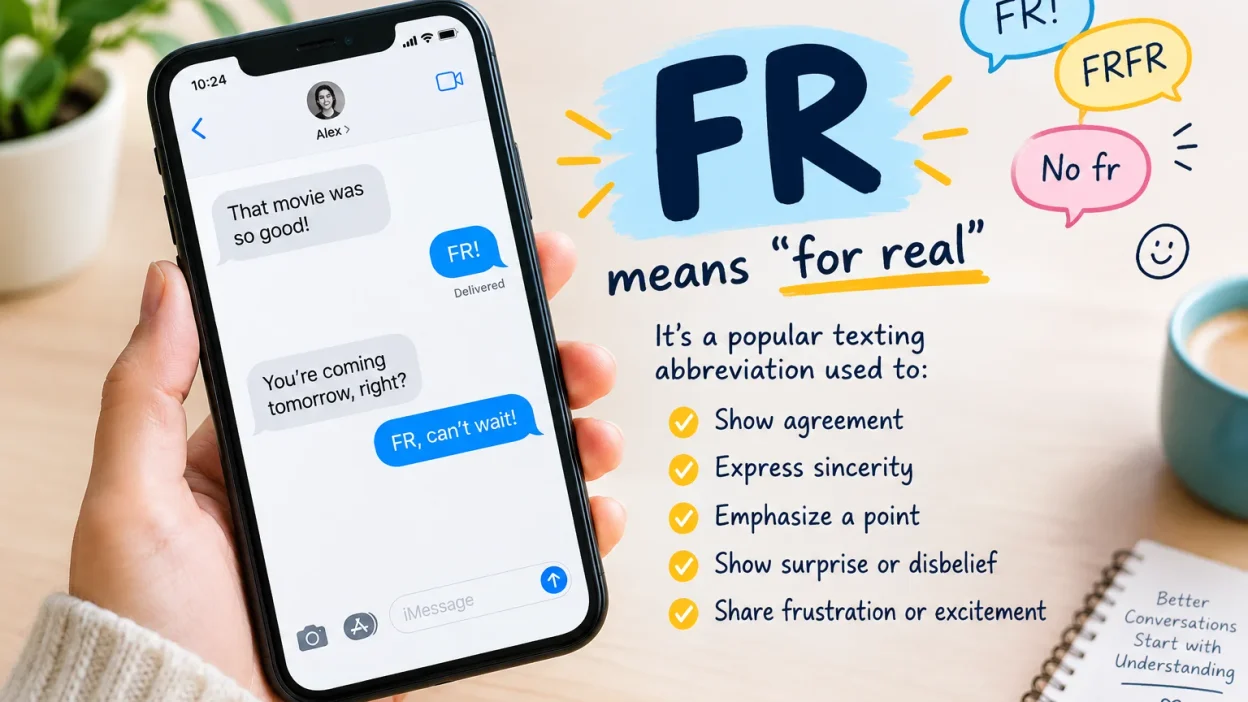
The FR meaning in text is usually “for real.” People use it to show agreement, express genuine feelings, emphasize an opinion, or react to something surprising. For example, if your friend texts, “That movie was amazing fr,” they’re emphasizing that they genuinely enjoyed it. Similarly, someone might reply “FR?” when they find something hard to believe.
However, FR doesn’t always communicate the same emotion. Depending on the conversation, it can express excitement, frustration, sincerity, or disbelief. You’ll also encounter related abbreviations such as FRFR, which means “for real, for real,” and expressions like “no fr,” which often emphasize agreement or honesty.
Quick Answer: What Does FR Mean in Text?
FR stands for “for real” in texting and online slang. It’s an informal abbreviation that people use to express agreement, emphasize a statement, or ask whether something is true.
Here are a few common examples:
- “FR, that’s amazing!” — The sender genuinely thinks something is amazing.
- “You’re moving next week? FR?” — The sender is surprised and wants confirmation.
- “This homework is exhausting fr.” — The sender emphasizes their frustration.
- “FRFR, I agree with you.” — The sender strongly emphasizes their agreement.
The simplest way to understand FR is to replace it with “for real” and see whether the sentence still makes sense. In most casual conversations, that substitution reveals the intended meaning.
What Does FR Stand For?
FR stands for “for real,” an informal English expression used to talk about truth, sincerity, or genuine feelings. In digital conversations, people shorten the phrase to two letters because the meaning is usually clear from context.
Think of FR as a small emphasis marker. It can strengthen an opinion, confirm another person’s statement, or question whether something really happened.
Consider these examples:
- “I’m serious fr.” — I’m genuinely serious.
- “FR, that was unfair.” — I genuinely think that was unfair.
- “You won the lottery? FR?” — Did that really happen?
The abbreviation doesn’t always translate into the same words. Sometimes it means “seriously,” while other times it means “I agree” or “Are you kidding me?” The surrounding conversation determines the most natural interpretation.
According to contemporary explanations of internet slang, FR commonly serves both as a standalone response and as an addition to a sentence. 【turn714172search0】【turn714172search8】
How Is FR Used in Text Messages?
FR has several everyday uses, and recognizing them makes online conversations easier to understand. The same two letters can express agreement, sincerity, surprise, or frustration without requiring a complete sentence.
FR to Show Agreement
One of the most common uses of FR is to agree with someone. When a friend shares an opinion you strongly support, replying “FR” tells them you feel the same way.
For example:
Friend: “Mondays should be optional.”
You: “FR.”
Your response means something like “Absolutely” or “I couldn’t agree more.” You don’t need to repeat the original statement because FR communicates your agreement.
Here are a few more examples:
- “That restaurant has the best burgers.” — “FR.”
- “Group projects are exhausting.” — “FR, seriously.”
- “This song deserves more attention.” — “FR, it’s so good.”
When to use it: Use FR when you want to agree quickly in a casual conversation. It’s especially natural when someone expresses an opinion or feeling you share.
FR to Emphasize Honesty
FR can also show that you’re telling the truth or speaking sincerely. In this case, it reinforces your statement rather than simply agreeing with another person.
Imagine that your friend thinks you’re exaggerating about how difficult an exam was. You might reply:
“FR, that was the hardest test I’ve taken all year.”
Here, FR emphasizes that you genuinely believe what you’re saying.
Other examples include:
- “FR, I didn’t see your message.”
- “I’m not upset with you fr.”
- “FR, I really appreciate your help.”
This use is helpful when you want to make your meaning clear without writing a long explanation. However, FR alone doesn’t prove that a statement is true. It only communicates the sender’s intended tone.
FR to Express Surprise or Disbelief
Have you ever heard unexpected news and immediately asked, “Really?” That’s precisely how FR can work in a text message.
When someone adds a question mark, “FR?” usually means “For real?” or “Are you serious?”
For example:
Friend: “I met my favorite singer yesterday.”
You: “FR? That’s amazing!”
Your reply shows surprise and asks for confirmation at the same time.
More examples:
- “You finished the entire project today? FR?”
- “She got accepted into her dream college? FR!”
- “Wait, you’re moving abroad? FR?”
Punctuation changes the tone here. “FR?” sounds like a question, while “FR!” can express excitement or amazement.
FR to Show Frustration
Sometimes FR adds weight to a complaint. It tells the reader that the frustration feels genuine rather than casual or exaggerated.
For instance:
“FR, this traffic is ridiculous.”
The sender isn’t necessarily asking a question. They’re emphasizing how annoyed they feel.
Other examples include:
- “FR, my internet keeps disconnecting.”
- “This assignment is taking forever fr.”
- “FR, why does everything cost so much?”
Notice that FR doesn’t create the frustration on its own. The surrounding words communicate the complaint, while FR makes the emotion more emphatic.
FR to Emphasize a Compliment or Opinion
FR can strengthen a positive statement, too. People use it to emphasize praise, recommendations, and personal opinions.
Examples:
- “You did an amazing job fr.”
- “That book changed my perspective fr.”
- “FR, your presentation was excellent.”
In these messages, FR signals genuine enthusiasm or confidence in the opinion. It doesn’t automatically make a compliment romantic or flirtatious. The relationship between the people and the rest of the conversation matter more.
Read More: WYM Meaning in Text: Definition, Real Examples and Best Reply
What Does FR Mean at the End of a Sentence?
When FR appears at the end of a sentence, it usually emphasizes the statement that comes before it.
For example:
- “I’m exhausted fr.”
- “That movie was incredible fr.”
- “We need a vacation fr.”
- “She explains everything so clearly fr.”
In each case, you can mentally replace FR with “for real” or “seriously.” The sentence still makes sense, although the exact wording may sound slightly different.
This placement is common in casual writing because the sender can make a statement first and add emphasis at the end. Lowercase “fr” often blends naturally into informal messages.
Example conversation
Alex: “I think we studied for six hours yesterday.”
Jordan: “More like eight hours fr.”
Jordan uses FR to emphasize the claim and reinforce the shared experience.
What Does FR Mean at the Beginning of a Sentence?
At the beginning of a sentence, FR often introduces a strong opinion, sincere statement, or reaction.
Examples include:
- “FR, that was the best concert I’ve ever attended.”
- “Fr, I need to get more sleep.”
- “FR, you should apply for that job.”
- “FR, I didn’t expect the ending.”
Here, FR sets the tone before the main point. It tells the reader to interpret the following statement as a genuine opinion or an emphatic reaction.
Compare these two sentences:
| Sentence | Meaning |
| “That restaurant is great fr.” | The sender emphasizes their opinion after stating it. |
| “FR, that restaurant is great.” | The sender emphasizes the opinion before stating it. |
Both are natural in informal conversation. The difference is mainly emphasis and writing style, not the core meaning.
What Does FRFR Mean in Text?
FRFR means “for real, for real.” It’s an intensified version of FR that people use to emphasize sincerity, agreement, or a strong reaction.
For example:
- “FRFR, that was the best meal I’ve had in months.”
- “I’m tired frfr.”
- “You need to take a break frfr.”
- “FRFR, I agree with every word.”
The repeated abbreviation adds emphasis. It can communicate that someone feels particularly strongly about a statement or wants to make sure the reader understands their sincerity.
However, FRFR doesn’t always indicate serious emotion. In some online conversations, people use it playfully or ironically.
FR vs. FRFR
| Expression | Full form | Typical meaning |
| FR | For real | Agreement, sincerity, or emphasis |
| FRFR | For real, for real | Stronger emphasis or insistence |
Example:
Friend: “You really think I should start my own business?”
You: “FRFR. You’ve got a solid plan.”
The second response reinforces the recommendation and shows that you’re serious about it.
What Does No FR Mean in Text?
“No fr” combines “no” with “for real.” Depending on the conversation, it can emphasize agreement, introduce a serious statement, or reinforce a person’s honesty.
For example:
Friend: “That exam was ridiculously difficult.”
You: “No fr, I wasn’t prepared for those questions.”
Your response means something like “Honestly, yes” or “Seriously, I agree.”
Here are other examples:
- “No fr, I need to start sleeping earlier.”
- “No fr, I’m telling you the truth.”
- “No fr, that was completely unexpected.”
- “No fr, we should plan something this weekend.”
The phrase can also signal a shift from joking to sincerity. Someone might joke about a situation before adding “no fr” to introduce what they genuinely think.
The exact meaning depends on the exchange. Don’t assume every use of “no fr” has an identical interpretation.
What Does FR Mean on Social Media?
FR works much like ordinary texting slang on social media. People use it in comments, captions, replies, and direct messages to communicate quickly.
FR on TikTok
On TikTok, FR may appear in comments reacting to a video, opinion, joke, or personal story.
Examples:
- “FR, this is exactly what happens to me.”
- “That ending was wild fr.”
- “FRFR, this creator deserves more recognition.”
A standalone “fr” generally indicates agreement with the original post or another comment. The video and surrounding discussion usually reveal the intended tone.
FR on Instagram
Instagram users may add FR to comments, captions, or direct messages.
For example:
- “Best weekend ever fr.”
- “FR, your photos look amazing.”
- “This outfit is perfect fr.”
In a comment thread, FR can acknowledge someone’s opinion without requiring a detailed reply. In a direct message, it can help convey sincerity or shared enthusiasm.
FR on Snapchat
Snapchat conversations often involve short, informal exchanges. FR fits that style because it communicates agreement or emphasis in just two letters.
For example:
Friend: “We stayed up way too late last night.”
You: “FR 😭”
The abbreviation communicates agreement, while the crying emoji may add humor or exaggeration.
FR on WhatsApp and Other Messaging Apps
FR has the same basic meaning in WhatsApp messages, Discord chats, gaming conversations, and group texts.
Examples:
- “FR, we need to meet up soon.”
- “That game was so difficult fr.”
- “FR? You beat the final level already?”
The platform doesn’t usually change the meaning. The conversation itself provides the clues you need to interpret it.
FR vs. FRFR vs. ONG: What’s the Difference?
FR, FRFR, and ONG all help people emphasize a statement in casual online conversations. However, they don’t express precisely the same idea.
| Slang | Full form | How people use it | Example |
| FR | For real | Agreement or sincerity | “That game was incredible fr.” |
| FRFR | For real, for real | Stronger emphasis | “FRFR, I’m serious.” |
| ONG | On God | Emphasizing sincerity or making a strong assertion | “ONG, I’m telling the truth.” |
| TBH | To be honest | Introducing an honest opinion | “TBH, I prefer the original.” |
| ISTG | I swear to God | Expressing strong feelings, frustration, or insistence | “ISTG, this traffic never ends.” |
These abbreviations overlap, but context determines which one sounds most natural. FR often confirms a shared opinion, while TBH introduces a personal viewpoint. ONG and ISTG can carry a stronger sense of insistence.
For example, “FR, that was unfair” emphasizes agreement or conviction. By contrast, “TBH, that was unfair” presents the statement as an honest opinion.
You don’t need to memorize every slang term. Understanding the main meaning and tone of each expression is usually enough to follow the conversation.
How to Reply to FR in a Text
The best response to FR depends on what the other person means. Sometimes they’re agreeing with you. Other times, they’re asking whether you’re serious.
When Someone Uses FR to Agree
If someone replies “fr” after you share an opinion, you can acknowledge their agreement or continue the conversation.
Try these responses:
- “Exactly!”
- “I know, right?”
- “That’s what I’m saying.”
- “Glad you agree.”
- “Right? It’s unbelievable.”
Example:
You: “This semester has been exhausting.”
Friend: “FR.”
You: “Hopefully, next semester is easier.”
The conversation moves forward naturally because you recognize the agreement and add something relevant.
When Someone Asks “FR?”
A message containing “FR?” usually asks whether something is true. Answer directly rather than assuming the sender is challenging you.
Possible replies include:
- “Yeah, seriously.”
- “For real!”
- “I’m not joking.”
- “Yep, it actually happened.”
- “No, I was kidding.”
Example:
Friend: “You got the internship?”
You: “Yeah, for real! I got the confirmation this morning.”
Your answer confirms the news and removes any uncertainty.
When Someone Uses FR to Express Frustration
When someone writes FR while complaining, a little empathy can be more helpful than a simple acknowledgment.
You could say:
- “I feel you.”
- “Same here.”
- “That’s so frustrating.”
- “Hopefully, it gets better.”
- “I know exactly what you mean.”
For example, if your friend says, “FR, this assignment is never-ending,” you might reply, “Same here. I’ve been working on mine all afternoon.”
That response recognizes their frustration and keeps the exchange friendly.
When Someone Uses FR to Emphasize a Compliment
If someone uses FR to stress a compliment, accept it naturally. You don’t need to interpret the abbreviation as a hidden romantic signal.
Possible responses include:
- “Thank you!”
- “That’s really kind of you.”
- “I appreciate that.”
- “Glad you liked it.”
- “That means a lot.”
The relationship and surrounding messages provide more reliable clues about someone’s intentions than FR alone.
Is FR Rude or Inappropriate?
No, FR isn’t inherently rude or offensive. It’s a casual abbreviation for “for real” that usually communicates agreement, sincerity, or emphasis.
Still, the same abbreviation can sound different depending on punctuation and context.
Consider these examples:
- “FR?” — May express genuine surprise or ask for confirmation.
- “Bro, FR?” — May sound surprised, skeptical, or mildly annoyed.
- “FR, thank you so much!” — Emphasizes sincere gratitude.
- “FR, stop doing that.” — Adds emphasis to a direct request.
The abbreviation itself doesn’t determine whether a message sounds friendly or confrontational. The surrounding words, relationship, and tone all matter.
Is FR Appropriate in Professional Messages?
FR generally belongs in informal conversations rather than formal business writing.
| Situation | Is FR appropriate? | Better approach when formality matters |
| Texting a close friend | Yes | Use FR naturally |
| Commenting on a funny video | Yes | Keep the tone casual |
| Messaging a classmate | Usually | Match the classmate’s tone |
| Emailing a professor | Usually not | Write “seriously” or “I agree” |
| Sending a job application | No | Use complete, professional sentences |
| Writing an academic paper | No | Express the idea precisely |
For example, instead of writing “FR, I agree with your proposal” in a formal email, write “I agree with your proposal.”
The message remains clear without relying on slang.
Is FR Still Used in Texting?
FR remains recognizable in contemporary online slang and continues to appear in casual digital conversations. Current explanations of texting abbreviations describe it as a common shorthand for “for real.” 【turn714172search8】【turn714172search4】
People use it because it’s brief, flexible, and easy to understand when both participants know the expression.
However, slang popularity varies between communities, age groups, and platforms. Not everyone uses FR, and you don’t need to add it to every message to sound natural.
The best approach is simple: understand the expression first, then use it when it fits your usual communication style.
Does FR Have Other Meanings?
Although FR usually means “for real” in casual texting, the same letters can represent something else in a different setting.
Context is especially important when you encounter FR in technical documents, travel information, or professional communication.
| Meaning | Where you might encounter it |
| For real | Text messages, social media, and online chats |
| France | Country codes and international information |
| French | Language settings and language labels |
| Functional requirements | Software development and business documentation |
| Federal Register | US government publications and legal references |
Capitalization and formatting can provide clues, but they don’t always settle the meaning.
For example, “FR, that was amazing” almost certainly uses the slang meaning. A field labeled “FR” in an international shipping form might instead refer to France.
Likewise, technical documentation may use FR as shorthand for functional requirements. In that situation, interpreting it as “for real” would make no sense.
The key rule: Read the abbreviation in context rather than assuming every occurrence has the same definition.
35 Examples of FR Meaning in Text
These examples show how people use FR in different conversations. Each one includes a short explanation so you can understand the intended meaning rather than memorize isolated phrases.
1.FR Examples for Agreement
| Example | Meaning |
| “That song is so good fr.” | The sender genuinely likes the song. |
| “FR, I completely agree.” | The sender strongly agrees. |
| “This weather is perfect fr.” | The sender emphasizes their enjoyment. |
| “You said exactly what I was thinking fr.” | The sender shares the same opinion. |
| “FR, that was a smart decision.” | The sender strongly supports the decision. |
2.FR Examples for Surprise
| Example | Meaning |
| “FR? You met him?” | The sender wants confirmation. |
| “Wait, fr?” | The sender is surprised. |
| “FR, they won the competition?” | The sender finds the result unexpected. |
| “You got tickets? FR?” | The sender wants to know whether it’s true. |
| “FR, I wasn’t expecting that.” | The sender emphasizes their surprise. |
3.FR Examples for Honesty
| Example | Meaning |
| “FR, I’m telling the truth.” | The sender insists on being honest. |
| “I didn’t mean to hurt you fr.” | The sender emphasizes their sincerity. |
| “FR, I had no idea.” | The sender stresses that they didn’t know. |
| “I’m being serious fr.” | The sender wants to be taken seriously. |
| “FR, that’s what happened.” | The sender reinforces their account. |
4.FR Examples for Frustration
| Example | Meaning |
| “FR, I’m tired of this.” | The sender expresses genuine frustration. |
| “This app keeps crashing fr.” | The sender emphasizes their annoyance. |
| “FR, why is everything so expensive?” | The sender expresses frustration about prices. |
| “I’ve been waiting forever fr.” | The sender stresses how long the wait feels. |
| “FR, this assignment is difficult.” | The sender emphasizes the challenge. |
5.FR Examples for Compliments and Opinions
| Example | Meaning |
| “You look great fr.” | The sender emphasizes the compliment. |
| “That was an incredible performance fr.” | The sender strongly praises the performance. |
| “FR, your advice helped me.” | The sender sincerely appreciates the advice. |
| “This is my favorite show fr.” | The sender emphasizes their preference. |
| “She’s really talented fr.” | The sender reinforces their positive opinion. |
6.FR Examples in Everyday Conversations
| Example | Meaning |
| “FR, we need to catch up.” | The sender genuinely wants to reconnect. |
| “I’m hungry fr.” | The sender emphasizes their hunger. |
| “That trip was worth it fr.” | The sender strongly recommends or approves of the experience. |
| “FR, let’s make plans.” | The sender seriously wants to arrange something. |
| “I could sleep all day fr.” | The sender emphasizes how tired they feel. |
FRFR and Related Expressions
| Example | Meaning |
| “FRFR, that was amazing.” | The sender strongly emphasizes their reaction. |
| “No fr, I understand.” | The sender emphasizes agreement or sincerity. |
| “FR? Are you serious?” | The sender asks for confirmation. |
| “I need a break frfr.” | The sender strongly emphasizes the need for a break. |
| “FR, you should give it a try.” | The sender sincerely recommends something. |
A Short Case Study: Understanding FR Through Context
Imagine three friends discussing their weekend plans. One abbreviation appears in three different messages, but its function changes with each conversation.
Example conversation — fictional messages
Conversation A: Agreement
Mia: “That new restaurant has incredible food.”
Noah: “FR.”
Interpretation: Noah agrees with Mia’s opinion. He isn’t asking a question or expressing doubt.
Conversation B: Surprise
Mia: “I got a free ticket to the concert!”
Noah: “FR?”
Interpretation: Noah is surprised and wants to confirm that Mia really received the ticket.
Conversation C: Sincerity
Mia: “I’m genuinely grateful for your help fr.”
Noah: “I’m glad I could help.”
Interpretation: Mia uses FR to emphasize her gratitude.
The lesson is straightforward: FR doesn’t have one fixed emotional tone. Its basic meaning remains “for real,” but the conversation determines whether it expresses agreement, surprise, or sincerity.
FAQs
What does FR mean from a girl?
FR usually means “for real” when a girl uses it in a text. She might be agreeing with you, emphasizing an opinion, or expressing surprise. The abbreviation alone doesn’t indicate romantic interest.
What does FR mean from a guy?
The meaning is generally the same. A guy might use FR to show agreement, stress that he’s serious, or ask whether something is true. Look at the message and conversation rather than assuming a special meaning based on gender.
Does FR mean “for real” or “friend request”?
It can mean either, depending on the context. In a casual conversation, FR usually stands for “for real.” In a discussion about adding someone on social media, “friend request” might be the intended meaning.
What does FR mean when texting a crush?
FR usually means “for real” when texting a crush, just as it does in other conversations. It doesn’t automatically indicate attraction or flirtation. Consider the rest of the conversation before drawing conclusions about someone’s feelings.
What does FR mean when someone replies with just “fr”?
A standalone “fr” usually means “I agree,” “Seriously,” or “That’s true.” If someone says, “This week has been exhausting,” and you receive “fr,” they’re probably expressing the same feeling.
What does FR mean in Gen Z slang?
In Gen Z slang, FR stands for “for real.” It’s used to express agreement, sincerity, or emphasis in texts and social media conversations. However, people outside Gen Z use it too.
Is FR the same as FRFR?
Not exactly. FR means “for real,” while FRFR means “for real, for real.” The doubled form generally adds emphasis, although the precise tone depends on the conversation.
Should I use FR in professional messages?
FR is best suited to casual communication. In professional emails, reports, and formal documents, use complete expressions such as “I agree,” “seriously,” or “to be honest” when appropriate.
Visit Us: 6 Good Ways to Spell a Whistle Sound
Conclusion:
The FR meaning in text is usually “for real.” People use it to express agreement, emphasize honesty, show surprise, or strengthen an opinion. It’s a flexible abbreviation that makes casual digital conversations shorter and more expressive.
You might see FR at the beginning or end of a sentence, as a standalone reply, or with a question mark. Related expressions such as FRFR and “no fr” add emphasis or help communicate sincerity.
Remember that context matters more than the abbreviation alone. When you understand the conversation, it’s usually easy to identify what the sender means. Use FR freely in casual chats when it feels natural, but choose complete expressions for formal communication.

Evelyn Shaw has spent 14 years at Yale University’s English Department, leading students through close readings, genre studies, and interpretive methodologies. Her scholarly interests include Renaissance drama, gothic fiction, feminist literary criticism, and archival research and examining how texts generate meaning across historical periods. Evelyn has presented at major academic conferences and published essays in peer-reviewed journals, reflecting her passion for rigorous analysis and student-centered learning.