Optometrist or Ophthalmologist: Difference and Usage can help you understand eye care and choose the right specialist.
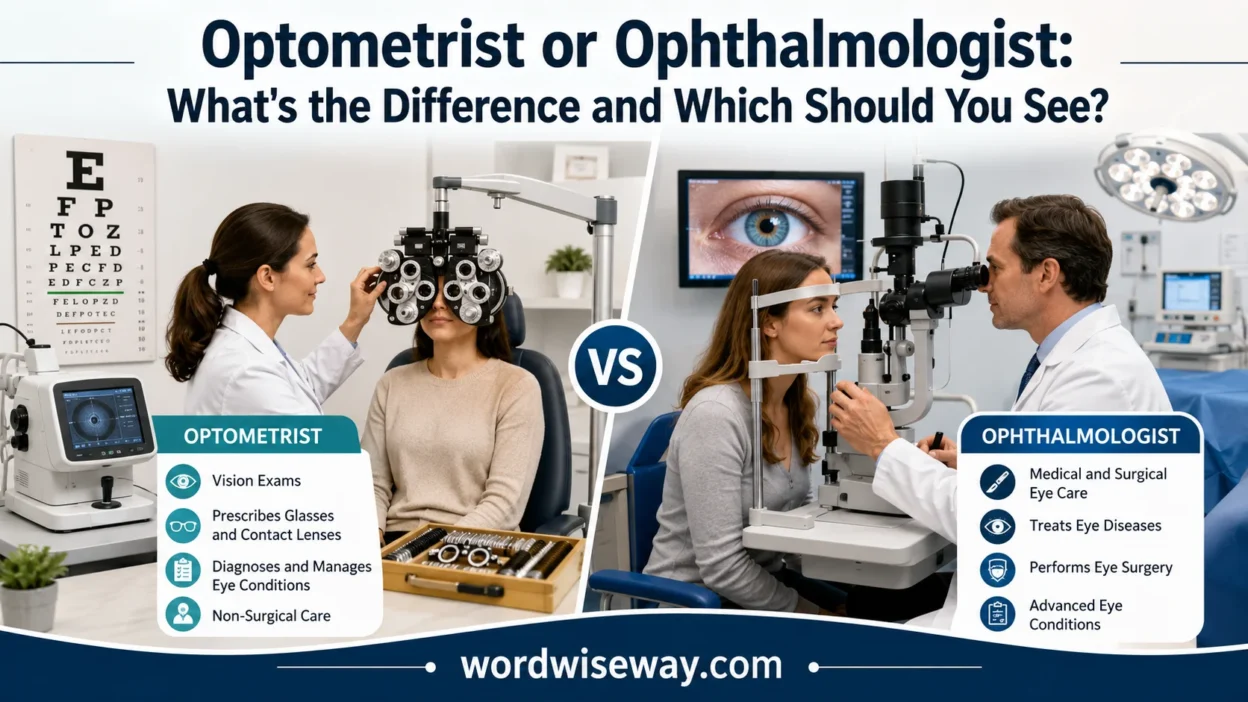
An optometrist handles a routine eye exam, comprehensive eye exam, and common vision problems. An ophthalmologist provides medical treatment and surgical treatment for serious eye diseases. Both are eye professionals, but their roles, training, and services differ.
For a first eye check-up, an optometrist may help with dry eyes and other common conditions. An ophthalmologist may treat cataracts and perform cataract removal. An optician handles your prescription and glasses, making sure they fit properly.
Knowing this difference helps you make informed decisions and schedule the right appointment.
Quick Answer:
For a routine eye exam, blurry vision, glasses, contact lenses, or common vision problems, an optometrist is often an appropriate first choice. Optometrists are trained to examine the eyes, diagnose vision problems, and manage many eye conditions within their legal scope of practice.
An ophthalmologist is generally the better choice when you have a known or suspected complex eye disease, need medical or surgical treatment, have a significant eye injury, or have been referred for specialized care. Ophthalmologists are medical doctors with advanced medical and surgical training and can diagnose and treat eye conditions, including those requiring surgery.
| Your situation | Usually appropriate |
| Routine eye examination | Optometrist or ophthalmologist |
| New glasses prescription | Optometrist or ophthalmologist |
| Contact lens prescription | Optometrist or ophthalmologist |
| Blurry vision | Optometrist or ophthalmologist |
| Suspected eye disease | Optometrist or ophthalmologist, depending on the problem |
| Complex eye disease | Ophthalmologist |
| Cataract evaluation | Ophthalmologist, particularly when surgery is being considered |
| Eye surgery | Ophthalmologist |
| Serious eye injury | Ophthalmologist or appropriate emergency eye care |
| Ongoing diabetes-related eye monitoring | Optometrist or ophthalmologist |
| Referral for advanced treatment | Ophthalmologist |
The important point is that optometrist vs. ophthalmologist isn’t a contest. These professionals can have complementary roles in eye care.
What Is an Optometrist?
An optometrist is a doctor of optometry, commonly holding an O.D. degree in the United States. Optometrists provide primary eye and vision care and are trained to examine the eyes, evaluate vision, diagnose and manage many eye disorders, and prescribe corrective lenses. Many also prescribe medications within the scope allowed by the jurisdiction where they practice.
An optometrist’s work goes well beyond checking whether you can read the smallest line on an eye chart. A comprehensive examination can evaluate both how well you see and whether your eyes appear healthy.
For example, an optometrist may identify a refractive error such as:
- Nearsightedness
- Farsightedness
- Astigmatism
- Presbyopia
Refractive errors can cause blurred vision, headaches, eye strain, squinting, glare, or difficulty focusing. A comprehensive eye exam can help identify the problem and determine whether glasses or contact lenses are appropriate.
Optometrists can also detect findings that need further medical evaluation. If an examination reveals a condition outside the optometrist’s scope or one that requires specialized treatment, the patient may be referred to an ophthalmologist.
When Should You See an Optometrist?
An optometrist can be a practical starting point when you need:
- A routine comprehensive eye exam
- A new glasses prescription
- Contact lens evaluation
- Evaluation of blurry or changing vision
- Assessment of common refractive errors
- Monitoring of certain eye conditions
- Evaluation of some symptoms affecting the eyes
- Ongoing primary eye care
A useful rule is simple: if your main concern involves vision or routine eye health, an optometrist may be the right first stop.
That doesn’t mean an optometrist will always be the final stop. If the examination uncovers something more complicated, referral can become part of the process.
What Is an Ophthalmologist?
An ophthalmologist is a medical doctor who specializes in eye care. Ophthalmologists receive medical training followed by specialized training in ophthalmology. Their education prepares them to diagnose and treat eye diseases and perform eye surgery.
That surgical training is one of the clearest differences between the two professions.
An ophthalmologist can provide routine eye care, prescribe glasses or contact lenses, diagnose eye diseases, use medical treatments, and perform appropriate surgical procedures. The National Institutes of Health also distinguishes ophthalmologists as medical doctors who treat eye diseases and perform eye surgery.
Ophthalmology also includes several subspecialties. Depending on the condition, a patient may see an ophthalmologist who focuses on areas such as:
- Retina
- Cornea
- Glaucoma
- Pediatric ophthalmology
- Neuro-ophthalmology
- Oculoplastic surgery
This specialized training becomes especially valuable when an eye problem is complicated or requires a procedure.
When Should You See an Ophthalmologist?
An ophthalmologist may be appropriate when you have:
- A diagnosed eye disease requiring specialist care
- A condition that may require surgery
- Cataracts
- Complex glaucoma
- Retinal disease
- Significant eye trauma
- A complicated medical eye condition
- A referral from another eye-care professional
The American Academy of Ophthalmology describes ophthalmologists as eye doctors with advanced medical and surgical training who can diagnose and treat eye conditions.
The Main Differences
The biggest difference lies in medical and surgical training, not in whether one professional can perform an eye examination.
optometrists and ophthalmologists can perform eye examinations. Both may evaluate vision. Both can prescribe corrective lenses. The distinction becomes more important when the patient needs complex medical treatment or surgery.
| Difference | Optometrist | Ophthalmologist |
| Professional degree in the U.S. | Doctor of Optometry (O.D.) | Medical degree (M.D. or D.O.) |
| Eye examinations | Yes | Yes |
| Vision testing | Yes | Yes |
| Glasses prescriptions | Yes | Yes |
| Contact lenses | Yes | Yes |
| Eye disease diagnosis | Yes, within scope | Yes |
| Medical treatment | Within scope of practice | Yes |
| Surgical training | Not equivalent to ophthalmology | Yes |
| Eye surgery | Limited by jurisdiction and procedure | Yes |
| Complex eye disease | May manage or refer | Yes |
| Primary eye care | Yes | Yes |
Scope-of-practice laws differ by jurisdiction. That matters because an optometrist’s permitted use of medications or procedures isn’t identical everywhere. A reliable article should never assume that rules in one U.S. state automatically apply in another country or region.
How Much Training Does Each Professional Receive?
Training helps explain why these professions overlap in some areas but diverge in others.
In the United States, optometrists complete undergraduate education followed by four years of professional optometry education leading to the O.D. degree. Some optometrists then complete additional residency training in a particular area of practice.
Ophthalmologists follow the medical-school pathway. They become physicians and then complete specialized ophthalmology training. Some pursue additional fellowship training in a subspecialty.
That difference matters because ophthalmology training includes both medical and surgical management of eye conditions.
Neither path should be viewed as a shortcut version of the other. Each profession has a distinct role in the health-care system.
What Happens During an Eye Exam?
A comprehensive eye exam isn’t simply a vision test.
During a standard eye examination, the eye-care professional may ask about your symptoms, medical history, medications, family history, glasses, and contact lenses. Visual acuity is commonly checked using an eye chart, followed by other tests based on your needs.
Depending on the examination, the clinician may evaluate:
- Visual acuity
- Refraction
- Eye movements
- Pupillary responses
- Eye pressure
- External eye structures
- Internal eye structures
- Retina and optic nerve
- Visual fields
Some examinations also involve dilating the pupils so the clinician can get a better view of the back of the eye.
This is important because certain eye diseases can develop before noticeable vision changes appear. Diabetes provides a good example. Diabetic retinopathy can damage the retina without causing obvious symptoms during its early stages, which is why regular eye examinations matter for people with diabetes.
Can an Optometrist Diagnose Eye Diseases?
Yes. The idea that optometrists only prescribe glasses is outdated.
Optometrists are trained to examine the eyes and diagnose and manage many eye conditions within their scope of practice. The exact conditions and treatments they can provide depend on local regulations.
For example, an optometrist may discover signs that suggest glaucoma during an eye examination. Tests for glaucoma can include measurements of eye pressure and evaluation of the optic nerve and visual field.
If the condition requires care beyond the optometrist’s scope, the patient can be referred to an ophthalmologist.
That referral isn’t a failure of the first appointment. It’s often exactly how coordinated eye care is supposed to work.
Can an Ophthalmologist Prescribe Glasses?
Yes.
An ophthalmologist can perform vision examinations and prescribe glasses or contact lenses. However, you don’t necessarily need an ophthalmologist every time you need a new prescription.
For straightforward vision correction, an optometrist may provide the care you need. If the examination also reveals a medical eye condition, an ophthalmologist may become involved.
Think of it in practical terms: you don’t need a surgeon simply because you need a prescription.
Can an Optometrist Perform Eye Surgery?
This question needs a careful answer because laws differ by location.
Ophthalmologists receive dedicated medical and surgical training and perform eye surgery. The American Academy of Ophthalmology specifically identifies surgical care as part of ophthalmology.
Some jurisdictions allow optometrists to perform certain procedures. The American Optometric Association notes that optometrists may perform certain surgical procedures depending on applicable laws.
Therefore, avoid the blanket statement that no optometrist anywhere can perform any procedure. That’s too broad.
The safer distinction is that ophthalmologists are physicians specifically trained to provide surgical eye care, while the procedures available to optometrists depend on local scope-of-practice rules.
Optometrist or Ophthalmologist for Blurry Vision?
For ordinary blurry vision, an optometrist can be an appropriate first choice.
Blurry vision can result from a refractive error such as nearsightedness, farsightedness, astigmatism, or presbyopia. An eye examination can determine whether corrective lenses may improve vision.
However, blurry vision isn’t always a simple prescription problem.
If the change is sudden, severe, or accompanied by other concerning symptoms, medical evaluation becomes more important. A comprehensive eye examination can help determine whether the problem is refractive or related to another eye condition.
Optometrist or Ophthalmologist for Cataracts?
When cataracts become significant enough to require surgical evaluation, an ophthalmologist is generally the relevant specialist because cataract surgery requires a surgeon.
An optometrist may still play an important role before or after surgery. For example, a patient may have routine vision care with an optometrist and receive surgical evaluation from an ophthalmologist.
This is another example of why the two professions can work together rather than compete.
Optometrist or Ophthalmologist for Glaucoma?
Both professionals may be involved in glaucoma care.
Glaucoma testing can involve several examinations, including eye-pressure measurement and evaluation of the optic nerve and visual field. MedlinePlus notes that glaucoma testing may be performed by either an optometrist or ophthalmologist, depending on the circumstances.
The appropriate professional depends on factors such as:
- Whether glaucoma is suspected or already diagnosed
- How advanced the condition is
- Whether treatment is working
- Whether surgery or advanced procedures may be needed
- The clinician’s scope and expertise
For complex or advanced disease, ophthalmology care may become particularly important.
Optometrist or Ophthalmologist for Diabetes?
People with diabetes need regular eye care because diabetes can damage the retina and increase the risk of several eye problems.
Diabetic retinopathy can develop without obvious symptoms in its early stages. A dilated retinal examination allows the eye doctor to inspect the back of the eye more closely.
Both optometrists and ophthalmologists can participate in diabetes-related eye care. The right professional depends on the patient’s condition and the level of treatment required.
A Practical Example
Case study: Imagine someone with diabetes who has no noticeable vision problems. During a comprehensive eye exam, the clinician notices retinal changes that need closer evaluation.
The patient may then be referred to an ophthalmologist for specialized assessment or treatment. The key lesson is simple: clear vision doesn’t always mean healthy eyes.
Optometrist vs. Ophthalmologist vs. Optician
Three names often get mixed together: optometrist, ophthalmologist, and optician.
They don’t have the same role.
| Professional | Main role |
| Optometrist | Examines eyes, evaluates vision, prescribes corrective lenses, and diagnoses or manages many eye conditions within scope |
| Ophthalmologist | Medical doctor who diagnoses and treats eye diseases and performs eye surgery |
| Optician | Fits, adjusts, and dispenses glasses or contact lenses based on prescriptions |
An optician generally doesn’t replace an eye examination. If your prescription has changed or you’re experiencing new symptoms, you need an appropriate eye-care professional rather than simply a new pair of glasses.
When Should You Seek Eye Care Quickly?
Some eye symptoms deserve prompt attention rather than a casual wait-and-see approach.
Seek timely medical attention for symptoms such as:
- Sudden vision changes
- Sudden loss of vision
- Significant eye pain
- A serious eye injury
- New or concerning visual disturbances
- Symptoms that appear suddenly or worsen rapidly
The exact cause can’t be determined from a symptom alone. An eye examination is often necessary to separate a minor vision problem from a condition requiring urgent care.
Can You See Both an Optometrist and an Ophthalmologist?
Absolutely.
In fact, shared care can make sense for many patients.
For example:
Routine examination → eye condition detected → ophthalmologist referral → specialized treatment → follow-up eye care
An optometrist may identify a concerning finding during a comprehensive examination. The ophthalmologist can then provide specialized medical or surgical treatment when needed.
After treatment, ongoing monitoring may involve the appropriate eye-care professional depending on the patient’s condition.
This approach creates a useful division of expertise. One professional doesn’t have to handle every part of the journey.
Which Eye Doctor Should You Choose?
If you’re deciding between an optometrist or ophthalmologist, start with the reason you need care.
Choose an Optometrist When:
- You need a routine comprehensive eye exam.
- You need glasses or contact lenses.
- Your vision has gradually become blurry.
- You need evaluation for a refractive error.
- You need routine monitoring of certain eye conditions.
- You want primary eye and vision care.
Choose an Ophthalmologist When:
- You have a complex eye disease.
- You need surgical evaluation.
- You have a condition requiring specialized medical treatment.
- You have significant eye trauma.
- You have been referred by another eye-care professional.
- You need treatment that falls within ophthalmic surgery or advanced specialty care.
If You’re Still Unsure
You don’t always need to solve the puzzle before making an appointment.
A qualified eye-care professional can examine your eyes and determine whether you need another level of care. If necessary, they can refer you to an ophthalmologist or another specialist.
The most important factor is getting the right examination and treatment for the actual problem.
Read More: Psychiatrist or Psychologist: Difference and Correct Usage
FAQs
1. What is the main difference between an optometrist and an ophthalmologist?
An optometrist mainly provides eye exams, checks vision, diagnoses many eye conditions, and manages common vision problems. An ophthalmologist is a medical doctor who can also provide advanced medical and surgical care for eye diseases.
2. Should I see an optometrist for a routine eye exam?
Yes. An optometrist can perform a routine or comprehensive eye exam and check for changes in your vision. They can also identify signs of certain eye conditions and recommend further care when needed.
3. Can an ophthalmologist perform eye surgery?
Yes. Ophthalmologists receive medical and surgical training, so they can treat eye diseases and perform procedures when surgery becomes necessary. Cataract surgery is one common example.
4. Can an optometrist treat dry eyes?
Yes. An optometrist can evaluate common problems such as dry eyes and recommend suitable treatment. If the condition appears more complex, they may refer you to an ophthalmologist.
5. What does an optician do?
An optician works with prescriptions for eyeglasses and other vision products. They help prepare, adjust, and fit glasses properly, but they don’t provide the same medical care as optometrists or ophthalmologists.
6. Can an optometrist diagnose eye diseases?
An optometrist can diagnose and manage many eye conditions. During an eye exam, they may also notice signs that require specialized medical treatment from an ophthalmologist.
7. Should I see an ophthalmologist for cataracts?
If you have cataracts or need cataract removal, an ophthalmologist is the appropriate specialist for surgical evaluation. They can assess the condition and determine whether surgery is needed.
8. Are optometrists and ophthalmologists the same?
No. Their titles may sound similar, but their training, roles, and services differ. Both care for your eyes, yet ophthalmologists have medical and surgical responsibilities that go beyond routine optometry.
9. How do I choose the right eye specialist?
Start with the reason for your appointment. An optometrist can be a good choice for routine exams, vision changes, and common conditions, while an ophthalmologist may be better for serious diseases or surgical care.
10. Can I visit an optometrist before seeing an ophthalmologist?
Yes. An optometrist can assess your eyes and determine whether you need specialized care. If they find a condition requiring advanced medical or surgical treatment, they can recommend an ophthalmologist.
Conclusion
Knowing the difference between an optometrist, ophthalmologist, and optician makes eye care easier to navigate. Each professional has a distinct role, from routine eye exams and vision care to medical treatment, surgery, and properly fitted glasses. Choosing the right person depends on what your eyes need.
For everyday vision concerns, an optometrist may be a sensible starting point. More complex eye diseases or surgical needs may call for an ophthalmologist. Understanding these differences can save time and help you make a more informed appointment.

Emma Smith has dedicated 14 years to Princeton University’s English Department, mentoring students in textual interpretation, literary movements, and critical frameworks. Her research explores Shakespearean drama, Victorian serial fiction, postcolonial narrative theory, and manuscript studies and probing how literary forms evolve across cultures and centuries. Emma has delivered lectures at international humanities congresses and published findings in distinguished academic journals, underscoring her commitment to scholarly depth and vibrant teaching.