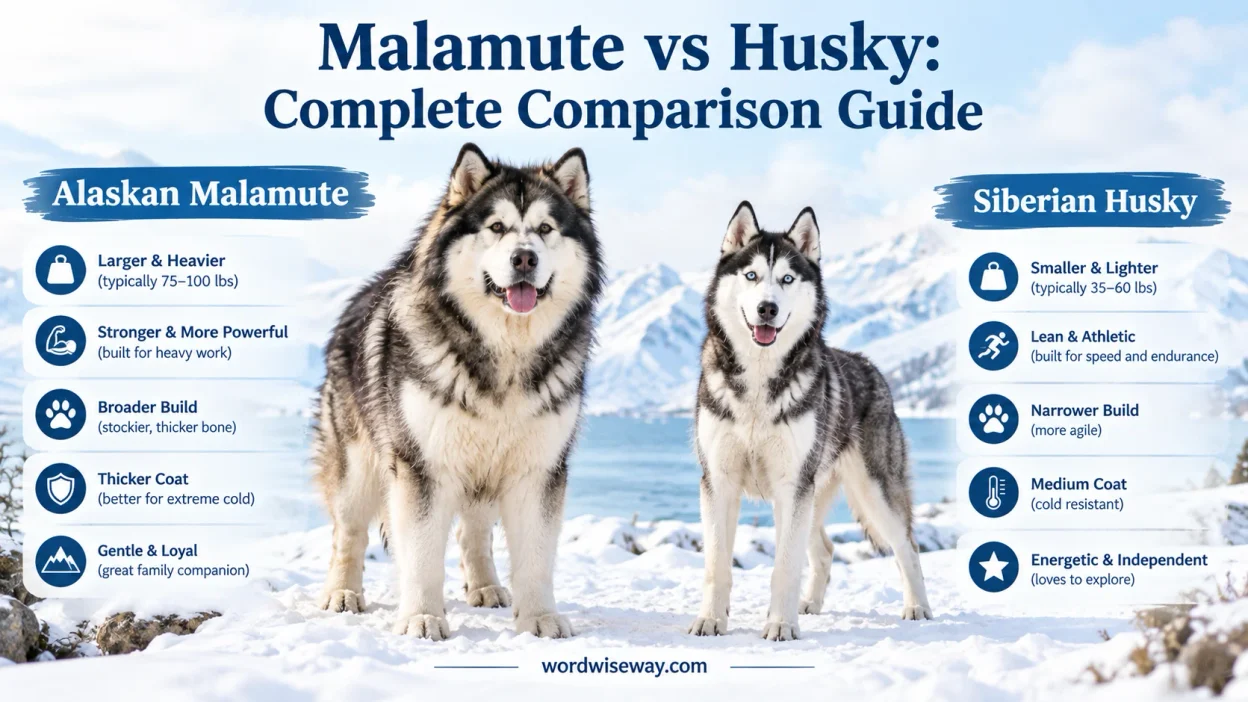
The Malamute vs Husky: Complete Comparison Guide helps you understand the husky and malamute beyond their similarities.
Siberian Huskies and Alaskan Malamutes are Arctic working dogs, bred to survive extreme snowy climates. Their thick double coats, wolf-like features, and piercing eyes can make them look alike.
Their differences become clearer through size, temperament, purpose, and care requirements. Huskies were developed for efficient sledding, while Malamutes were bred for strength and heavier work. These original roles still influence their behavior and daily needs.
If you’re adopting, understanding the breed can make adoption easier. A husky may suit an active pet owner who enjoys exercise and engagement, while a malamute can be a larger, powerful companion. Their special characteristics shape companionship and behavior.
Quick Answer:
The Alaskan Malamute is larger, heavier, and more powerfully built than the Siberian Husky. The Malamute’s breed standard gives desirable freighting sizes of about 25 inches and 85 pounds for males and 23 inches and 75 pounds for females. Siberian Huskies are considerably smaller, with males typically 21–23.5 inches and 45–60 pounds and females 20–22 inches and 35–50 pounds.
A Husky was bred primarily for endurance and efficient movement. A Malamute was bred for strength and heavy hauling. That difference is the foundation of almost every major distinction between them.
| Feature | Alaskan Malamute | Siberian Husky |
| Origin | Alaska | Siberia |
| Original purpose | Heavy freight hauling | Endurance sled work |
| Typical build | Large, powerful, heavy-boned | Medium-sized, compact, athletic |
| Male desirable weight | About 85 lb | 45–60 lb |
| Female desirable weight | About 75 lb | 35–50 lb |
| Male height | About 25 in | 21–23.5 in |
| Female height | About 23 in | 20–22 in |
| Energy | High | Very high |
| Running drive | High | Extremely strong |
| Vocal behavior | Often vocal | Frequently very vocal |
| Coat | Thick double coat | Thick double coat |
| Eye color | Brown | Brown, blue, or combinations |
| Independence | High | High |
| Escape tendency | Significant | Particularly strong |
| Best suited to | Strong, active households | Highly active households |
Breed Overview
Alaskan Malamute
The Alaskan Malamute is one of the oldest Arctic sled breeds. The breed takes its name from the Mahlemut people of northwestern Alaska, who developed these dogs for demanding work in an extremely harsh environment.
The Malamute’s body tells the story of its original job. It has substantial bone, powerful shoulders, a deep chest, strong legs, and a dense coat. The AKC breed standard specifically describes the breed as powerful and substantially built rather than a lightweight racing sled dog.
This dog was built to pull heavy loads rather than win a sprint. Strength and endurance matter more than raw speed.
Siberian Husky
The Siberian Husky developed among the Chukchi people of northeastern Asia. These dogs were bred to pull relatively light loads efficiently across long distances.
That purpose produced a different athlete. The Husky is lighter, more compact, and exceptionally efficient in motion. The AKC describes it as a medium-sized working dog capable of carrying a light load at moderate speed over great distances.
Think of the distinction this way: the Malamute is the heavyweight hauler, while the Husky is the endurance specialist.
Size and Appearance
Size is one of the easiest ways to tell these breeds apart once you know what to look for.
Height and Weight Comparison
An adult Malamute generally has much more physical substance than an adult Husky. The Malamute breed standard lists desirable freighting sizes of 25 inches and 85 pounds for males and 23 inches and 75 pounds for females.
The Siberian Husky standard is considerably lighter. Males measure 21–23.5 inches and weigh 45–60 pounds, while females measure 20–22 inches and weigh 35–50 pounds.
The difference becomes obvious when the dogs stand beside each other.
A Malamute can look almost massive next to a Husky, even though both belong to the northern working-dog group.
Body Structure
The Malamute has a broad, powerful body with substantial bone and strong shoulders. Its physique supports pulling heavy loads.
The Husky has a more moderate frame. Its body balances power with efficient movement, allowing it to travel long distances without carrying unnecessary weight.
This distinction matters because a larger dog isn’t automatically stronger in every athletic category. The two breeds were simply optimized for different kinds of work.
Head, Ears, and Face
Malamutes generally have a broader head and a bulkier muzzle. Their facial markings often include a cap, mask, bar, or combination of markings.
Huskies usually have a narrower, more refined head with medium-sized triangular ears. Their facial patterns can vary considerably.
The eyes also provide a useful clue.
Eye Color
Blue eyes are strongly associated with Siberian Huskies. The breed standard permits brown or blue eyes, including one of each or parti-colored eyes.
Alaskan Malamutes have brown eyes in the breed standard. Blue eyes are a disqualifying fault under that standard.
Therefore, a striking blue-eyed Arctic dog is much more likely to be a Husky than a purebred Malamute.
Temperament
Appearance tells only half the story. Temperament can make an even bigger difference in everyday life.
Malamute Personality
Malamutes are generally affectionate, loyal, playful, confident, and independent. They often enjoy human company and can form strong relationships with their families.
However, they aren’t typically eager-to-please dogs in the same way as some highly biddable working breeds. A Malamute may understand what you want and still decide that its own idea sounds better.
The breed’s independence comes from its working heritage. These dogs needed enough confidence and judgment to function in demanding conditions.
The AKC also notes that Malamutes can be strong-willed and may have challenges with dogs of the same sex.
Husky Personality
Siberian Huskies tend to be friendly, social, outgoing, and energetic. They usually enjoy interaction with people and other dogs.
The AKC describes the breed as friendly and social rather than naturally suspicious of strangers. That makes the Husky a poor choice if your main goal is a traditional guard dog.
Their social nature comes with a catch. Huskies generally don’t thrive when left isolated for long periods.
Which Is More Independent?
Both breeds are independent, but Huskies often combine independence with a powerful urge to explore and run.
A Malamute may challenge your instructions because it has its own opinion. A Husky may accept the challenge as an invitation to find an unlocked gate.
That difference can become very important outside the house.
Energy Levels
Neither breed belongs in the low-energy category.
A short walk around the block won’t normally satisfy a healthy young Malamute or Husky. Both need physical exercise and mental stimulation.
Exercise Needs
Malamutes can enjoy hiking, backpacking, pulling sports, jogging, and other structured activities. The breed remains capable of impressive physical work despite its popularity as a companion dog.
Huskies often excel at running, hiking, pulling activities, and other endurance-based exercise. Their historical purpose makes sustained activity particularly natural for them.
A useful distinction is this:
- Malamute: strength + endurance
- Husky: speed + endurance
- Both: substantial daily activity and mental engagement
What Happens Without Enough Exercise?
An under-stimulated northern working dog can invent its own entertainment.
That may include digging, chewing, excessive vocalization, pacing, or attempts to escape. Huskies are especially famous for their ability to exploit weaknesses in fences and gates.
A backyard helps, but it isn’t a substitute for interaction and structured exercise.
Training and Intelligence
Training these breeds requires patience rather than brute force.
Trainability
Both Malamutes and Huskies are intelligent. The bigger question isn’t whether they can learn. It’s whether they see value in cooperating with you.
Positive reinforcement, consistency, early socialization, and short engaging sessions generally work better than harsh methods.
Huskies can become bored quickly. Malamutes can become stubborn when training feels repetitive.
Common Training Challenges
Owners may encounter:
- Independent decision-making
- Poor recall when distracted
- Strong prey drive
- Pulling on leash
- Digging
- Escape attempts
- Selective attention
- Boredom-related behavior
The Siberian Husky’s instinct to run deserves particular attention. The AKC specifically recommends secure fencing or keeping the dog on leash because of this deep-rooted behavior.
Which Breed Is Easier to Train?
Neither breed is an obvious obedience champion.
A Husky may learn quickly but become distracted by something more interesting. A Malamute may learn the same command while questioning whether it is worth obeying.
For a first-time owner, the challenge isn’t intelligence. It’s consistency.
Malamute vs Husky Vocalization
If you prefer a very quiet dog, neither breed is an ideal bet.
Huskies are particularly famous for howling, whining, chirping, and other expressive sounds. Some seem to conduct entire conversations with their owners.
Malamutes can also be vocal. They may howl, grumble, whine, or produce distinctive “talking” sounds.
However, individual dogs vary. Breed tendencies aren’t guarantees.
Malamute vs Husky With Children
Both breeds can become loving family companions when properly socialized and trained.
Family Compatibility
Huskies are generally friendly and social, and the AKC notes that they can make excellent family companions for active households.
Malamutes can also be affectionate and playful with their families. Their larger size, however, means you need to take physical strength into account.
A young, energetic Malamute can accidentally knock over a small child during enthusiastic play. Children should always interact with large dogs under appropriate adult supervision.
Which Is Better for Families?
The answer depends on the family.
A highly active family that enjoys outdoor adventures may find a Husky appealing. A family seeking a larger, powerful companion and prepared for its exercise and training needs may prefer a Malamute.
Neither breed should be chosen simply because it looks like a giant stuffed animal.
Malamute vs Husky With Other Dogs and Pets
Socialization plays a major role in both breeds.
Huskies generally have a strong social orientation toward other dogs. However, their prey drive can make households with cats, rabbits, birds, or other small animals more complicated.
Malamutes can also have substantial prey drive. The breed may require careful management around smaller animals.
The safest approach is to evaluate the individual dog’s history and behavior, not just its breed label.
Grooming and Shedding
Both breeds have thick double coats designed for demanding northern climates.
Coat Maintenance
Weekly brushing can help manage normal shedding and remove loose undercoat. During seasonal coat blows, however, the amount of fur can increase dramatically.
The Siberian Husky is known for heavier seasonal shedding and typically needs regular brushing to maintain coat and skin health.
Malamutes also produce substantial amounts of loose undercoat.
If you’re considering either breed, invest in a good brush and a serious vacuum cleaner. Your furniture may become part of the ecosystem.
Bathing and General Grooming
Neither breed needs constant bathing when the coat remains healthy and clean. Routine grooming should also include:
- Nail trimming
- Dental care
- Ear checks
- Coat inspection
- Veterinary examinations
Regular brushing isn’t merely cosmetic. It helps you notice skin problems, parasites, mats, or unusual changes earlier.
Climate Tolerance
Both breeds evolved for cold environments, so their thick coats provide excellent insulation in appropriate conditions.
That doesn’t mean either breed is immune to heat.
Cold Weather
Their double coats help regulate body temperature in cold conditions. Their Arctic heritage is one reason both breeds perform so well in winter environments.
Hot Weather
Warm climates require careful management.
Exercise should occur during cooler parts of the day. Dogs need reliable access to fresh water, shade, and a cool environment.
Never assume a thick-coated dog can simply “adapt” to extreme heat without risk.
Can Malamutes and Huskies Live in Warm Climates?
Yes, many do live successfully in warmer regions. However, owners need to manage heat carefully.
This becomes especially important in places where summer temperatures remain high for extended periods. Heavy exercise during the hottest part of the day can create unnecessary danger.
Health
Responsible ownership includes understanding inherited health risks before choosing a breed.
Common Malamute Health Concerns
Malamutes can be affected by conditions including hip dysplasia and inherited eye disorders. Responsible breeding programs use health screening to reduce the risk of passing known problems to future generations.
The Alaskan Malamute Club of America and recognized veterinary screening systems provide resources for evaluating breeding stock.
Common Husky Health Concerns
Siberian Huskies can also experience inherited eye conditions and hip dysplasia. The Siberian Husky Club of America currently recommends eye examinations and hip evaluations for breeding dogs. Its health statement also addresses genetic testing for Siberian Husky Polyneuropathy Type 1 and Shaking Puppy Syndrome Type 1.
This is one reason breeder selection matters so much.
Lifespan Comparison
A commonly cited lifespan for Siberian Huskies is roughly 12–14 years, while Alaskan Malamutes commonly live around 10–14 years.
Individual lifespan can vary considerably based on genetics, nutrition, preventive veterinary care, weight management, and overall lifestyle.
Health Testing Before Buying
If purchasing from a breeder, ask for documented health screening rather than relying on verbal assurances.
Useful questions include:
- Have the parents received hip evaluations?
- Have their eyes been examined?
- What genetic tests are relevant to this breeding?
- Can you see the parents’ health records?
- What health problems have appeared in previous generations?
- What veterinary care has the puppy already received?
A responsible breeder should be comfortable discussing health rather than treating questions as an inconvenience.
Food and Feeding
Food requirements depend on age, size, activity level, health, and individual metabolism.
Because Malamutes are substantially heavier than Huskies, their calorie requirements can be higher. However, you shouldn’t feed solely according to the breed’s reputation.
An inactive Malamute can gain excess weight just as easily as another dog.
A better approach involves monitoring body condition and adjusting portions according to veterinary guidance.
Which Breed Eats More?
The Malamute generally needs more food because it is substantially larger.
Still, an exceptionally active Husky can require significant calories because endurance work burns substantial energy.
Food should match the dog’s actual lifestyle rather than an assumption about the breed.
Living Requirements
Apartment Living
Apartment life isn’t automatically impossible for either breed, but it raises the difficulty level.
The biggest concern isn’t simply floor space. It’s whether you can consistently provide enough exercise, stimulation, training, and companionship.
A large home with no activity can be worse than a smaller home with an extremely active owner.
House With a Yard
A secure yard provides useful exercise space, but it doesn’t eliminate the need for walks and structured activities.
Huskies in particular can turn an ordinary fence into a personal engineering puzzle.
Fencing and Escape Prevention
Huskies have an especially strong reputation for escaping. The AKC describes their running instinct as deeply rooted and warns owners about their ability to climb, dig, or exploit unsecured gates.
Malamutes can also dig and roam.
Secure fencing should therefore be considered part of responsible ownership, not an optional accessory.
Malamute vs Husky Cost of Ownership
The purchase price varies widely depending on location, breeder reputation, pedigree, age, and availability.
The more important calculation is the long-term ownership cost.
Consider expenses such as:
- Quality food
- Veterinary examinations
- Vaccinations
- Parasite prevention
- Grooming supplies
- Training
- Secure fencing
- Emergency veterinary care
- Toys and enrichment
- Boarding or pet care when traveling
A larger Malamute can cost more to feed and may require larger equipment. A Husky can also generate significant costs because of its exercise needs and escape-management requirements.
Malamute vs Husky: Male vs Female Differences
Male Malamutes and Huskies are generally larger than females, although individual dogs vary.
Sex shouldn’t be the only factor guiding your choice. Temperament, health, early socialization, breeding quality, and the dog’s individual personality matter enormously.
Instead of asking whether males or females are automatically “better,” focus on the specific dog’s behavior and how it fits your household.
Which Dog Is Better for You?
Choose a Malamute If…
An Alaskan Malamute may suit you if you want:
- A larger and stronger Arctic breed
- A powerful hiking or outdoor companion
- A dog with substantial physical presence
- An affectionate but independent personality
- A companion for activities such as backpacking or pulling sports
- A household prepared for heavy shedding and serious exercise needs
The breed’s physical strength is impressive, but that strength demands responsible handling.
Choose a Husky If…
A Siberian Husky may suit you if you want:
- A medium-sized endurance athlete
- A highly energetic outdoor companion
- A social and outgoing dog
- A dog that enjoys running and active games
- A striking coat and potentially blue eyes
- A companion for an active household
You should also be prepared for vocal behavior and a powerful desire to run.
Consider Neither Breed If…
Neither may be suitable if you:
- Want a low-energy companion
- Work long hours away from home with little interaction available
- Don’t enjoy regular outdoor exercise
- Need a reliably quiet dog
- Can’t provide secure fencing
- Want effortless off-leash reliability
- Live in a very hot environment without reliable cooling and careful exercise management
Choosing the wrong high-energy breed can create frustration for both you and the dog.
Comparison Table
| Category | Alaskan Malamute | Siberian Husky |
| Origin | Alaska | Siberia |
| Primary historical job | Heavy freight hauling | Long-distance sled work |
| Size | Large | Medium |
| Typical male weight | About 85 lb | 45–60 lb |
| Typical female weight | About 75 lb | 35–50 lb |
| Build | Heavy-boned and powerful | Compact and athletic |
| Strength | Exceptional | High |
| Endurance | High | Exceptional |
| Speed | Moderate | High |
| Temperament | Affectionate, independent, strong-willed | Friendly, social, energetic |
| Vocalization | Often vocal | Frequently very vocal |
| Shedding | Heavy | Heavy |
| Eye colors | Brown | Brown, blue, or mixed |
| Prey drive | Can be strong | Can be strong |
| Escape tendency | Significant | Very significant |
| Cold-weather ability | Excellent | Excellent |
| Heat management | Requires care | Requires care |
| Best owner | Strong, active, experienced household | Very active, attentive household |
Key Differences at a Glance
The biggest distinctions become simple when you strip away the similar appearance.
- Malamutes are larger and heavier.
- Malamutes were developed for heavy hauling.
- Huskies were developed for endurance and efficient long-distance travel.
- Huskies generally have a stronger reputation for running and escaping.
- Both breeds are highly active.
- Both breeds shed heavily.
- Both can be independent and challenging to train.
- Huskies commonly have blue eyes, while Malamute breed standards call for brown eyes.
- Malamutes generally have greater physical strength.
- Both require thoughtful exercise, socialization, training, and secure management.
Read More: Sorbet vs Sherbet: What’s the Difference?
FAQs
What is the main difference between a Malamute and a Husky?
The biggest difference is their build and original purpose. Malamutes are larger and stronger, while Huskies are lighter and built for speed and endurance.
Which dog is larger, a Malamute or a Husky?
An Alaskan Malamute is generally larger than a Siberian Husky. Malamutes have a heavier frame, broader body, and greater pulling strength.
Are Malamutes stronger than Siberian Huskies?
Yes, Malamutes generally have greater physical strength. They were developed to pull heavy loads, while Huskies were bred to pull lighter loads over longer distances.
Which breed is more energetic?
Both breeds need plenty of activity, but Huskies are especially energetic and often enjoy running, playing, and exploring. They need regular physical and mental stimulation.
Do Huskies and Malamutes have similar temperaments?
They share some traits, including friendliness and independence. However, individual personality varies, so you should consider the dog’s behavior rather than relying only on breed traits.
Which dog requires more grooming?
Both have thick double coats and shed heavily. Regular brushing helps manage loose fur and keeps their coats clean, especially during seasonal shedding periods.
Are Malamutes or Huskies easier to train?
Neither breed is effortless to train. Huskies can be independent and easily distracted, while Malamutes may also test boundaries. Consistent, reward-based training works best.
Which breed is better suited for cold climates?
Both breeds handle cold weather well because of their dense double coats. However, they still need proper shelter, fresh water, and responsible care in extreme conditions.
Can a Husky and Malamute live well with other pets?
They can, but compatibility depends on the individual dog, socialization, training, and the other pet’s behavior. Introductions should be gradual and carefully supervised.
How should you choose between a Malamute and a Husky?
Consider your lifestyle, available space, activity level, grooming commitment, and experience with dogs. Choose the breed whose needs you can consistently meet.
Conclusion
Choosing between a Malamute and Husky becomes easier when you understand what makes each breed unique. Both dogs have Arctic roots, thick double coats, and strong working instincts. However, their size, energy levels, temperament, exercise needs, and original purpose can be quite different.
A Siberian Husky may be a good choice for someone who enjoys an energetic and active companion. Huskies are known for their endurance, curiosity, and playful nature. They need regular exercise, mental stimulation, training, and plenty of interaction to stay engaged and well behaved.
An Alaskan Malamute is generally larger, heavier, and more powerful than a Husky. Its history as a heavy-duty sled dog influences its strength and personality. Malamutes can make loyal companions, but they require consistent training, grooming, exercise, and responsible handling.
Before adopting either breed, think carefully about your lifestyle, living space, available time, and ability to provide long-term care. Don’t choose based only on appearance. The better choice is the breed whose needs, temperament, and energy level fit comfortably with your everyday life.

Emma Smith has dedicated 14 years to Princeton University’s English Department, mentoring students in textual interpretation, literary movements, and critical frameworks. Her research explores Shakespearean drama, Victorian serial fiction, postcolonial narrative theory, and manuscript studies and probing how literary forms evolve across cultures and centuries. Emma has delivered lectures at international humanities congresses and published findings in distinguished academic journals, underscoring her commitment to scholarly depth and vibrant teaching.