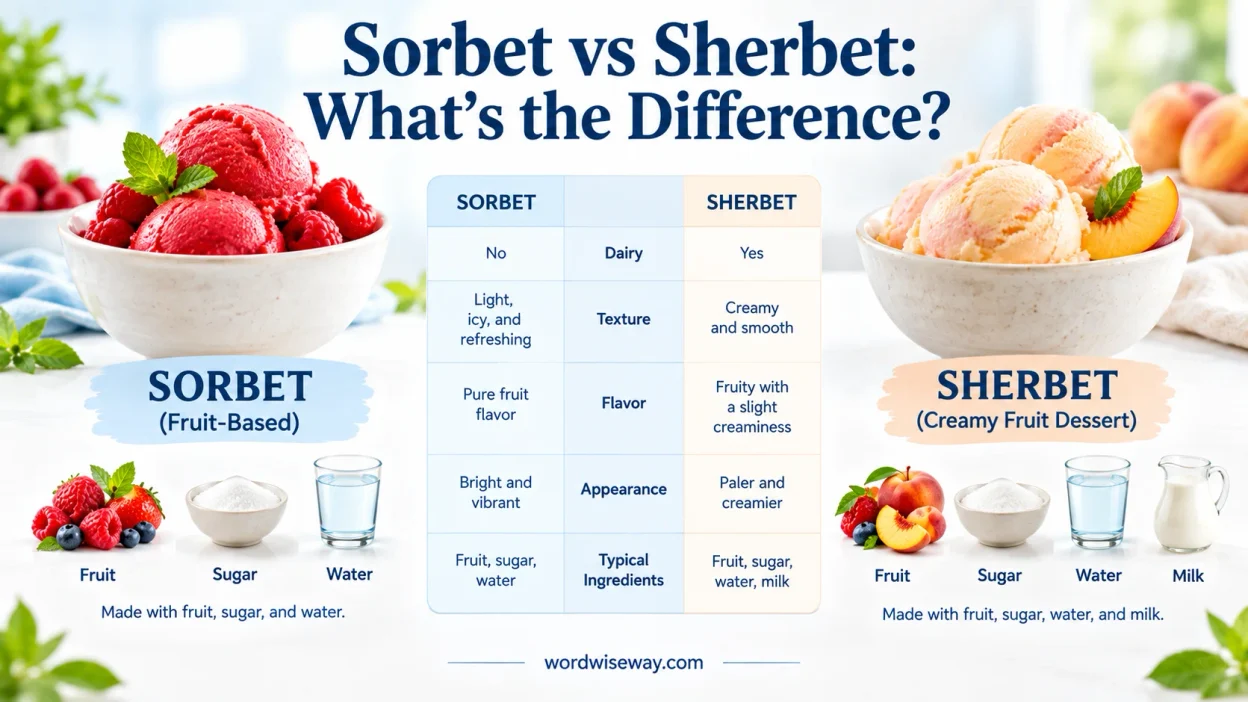
Sorbet vs Sherbet: What’s the Difference? becomes easier when you compare their ingredients, texture, and dairy content. Both are frozen desserts, but they are distinctly different treats, despite having similar names and a delicious reputation.
Sorbet is typically made without milk, using fruit and sweetened water. It offers a lighter alternative to ice cream, making it a perfect option for people who are lactose intolerant or sensitive to dairy. This non-dairy treat has a refreshing, sweet character.
Sherbet contains some dairy, which gives it a richer creaminess. A raspberry sherbet in a glass bowl shows this difference clearly. Remember, sherbet, not sherbert, is the correct word. This distinction helps you choose the dessert that suits your preferences best.
Quick Answer
Sorbet is generally a dairy-free frozen dessert made from fruit, sugar, and water. Sherbet usually contains fruit, sugar, water, and a small amount of milk or another dairy ingredient.
That dairy difference gives sherbet a creamier texture and slightly richer flavor. Sorbet usually feels lighter, icier, and more intensely fruit-focused.
| Feature | Sorbet | Sherbet |
| Dairy | Usually none | Usually contains dairy |
| Main ingredients | Fruit, sugar, water | Fruit, sugar, water, dairy |
| Texture | Smooth but icy | Creamy and softer |
| Flavor | Bright and fruit-forward | Fruity with a richer finish |
| Appearance | Often bright or slightly translucent | Usually more opaque |
| Fat | Usually very low | Usually higher than sorbet |
| Dairy-free | Usually yes | Usually no |
| Vegan | Often, but check the label | Usually not |
The word usually matters here. Recipes and commercial products can vary, so an ingredient label remains the final authority for packaged desserts.
What Is Sorbet?
Sorbet is a frozen dessert built around fruit rather than dairy. A basic recipe needs only a few ingredients: fruit or fruit juice, sugar, and water. Some recipes add lemon juice, herbs, spices, or other flavorings to sharpen the taste.
Because sorbet doesn’t rely on milk fat for its texture, the fruit often takes center stage. A ripe mango sorbet can taste almost like frozen mango puree. Lemon sorbet can deliver a particularly sharp combination of acidity and sweetness.
Sorbet Ingredients
A traditional sorbet may contain:
- Fresh or frozen fruit
- Fruit juice or puree
- Water
- Sugar
- Lemon or lime juice
- Herbs or spices for additional flavor
The sugar isn’t included simply to make sorbet sweet. It also affects the way the mixture freezes. Too little sugar can leave the dessert excessively hard and icy. Too much can make it overly soft.
That balance explains why good sorbet feels scoopable without turning into a block of ice.
How Sorbet Is Made
The basic process starts with preparing the fruit. Depending on the recipe, the fruit gets pureed, juiced, or strained. Sugar and water then form a sweet base that gets blended with the fruit.
The mixture must freeze while remaining smooth enough to scoop. Churning helps break up larger ice crystals and creates a more pleasant texture.
A useful way to picture the process is to think of ice crystals as tiny building blocks. The smaller those crystals remain, the smoother the finished sorbet feels.
What Does Sorbet Taste Like?
Sorbet usually has a clean, direct fruit flavor. Without dairy to soften the acidity, tart fruits can taste especially vivid.
Common sorbet flavors include:
- Lemon
- Lime
- Raspberry
- Strawberry
- Mango
- Peach
- Passion fruit
- Watermelon
- Orange
- Blackberry
A lemon sorbet, for example, can taste sharply citrusy and refreshing. A mango version usually feels sweeter and rounder because ripe mango naturally contains more sweetness and less acidity.
What Is Sherbet?
Sherbet is a fruit-based frozen dessert that usually contains some dairy. Milk or another dairy ingredient gives it a creamier consistency than traditional sorbet.
In the United States, sherbet commonly occupies the middle ground between sorbet and ice cream. It keeps the fruity character of a fruit ice while gaining some of the softness associated with dairy-based desserts.
The FDA includes sherbet among frozen dairy desserts and separately distinguishes nonmilk frozen desserts in its food-category guidance.
Sherbet Ingredients
A typical sherbet recipe may include:
- Fruit or fruit juice
- Sugar
- Water
- Milk
- Cream or another dairy ingredient
- Flavorings or stabilizers in some commercial products
The amount and type of dairy can differ substantially between recipes. That’s why two sherbets can have noticeably different textures.
How Sherbet Is Made
Sherbet starts with a fruit mixture much like sorbet. The important addition is dairy.
The mixture freezes while churning incorporates air and helps control ice-crystal formation. Milk solids and fat also contribute to the final mouthfeel.
The result usually feels less icy than sorbet. It isn’t as rich as conventional ice cream, either. In that sense, sherbet acts as a culinary bridge between the two.
What Does Sherbet Taste Like?
Sherbet still tastes distinctly fruity, but the dairy gives the flavor a softer edge.
Orange sherbet provides a classic example. The citrus remains noticeable, yet the creamy texture makes the flavor feel gentler than a sharp orange sorbet.
Popular sherbet flavors include:
- Orange
- Lime
- Raspberry
- Strawberry
- Pineapple
- Lemon
- Rainbow combinations
Key Differences Explained
The two desserts may look similar in a freezer case, but several details separate them.
Dairy Content
Dairy content provides the clearest distinction between sorbet and sherbet.
Traditional sorbet doesn’t contain milk or cream. Sherbet generally does. That single ingredient difference influences texture, flavor, fat content, and dietary suitability.
For packaged products, don’t rely solely on the word printed on the front. FDA guidance explains that food ingredients generally appear on labels in descending order by weight.
If dairy matters for your diet, checking the ingredient list is much safer than judging a dessert by appearance.
Texture and Consistency
Sorbet usually has a lighter, icier texture. Sherbet tends to feel smoother and creamier.
The difference comes from the ingredients and freezing behavior. Dairy contributes fat and milk solids, which can influence how ice crystals develop and how the dessert feels in your mouth.
That doesn’t mean sorbet must feel coarse. A carefully balanced sorbet can be remarkably smooth.
Flavor
Sorbet generally lets fruit speak at full volume.
Sherbet turns the volume down slightly by adding dairy. The result can feel rounder and less sharply acidic.
For example, compare lemon sorbet with lemon sherbet. Both can taste unmistakably lemony, but the sorbet usually emphasizes the fruit’s acidity more strongly.
Appearance
Appearance can offer a useful clue, although it isn’t a reliable test.
Sorbet often looks vibrant because fruit pigments remain prominent without dairy making the mixture opaque. Sherbet tends to look creamier or more pastel because milk changes its appearance.
Still, colors vary according to fruit, processing, added ingredients, and commercial formulation.
Fat and Calories
Sorbet generally contains little or no fat from dairy because traditional recipes don’t use milk or cream. Sherbet can contain more fat because it includes dairy.
However, fat content doesn’t automatically determine whether one dessert has fewer calories. Sugar concentration, serving size, fruit content, and other ingredients also matter.
The FDA’s current guidance emphasizes checking Nutrition Facts labels when comparing packaged foods rather than making assumptions based on a product’s name alone.
A Simple Ingredient Test
When you’re unsure which dessert you’re looking at, check the ingredient list.
If the product contains milk or cream, it isn’t traditional dairy-free sorbet.
Here’s a simple example:
| Ingredient list clue | Likely result |
| Fruit + water + sugar | Sorbet-style dessert |
| Fruit + water + sugar + milk | Sherbet-style dessert |
| Fruit + cream + milk + sugar | More like a creamy frozen dessert |
| Fruit + sugar + stabilizers with no dairy | Could be commercial sorbet |
Commercial formulations can include stabilizers, emulsifiers, concentrates, or other ingredients. The label gives you a much more dependable answer than the product’s color or texture.
Is Sorbet Dairy-Free?
Traditional sorbet is dairy-free because its basic formula doesn’t require milk or cream.
That makes sorbet a common choice for people avoiding dairy. However, not every product labeled with a similar frozen-fruit description will follow the same formula.
Cross-contact can also matter for people with severe food allergies. A product can have no obvious dairy ingredient while being produced in a facility that handles milk.
For packaged food, read the ingredient list and allergen information carefully.
Is Sherbet Dairy-Free?
Traditional sherbet generally isn’t dairy-free because it commonly contains milk or another dairy ingredient.
This distinction matters if you’re avoiding dairy because of an allergy, intolerance, or dietary preference.
Some modern frozen desserts use plant-based ingredients and may resemble sherbet. Those products can have different formulations, so the label remains more useful than the name alone.
Sorbet vs Sherbet vs Ice Cream
Sorbet and sherbet become easier to understand when you place them beside ice cream.
| Dessert | Dairy | Texture | Typical flavor profile |
| Sorbet | Usually none | Icy and smooth | Bright, fruit-focused |
| Sherbet | Usually some | Soft and creamy | Fruity with dairy richness |
| Ice cream | Yes | Rich and creamy | Dairy-rich with many flavors |
Ice cream depends much more heavily on dairy fat and milk solids. Sorbet doesn’t need either. Sherbet sits between the two in both composition and sensory experience.
The FDA’s food-category materials distinguish sherbet and other milk-based frozen desserts from nonmilk frozen fruit products.
Sorbet vs Sherbet vs Gelato
Gelato creates another point of confusion because it can look similar to other frozen desserts.
Gelato is a dairy-based frozen dessert with a dense, creamy texture. It usually contains milk and may contain cream, depending on the recipe. Unlike sorbet, it isn’t centered on an ice-and-fruit formula.
The easiest shortcut is this:
- Sorbet: fruit-forward and dairy-free in traditional recipes.
- Sherbet: fruit-forward with some dairy.
- Gelato: dairy-based and creamy.
These categories can overlap in flavor, but their basic structures remain different.
Why Are Sorbet and Sherbet Often Confused?
The confusion comes from more than their similar spelling.
Both are:
- Frozen desserts
- Often fruit-based
- Usually sweet
- Commonly served by the scoop
- Available in overlapping flavors
- Closely associated with refreshing summer desserts
Their names also have a shared linguistic history. Both words are connected to older terms associated with chilled fruit drinks and frozen refreshments.
The terminology changed as these foods traveled across regions and culinary traditions. That history helps explain why the two names feel like linguistic cousins rather than completely unrelated words.
Where Did the Words Sorbet and Sherbet Come From?
The history of these desserts stretches beyond modern ice cream shops.
The History of Sorbet
The word sorbet entered European languages through forms related to the Italian sorbetto and French sorbet. These terms connect to earlier words for chilled drinks and frozen refreshments.
The broader story involves traditions of cooling sweetened fruit mixtures long before modern mechanical freezers existed.
That history matters because early frozen desserts didn’t fit neatly into today’s supermarket categories. Techniques, ingredients, and names evolved as recipes moved between cultures.
The History of Sherbet
Sherbet is closely related to the Arabic sharbat and the broader family of words associated with sharbat, a sweetened fruit drink served chilled in parts of the Middle East and South Asia.
As the word traveled into English, its meaning shifted. In American English, sherbet eventually became associated with a partially dairy-based frozen dessert.
So the names aren’t random spellings. They carry traces of a much older history involving sweet drinks, cooling techniques, and culinary exchange.
Which One Should You Choose?
The better choice depends on what you want from the dessert.
Choose Sorbet If You Want
- A dairy-free frozen dessert
- A bright fruit flavor
- A lighter, icier texture
- A refreshing finish after a meal
- A fruit-centered dessert without milk or cream
Sorbet works particularly well after rich foods because its tart fruit character can provide a clean contrast.
Choose Sherbet If You Want
- A creamy fruit dessert
- A softer texture
- Less intense acidity
- A middle ground between sorbet and ice cream
- A fruit flavor with some dairy richness
Sherbet can feel more indulgent without becoming as rich as conventional ice cream.
Popular Sorbet and Sherbet Flavors
Flavor availability varies, but some combinations appear again and again.
Popular Sorbet Flavors
- Lemon
- Mango
- Raspberry
- Strawberry
- Lime
- Peach
- Passion fruit
- Watermelon
- Blackberry
These fruits work well because their natural flavors remain expressive after freezing.
Popular Sherbet Flavors
- Orange
- Lime
- Raspberry
- Pineapple
- Strawberry
- Lemon
- Rainbow blends
Citrus fruits work particularly well in sherbet because dairy can soften their natural sharpness.
Can You Make Sorbet and Sherbet at Home?
Yes. The basic formulas are surprisingly simple, although texture requires some attention.
Basic Sorbet Formula
A simple homemade sorbet starts with:
Fruit + sugar + water
You can adjust the proportions according to the fruit’s sweetness, acidity, and water content.
A watery fruit may require less added water. A tart fruit may need more sugar to balance its acidity.
The mixture then gets chilled and churned before being frozen to the desired consistency.
Basic Sherbet Formula
Sherbet follows a similar structure:
Fruit + sugar + water + dairy
Milk changes the mixture’s body and freezing behavior. It can also soften sharp fruit flavors.
For either dessert, serving temperature matters. A very cold freezer can make homemade frozen desserts extremely firm. Letting the dessert sit briefly before scooping can improve its texture.
A Practical Sorbet vs Sherbet Example
Imagine two bowls containing mango-flavored frozen dessert.
The first contains mango puree, sugar, and water. It tastes intensely fruity and feels cold and refreshing. That’s the typical character of sorbet.
The second contains mango, sugar, water, and milk. It still tastes like mango, but the texture feels smoother and creamier. That’s the basic character of sherbet.
The fruit hasn’t changed. The dairy has.
That small formulation change can transform the entire sensory experience.
Read More: Queue or Que: Which Spelling Is Correct?
FAQs
Is sorbet completely dairy-free?
Yes, traditional sorbet is generally made without milk or other dairy ingredients. Its main ingredients usually include fruit, water, and sweeteners.
Does sherbet contain dairy?
Yes, sherbet typically contains some dairy. This gives it a creamier texture than sorbet while keeping it lighter than traditional ice cream.
Which is lighter, sorbet or sherbet?
Sorbet is usually the lighter choice because it doesn’t contain dairy. Its fruit and water base gives it a refreshing texture and flavor.
Why does sherbet taste creamier than sorbet?
Sherbet contains dairy, which adds richness and creaminess. Sorbet relies mainly on fruit, water, and sweeteners, so its texture feels more refreshing.
Is sorbet made with milk?
Traditional sorbet isn’t made with milk. It usually combines fruit, water, and sugar or another sweetener to create a smooth frozen dessert.
Is sherbet the same as sherbert?
No. Sherbet is the standard spelling. Sherbert is a common misspelling that people sometimes use when referring to the same frozen dessert.
Which has more fruit flavor, sorbet or sherbet?
Sorbet often has a stronger fruit-forward taste because it doesn’t contain dairy. The absence of milk allows the fruit flavor to stand out more clearly.
Can lactose-intolerant people eat sorbet?
Many traditional sorbets are suitable for people avoiding lactose because they contain no dairy. However, you should always check the ingredient label for a particular product.
Is sherbet healthier than ice cream?
Sherbet can be lighter than some ice creams, but the nutritional value depends on the recipe. Check the serving size, sugar, and other ingredients before comparing them.
How can you quickly remember the difference?
Think about dairy. Sorbet is usually dairy-free, while sherbet contains some dairy. That simple distinction makes the two much easier to tell apart.
Conclusion
Sorbet and sherbet may sound almost identical, but their ingredients create a clear difference. Sorbet is usually dairy-free and relies on fruit, water, and sweeteners for its refreshing taste and smooth texture. Sherbet contains some dairy, giving it a creamier and slightly richer character.
When choosing between them, think about what you want from your frozen dessert. Sorbet works well when you prefer a light, fruit-focused treat or need to avoid dairy. Sherbet is a better fit when you enjoy a creamy texture without choosing full ice cream.
Once you know the dairy distinction, remembering sorbet vs sherbet becomes simple. The names may cause confusion, but the ingredients tell the real story. Check the label when buying a packaged product because recipes can vary between brands and flavors.

Amelia Sanders has spent 14 years in Harvard University’s English Department, helping students navigate literary analysis, interpretive theory, and narrative techniques. Her academic pursuits center on 18th-century British prose, romantic poetry, diasporic writing, and digital editing exploring how textual choices influence cultural perspectives. Amelia has spoken at major international meetings and contributed essays to respected academic volumes, demonstrating her dedication to thoughtful scholarship and effective teaching.