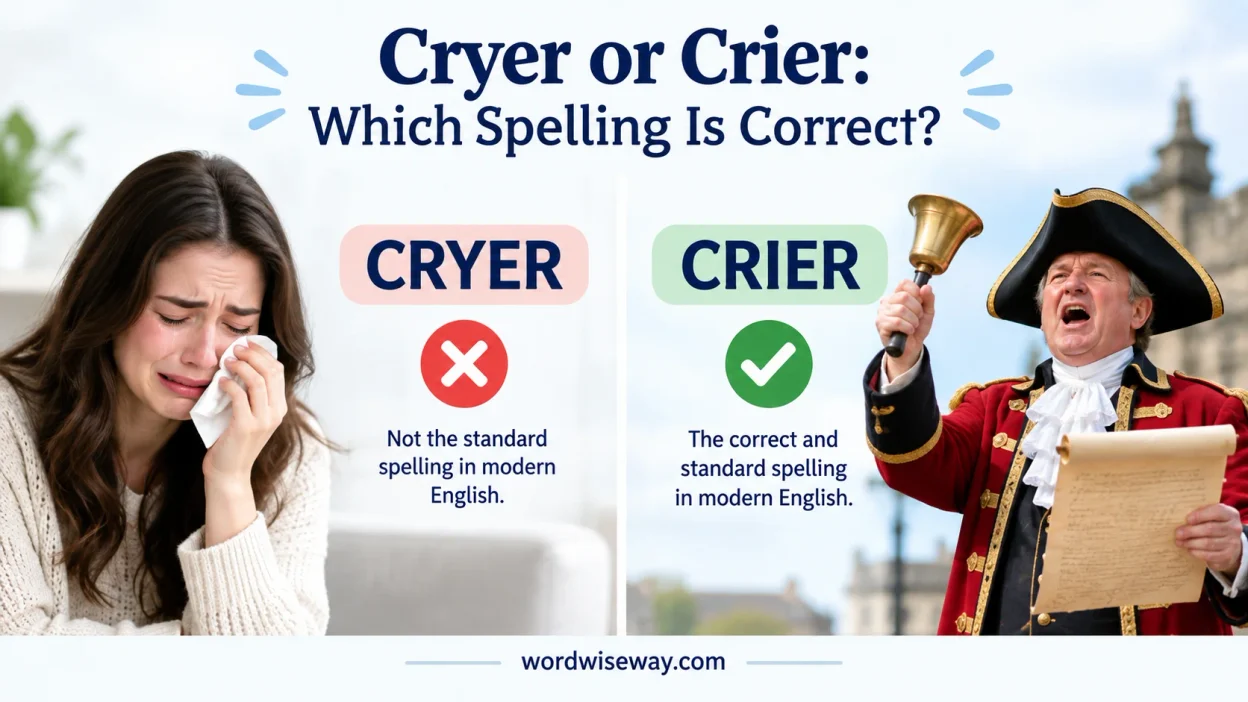
Cryer or Crier: Correct Spelling, Meaning, and Usage can feel confusing at first glance. When you search this phrase, crier is the preferred spelling in standard English, while cryer is less common for an answer in everyday English writing. Both forms have similar sounds, but their spelling differs.
A crier is a person who makes announcements in public places, especially town squares. Historically, a town crier was known for calling loudly, sharing news, and making public proclamations. Today, you may see this word in historical texts, newspapers, and old books.
In everyday writing, choosing crier helps you avoid mistakes and improves clarity, accuracy, and professionalism. Pronunciation can make the two forms seem interchangeable, but English rules favor crier. Once you understand the context, the word choice becomes straightforward and confident.
Quick Answer:
Crier is the preferred spelling in modern English.
Use crier when you mean:
- A person who cries or weeps.
- A person who makes a public announcement.
- A traditional town crier.
- A person whose role involves calling something out publicly.
The word cry itself has two relevant meanings. It can describe producing tears, but it can also mean shouting or calling out loudly. That second meaning explains the historical role of a town crier.
Cryer does exist as a less common form, particularly in historical or variant usage. However, it isn’t normally interchangeable with crier when you’re aiming for standard contemporary English.
| Word | Modern status | Main use |
| Crier | Standard and established | A person who cries or a public announcer |
| Cryer | Less common variant | Historical or variant usage |
| Town crier | Established expression | Traditional public announcer |
| Town cryer | Not the standard expression | Usually avoided |
For example, write:
I’m not normally a crier, but that movie made me cry.
For the historical role, write:
The town crier announced the news in the village square.
The Main Difference
The main difference isn’t simply that one spelling is “right” and the other is “wrong.” English contains many historical variants that have survived in dictionaries and older texts.
The more useful question is which form fits modern standard usage.
For that purpose, crier has the clear advantage. Cambridge defines a crier as someone who cries and also identifies the word with the traditional role of a town crier.
Oxford similarly records crier as a noun for the person whose historical job involved walking through a town and shouting news or official announcements.
Crier Means Someone Who Cries
The most familiar meaning of crier is simply a person who cries.
For example:
- “She’s a frequent crier during emotional movies.”
- “I’m not much of a crier.”
- “The baby was a loud crier.”
- “He became an emotional crier after the difficult experience.”
Cambridge specifically gives the meaning “someone who cries” and provides examples using crier in this sense.
So if you’re describing someone who sheds tears, crier is the natural modern spelling.
Crier Also Means a Public Announcer
The word becomes more interesting when you look at the older meaning of cry.
A person can cry because they’re upset. However, a person can also cry something aloud. Oxford defines cry as both producing tears and shouting loudly.
That second meaning gave rise to occupations involving public announcements.
A town crier, for example, traditionally announced news and official information by calling it out in public. Cambridge and Oxford both record this historical meaning.
What Does “Crier” Mean?
Crier is a noun formed around the action of crying or calling out. Its meaning depends on context.
Crier as a Person Who Cries
In everyday modern English, a crier can simply be someone who cries.
Imagine two people watching a sad movie. One person stays completely dry-eyed. The other reaches for tissues halfway through the opening scene.
You could describe the second person as a crier.
Examples include:
- “She’s a real crier when she watches family dramas.”
- “I wasn’t always a crier, but that scene got me.”
- “He’s a quiet crier who prefers to be alone.”
The meaning is straightforward, and modern dictionaries support it.
Crier as a Public Announcer
The other meaning comes from an older sense of cry.
Historically, people sometimes needed to communicate information before modern mass communication existed. A person could walk through a town and announce important information by calling it out loudly.
That person was a crier or, more specifically, a town crier.
The role could involve announcing:
- Official notices
- Public information
- Local news
- Court-related announcements
- Other information intended for the community
The traditional occupation is now mostly historical, but the expression town crier remains familiar.
What Does “Cryer” Mean?
Cryer is the less common spelling.
It may appear in historical material, variant usage, or texts that preserve older spelling practices. Its existence doesn’t mean that you should automatically use it in modern writing.
That’s an important distinction.
English contains plenty of forms that are understandable and historically attested but aren’t the usual modern choice. Cryer falls into that category when compared with the much more established crier.
Why “Cryer” Looks Correct
The confusion makes perfect sense.
If you start with the verb cry and add -er, you might naturally expect:
cry + er = cryer
English spelling doesn’t always work that mechanically, though.
Compare these forms:
- cry → cries
- cry → cried
- cry → crying
- cry → crier
The spelling changes according to the form and the established history of the word.
So although cryer looks logical at first glance, crier is the form that modern readers are much more likely to recognize and expect.
Why Is It “Crier” Instead of “Cryer”?
The answer lies partly in the history of the word.
Oxford gives crier a Middle English origin and traces it to Old French criere, from crier, meaning “to shout.”
That origin fits the older public-announcement meaning particularly well.
The verb cry itself also has a long history connected with calling out or shouting. Oxford records the verb’s meanings of both producing tears and shouting loudly.
Over centuries, English developed several related forms. The modern spelling crier became established even though cryer may look more straightforward to someone applying the suffix mechanically.
The Y-to-I Pattern
The spelling of crier also fits a familiar pattern found in English words related to verbs ending in consonant + y.
Consider:
- try → tries
- try → tried
- dry → dries
- dry → dried
- cry → cries
- cry → cried
These examples show that the final y doesn’t always remain unchanged when the word takes a new grammatical form.
However, spelling patterns aren’t mathematical formulas. English has accumulated forms from different historical periods and languages.
That’s why the safest approach is to learn established forms such as crier rather than assuming that every word must follow a perfectly predictable suffix rule.
Crier or Cryer in “Town Crier”
If you’re talking about the traditional public announcer, the standard expression is:
town crier
Not:
town cryer
Oxford defines town crier as a person whose historical job was to walk through a town shouting news and official announcements.
Cambridge gives essentially the same meaning, describing a town crier as someone who made official announcements by calling them out publicly.
What Did a Town Crier Do?
A town crier served as a human announcement system.
Before newspapers, radio, television, websites, and smartphones could spread information quickly, communities relied on direct forms of communication.
A town crier could travel through public areas and call out information so people nearby could hear it.
The job wasn’t simply about having a loud voice. It involved communicating information clearly enough for a community to understand.
That historical meaning remains embedded in the phrase town crier today.
Is “Town Cryer” Correct?
For standard modern English, use town crier.
For example:
The town crier announced the new regulations.
The spelling crier is part of the established expression.
If you’re writing a history article, grammar lesson, or general-interest blog post, town crier is the form readers should expect.
Which One Should You Use?
For most modern writing, choose crier.
The choice becomes especially straightforward when the word describes someone who cries or appears in a recognized expression.
Use “Crier” for Someone Who Cries
When you mean someone who cries, use crier.
Examples:
- “She’s a crier during sad films.”
- “I’m not usually a crier.”
- “The child was a frequent crier.”
- “He admitted that he’s an emotional crier.”
This matches the modern dictionary meaning recorded by Cambridge.
Use “Crier” for a Traditional Announcer
Use crier in expressions such as:
- town crier
- court crier
- public crier
These uses connect with the older meaning of cry as calling or shouting.
The historical role of a town crier is directly documented by Oxford and Cambridge.
When Can “Cryer” Appear?
You may encounter cryer in historical sources or less common variant usage.
If you’re quoting an old document, preserving a historical spelling can be appropriate. If you’re writing modern general English, however, crier is usually the better choice.
The distinction is similar to many other spelling questions in English: historical existence doesn’t automatically make two forms equally common or equally suitable today.
Examples
Seeing the words in complete sentences makes the distinction easier to remember.
Examples With “Crier”
- “I’m not normally a crier, but that film was heartbreaking.”
- “She’s such a crier that she keeps tissues in every room.”
- “The town crier announced the news.”
- “The court crier called the proceedings to order.”
- “The village crier delivered the official announcement.”
The first two examples use crier for someone who cries. The others reflect the older sense of someone who calls information out publicly.
Examples With “Cryer”
Because cryer is less common, you may see it in historical or variant contexts.
For modern general writing, these sentences are normally better written with crier:
- “She is a crier.”
- “The town crier made the announcement.”
- “He became a crier during emotional scenes.”
This keeps your wording aligned with established contemporary usage.
A Simple Case Study: “Town Crier”
Consider this sentence:
The town crier announced the arrival of the new governor.
Here, crier has nothing to do with tears.
The person is a public announcer. The verb cry carries its older sense of calling something out loudly.
Now consider:
She became a crier after watching the emotional ending.
Here, the meaning is completely different. The person cries emotionally.
The same noun works because cry itself has multiple meanings.
Oxford explicitly records both major senses of the verb: producing tears and shouting loudly.
That little detail explains much of the confusion surrounding crier.
Common Mistakes
Writing “Town Cryer”
This is the most common trap.
The established expression is town crier.
If you’re referring to the traditional public announcer, use the spelling with -ier.
Assuming Crier Only Means Someone Who Cries
The word has a broader history.
A crier can describe someone who cries emotionally. It can also refer to someone who calls out announcements publicly.
The phrase town crier preserves this older meaning.
Assuming Cryer Is Always a Typographical Error
That conclusion goes too far.
Cryer can occur as a variant or historical form. The more useful distinction is between a form that exists and the form that modern standard usage normally prefers.
For contemporary general writing, crier is the safer choice.
Treating English Spelling Like a Formula
English spelling has plenty of patterns, but it also has centuries of accumulated history.
You can’t always take a base word, add a suffix, and predict the accepted spelling perfectly.
That’s why established dictionary forms matter.
An Easy Memory Trick
Here’s a simple way to remember the spelling:
Town crier = crier.
Once you remember town crier, the spelling becomes easier to transfer to other contexts.
You can also connect crier with these forms:
- cry
- cries
- cried
- crier
When the noun means someone who cries, crier is the standard modern choice.
Comparison Table
| Feature | Crier | Cryer |
| Established English form | ✓ | ✓, as a less common variant |
| Common modern spelling | ✓ | |
| Person who cries | ✓ | Less common variant |
| Traditional public announcer | ✓ | |
| Used in town crier | ✓ | |
| Historical appearances | ✓ | ✓ |
| Best choice for ordinary modern writing | ✓ |
The key takeaway is simple: crier is the form to choose when you want the standard modern spelling.
Read More: Feening or Fiending: Which Spelling Is Correct?
FAQs
Is crier or cryer the correct spelling?
Crier is the standard spelling in modern English. Cryer can appear occasionally, but it’s much less common and usually isn’t the form you want in ordinary writing.
What does crier mean?
A crier is a person who cries out or makes announcements. Historically, a town crier publicly announced news, notices, and proclamations.
Is cryer an incorrect word?
Cryer isn’t simply a random spelling mistake in every historical context, but it’s uncommon. For standard modern English writing, crier is the safer and more familiar form.
Why do crier and cryer sound the same?
The two spellings can have the same pronunciation because English spelling doesn’t always directly reflect pronunciation. The difference appears mainly in their written forms.
What is a town crier?
A town crier was a person who publicly announced important information, often in a town square. This role was especially associated with earlier periods when public announcements were made aloud.
How do you use crier in a sentence?
You can use crier when referring to someone who cries out or makes an announcement. For example, you might describe a historical figure as a town crier who announced news to local residents.
Should I use crier in formal writing?
Yes. Crier is the conventional choice when you need the standard modern English spelling. It works well in formal, academic, and everyday writing.
Does crier have more than one meaning?
Yes. Crier can refer to someone who cries out, calls loudly, or makes public announcements. Its exact meaning depends on the surrounding context.
Is town crier still used today?
The term town crier still exists today, although the traditional role is far less common than it was historically. Modern references often appear in historical discussions, ceremonies, or cultural events.
How can I remember whether to write crier or cryer?
A useful way to remember it is to connect crier with the verb cry plus the ending -er. When you need the standard spelling for a person who cries out or announces something, choose crier.
Conclusion
Choosing between crier and cryer can seem confusing because both spellings sound nearly identical. However, crier is the standard and more familiar spelling in modern English, especially when you’re referring to someone who cries out, calls loudly, or makes public announcements.
The word crier has a long history, most notably in the phrase town crier. Although the traditional role has become less common, you’ll still encounter the term in historical writing, books, ceremonies, and discussions about public announcements.
When you’re writing today, crier is usually the clearest choice. Remembering this spelling can help you avoid unnecessary mistakes and make your writing more accurate, polished, and easy to understand.