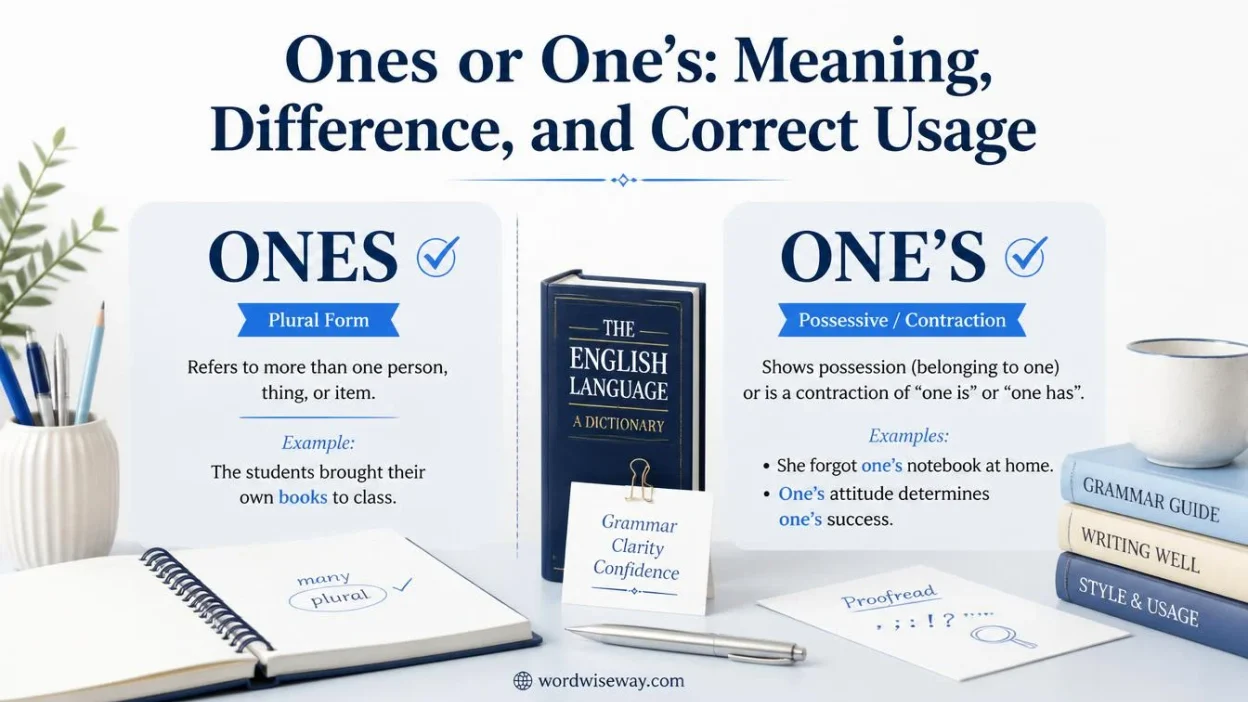
One’s or Ones : Meaning, Difference, and Correct Usage becomes easier when you understand the meaning and uses of each form. Ones is the plural form of one, while one’s is the possessive form. Ones’ can show possession involving multiple people or things. The apostrophe changes the word and its grammatical role.
This simple difference helps writers avoid common grammar mistakes and punctuation mistakes. With clear examples and simple explanations, English learners can understand these forms without feeling confused. This guide also covers correct usage, spelling differences, and practical rules for formal writing, emails, essays, and everyday communication.
Correct grammar and proper punctuation improve clear communication, professional communication, and credibility. These forms can appear in academic papers, reports, business communication, meetings, and social media posts. Learning the correct meaning helps you write accurate, polished sentences with confidence and avoid misunderstandings.
Quick Answer:
Ones is the plural form used when one refers to multiple people or things. One’s usually indicates possession, meaning “belonging to one,” but it can also contract one is or one has.
| Form | Main meaning | Example |
| one | Singular person or thing | “Choose one.” |
| ones | More than one; plural reference | “Choose the best ones.” |
| one’s | Possessive form of one | “One should trust one’s judgment.” |
| one’s | Contraction of one is | “One’s responsible for the decision.” |
| one’s | Contraction of one has | “One’s already completed the work.” |
A quick test makes the distinction easier:
- If you can replace the word with multiple ones, use ones.
- If you mean belonging to one, use one’s.
- If you can expand it to one is or one has, use one’s.
Ones Meaning and Usage
What Does “Ones” Mean?
Ones is the plural form of one. It commonly functions as a pronoun when you don’t want to repeat a noun that has already appeared or is obvious from context.
For example:
“Which shoes do you want? The black ones.”
Here, ones stands for black shoes. Repeating the noun would be unnecessary: “The black shoes” is grammatically fine, but the black ones sounds more natural when the noun is already understood.
You can use ones with adjectives, demonstratives, and other words that identify a particular group:
- “The larger ones cost more.”
- “I prefer the older ones.”
- “These ones need cleaning.”
- “Which ones are yours?”
- “The broken ones should be replaced.”
The important point is that ones refers to multiple items. It doesn’t show ownership.
How to Use “Ones” in a Sentence
The most common use of ones appears when a speaker or writer wants to avoid repeating a plural noun.
Imagine you’re comparing several notebooks:
“The blue notebooks are cheaper than the black notebooks.”
You could make the sentence smoother:
“The blue ones are cheaper than the black ones.”
The word ones carries the noun’s meaning from the earlier context. Readers understand that ones means notebooks.
This makes ones especially useful when several objects share the same category but differ in a particular quality.
For example:
- “The expensive ones have leather covers.”
- “Take the clean ones from the shelf.”
- “The smaller ones fit inside the drawer.”
- “I saved the important ones separately.”
However, ones shouldn’t become a substitute for every noun. If the reader doesn’t know what it refers to, the sentence can become vague.
Compare:
“I chose the good ones.”
Good ones of what?
Without context, the sentence leaves the reader searching for the missing noun. Clear writing depends on a recognizable reference.
“Ones” as a Pronoun
In many sentences, ones works as a pronoun because it takes the place of a plural noun.
For example:
“Which cookies do you want?”
“The chocolate ones.”
Here, ones replaces cookies. It doesn’t mean an unspecified number of things. Instead, it points back to a known group.
This pattern is particularly common with adjectives:
the + adjective + ones
Examples include:
- the small ones
- the expensive ones
- the new ones
- the damaged ones
- the blue ones
- the useful ones
You can also use ones when comparing alternatives:
“The newer ones are easier to use than the older ones.”
The noun ones remains plural even though the adjective changes.
One’s Meaning and Usage
What Does “One’s” Mean?
One’s has an apostrophe because it performs a different grammatical job from ones.
Most commonly, one’s is the possessive form of the pronoun one. It refers to something associated with or belonging to a person in a general sense.
For example:
“One should always check one’s work.”
Here, one’s work means the work belonging to the person being referred to as one.
The apostrophe tells you that one’s expresses possession or association.
However, possession isn’t its only possible function. In certain sentences, one’s is a contraction of one is or one has.
“One’s” as a Possessive
The possessive use of one’s is straightforward once you understand the pronoun one.
When one means a person in general, one’s can indicate something belonging to that person:
- “One should respect one’s commitments.”
- “A person should know one’s limitations.”
- “One must accept one’s responsibilities.”
- “It’s important to understand one’s priorities.”
The structure is similar to possessive forms such as my, your, his, and her. The difference is that one’s refers to a person in a general or formal sense.
A particularly common pattern is:
one + verb + one’s + noun
For example:
“One should consider one’s options carefully.”
The first one acts as the subject. The second one’s indicates possession.
This construction often appears in formal writing, academic discussion, philosophical statements, and general advice.
“One’s” as a Contraction
The same spelling, one’s, can also represent a contraction.
Depending on the sentence, it can mean:
- one is
- one has
For example:
“One’s going to need more time.”
Expand the contraction:
“One is going to need more time.”
Here, one’s doesn’t show possession. It’s simply a shortened form of one is.
Another example:
“One’s already finished the assignment.”
This can expand to:
“One has already finished the assignment.”
Context tells you which expansion makes sense.
This use is grammatically possible, although it tends to sound more formal, literary, or unusual than contractions such as he’s, she’s, or it’s. In everyday American English, writers often avoid one altogether and choose a more direct construction.
For example:
“You’re going to need more time.”
often sounds more natural in conversational writing than:
“One’s going to need more time.”
Key Differences
The easiest way to understand ones vs. one’s is to focus on the apostrophe.
| Word | Function | What it means | Example |
| one | Singular pronoun/noun | A single person or thing | “I need one.” |
| ones | Plural pronoun/noun form | Multiple people or things | “I need the larger ones.” |
| one’s | Possessive | Belonging to one | “One should know one’s limits.” |
| one’s | Contraction | One is / one has | “One’s already arrived.” |
Notice the key distinction:
ones = plural
one’s = possession or contraction
The apostrophe doesn’t make one plural. That’s a common misunderstanding. In standard English, apostrophes generally don’t form ordinary plurals.
For instance:
- ✓ “Which ones do you want?”
- ✗ “Which one’s do you want?”
The second version suggests possession or a contraction rather than a plural.
Examples
Examples With “Ones”
Here are several natural examples of ones:
- “The red ones are mine.”
- “I prefer the newer ones.”
- “Which ones should we keep?”
- “The damaged ones need replacing.”
- “These ones are much easier to use.”
- “The cheaper ones may not last as long.”
In every case, ones refers to multiple people or things.
You can often test the sentence by replacing ones with a plural noun.
“The red ones are mine.”
becomes:
“The red shoes are mine.”
If that substitution works and the meaning remains clear, ones is probably the correct form.
Examples With “One’s”
Possessive examples:
- “One should accept one’s mistakes.”
- “Everyone should consider one’s responsibilities carefully” is generally awkward because everyone normally pairs with a different possessive structure.
- “One must protect one’s personal information.”
- “It helps to understand one’s strengths.”
- “A person should examine one’s assumptions carefully” can also sound mismatched because a person and one’s don’t always create the smoothest agreement.
The cleanest formal construction keeps one as the subject:
“One should understand one’s responsibilities.”
Contraction examples:
- “One’s going to need additional evidence.” = “One is going to need additional evidence.”
- “One’s already completed the task.” = “One has already completed the task.”
Context determines which contraction is intended.
Side-by-Side Sentence Comparison
A direct comparison makes the difference easier to spot.
| Correct form | Meaning | Explanation |
| “I like the small ones.” | Multiple small items | Ones replaces a plural noun. |
| “One should know one’s limits.” | Limits belonging to one | One’s is possessive. |
| “Which ones did you choose?” | Which items? | Ones means multiple items. |
| “One’s difficult to predict.” | One is difficult to predict | One’s contracts one is. |
| “One’s finished the project.” | One has finished the project | One’s contracts one has. |
The surrounding words usually expose the intended meaning.
Common Mistakes
Using “One’s” as the Plural of “One”
This is probably the most common mistake.
Some writers assume that an apostrophe makes one plural. It doesn’t.
The correct plural is:
one → ones
Not:
one → one’s
For example:
- ✓ “Which ones are yours?”
- ✗ “Which one’s are yours?”
The first sentence asks about multiple items. Therefore, ones fits.
Using “Ones” for Possession
The reverse mistake happens when writers leave out the apostrophe even though they mean possession.
Compare:
“One should respect one’s privacy.”
Here, one’s privacy means privacy belonging to or associated with one.
Writing ones privacy removes the possessive marker and produces an incorrect construction.
The apostrophe has a job. Don’t treat it like optional punctuation.
Confusing “One’s” With “Ones”
A useful editing trick is to ask what role the word plays.
If it answers “How many?”, you’re probably dealing with ones.
If it answers “Whose?”, you’re probably dealing with one’s.
For example:
“Which ones are broken?”
“How many?” Multiple items. Use ones.
“One should protect one’s reputation.”
“Whose reputation?” The person’s own reputation. Use one’s.
If the sentence can expand one’s into one is or one has, the apostrophe also belongs there.
Ones vs. One’s vs. One
Adding one to the comparison clears up another common source of confusion.
One refers to a single person or thing:
“I only need one.”
Ones refers to multiple people or things:
“I need the larger ones.”
One’s expresses possession or forms a contraction:
“One should trust one’s judgment.”
The progression is simple:
| Form | Basic idea | Example |
| one | Singular | “Choose one.” |
| ones | Plural | “Choose the best ones.” |
| one’s | Possessive/contraction | “Know one’s priorities.” |
Think of the apostrophe as a grammatical signal rather than a plural marker.
How to Remember the Difference Between Ones and One’s
Use the apostrophe test.
When you’re deciding between ones and one’s, ask yourself three quick questions:
- Do I mean multiple people or things?
Use ones. - Do I mean something belonging to or associated with one?
Use one’s. - Can I expand one’s to “one is” or “one has”?
Use one’s.
For example:
“I chose the cheaper ___.”
You’re referring to multiple items. The answer is ones.
“One should learn from ___ mistakes.”
You mean mistakes associated with that person. The answer is one’s.
“___ already finished.”
Expand it:
“One has already finished.”
Therefore, one’s works as the contraction.
Apostrophes often look tiny on the page, but here one small mark completely changes the grammatical meaning.
Which Is Correct?
Neither form is always correct. The intended meaning determines the correct spelling.
Choose ones when the word refers to multiple people or things:
- “The good ones are expensive.”
- “I prefer the older ones.”
- “Which ones did you select?”
one’s when you express possession:
- “One should know one’s responsibilities.”
- “One must protect one’s privacy.”
- “One should consider one’s options.”
Choose one’s when it means one is:
- “One’s likely to encounter difficulties.”
Choose one’s when it means one has:
- “One’s already completed the work.”
A Simple Fill-in-the-Blank Test
Try these sentences:
- “The blue ___ are mine.”
- “One should understand ___ responsibilities.”
- “Which ___ did you buy?”
- “One ___ already finished.”
- “The larger ___ are more practical.”
The answers are:
- ones
- one’s
- ones
- one’s
- ones
The pattern becomes much easier once you identify the word’s function instead of focusing only on its appearance.
Read More: Sink or Sank or Sunk: Meaning, Difference, and Correct Usage
FAQs
Is “ones” the plural form of “one”?
Yes. Ones is the plural form of one when you’re referring to more than one person or thing. For example, “The red ones are cheaper” uses ones to replace a repeated noun.
What does “one’s” mean in a sentence?
One’s is normally a possessive form. It shows that something belongs to or is associated with a person represented by “one.” For example, “One should respect one’s responsibilities” uses the apostrophe to show possession.
Is “ones’” a correct word in English?
Yes, but ones’ has a much narrower use. It can show possession when ones is already plural and the plural group owns or relates to something. The context must clearly establish what “ones” represents.
Why does the apostrophe matter in “ones” and “one’s”?
The apostrophe changes the grammatical function of the word. Ones simply refers to multiple people or things, while one’s indicates possession. Removing or adding the apostrophe can therefore change the intended meaning.
Can “ones” replace a repeated noun?
Yes. Ones can replace a noun that has already been mentioned when you’re talking about multiple items. For example, instead of repeating “shoes,” you can say, “I prefer the black ones.”
When should I use “one’s” instead of “ones”?
Use one’s when you need to express possession or association with “one.” If you’re simply referring to multiple people or things, use ones without an apostrophe.
Is “one’s” the same as “ones”?
No. Although the two forms look nearly identical, they perform different grammatical jobs. Ones is plural, whereas one’s is possessive. The apostrophe is the key difference.
How can I remember the difference between “ones” and “one’s”?
A useful trick is to ask whether you mean more than one or belonging to one. If you mean multiple items, choose ones. If you mean possession, choose one’s.
Do “ones” and “one’s” appear in formal writing?
Yes. Both forms can appear in formal writing when the context requires them. Academic papers, reports, professional emails, and other polished writing should use the correct form because punctuation can affect clarity.
What is the easiest way to avoid mistakes with “ones” and “one’s”?
Focus on the meaning before looking at the spelling. If the word replaces several people or things, ones is usually appropriate. If it shows possession connected with “one,” one’s is the appropriate form.
Conclusion
Understanding ones, one’s, and ones’ becomes much easier when you focus on what each form does rather than simply looking at the apostrophe. Ones refers to multiple people or things, while one’s usually expresses possession. Ones’ can also show possession when the plural ones owns or relates to something. These small spelling differences can have a noticeable effect on the meaning of a sentence.
When you’re writing an email, essay, report, social media post, or professional message, taking a moment to check the intended meaning can prevent unnecessary grammar and punctuation mistakes. Instead of guessing based on how the words look, identify whether you’re talking about multiple items or showing possession. That quick check makes choosing the correct form far more straightforward.
With regular practice, the distinction becomes natural. Pay attention to the context, notice where the apostrophe appears, and read the complete sentence once before finalizing it. Once these forms stop looking interchangeable, you can use ones, one’s, and ones’ with greater accuracy and confidence in everyday and formal writing.

Emma Smith has dedicated 14 years to Princeton University’s English Department, mentoring students in textual interpretation, literary movements, and critical frameworks. Her research explores Shakespearean drama, Victorian serial fiction, postcolonial narrative theory, and manuscript studies and probing how literary forms evolve across cultures and centuries. Emma has delivered lectures at international humanities congresses and published findings in distinguished academic journals, underscoring her commitment to scholarly depth and vibrant teaching.