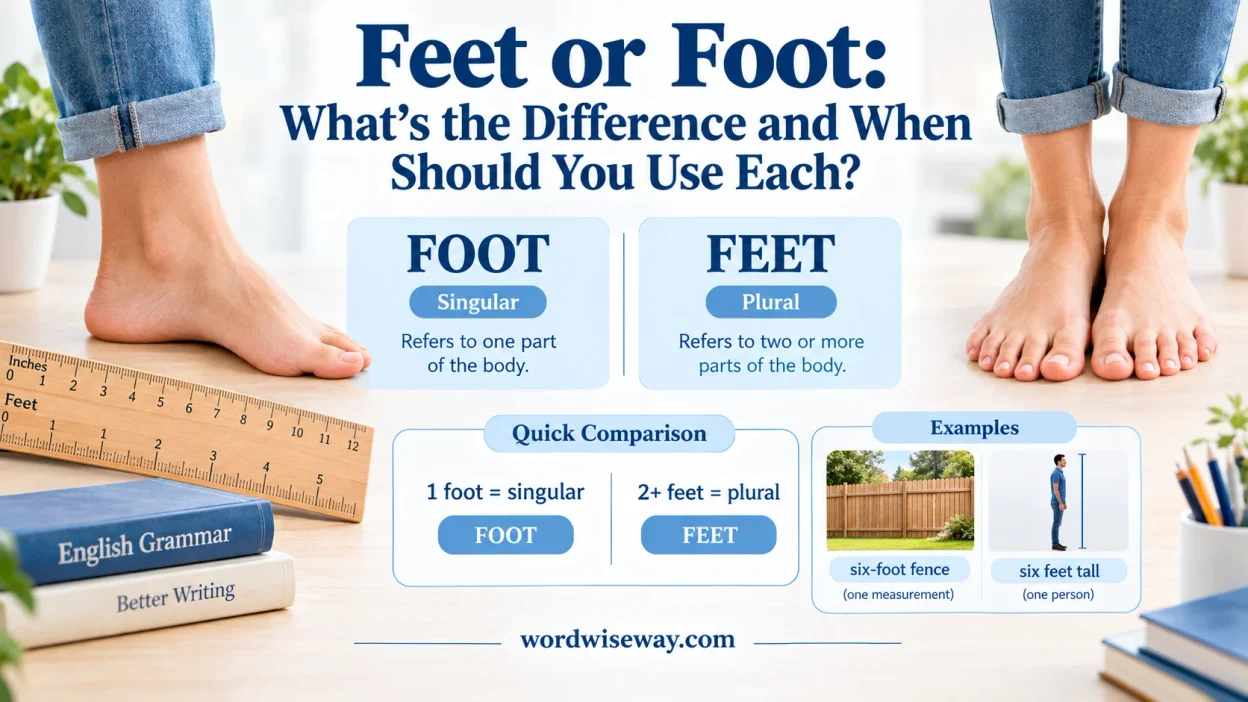
Feet or Foot: What’s the Difference and When Should You Use Each? starts with one simple rule: foot is the singular form, while feet is the plural form. Both words describe the same body part, but their different meanings depend on the number.
This common grammar issue can confuse English learners and native speakers. In measurements, 6 feet tall is normally correct when describing height, while one feet is incorrect. Your context matters in writing, speaking, an email, report, or social media post.
The usage of foot and usage of feet can also involve exceptions and style differences between British English and American English. These usage tips, clear examples, and grammar rules help you decide the correct form and avoid common mistakes in real-world usage
Quick Answer:
Foot is the singular form, while feet is its irregular plural.
- Foot = one
- Feet = two or more
- One foot = one unit of measurement
- Five feet = five units of measurement
- A five-foot wall = singular foot inside a compound adjective
- The wall is five feet high = plural feet in a normal measurement
| Word | Number | Example |
| Foot | Singular | My left foot hurts. |
| Feet | Plural | Both my feet hurt. |
| Foot | One measurement | The rope is one foot long. |
| Feet | Multiple measurements | The rope is six feet long. |
| Foot | Compound adjective | It is a six-foot rope. |
So, if you’re simply talking about more than one foot, choose feet. If you’re describing something with a measurement before a noun, check whether that measurement forms a compound adjective.
What Does “Foot” Mean?
The word foot has several established meanings in English. Its most familiar meaning refers to the body part at the bottom of the leg.
Foot as a Body Part
When you mean one body part, use foot.
For example:
- I injured my foot.
- She washed her foot.
- He stepped on a sharp object with his right foot.
- The child has a small foot.
The singular form works because each sentence refers to one foot.
When you refer to both sides, however, English switches to feet.
- My feet hurt.
- She washed her feet.
- He stood firmly on both feet.
This distinction also affects possessive phrases. You might say my foot when discussing one side and my feet when discussing both.
Foot as a Unit of Measurement
Foot also names a traditional unit of length. One foot contains 12 inches.
The standard abbreviation is ft, although ft. also appears in some writing styles.
Examples include:
- The board is one foot long.
- The shelf is a foot wide.
- The box is one foot tall.
When the measurement becomes plural, the noun normally changes to feet.
- The board is three feet long.
- The shelf is eight feet wide.
- The wall is twelve feet high.
The number determines whether you need the singular or plural form.
Other Meanings of “Foot”
The word foot doesn’t only describe a body part or measurement. English also uses it for the lower or final part of something.
For example:
- The hikers reached the foot of the mountain.
- A note appears at the foot of the page.
- The table has a broken foot.
In poetry, foot has another technical meaning. It can describe a metrical unit made from a particular arrangement of stressed and unstressed syllables.
The important point is simple: foot has several meanings, but its plural form is still feet in ordinary uses referring to multiple feet or measurement units.
What Does “Feet” Mean?
Feet is the standard irregular plural of foot.
It can refer to multiple body parts or multiple units of measurement.
Feet as the Plural of Foot
Use feet when you mean more than one foot.
Consider these examples:
- Her feet were tired after the hike.
- The baby’s feet are tiny.
- Keep both feet on the ground.
- The shoes protect your feet.
Here, feet clearly refers to more than one physical foot.
English doesn’t form this plural by adding -s. That’s why foots isn’t the ordinary plural form.
Feet as a Measurement
You also use feet for measurements greater than one foot.
Examples:
- The room is twelve feet wide.
- The tree is twenty feet tall.
- The pool is six feet deep.
- The rope is fifteen feet long.
The same rule applies regardless of the thing you’re measuring.
You could measure a wall, room, tree, boat, table, or distance. If the measurement is greater than one foot and you’re using the noun normally, feet is generally the correct form.
The Main Difference
The central distinction is number.
Foot represents one. Feet represents more than one.
| Feature | Foot | Feet |
| Grammatical number | Singular | Plural |
| Body part | One foot | More than one foot |
| Measurement | One foot | More than one foot |
| Example | My foot hurts. | My feet hurt. |
| Measurement example | The board is one foot long. | The board is six feet long. |
There’s one major pattern worth remembering. When a measurement acts as part of a compound adjective before a noun, English normally uses the singular foot.
Compare these sentences:
The fence is six feet high.
It is a six-foot fence.
The first sentence uses feet because the measurement stands as a normal noun phrase. The second uses foot because the measurement forms part of a compound modifier.
When Should You Use “Foot”?
Knowing when to use foot becomes much easier when you look at the sentence structure.
Use “Foot” for One Body Part
Choose foot when you mean a single foot.
Correct examples:
- My left foot hurts.
- He injured his foot.
- She put one foot forward.
- The dog stepped on my foot.
If the sentence refers to two feet, switch to feet.
- Both feet hurt.
- She stood on her feet.
- He washed his feet.
Use “Foot” for One-Foot Measurements
Use foot when the measurement equals one foot.
Examples:
- The ruler is one foot long.
- The shelf is a foot wide.
- The hole is one foot deep.
You can also use a foot when the context permits.
For example:
- The table is about a foot wide.
- The plant has grown nearly a foot.
Here, a foot means one foot as a measurement.
Use “Foot” in Compound Adjectives
This is where many writers hesitate.
When a measurement modifies a noun directly, English normally keeps foot singular.
Examples include:
- a six-foot fence
- a ten-foot ladder
- a twelve-foot boat
- a three-foot table
- a five-foot wall
Notice that the number doesn’t force feet in these constructions.
That’s because six-foot works as one compound adjective. The measurement doesn’t function as an ordinary plural noun.
When Should You Use “Feet”?
Use feet when you’re talking about multiple physical feet or multiple measurement units.
Use “Feet” for Multiple Body Parts
If you’re referring to more than one foot, use feet.
Examples:
- My feet are cold.
- She hurt both feet.
- The children washed their feet.
- The runner planted both feet firmly.
The plural remains feet regardless of whose feet you’re discussing.
Use “Feet” for Measurements Greater Than One Foot
Normal measurement statements take feet when the quantity exceeds one.
Examples:
- The room is ten feet long.
- The tree is thirty feet tall.
- The river is several feet deep.
- The table is four feet wide.
This pattern works across different types of measurement.
Use “Feet” After Numbers in Normal Measurement Statements
A useful shortcut is to look at what comes immediately after the measurement.
If the measurement functions normally in the sentence, plural quantities generally take feet.
For example:
- The wall is eight feet high.
- The building is sixty feet tall.
- The road is twenty feet wide.
- The pool is five feet deep.
The number tells you that you’re dealing with multiple units.
Foot or Feet for Measurements?
Measurement grammar creates most of the confusion surrounding these words.
“One Foot” vs. “Two Feet”
The basic pattern is:
1 foot
2 feet
3 feet
10 feet
For example:
- The stick is one foot long.
- The stick is two feet long.
- The stick is three feet long.
The same principle applies to other dimensions.
| Measurement | Correct Form | Example |
| 1 | one foot | The table is one foot wide. |
| 2 | two feet | The table is two feet wide. |
| 5 | five feet | The table is five feet wide. |
| 10 | ten feet | The table is ten feet wide. |
| 12 | twelve feet | The table is twelve feet wide. |
“Foot” in Compound Measurements
Compound adjectives follow a different grammatical pattern.
Consider:
- a three-foot table
- a six-foot wall
- a ten-foot pole
- a twenty-foot boat
In each case, foot remains singular.
That’s not an accident. The entire measurement phrase functions as a modifier before the noun.
Think of six-foot as one descriptive unit. English treats the compound measurement as a single modifier rather than a normal plural noun phrase.
“Feet” in Predicate Measurements
When the measurement appears after a linking verb, use the normal plural form.
- The wall is six feet high.
- The pole is ten feet long.
- The boat is twenty feet wide.
- The building is fifty feet tall.
This creates a useful contrast:
| Before a noun | After the verb |
| a six-foot wall | The wall is six feet high. |
| a ten-foot pole | The pole is ten feet long. |
| a twenty-foot boat | The boat is twenty feet long. |
| a five-foot table | The table is five feet wide. |
Once you recognize this pattern, the choice becomes much less mysterious.
Foot or Feet With Hyphens
Hyphens matter when a measurement works as a compound adjective.
Consider:
a six-foot fence
The phrase six-foot jointly modifies fence, so the hyphen connects the words.However, you don’t normally hyphenate a regular measurement statement.
Correct:
- The fence is six feet tall.
- We built a six-foot fence.
Incorrect in standard usage:
- The fence is six-feet tall.
- We built a six feet fence.
The grammatical structure determines both the number and the hyphenation.
Foot or Feet in Height Descriptions?
Height descriptions provide one of the clearest examples of this rule.
“He Is Six Feet Tall”
When describing someone’s height in a normal sentence, use feet for a measurement greater than one.
- He is six feet tall.
- She is five feet tall.
- The statue is eight feet tall.
Here, six feet functions as a measurement phrase.
“A Six-Foot-Tall Person”
When the measurement becomes part of a compound adjective, use foot.
For example:
- He is a six-foot-tall athlete.
- They built a six-foot-tall statue.
- The company installed a seven-foot-tall door.
The phrase six-foot-tall acts as one compound modifier.
You can also see the difference in these paired examples:
The statue is eight feet tall.
It is an eight-foot-tall statue.
The meaning stays nearly identical. The grammatical construction changes.
“Six Foot Tall” vs. “Six Feet Tall”
In ordinary prose, six feet tall is the standard construction.
Use six-foot-tall when the entire phrase modifies a noun.
| Construction | Correct Example |
| Normal measurement | She is six feet tall. |
| Compound adjective | She is a six-foot-tall athlete. |
| Noun compound | It is a six-foot fence. |
This distinction is one of the most useful rules to remember about foot or feet.
Common Expressions
Both forms appear in established English expressions.
Common Expressions With “Foot”
On foot means traveling by walking.
- We explored the town on foot.
Set foot means to enter or be present somewhere.
- He never set foot inside the old building.
Put your best foot forward means to make a strong effort or good impression.
Get off on the right foot means to begin something positively.
These expressions preserve foot even when their meaning isn’t literally about one physical foot.
Common Expressions With “Feet”
Get your feet wet means to gain initial experience with something.
- The course helps beginners get their feet wet.
Drag your feet means to delay or move slowly because you don’t want to act.
Have both feet on the ground describes someone who remains practical and realistic.
Sweep someone off their feet means to make someone suddenly very excited or impressed.
The plural feet remains fixed in these established expressions.
Why Is the Plural of Foot “Feet” Instead of “Foots”?
Foot → feet is an irregular plural. English inherited this pattern from older forms of the language.
The change belongs to a historical type of plural formation often called i-mutation or umlaut. A vowel in an older form changed because of a sound in a following syllable. Over centuries, that historical sound disappeared while the altered vowel remained.
The same broad historical pattern helps explain forms such as:
- foot → feet
- tooth → teeth
- goose → geese
Modern speakers don’t create these plurals by applying a productive rule. You simply learn them as established forms.
That’s why foots isn’t the ordinary plural of foot.
Common Mistakes
The mistakes usually come from applying a regular plural rule where English uses an irregular form.
Using “Foots” as the Plural
In ordinary modern English, don’t use foots as the plural of foot.
Incorrect:
- My foots hurt.
Correct:
- My feet hurt.
The same rule applies to measurement.
Incorrect:
- The wall is six foots high.
Correct:
- The wall is six feet high.
Using “Feet” in a Compound Adjective
This is another frequent error.
Incorrect:
- a six-feet-tall building
- a ten-feet ladder
Correct:
- a six-foot-tall building
- a ten-foot ladder
The singular foot belongs in these compound modifiers.
Using “Foot” for Multiple Body Parts
If you mean both or several feet, don’t use the singular form.
Incorrect:
- My foot hurt after walking all day.
If both feet hurt, write:
- My feet hurt after walking all day.
The context matters. If only one foot hurts, the singular sentence is perfectly correct.
Confusing Measurement Grammar
Compare these structures carefully:
- The room is twelve feet wide.
- It is a twelve-foot-wide room.
Both can be correct. The first uses a normal measurement phrase. The second uses a compound adjective.
Comparison Table
This table captures the most useful patterns at a glance.
| Situation | Correct Form | Example |
| One body part | foot | My foot hurts. |
| More than one body part | feet | My feet hurt. |
| One measurement | foot | The board is one foot long. |
| Multiple measurements | feet | The board is six feet long. |
| Compound adjective | foot | a six-foot board |
| Height after a verb | feet | He is six feet tall. |
| Height before a noun | foot | a six-foot-tall man |
| Fixed expression | foot | on foot |
| Plural expression | feet | stand on your feet |
Foot or Feet in American English
In American English, the singular and plural distinction remains the same:
- foot = singular
- feet = plural
The foot is equal to 12 inches. The measurement is part of the customary US system and remains widely used for everyday measurements such as height, room dimensions, construction, and property descriptions.
For example:
- The room is twelve feet wide.
- The fence is six feet tall.
- The package is two feet long.
American English also follows the compound-adjective rule:
- a six-foot fence
- a ten-foot ceiling
- a five-foot table
The spelling doesn’t change based on whether the measurement describes height, length, width, or depth.
Foot or Feet in British English
British English follows the same basic grammatical distinction between foot and feet.
You still write:
- one foot
- two feet
- six feet
- a six-foot wall
The larger difference concerns measurement preferences. British English commonly uses metric measurements in many modern contexts, while feet and inches still appear frequently for certain everyday purposes, especially human height.
Regardless of the measurement system, the grammar of foot versus feet remains consistent.
How to Remember the Difference Between Foot and Feet
You only need two rules to solve most feet or foot questions.
Rule One: One = Foot
Use foot for one physical foot or one unit.
One foot.
Rule Two: More Than One = Feet
Use feet for multiple feet or multiple measurement units.
Two feet.
Six feet.
Ten feet.
Then remember the special compound-adjective rule:
Six-foot fence.
Six feet high.
A useful memory trick is to compare the two forms side by side:
The fence is six feet high.
It is a six-foot fence.
The first describes the fence’s measurement. The second uses the measurement as an adjective.
Practice:
Test yourself with these sentences.
Fill in the Blank
- My left ___ hurts.
- Both my ___ are cold.
- The table is four ___ long.
- They installed a six-___ ladder.
- The building is fifty ___ tall.
- She is five ___ tall.
- They built a ten-___ wall.
- The child stood firmly on both ___.
Answers
- foot
- feet
- feet
- foot
- feet
- feet
- foot
- feet
The answers follow the same core rule. Normal plural measurements take feet, while compound modifiers take singular foot.
Choose the Correct Sentence
A. The wall is six feet high.
B. The wall is six foot high.
Correct answer: A
Now compare:
A. They built a six-feet wall.
B. They built a six-foot wall.
Correct answer: B
These examples demonstrate why sentence structure matters more than the number alone.
Quick Revision:
Here’s the whole lesson condensed into a quick reference:
- Foot is singular.
- Feet is plural.
- Use foot for one physical foot.
- Use feet for two or more physical feet.
- Use foot for one unit of measurement.
- Use feet for multiple measurement units.
- Use singular foot in compound adjectives.
- Write six feet tall in a normal measurement statement.
- Write a six-foot-tall building when the measurement modifies a noun.
- Foots isn’t the ordinary plural of foot.
- The abbreviation ft can represent either foot or feet, depending on context.
Key Takeaways
The difference between foot and feet comes down to number and sentence structure.
Foot is the singular form. You use it for one body part or one measurement unit.
Feet is the irregular plural. You use it for multiple body parts or measurement units.
The most important exception appears in compound adjectives. English uses foot in expressions such as a six-foot wall and a ten-foot ladder. However, ordinary measurement statements use feet, as in The wall is six feet high.
Once you recognize whether the measurement stands alone or modifies a noun, the correct form becomes much easier to choose.
Read More: Kiss or Slap: Meaning, Difference, Usage, Grammar, and Examples
FAQs
1. Is “foot” singular or plural?
Foot is the singular form, while feet is the plural form. You use foot when referring to one unit or one body part. For example, “My left foot hurts” uses the singular form.
2. Is “feet” always the plural of “foot”?
Yes, feet is the irregular plural of foot. You use it when referring to two or more feet or multiple measurement units. For example, “The table is six feet long.”
3. Should I say “6 foot” or “6 feet”?
In normal measurement expressions, 6 feet is generally correct. However, 6 foot can appear before a noun as part of a compound adjective, such as “a 6-foot wall.”
4. Is “one feet” grammatically correct?
No. One feet is incorrect because one refers to a single unit. The correct expression is one foot, such as “The box is one foot wide.”
5. Why do people confuse foot and feet?
The confusion usually comes from the irregular plural form. Unlike many English nouns that add “s,” foot changes to feet. Fast speech and informal writing can make this distinction easier to miss.
6. Can “foot” be used for measurements?
Yes. Foot is used for a single measurement unit. For example, “The shelf is one foot long.” It can also appear in compound descriptions, such as “a 10-foot pole.”
7. Can “feet” describe a person’s height?
Yes. Feet commonly describes height when the measurement contains more than one foot. For example, “She is five feet tall.” Inches can be added for a more precise measurement.
8. Is “6 foot tall” ever correct?
Yes, but the context matters. “He is 6 feet tall” is the standard phrasing in a sentence. “A 6-foot-tall player” uses foot because the measurement functions as part of a compound modifier.
9. Are foot and feet used differently in British and American English?
The basic distinction remains the same in both varieties. Foot represents one unit, while feet represents more than one. Some measurement expressions may vary by style or context, but the core grammar stays consistent.
10. How can I remember when to use foot or feet?
Think about the number first. Use foot for one and feet for more than one. Checking the surrounding sentence also helps, especially when the measurement works as a compound adjective.
Conclusion
Understanding foot and feet becomes much easier once you focus on the number and grammatical role. Foot is the singular form, while feet is the irregular plural form. This simple distinction covers most everyday situations, including body parts and measurements.
The main challenge appears when measurements are used before nouns. Expressions such as “six feet tall” and “a six-foot wall” look different because they serve different grammatical purposes. Paying attention to the sentence structure can help you avoid common mistakes such as “one feet” or using “feet” inside a compound modifier.
With regular practice, choosing between foot and feet becomes almost automatic. When you’re unsure, identify whether you mean one unit, several units, or a compound description. That quick check can improve your grammar in conversations, emails, reports, and everyday writing.

Amelia Sanders has spent 14 years in Harvard University’s English Department, helping students navigate literary analysis, interpretive theory, and narrative techniques. Her academic pursuits center on 18th-century British prose, romantic poetry, diasporic writing, and digital editing exploring how textual choices influence cultural perspectives. Amelia has spoken at major international meetings and contributed essays to respected academic volumes, demonstrating her dedication to thoughtful scholarship and effective teaching.