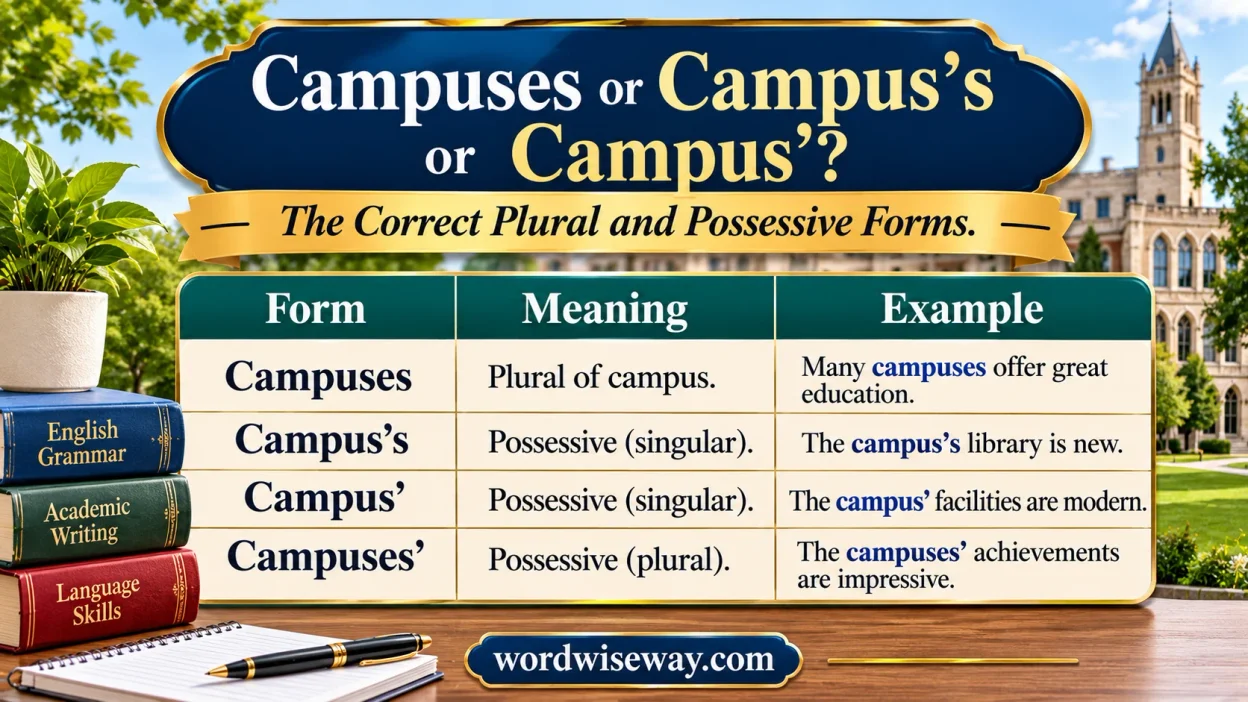
Campuses or Campus’s or Campus’? Correct Possessive Forms becomes easier to understand when you learn how apostrophes show ownership. English grammar uses different possessive forms for singular and plural nouns. Since campus is singular, campus’s usually shows ownership. For example, “The campus’s library opens early” identifies a library belonging to one campus.
When discussing multiple campuses, use campuses’ to show plural possession. For example, “The campuses’ libraries serve students across different locations.” The apostrophe comes after the final s because campuses is plural. Although campus’ appears in some style guides, campus’s is widely accepted as the singular possessive form.
Understanding these apostrophe rules improves your grammar, sentence structure, and writing accuracy. Remember to identify whether one campus or several campuses own something before choosing the correct possessive form. This simple check helps you write clear, natural, and grammatically correct English sentences.
Quick Answer:
Campuses is the standard plural form of campus. Campus’s is the usual singular possessive form in American English, while campus’ is an accepted alternative under certain style guides. If something belongs to multiple campuses, use campuses’.
| Form | Meaning | Example |
| Campuses | More than one campus | Three campuses offer nursing programs. |
| Campus’s | Something belonging to one campus | The campus’s library closes at nine. |
| Campus’ | Singular possession under an alternative style convention | The campus’ entrance faces north. |
| Campuses’ | Something belonging to multiple campuses | The campuses’ libraries open early. |
Remember this simple rule: Use an apostrophe to show possession, not to form an ordinary plural. Once you understand that distinction, choosing the right spelling becomes much easier.
What Does Campuses Mean?
Campuses is the standard plural form of campus. Use it whenever you refer to two or more university, college, or school grounds.
A campus typically includes the buildings, facilities, and outdoor spaces associated with an educational institution. A university may operate one campus or several campuses across different cities.
For example, a university might have a main campus in one city and two additional campuses elsewhere. When you discuss all three locations, campuses is the correct word.
Why Is the Plural of Campus Campuses?
English forms many plurals by adding -s or -es to singular nouns. The spelling depends partly on how the word ends.
The noun campus ends in s, but its standard plural adds -es to produce campuses. You don’t simply add an apostrophe or write campuss.
Consider these examples:
- One campus becomes two campuses.
- One bonus becomes several bonuses.
- One bus becomes several buses.
- One class becomes several classes.
These words follow a familiar spelling pattern. However, plural formation varies across English nouns, so it’s wise to check unfamiliar words rather than assume every noun follows the same rule.
Examples of Campuses in Sentences
Here are several natural ways to use campuses correctly.
- The university operates three campuses across the state.
- Students can access online services from all campuses.
- Several campuses introduced new science laboratories this year.
- The college plans to expand its campuses over the next decade.
- Each of the university’s campuses offers different academic programs.
Notice that none of these examples requires an apostrophe in campuses. The word simply identifies multiple locations.
Campuses in Academic and Professional Writing
Writers frequently use campuses when discussing university systems, educational facilities, and institutional expansion.
For instance, a report might state, “The university operates five campuses and enrolls students at each location.” The plural noun communicates the number of locations without suggesting ownership.
Similarly, a sentence such as “Students from different campuses attended the conference” describes students associated with multiple locations.
If the sentence merely identifies more than one campus, use campuses. Save the apostrophe for a genuine possessive relationship.
What Does Campus’s Mean?
Campus’s is the singular possessive form of campus in standard American English usage. It indicates that something belongs to, relates to, or is associated with one campus.
To form it, begin with the singular noun campus and add an apostrophe followed by s. This produces campus’s.
For example, “The campus’s library recently expanded” means the library associated with that particular campus recently expanded.
The word doesn’t become plural simply because it contains another s. The apostrophe signals possession, while the noun remains singular.
When Should You Use Campus’s?
Use campus’s when you refer to something associated with one campus and your chosen style guide follows the common American English convention.
Examples include:
- The campus’s library stays open during exam week.
- The campus’s security team monitors the main entrance.
- The campus’s history dates back more than a century.
- The campus’s facilities include a modern research laboratory.
- The campus’s location makes commuting convenient for students.
Each example describes something associated with one campus.
However, possession doesn’t always mean literal ownership. A campus may not legally own its history, location, or reputation. The possessive form can also express a relationship or association.
Why Does Campus’s Have Two S’s?
This spelling can look unusual because the word already ends in s. However, many American English style guides recommend adding ’s to singular nouns ending in s.
The extra s helps distinguish the possessive form from the singular noun itself. It also follows the general rule of forming singular possessives by adding an apostrophe and s.
Compare these examples:
- The campus has a new library.
- The campus’s library has a new reading room.
The first sentence simply describes the campus. The second identifies the library associated with it.
Although campus’s is standard under many American English conventions, some publications prefer a different approach. Always follow the relevant style guide when writing for a specific organization or publication.
What Does Campus’ Mean?
Campus’ is an alternative singular possessive form. Some style guides recommend placing only an apostrophe after singular nouns ending in s, while others prefer ’s.
Both conventions can be correct within their respective style systems. The important point is that campus’ does not mean more than one campus. It still refers to something associated with one campus.
For example, “The campus’ entrance faces north” expresses the same basic possessive relationship as “The campus’s entrance faces north.”
When Is Campus’ Acceptable?
Use campus’ when the style guide you’re following calls for a final apostrophe after singular nouns ending in s. Some publications adopt this convention to maintain consistency across their writing.
Examples include:
- The campus’ entrance faces the main road.
- The campus’ reputation attracts students from abroad.
- The campus’ facilities underwent extensive renovations.
- The campus’ history appears in the university archive.
These examples illustrate the alternative convention rather than a universal requirement. Many American English style guides prefer campus’s instead.
Campus’ vs. Campus’s: Does the Meaning Change?
In ordinary usage, the two forms generally express the same singular possessive meaning. The difference comes from punctuation style, not the number of campuses.
| Sentence | Meaning |
| The campus’s library is spacious. | One campus has an associated library. |
| The campus’ library is spacious. | The same meaning under an alternative style convention. |
Neither form is the ordinary plural of campus. If you mean several locations, write campuses.
Practical tip: Follow your teacher’s, publisher’s, or organization’s preferred style. If no specific rule applies, campus’s is a reliable choice for standard American English writing.
What Does Campuses’ Mean?
Campuses’ is the plural possessive form of campus. Use it when something belongs to, relates to, or is associated with multiple campuses.
To form this possessive, first make the noun plural: campus becomes campuses. Then add an apostrophe after the final s.
The result is campuses’.
For example, “The campuses’ libraries offer extended hours” means the libraries associated with multiple campuses offer extended hours.
Examples of Campuses’ in Sentences
Here are several examples showing how plural possession works:
- The campuses’ libraries offer free tutoring services.
- The campuses’ parking facilities need additional spaces.
- The campuses’ research programs received new funding.
- The campuses’ academic calendars follow different schedules.
- The campuses’ security teams coordinate during major events.
In each sentence, the apostrophe comes after the plural noun because the sentence refers to multiple campuses.
Campuses’ vs. Campus’s
These two forms differ in both number and grammatical meaning.
Consider the following examples:
- The campus’s library is closed. One campus has an associated library.
- The campuses’ libraries are closed. Multiple campuses have associated libraries.
The first sentence uses a singular possessive. The second uses a plural possessive.
The number of campuses determines where the apostrophe belongs. First identify whether the noun is singular or plural. Then apply the appropriate possessive rule.
What’s the Difference?
The clearest way to understand these spellings is to separate pluralization from possession.
Pluralization tells readers that you’re referring to more than one thing. Possession indicates a relationship between a noun and something associated with it.
The spelling changes reflect those different functions.
Comparison Table:
| Form | Grammatical function | What it tells the reader |
| Campus | Singular noun | One campus |
| Campuses | Plural noun | More than one campus |
| Campus’s | Singular possessive | Something associated with one campus |
| Campus’ | Alternative singular possessive | The same basic meaning as campus’s |
| Campuses’ | Plural possessive | Something associated with multiple campuses |
This table highlights a crucial distinction: campuses and campus’s are not interchangeable.
One refers to multiple locations. The other indicates a possessive relationship with one location.
How Apostrophe Placement Changes Meaning
A small punctuation mark can change the grammatical role of a word.
Compare these sentences:
- The campuses need better transportation.
- The campus’s transportation system needs improvement.
- The campuses’ transportation systems need improvement.
The first sentence refers to multiple campuses. The second identifies a transportation system associated with one campus. The third refers to systems associated with multiple campuses.
These differences matter in academic writing, reports, and institutional communications. An incorrectly placed apostrophe may confuse readers about the number of locations involved or the relationship being described.
Is Campus’ the Plural Form of Campus?
No. Campuses is the standard plural form.
The apostrophe in campus’ signals a possessive construction under certain style conventions. It doesn’t turn a singular noun into a plural noun.
For example:
Incorrect for an ordinary plural: “The university operates three campus’.”
Correct: “The university operates three campuses.”
Correct under a permitted singular possessive convention: “The campus’ library is open.”
When you need an ordinary plural, leave out the apostrophe and use campuses.
How to Use Campuses and Possessive Forms Correctly
Choosing the right form becomes easier when you work through the sentence’s meaning before deciding on its punctuation.
Start by asking whether you’re referring to one campus, several campuses, or something associated with either.
Use Campuses When Referring to Multiple Locations
Choose campuses when the noun simply means more than one campus.
Examples:
- The university operates four campuses.
- Students can transfer between campuses.
- Several campuses offer evening classes.
- The institution plans to renovate its campuses.
None of these examples expresses possession through the word campuses. Each sentence simply identifies multiple locations.
Use Campus’s for Singular Possession
Choose campus’s when something relates to one campus and your style guide follows the common American English convention.
Examples:
- The campus’s main gate closes at midnight.
- The campus’s library contains a rare collection.
- The campus’s academic programs attract international students.
The key is that each example refers to one campus. The apostrophe and s indicate the possessive relationship.
Use Campus’ When Your Style Guide Permits It
Choose campus’ when your publication or institution follows a convention that omits the extra s after singular nouns ending in s.
Examples:
- The campus’ main gate closes at midnight.
- The campus’ library contains a rare collection.
- The campus’ academic programs attract international students.
These sentences have the same intended meanings as their campus’s versions. The difference lies in the style convention.
Avoid switching between the two forms without a reason. Consistent punctuation makes writing easier to edit and read.
Use Campuses’ for Plural Possession
Choose campuses’ when something belongs to or is associated with more than one campus.
Examples:
- The campuses’ libraries share digital resources.
- The campuses’ administrators met to discuss enrollment.
- The campuses’ sports facilities need new equipment.
Notice the sequence: first, campus becomes campuses. Then the apostrophe follows the final s.
This pattern applies to many regular plural nouns that end in s. For example, teachers’ classrooms refers to classrooms associated with multiple teachers.
Common Mistakes to Avoid
Even experienced writers sometimes confuse plural and possessive forms. Most errors happen when writers add apostrophes without checking the sentence’s meaning.
Using Campus’s as the Ordinary Plural
Incorrect: “Several campus’s offer engineering degrees.”
Correct: “Several campuses offer engineering degrees.”
The sentence refers to multiple locations rather than something belonging to one location. Therefore, it needs the plural noun campuses.
Using Campus’ to Mean Multiple Campuses
Incorrect: “The university operates three campus’.”
Correct: “The university operates three campuses.”
An apostrophe doesn’t replace the normal plural ending. Use campuses when counting locations.
Confusing Campuses’ With Campus’s
Incorrect: “The campus’s libraries serve students at all four locations.”
If the intended meaning is that the libraries belong to multiple campuses, write:
Correct: “The campuses’ libraries serve students at all four locations.”
The singular possessive campus’s refers to one campus. The plural possessive campuses’ refers to multiple campuses.
Adding an Apostrophe to an Ordinary Plural
Incorrect: “Students visited several campus’s during orientation.”
Correct: “Students visited several campuses during orientation.”
The word several already signals that the noun is plural. No possessive relationship exists, so an apostrophe isn’t necessary.
Mixing Possessive Styles
Inconsistent: “The campus’s library opened early, and the campus’ cafeteria closed late.”
More consistent: “The campus’s library opened early, and the campus’s cafeteria closed late.”
The first version may be appropriate if a writer intentionally follows different rules for different grammatical constructions, but ordinary editorial practice favors one consistent possessive convention. Choose the required style guide and apply its rules throughout the document.
Assuming Every Noun Ending in S Follows One Rule
English possessives depend on whether a noun is singular or plural and on the style convention being used.
For example, singular possessives often take ’s, while regular plural nouns ending in s generally take only an apostrophe.
Compare:
- The student’s notebook
- The students’ notebooks
- The campus’s library
- The campuses’ libraries
These examples illustrate the standard distinction between singular and plural possessives. However, singular nouns ending in s can follow different editorial conventions.
Example Sentences
The following examples show how each form works in everyday and academic contexts.
| Sentence | Correct form | Why it works |
| The university operates five campuses. | Campuses | The noun refers to multiple locations. |
| The campus’s library opens at eight. | Campus’s | The library is associated with one campus. |
| The campus’ entrance faces east. | Campus’ | This uses an accepted alternative possessive style. |
| The campuses’ libraries offer free Wi-Fi. | Campuses’ | The libraries are associated with multiple campuses. |
| Students toured two campuses yesterday. | Campuses | The sentence describes two locations. |
| The campus’s new laboratory opens tomorrow. | Campus’s | The laboratory belongs to or is associated with one campus. |
| The campuses’ administrators approved the proposal. | Campuses’ | The administrators are associated with multiple campuses. |
Correct and Incorrect Usage in Context
Consider a university expanding its facilities across several locations.
Incorrect: “The university renovated three campus’s last year.”
Correct: “The university renovated three campuses last year.”
The corrected sentence uses the standard plural form because it refers to three locations.
Now consider a library located at one university campus.
Incorrect for the usual American English possessive convention: “The campus library’s collection expanded.”
This sentence isn’t necessarily incorrect. It simply expresses a different grammatical construction, using campus library as a compound noun and placing the possessive on library. If the intended meaning is that the campus itself has an associated library, both the campus library’s collection and the campus’s library collection may work, depending on the intended structure.
A clearer example is:
“The campus’s library collection expanded.”
Here, campus’s directly marks the singular possessive relationship.
Finally, consider a university system with multiple campuses.
Correct: “The campuses’ libraries expanded their digital collections.”
The plural possessive shows that the libraries belong to or are associated with multiple campuses.
A Simple Case Study: Choosing the Correct Form
Imagine a university that operates three campuses in different cities. Its communications team needs to describe the locations, facilities, and shared resources in an annual report.
The team writes these sentences:
- The university operates three campuses.
- Each campus’s library provides study spaces.
- The campuses’ libraries share an online catalog.
Each sentence uses a different grammatical form for a specific reason.
The first sentence counts locations. The second describes a library associated with one campus. The third describes libraries associated with multiple campuses.
This example demonstrates why context matters more than the appearance of the word. Instead of memorizing spellings without understanding them, identify the intended meaning first.
How to Choose the Correct Form in a Sentence
Use this simple decision process whenever you’re unsure which spelling belongs in your sentence.
- Are you referring to more than one campus? Write campuses.
- Does something belong to one campus? Write campus’s under the usual American English convention.
- Does your style guide omit the extra s after singular nouns ending in s? Write campus’ if that convention applies.
- Does something belong to multiple campuses? Write campuses’.
For example, consider the sentence, “The university renovated the campus___ library.”
If the sentence follows standard American English possessive guidance, fill in the blank with campus’s. The completed sentence reads, “The university renovated the campus’s library.”
Now consider, “The university renovated the libraries at several ___.”
The correct answer is campuses. The sentence identifies multiple locations without expressing possession through the noun.
Practice Questions: Campuses or Campus’s?
Test your understanding with these examples. Choose the correct form for each sentence.
- The university operates four (campuses / campus’s).
- The (campus’s / campuses’) main entrance needs repairs. Only one campus is involved.
- The (campuses’ / campus’s) libraries share research resources. Several campuses are involved.
- The (campus’ / campuses) student center closes at ten. One campus is involved, and the writer follows a style guide that permits the final-apostrophe form.
- Students visited three (campuses / campuses’) during their tour.
Answers and explanations
| Question | Correct answer | Explanation |
| One | Campuses | The sentence refers to four locations. |
| Two | Campus’s | The possessive refers to one campus. |
| Three | Campuses’ | The libraries are associated with multiple campuses. |
| Four | Campus’ | The sentence follows an alternative singular possessive convention. |
| Five | Campuses | The sentence counts locations without expressing possession. |
Practice helps reinforce the distinction. Whenever an apostrophe seems necessary, pause and check whether the sentence actually expresses possession.
Read More: 25 Best Replies to “You’re Welcome” Polite, and Funny
FAQs
1. What Is the Correct Possessive Form of Campus?
The correct possessive form is usually campus’s. It shows that something belongs to one campus. For example, “The campus’s entrance looks beautiful.”
2. Is Campus’s Grammatically Correct?
Yes, campus’s is grammatically correct and widely accepted in English. It follows the common rule of adding an apostrophe and s to a singular noun to show ownership.
3. When Should You Use Campuses’?
Use campuses’ when something belongs to multiple campuses. For example, “The campuses’ libraries close at five.” The apostrophe comes after the s because campuses is plural.
4. Is Campus’ Also a Correct Possessive Form?
Yes, some style guides accept campus’ as a singular possessive form. However, campus’s is widely accepted, so check your preferred style guide and remain consistent.
5. What Is the Difference Between Campus’s and Campuses’?
Campus’s indicates possession by one campus, while campuses’ indicates possession by multiple campuses. The difference depends on whether the noun is singular or plural.
6. How Do You Make Campus Plural and Possessive?
First, change campus to campuses to form the plural. Then add an apostrophe after the final s to create campuses’, which expresses plural ownership.
7. Does Campus’s Always Mean Ownership?
Usually, campus’s shows ownership or association with one campus. For example, “The campus’s rules are clearly displayed” connects the rules to that campus.
8. Where Does the Apostrophe Go in Campuses’?
Place the apostrophe after the final s in campuses’. This form applies when multiple campuses possess something, as in “The campuses’ facilities need maintenance.”
9. What Are Common Mistakes When Writing Campus’s or Campuses’?
A common mistake is using campus’s for multiple campuses or campuses’ for one campus. Identify whether the noun is singular or plural before adding the apostrophe.
10. How Can You Remember the Correct Possessive Form of Campus?
Remember this simple rule: campus’s usually means one campus owns something, while campuses’ means multiple campuses own something. Checking the noun first makes the choice easier.
Conclusion
Choosing between campus’s, campus’, and campuses’ becomes much easier when you understand how singular and plural nouns work. Use campus’s to show that something belongs to one campus, such as “The campus’s library stays open late.” This form follows a common English grammar rule and helps you express ownership clearly.
When you’re talking about more than one campus, use campuses’ to show plural possession. For example, “The campuses’ facilities need improvement” refers to facilities associated with multiple campuses. You may also see campus’ used as a singular possessive form in certain style guides. When in doubt, follow your preferred style guide and use the same rule throughout your writing.
The easiest way to avoid mistakes is to identify the noun first. Ask yourself whether you mean one campus or several campuses, then place the apostrophe accordingly. A little attention to these possessive forms can improve your grammar, strengthen your sentence structure, and make your English writing clearer and more natural.

Emma Smith has dedicated 14 years to Princeton University’s English Department, mentoring students in textual interpretation, literary movements, and critical frameworks. Her research explores Shakespearean drama, Victorian serial fiction, postcolonial narrative theory, and manuscript studies and probing how literary forms evolve across cultures and centuries. Emma has delivered lectures at international humanities congresses and published findings in distinguished academic journals, underscoring her commitment to scholarly depth and vibrant teaching.