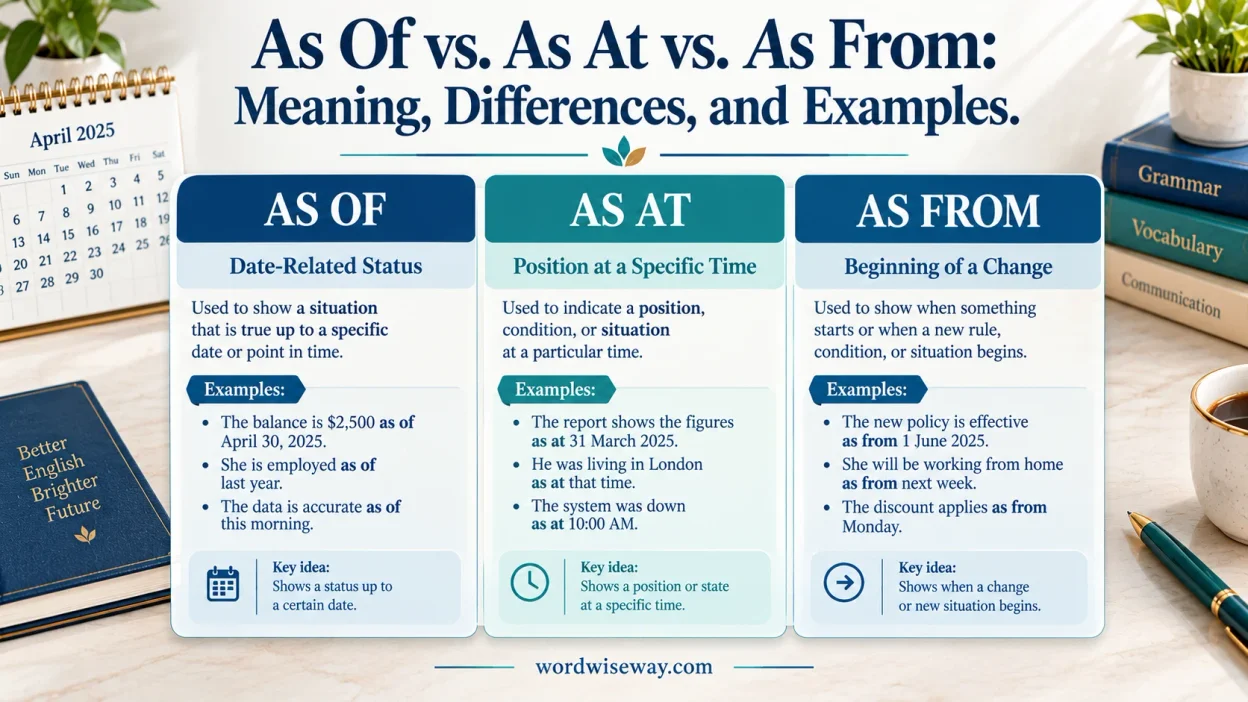
As Of vs. As At vs. As From: Meaning, Differences, and Examples explains how these phrases express dates, times, and changes in English grammar. Although they have similar meanings, each phrase serves a different purpose in everyday English usage.
As of describes a situation effective from a specified date, while as at reports a situation at a particular time. For example, “As of June 1, the policy is effective” and “As at June 1, the balance was $500.” These examples highlight their contextual meanings and grammatical differences.
As from indicates when a change will begin. For example, “As from June 1, the new schedule will start.” Understanding these time expressions helps you choose the correct preposition and use each phrase naturally in different sentences and situations.
Quick Answer:
The main difference between “as of,” “as at,” and “as from” lies in how each expression connects information to a particular date.
| Expression | Meaning | Common Use | Example |
| As of | Indicates a date associated with a fact, status, or effective change | General American English, reports, announcements | As of October 20, the company employs 150 people. |
| As at | Identifies a position or status at a specific point in time | Financial statements and formal reports | As at October 20, the account balance was $4,500. |
| As from | Indicates when a new arrangement begins to apply | Formal notices, policies, employment documents | As from October 20, the new schedule applies. |
Remember this simple distinction:
- As of: What is true or applicable on a specified date?
- As at: What was the position at a particular point in time?
- As from: When does a new arrangement begin?
The first two expressions can overlap, particularly in reporting. The third more directly emphasizes the start of a new arrangement.
What Does “As Of” Mean?
“As of” identifies a date or time associated with a fact, condition, status, or change. Its exact meaning depends on the surrounding sentence.
American English uses this expression widely in business communication, everyday conversation, financial reporting, and official announcements.
For example, a company might report its employee count as of October 20. Another company might announce that a new policy takes effect as of the same date.
Although both sentences contain the same expression, they communicate different things. One reports information associated with a date, while the other establishes when a change applies.
How to Use “As Of” in a Sentence
You can place “as of” at the beginning or within a sentence. The expression usually appears immediately before the relevant date or time.
Consider these examples:
- As of October 20, the company has 150 employees.
- The application process remains open as of today.
- As of Monday, all employees must use the updated system.
- The account showed a balance of $2,800 as of September 30.
- As of 9 a.m., the event had received 250 registrations.
Each example connects information to a particular point in time. However, the sentence determines whether that date describes a status, a reporting cutoff, or an effective change.
For formal writing, use a comma after an introductory date phrase when it improves readability.
Example:
“As of January 1, the revised policy applies to all new employees.”
This sentence clearly identifies when the policy begins to apply, although “effective January 1” may communicate the same idea more directly.
“As Of” Examples in American English
“As of” is a familiar expression in American English. Writers use it across many situations because it connects dates to information without requiring complicated wording.
Business updates
“As of Friday, the team has completed 80% of the project.”
This sentence reports the project’s progress at the stated time.
Employment announcements
“As of November 1, Jordan will lead the customer service department.”
The sentence connects a new job responsibility with a specified date.
Financial information
“As of December 31, the business reported $75,000 in outstanding receivables.”
The date identifies the reporting point for the financial figure.
Public announcements
“As of today, visitors can register for the event online.”
The sentence communicates the availability of a service at the stated time.
These examples show why “as of” works well in professional and everyday writing. It can introduce a reporting date or identify when a new condition takes effect.
Does “As Of” Mean “Starting On” or “Up To and Including”?
“As of” can communicate different temporal relationships, so context matters.
Sometimes, it identifies the date when a condition begins to apply:
“As of November 1, the monthly subscription costs $15.”
Here, the expression indicates a new price associated with November 1.
In other situations, it identifies the date of a reported status:
“As of November 1, the company had received 500 applications.”
Here, the date establishes the point at which the application count was reported.
However, “as of” does not always clearly establish whether a period includes its stated endpoint. If that distinction matters, use more precise wording.
Compare these examples:
- Through November 30: Clearly indicates a period that includes November 30.
- Until November 30: Can require clarification about whether November 30 itself is included.
- Effective November 30: Identifies the date a change takes effect.
- As of November 30: Connects information or a condition to that date, but the exact temporal relationship depends on context.
When dates affect contracts, deadlines, payments, or eligibility, explicit wording is safer than relying on an expression that readers might interpret differently.
What Does “As At” Mean?
“As at” identifies the state, position, or condition of something at a particular point in time. It appears especially often in accounting, financial statements, audit documents, and formal business reporting.
For example, a financial statement might list a company’s cash balance as at December 31. That date identifies the point at which the reported balance applies.
The expression emphasizes a snapshot rather than necessarily describing a change.
Imagine taking a photograph of a company’s financial position on the final day of its fiscal year. The photograph captures the situation at that moment, while the business’s transactions continue over time.
“As at” serves a similar purpose in formal reporting.
How to Use “As At” in a Sentence
“As at” usually appears before a date or time that identifies the relevant position or status.
Here are several examples:
- As at March 31, the company held $120,000 in cash.
- The outstanding loan balance was $18,500 as at June 30.
- As at December 31, the organization had 75 active employees.
- The inventory report recorded 2,400 units as at September 15.
- As at the reporting date, the business had no overdue supplier payments.
These sentences describe information associated with a particular reporting point.
Notice that the figures represent a status at a specific date. They don’t necessarily describe everything that happened during the period leading up to that date.
For example, an inventory report showing 2,400 units as at September 15 doesn’t reveal how many units the company sold throughout September. That question requires information about transactions over time.
“As At” in Financial Statements and Reports
Financial reporting often distinguishes between a position at a specific date and activity across an entire period.
This distinction matters because different financial statements answer different questions.
A statement of financial position, commonly called a balance sheet, reports assets, liabilities, and equity at a particular date. An income statement, by contrast, generally reports financial performance over a defined period.
For example:
| Statement | Reporting Example | What It Communicates |
| Statement of financial position | Cash as at December 31: $45,000 | The cash balance at the reporting date |
| Accounts receivable report | Outstanding invoices as at December 31: $12,000 | The amount owed to the business at that date |
| Income statement | Revenue for the year ended December 31: $300,000 | Revenue generated during the reporting period |
| Inventory report | Stock as at December 31: 1,800 units | The inventory position at that date |
The distinction between a point-in-time figure and a period-based figure is essential. Using the wrong date expression can blur the difference.
In American financial documents, “as of” is also widely used for reporting dates. Therefore, “as at” isn’t required simply because a sentence discusses accounting.
The preferred wording depends on the organization’s style guide, applicable reporting conventions, and intended audience.
Is “As At” Correct in American English?
Yes. “As at” is understandable in American English, particularly in formal financial and business contexts. However, many American readers find “as of” more familiar.
For example:
- Formal international usage: “The balance as at June 30 was $8,000.”
- Common American usage: “The balance as of June 30 was $8,000.”
Both sentences identify the date associated with the balance.
For general American English writing, “as of” is usually the more natural choice. However, if a financial institution, regulator, or organization’s style guide specifies “as at,” follow the relevant convention.
Consistency matters more than switching between expressions without a clear reason.
What Does “As From” Mean?
“As from” indicates when a new arrangement, condition, rule, or rate begins to apply. It appears in formal notices, employment documents, administrative communications, and policy announcements.
For example:
“As from November 1, the office will open at 8 a.m.”
This sentence announces the beginning of a new schedule.
The expression emphasizes the starting point of a change. It doesn’t primarily describe a snapshot of an existing situation.
Although “as from” is accepted English, it can sound formal or regionally unfamiliar to many American readers. In American English, “starting on,” “beginning on,” and “effective on” often communicate the same idea more naturally.
How to Use “As From” in a Sentence
Use “as from” before the date when a new arrangement begins.
Examples include:
- As from January 1, the revised fees will apply.
- The employee’s new salary will take effect as from November 1.
- As from Monday, the library will close at 6 p.m.
- The updated procedure applies as from the first day of next month.
- As from July 1, customers must submit applications electronically.
Each sentence establishes a transition from one arrangement to another.
For example, a revised fee schedule replaces the previous schedule from the specified date. The expression signals when that change begins.
However, the wording doesn’t automatically resolve every question about timing. If a contract or policy must specify an exact effective moment, state the date and time clearly.
“As From” vs. “Effective From”
“As from” and “effective from” both commonly indicate the beginning of an arrangement. However, their style and naturalness can differ by audience.
“As from” often appears in formal or international English. “Effective from” is also common in formal notices and administrative writing.
Consider these examples:
- “As from January 1, the revised policy applies.”
- “The revised policy is effective from January 1.”
- “The revised policy takes effect on January 1.”
All three sentences announce when the policy begins to apply, although the third often sounds more direct in American English.
Use “effective on” when you want to identify a specific date in American English:
“The revised policy is effective on January 1.”
Use “starting on” for a simpler, more conversational tone:
“Starting on January 1, the office will use a new booking system.”
For contracts and official notices, make sure the selected wording matches the intended effective date and any rules about when the change becomes enforceable.
Is “As From” Common in American English?
“As from” is grammatical, but it isn’t usually the first choice in everyday American English.
American writers often prefer these alternatives:
| Formal or Less Familiar Wording | Natural American English Alternative |
| As from March 1, the new rate applies. | Starting March 1, the new rate applies. |
| The changes apply as from Monday. | The changes take effect on Monday. |
| As from next week, the office opens earlier. | Beginning next week, the office will open earlier. |
| The contract is effective as from July 1. | The contract takes effect on July 1. |
The best alternative depends on the sentence. “Starting on” emphasizes the beginning of an arrangement, while “takes effect on” highlights the date a change becomes operative.
When writing for an American audience, choose the clearest natural expression rather than preserving formal wording unnecessarily.
Key Differences
The easiest way to distinguish these expressions is to examine what the sentence communicates about time.
“As of” and “as at” can both identify a date associated with a reported status. “As from” more directly identifies the beginning of a new arrangement.
Meaning and Function
Consider three sentences about the same company and date.
As of October 20: The company employs 150 people.
This sentence reports the company’s employee count in relation to October 20.
As at October 20: The company had 150 employees.
This version emphasizes the company’s position at a particular reporting point. It may sound more natural in certain formal or international contexts.
As from October 20: The company will use a four-day workweek.
This sentence announces when a new arrangement begins.
The differences become clearer when each expression serves a distinct purpose. However, the first two can overlap, so the distinction isn’t an absolute grammatical rule.
Reference Date vs. Effective Date
A reference date identifies the time associated with a piece of information. An effective date identifies when a change begins to apply.
Confusing these concepts can create real problems in business communication.
Suppose a company reports its outstanding invoices as of June 30. The date identifies the reporting point for the figures.
Now imagine the company announces that a new payment policy takes effect on July 1. That date identifies when the new policy begins.
These dates serve different purposes, even though they appear in the same document.
Use the following comparison:
| Situation | Appropriate Wording | Reason |
| Reporting an account balance | The balance as of June 30 was $5,000. | Identifies the reporting date |
| Describing a financial position in formal international reporting | The balance as at June 30 was $5,000. | Identifies the position at a point in time |
| Announcing a new payment policy | The policy takes effect on July 1. | Identifies the effective date |
| Announcing a formal change in international English | As from July 1, the new policy applies. | Identifies when the arrangement begins |
The distinction is especially important in financial documents, employment agreements, and policy notices.
Regional Usage and Style
English varies across regions, and time expressions are no exception.
American English commonly uses “as of” for reporting dates and effective dates. British English and other varieties also use “as of,” while “as at” and “as from” appear in certain formal contexts.
These preferences aren’t rigid rules that apply to every writer or organization.
For example, an American company may use “as at” because its international reporting template follows a particular convention. Similarly, a British writer may use “as of” in an ordinary business update.
When choosing an expression, consider three factors:
- Audience: Will readers recognize the phrase as natural?
- Purpose: Are you reporting a position or announcing a change?
- Style: Does the organization follow a particular editorial or reporting convention?
For general American English content, “as of” is a practical default for reference dates. For changes, “effective on” or “starting on” often provides greater clarity.
Real-World Contexts
Understanding the definitions is useful, but applying them to real situations makes the distinctions easier to remember.
Business and Corporate Communication
Businesses regularly communicate employee numbers, project progress, sales figures, and organizational changes. The correct expression depends on whether the writer reports a situation or announces a change.
Reporting a current status:
“As of Friday, the project was 80% complete.”
The date identifies when the progress figure applied.
Announcing a new arrangement:
“Starting Monday, the project team will meet every morning.”
The sentence identifies when the new meeting schedule begins.
Using formal international wording:
“As from Monday, the revised reporting procedure will apply.”
This sentence communicates the beginning of a new procedure.
For American business writing, “starting Monday” or “effective Monday” often sounds more natural than “as from Monday.”
The key is to make the timeline unmistakable. Readers should understand whether the sentence reports existing information or introduces a change.
Accounting and Financial Reporting
Financial reports often identify balances, liabilities, receivables, and inventory at specific dates.
For example:
“As at December 31, the company had $60,000 in outstanding receivables.”
This sentence describes the amount owed to the business at the reporting date.
An American version might read:
“As of December 31, the company had $60,000 in outstanding receivables.”
Both versions communicate the same basic information.
However, a different sentence is needed to describe revenue generated during the year:
“The company earned $240,000 in revenue during the year ended December 31.”
The phrase “during the year” identifies a period rather than a single reporting point.
This distinction matters because financial statements report different types of information over different time frames. A balance sheet describes a position at a date, while an income statement generally covers activity across a period.
Employment Contracts and Salary Changes
Employment documents need precise wording because dates can determine when a new salary, role, or work arrangement applies.
Consider this announcement:
“As from November 1, Maya’s annual salary will increase to $52,000.”
The sentence identifies when the new salary arrangement begins.
For American English, a more direct version is:
“Effective November 1, Maya’s annual salary will increase to $52,000.”
A simpler alternative is:
“Starting November 1, Maya will earn an annual salary of $52,000.”
The best wording depends on the document’s formality. A casual internal announcement may favor “starting,” while an official compensation letter may favor “effective.”
If the date affects payment calculations, the document should also clarify the relevant pay period and any applicable conditions. A start date alone doesn’t necessarily explain how the company will calculate partial-period payments.
Policies, Rules, and Regulations
Policy documents distinguish between the date an announcement appears and the date the new rule begins to apply.
Suppose an organization announces a revised attendance policy on September 10. The policy takes effect on October 1.
A clear announcement would say:
“The revised attendance policy takes effect on October 1.”
The publication date and effective date are separate facts. If the announcement simply says “as of September 10,” readers might assume the policy already applies on that date.
When both dates matter, state them explicitly:
“The organization announced the revised attendance policy on September 10. The policy takes effect on October 1.”
This wording leaves little room for confusion.
For legal or regulatory documents, follow the applicable official terminology. A small difference in wording can matter when a rule establishes rights, obligations, deadlines, or eligibility.
Statistics, Research, and Progress Reports
Reports often combine data collected over a period with figures reported at a particular point.
For example:
“As of August 31, the survey had received 1,200 responses.”
This sentence reports the response count associated with the stated date.
By contrast:
“The survey collected responses from August 1 through August 31.”
This sentence identifies the collection period and explicitly includes the final date.
A progress report might also say:
“As of Friday, the research team had completed six of eight interviews.”
The date connects the reported progress to a particular time.
When presenting statistics, distinguish the measurement date from the period covered by the data. That distinction helps readers interpret figures accurately and compare reports fairly.
Common Mistakes
Even experienced writers can use these expressions imprecisely. Most problems arise when the sentence doesn’t clearly identify the intended time relationship.
Treating All Three Expressions as Interchangeable
The expressions overlap, but they don’t always serve the same purpose.
Unclear: “As from June 30, the account balance was $5,000.”
This sentence sounds as though the balance began applying on June 30. If the intention is to report the balance at that date, another expression is clearer.
Better: “As of June 30, the account balance was $5,000.”
Also acceptable in relevant formal usage: “As at June 30, the account balance was $5,000.”
Use “as from” when the sentence emphasizes the beginning of an arrangement, not merely the reporting date.
Confusing a Reporting Date With a Start Date
A reporting date tells readers when information applies. A start date tells readers when an arrangement begins.
Potentially confusing: “As of April 1, the company had introduced a new leave policy.”
Depending on the context, this may describe a policy already introduced by April 1 or one taking effect on that date.
Clearer for an effective date: “The new leave policy takes effect on April 1.”
Clearer for a status report: “As of April 1, the new leave policy was in effect.”
These revisions distinguish the change itself from the reported status.
Creating Ambiguity Around Inclusive Dates
Some expressions leave room for uncertainty about whether the stated date is included in a deadline or reporting period.
For example:
“Applications are accepted until October 31.”
Readers may wonder whether they can submit an application on October 31 itself.
If the final day is included, write:
“Applications are accepted through October 31.”
If the deadline is a specific moment, provide that detail:
“Applications must be submitted by 11:59 p.m. on October 31.”
Precise wording is particularly important when deadlines affect payments, registrations, contracts, or eligibility.
Using Unnecessarily Formal Language
Formal wording isn’t automatically more accurate. Sometimes, it simply makes a sentence harder to read.
Overly formal for many American readers: “As from Monday, the revised office hours shall apply.”
Clearer: “The revised office hours take effect Monday.”
The second version communicates the same basic change in fewer words.
However, don’t replace formal language mechanically. A contract or regulatory document may need terminology that matches its governing rules or established conventions.
Ignoring Regional English Differences
A phrase can be grammatically acceptable yet sound unusual to a particular audience.
For example, “as at December 31” may fit an international financial report. In a general American business email, “as of December 31” will often sound more familiar.
Likewise, “as from January 1” may be appropriate in formal international writing, while “starting January 1” may sound more natural to an American reader.
The goal isn’t to eliminate regional expressions. It’s to choose wording that communicates clearly to the intended audience.
Better Alternatives
Sometimes, the best way to improve a sentence is to replace a time expression with more specific wording.
When to Use “Starting On”
Use “starting on” when you want to identify the beginning of an activity, schedule, or arrangement.
Examples:
- Starting on May 1, the store will open at 9 a.m.
- Starting Monday, employees will use the new booking system.
- Starting January 1, the subscription will cost $20 per month.
In American English, writers often omit “on” before a weekday in sentences such as “Starting Monday.” Both forms can be natural, depending on the sentence.
When to Use “Effective On” or “Effective From”
“Effective on” is useful when a rule, policy, agreement, or rate begins to apply on a specific date.
Examples:
- The new policy is effective on July 1.
- The revised contract terms take effect on September 15.
- The updated fee schedule becomes effective on January 1.
“Effective from” is also used, particularly in formal and international English. Regional conventions and the organization’s preferred style may determine which form is appropriate.
For a general American audience, “takes effect on” is often a clear and natural choice.
When to Use “At the End Of” or “Through”
These expressions help define a reporting period or deadline more precisely.
Use “at the end of” when referring to a point near the conclusion of a period:
“At the end of December, the company reviewed its annual results.”
Use “through” when the stated final date is included:
“The promotion runs through December 31.”
Compare that sentence with:
“The promotion ends before December 31.”
The second sentence explicitly excludes December 31 from the promotion period.
Choose the wording that matches the intended timeline rather than relying on a general time expression.
When to Use “On” or “Beginning On”
Simple wording often improves readability.
Instead of writing:
“As from October 1, the revised timetable will be implemented.”
Write:
“The revised timetable begins on October 1.”
Instead of:
“As of November 15, the new application fee is applicable.”
Write:
“The new application fee applies on November 15 and afterward.”
The best revision depends on whether the sentence describes a change, a status, or a period. Always preserve the original meaning when simplifying the wording.
How to Choose the Correct Expression
Choosing the right phrase becomes easier when you identify the job the date performs in your sentence.
A Simple Decision Guide
Ask yourself what you’re trying to communicate.
If you’re reporting information associated with a date, consider “as of.”
Example: “As of September 30, the company had received 400 orders.”
If you’re describing a position at a particular point in time, consider “as at” when it suits the regional or reporting convention.
Example: “As at September 30, the outstanding balance was $7,500.”
If you’re announcing when a new arrangement begins, consider “as from” or a clearer alternative.
Example: “Effective October 1, the revised policy applies.”
If the deadline or reporting period must include a specific final date, state that explicitly.
Example: “Applications will be accepted through October 31.”
This decision guide isn’t a rigid grammar formula. “As of” and “as at” can overlap, and the most natural wording depends on the sentence’s meaning and audience.
A Quick Editing Checklist
Before publishing a sentence that contains one of these expressions, check the following points:
- Meaning: Does the sentence report a status, describe a position, or announce a change?
- Date: Does the date identify a reference point, an effective date, or a deadline?
- Audience: Does the expression sound natural in the intended variety of English?
- Precision: Could readers misunderstand whether the stated date is included?
- Consistency: Does the wording follow the document’s style guide?
- Clarity: Would “starting on,” “effective on,” or “through” communicate the meaning more directly?
A few seconds of checking can prevent confusion, especially in formal documents where dates determine important obligations.
Read More: Answer To, For, or Of the Question? The Correct Version Explained
FAQs
What does “as of” mean?
“As of” refers to a particular date when something becomes effective or describes a situation at that time. For example, “As of Monday, the new rules apply.”
What does “as at” mean?
“As at” refers to a specific point in time when something is true or recorded. For example, “As at December 31, the company had 50 employees.”
What does “as from” mean?
“As from” indicates when something begins or becomes effective. For example, “As from July 1, the office will open earlier.”
Are “as of” and “as from” interchangeable?
Sometimes, both phrases refer to an effective date. However, “as from” emphasizes the start of a change, while “as of” can describe a status or a change effective from a date.
When should you use “as at” instead of “as of”?
Use “as at” when reporting information at a specific moment, such as an account balance on a particular date. Use “as of” when stating a status or effective date.
Is “as of today” grammatically correct?
Yes, “as of today” is a common expression. For example, “As of today, all applications must include identification.” It identifies today as the relevant date.
Can you use “as from” with a specific date?
Yes, you can use “as from” with a date to show when a change starts. For example, “As from September 1, the revised schedule will apply.”
Is “as at” common in American English?
“As at” is less common in everyday American English than “as of.” However, it appears in financial reports, accounting records, and formal documents.
What is the difference between “as of June 1” and “as at June 1”?
“As of June 1” often indicates an effective date or status beginning on that date. “As at June 1” usually describes the situation recorded at that particular point in time.
Which phrase should you use in formal writing?
Choose the phrase that matches your intended meaning. Use “as of” for effective dates or current status, “as at” for information recorded at a specific time, and “as from” to emphasize when a change begins.
Conclusion
Understanding as of vs. as at vs. as from makes English writing clearer and more precise. Although these expressions relate to dates and times, each one serves a slightly different purpose. Choosing the right phrase helps readers understand exactly what you mean.
Use as of when describing a status or an effective date, and choose as at when referring to information recorded at a specific point in time. Use as from when emphasizing the beginning of a change, new rule, or arrangement. These distinctions become easier to remember when you practice with everyday examples.
Before using any of these phrases, consider the date, context, and message you want to communicate. A small preposition can change how readers interpret a sentence. With regular practice, you can use all three expressions confidently in professional documents, formal writing, and daily communication.

Emma Smith has dedicated 14 years to Princeton University’s English Department, mentoring students in textual interpretation, literary movements, and critical frameworks. Her research explores Shakespearean drama, Victorian serial fiction, postcolonial narrative theory, and manuscript studies and probing how literary forms evolve across cultures and centuries. Emma has delivered lectures at international humanities congresses and published findings in distinguished academic journals, underscoring her commitment to scholarly depth and vibrant teaching.