The Smiths, The Smiths’, or The Smiths’s? Which Is Correct? question helps you understand how family names, plural forms, and possessive forms work in English grammar. You can pluralize most surnames by adding -s or -es, just as you do with regular nouns. For example, The Smiths refers to the Smith family as a group. These spelling rules apply to proper nouns and help you write family names correctly in everyday writing.
The key difference lies in apostrophe usage and grammatical rules. The Smiths’ is the plural possessive form, showing ownership or possession by the family. For example, “The Smiths’ house is near the park.” However, The Smiths’s is generally incorrect when referring to something owned by the entire family. Correct punctuation makes your meaning clear.
Understanding name endings, singular possessive forms, and plural names helps you avoid common mistakes. These usage examples also make English spelling, language, and terminology easier to understand. When you explore these forms, you can apply the correct grammar rules to family names confidently.
Quick Answer:
The correct form depends on whether you’re naming a family or showing ownership.
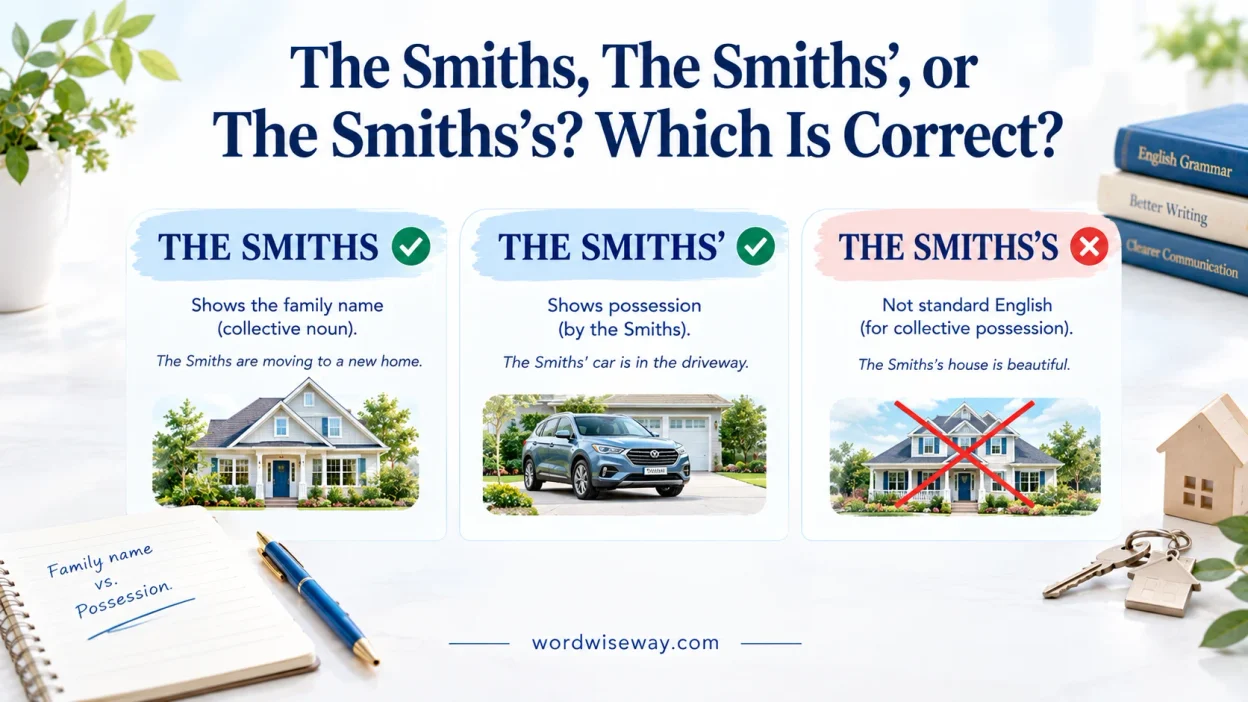
| Form | Correct? | Meaning | Example |
| The Smiths | Yes | The Smith family as a group | The Smiths are coming to dinner. |
| The Smiths’ | Yes | Something belonging to the Smith family | The Smiths’ house has a blue door. |
| The Smiths’s | Generally no for collective family possession | A nonstandard way to form the family’s plural possessive | Write the Smiths’ house instead. |
| Smith’s | Yes | Something belonging to one person named Smith | Mr. Smith’s car is outside. |
Remember this simple rule: Use the Smiths for the family, the Smiths’ for something the family owns, and Smith’s for something one person named Smith owns.
For example, you might write, “The Smiths invited us to their house.” If you want to emphasize ownership, write, “The Smiths’ house is beautiful.” Both sentences are correct, but the apostrophe serves a different purpose in the second one.
Is It The Smiths or The Smiths’?
The difference between the Smiths and the Smiths’ comes down to possession. One identifies several family members, while the other indicates that something belongs to them.
When to Use The Smiths
Use the Smiths when referring to two or more members of the Smith family. The surname becomes plural by adding -s, without an apostrophe.
This follows the standard rule for pluralizing most surnames. You don’t need an apostrophe simply because you’re talking about more than one person.
Consider these examples:
- The Smiths are hosting a family reunion this weekend.
- We invited the Smiths to our wedding.
- The Smiths live in a small town in Pennsylvania.
- The Smiths celebrated their anniversary with friends.
- Our neighbors, the Smiths, recently adopted a dog.
Notice that none of these sentences requires an apostrophe in the surname. Each sentence refers to the family as a group rather than identifying ownership.
This rule also applies to family names on greeting cards, holiday letters, and invitations. If you’re sending a card to an entire household, “To the Smiths” is correct. Writing “To the Smith’s” incorrectly suggests a possessive relationship rather than simply naming the recipients.
When to Use The Smiths’
Use the Smiths’ when something belongs to the Smith family. Because Smiths is already plural and ends in s, you generally form the plural possessive by adding an apostrophe after the final letter.
Here are some examples:
- The Smiths’ house overlooks a beautiful lake.
- We attended the Smiths’ annual holiday party.
- The Smiths’ children play soccer after school.
- Everyone admired the Smiths’ garden.
- The Smiths’ vacation plans changed because of the weather.
In each example, the apostrophe signals possession or association with the family.
For instance, “The Smiths’ garden looks wonderful” means the garden belongs to the Smith family. The apostrophe doesn’t make the surname plural. The s already does that job.
Possession can also refer to a shared responsibility, event, or relationship rather than a physical object. In “The Smiths’ wedding anniversary is next week,” the possessive form connects the anniversary with the couple or family.
The Difference Between The Smiths and The Smiths’
These two forms may differ by only one punctuation mark, but that mark changes their grammatical function.
| Sentence | Meaning |
| The Smiths are moving. | The family members are moving. |
| The Smiths’ house is for sale. | The house belonging to the Smith family is for sale. |
| We visited the Smiths. | We visited the family. |
| We visited the Smiths’ farm. | We visited the farm associated with or owned by the family. |
| The Smiths have three children. | The family has three children. |
| The Smiths’ children attend the local school. | The children belong to the Smith family. |
A useful way to check your sentence is to remove the possessive relationship mentally. If you’re simply naming the family, use the Smiths. If you’re answering the question “Whose?” use the Smiths’ when referring to the family collectively.
For example, ask yourself, “Whose car is parked outside?” If the car belongs to the Smith family, the answer is “the Smiths’ car.”
Is The Smiths’s Grammatically Correct?
The form the Smiths’s is generally not the correct choice when expressing collective possession by the Smith family. Standard English normally places the apostrophe after the s in a plural noun that already ends in s.
The correct phrase is therefore the Smiths’ house, not the Smiths’s house.
However, it’s important to distinguish a plural family name from a singular person’s name. The rules for singular possessives can differ from those for plural possessives, particularly when a singular name already ends in s.
The Standard Rule for Plural Possessive Surnames
To form a plural possessive, first make the noun plural. Then place an apostrophe after the final s.
Follow these steps:
- Start with the surname: Smith.
- Make it plural: Smiths.
- Add an apostrophe to show family possession: Smiths’.
The result is the Smiths’ house.
The same principle applies to other plural nouns ending in s. For example, the teachers’ lounge refers to a lounge used by or belonging to multiple teachers. Likewise, the players’ uniforms refers to uniforms associated with multiple players.
This pattern keeps the plural ending and possessive punctuation separate. The final s marks the plural, while the apostrophe indicates possession.
The Difference Between Smith’s, Smiths’, and Smiths’s
Understanding the difference between these forms makes family-name punctuation much easier.
Smith’s is the singular possessive form. Use it when one person named Smith owns something or has a particular association with it.
Example: “Mr. Smith’s office is on the second floor.”
Smiths’ is the plural possessive form. Use it when something belongs to multiple people named Smith or to the Smith family collectively.
Example: “The Smiths’ office is next to the reception area.”
Smiths’s is generally unnecessary when referring to the collective possession of the Smith family. The standard plural possessive already ends in s, so an additional s after the apostrophe isn’t needed.
Here’s a practical comparison:
| Form | Grammatical role | Example |
| Smith | Singular surname | Mr. Smith arrived early. |
| Smiths | Plural surname | The Smiths arrived early. |
| Smith’s | Singular possessive | Mr. Smith’s keys are missing. |
| Smiths’ | Plural possessive | The Smiths’ keys are on the table. |
| Smiths’s | Generally nonstandard for collective family possession | Use the Smiths’ keys instead. |
One detail matters here: Smiths’ doesn’t automatically mean that every individual family member owns an item separately. It can describe shared ownership or something associated with the family as a group.
For example, “The Smiths’ home” usually refers to the family home, even if the legal ownership belongs to only one member of the household.
How to Make Last Names Ending in S Plural and Possessive
The Smith family provides a useful example, but the same general principles apply to many other surnames. Names ending in s, x, z, ch, or sh often need an -es ending to form their plural, depending on their spelling and pronunciation.
The key is to form the plural correctly before adding the possessive apostrophe.
How to Pluralize a Last Name Ending in S
To refer to an entire family, most surnames become plural by adding -s or -es.
Examples include:
- Smith becomes the Smiths.
- Jones becomes the Joneses.
- Harris becomes the Harrises.
- Williams becomes the Williamses.
- Davis becomes the Davises.
- Garcia becomes the Garcias.
Why do some names need -es? English spelling generally adds -es to names ending in sibilant sounds or spellings, such as s, x, z, ch, and sh. The extra syllable helps make the plural easier to pronounce.
For example, Jones becomes Joneses, pronounced with an additional syllable at the end. By contrast, Smith becomes Smiths, which doesn’t need an extra syllable.
Remember that surnames are proper nouns, so capitalize them. When pluralized, they remain capitalized even though they take an ordinary plural ending.
How to Form the Possessive of a Plural Surname
Once you’ve formed the plural surname, add an apostrophe after its final s to show possession.
| Family name | Plural form | Plural possessive |
| Smith | The Smiths | The Smiths’ home |
| Jones | The Joneses | The Joneses’ home |
| Harris | The Harrises | The Harrises’ home |
| Williams | The Williamses | The Williamses’ home |
| Davis | The Davises | The Davises’ home |
| Garcia | The Garcias | The Garcias’ home |
Notice that the plural form comes first. You wouldn’t normally write the Jones’ home if you mean a home belonging to the entire Jones family. The conventional plural is the Joneses, making the plural possessive the Joneses’ home.
The distinction matters because a singular possessive and a plural possessive can communicate different ownership relationships.
For example:
- Mr. Jones’ home: A possessive form for one person named Jones, following a style that uses only an apostrophe for singular names ending in s.
- The Joneses’ home: A home belonging to or associated with the Jones family.
The first form follows a style convention for singular proper names ending in s. The second follows the standard plural possessive rule.
Singular Possessive vs. Plural Possessive
The number of owners determines whether you need a singular or plural possessive.
A singular possessive refers to one person or thing. A plural possessive refers to more than one person or thing.
Compare these examples:
Singular possessives
- The Smith’s car needs repairs.
- Sarah’s notebook is on the desk.
- James’s presentation begins at noon.
Plural possessives
- The Smiths’ car needs repairs.
- The students’ notebooks are on the desk.
- The teachers’ meeting begins at noon.
The phrase the Smith’s car assumes that Smith refers to one person whose car needs repairs. If the car belongs to the entire Smith family, the Smiths’ car is the appropriate form.
This is why context matters. The apostrophe alone doesn’t tell you how many people you’re discussing. You must first identify the noun’s intended meaning.
The Smiths’ vs. The Smiths’s in American and British English
American and British English share the basic rule for plural possessives. Both generally use the Smiths’ to indicate possession by the Smith family.
The more noticeable differences arise with singular proper names ending in s. Some style guides prefer adding apostrophe-s, while others allow or recommend a final apostrophe alone.
For example, both James’s book and James’ book appear in established English writing. The preferred form depends on the applicable style guide, the publication’s house rules, and sometimes pronunciation.
However, this variation doesn’t change the standard plural possessive form:
- The Smiths’ house
- The Joneses’ garden
- The Williamses’ business
Don’t apply a singular-name rule to a plural family name. James’s may be accepted for one person named James, but that doesn’t make the Smiths’s the standard way to describe something belonging to the Smith family.
A practical rule for American English: Use the Smiths for the family and the Smiths’ for collective possession. Follow your chosen style guide consistently when forming the possessives of singular names ending in s.
Common Mistakes
Even experienced writers occasionally place apostrophes incorrectly. Most mistakes happen because people use an apostrophe to make a surname plural or confuse one owner’s possession with a family’s possession.
Here are the errors worth avoiding.
Using The Smith’s to Refer to the Entire Family
Incorrect: “The Smith’s are coming to dinner.”
Correct: “The Smiths are coming to dinner.”
The first sentence uses a singular possessive form. The second correctly identifies multiple family members.
If you want to refer to the family’s property, however, the apostrophe belongs after the plural s: “The Smiths’ house is nearby.”
Adding an Apostrophe to Make a Surname Plural
Incorrect: “We sent invitations to the Smith’s.”
Correct: “We sent invitations to the Smiths.”
An apostrophe doesn’t create a plural surname. It signals possession or, in some cases, omitted letters. Simply add the appropriate plural ending to the family name.
This rule applies to envelopes, signs, greeting cards, and invitations. For example, a holiday card addressed to “The Smiths” is correct because you’re naming the recipients, not showing ownership.
Writing The Smiths’s for Collective Ownership
Incorrect: “We visited the Smiths’s garden.”
Correct: “We visited the Smiths’ garden.”
The plural surname already ends in s. Adding another s after the apostrophe isn’t the standard way to form the collective plural possessive.
Confusing Singular and Plural Ownership
Incorrect for a family-owned home: “The Smith’s home has a new roof.”
Correct: “The Smiths’ home has a new roof.”
The first sentence points toward one person named Smith. The second refers to the Smith family collectively.
However, if one person named Smith owns the home, Mr. Smith’s home has a new roof is perfectly correct.
Forgetting to Pluralize Names Ending in S
Incorrect: “The Jones’ invited us over.”
Correct: “The Joneses invited us over.”
When referring to the Jones family, use the conventional plural form Joneses. If the sentence describes something belonging to the family, write the Joneses’ home.
This extra step prevents errors in both the plural and possessive forms.
Examples of The Smiths, The Smiths’, and Related Forms
The easiest way to learn these rules is to see how they work in everyday writing. The examples below cover family invitations, belongings, homes, and other common situations.
| Incorrect or potentially confusing | Correct form | Explanation |
| The Smith’s are here. | The Smiths are here. | Use the plural surname without an apostrophe. |
| We visited the Smiths’s house. | We visited the Smiths’ house. | Use the plural possessive for collective family possession. |
| To the Smith’s | To the Smiths | Use the plural form when addressing the family. |
| The Smiths car is new. | The Smiths’ car is new. | Add an apostrophe to show possession. |
| The Jones’ are visiting. | The Joneses are visiting. | The conventional plural of Jones is Joneses. |
| The Joneses house is large. | The Joneses’ house is large. | The apostrophe marks the plural possessive. |
| Mr. Smiths office is upstairs. | Mr. Smith’s office is upstairs. | Use the singular possessive for one Mr. Smith. |
| The Harrises’s garden is lovely. | The Harrises’ garden is lovely. | Use an apostrophe after the plural surname. |
A few examples deserve closer attention because context can change the intended meaning.
Example: Family invitation
Correct: “The Smiths will attend the graduation ceremony.”
The sentence identifies the family members who plan to attend. No apostrophe is necessary because nobody is claiming ownership.
Example: Family property
Correct: “The Smiths’ car is parked beside the garage.”
Here, the apostrophe shows that the car belongs to or is associated with the Smith family.
Example: One person’s belongings
Correct: “Emily Smith’s suitcase is missing.”
This sentence refers to one person named Emily Smith. The singular possessive requires apostrophe-s.
Example: A family business
Correct: “The Smiths’ bakery has served the neighborhood for years.”
The possessive connects the bakery with the Smith family. It doesn’t necessarily establish that every family member legally owns part of the business.
A Practical Case Study: Addressing a Family Holiday Card
Imagine you’re preparing holiday cards for several neighbors. One household has the surname Smith, another has the surname Jones, and a third has the surname Harris.
How should you address the envelopes?
| Recipient | Correct envelope wording |
| The Smith family | The Smiths |
| The Jones family | The Joneses |
| The Harris family | The Harrises |
You don’t need apostrophes because the envelopes identify the recipients rather than describe ownership.
Now imagine writing a sentence inside each card. You want to mention the family home or garden.
- We hope the Smiths’ new home brings them happiness.
- We loved seeing the Joneses’ garden this summer.
- The Harrises’ holiday decorations look wonderful.
Each possessive follows the same principle: form the plural family name first, then add an apostrophe after its final s.
This simple distinction works across many situations, from personal letters to professional correspondence. Once you identify whether you’re naming a family or showing possession, the punctuation becomes much easier to manage.
Read More: Universities, University’s or Universities’: Which Spelling is Correct?
FAQs
1. Is The Smiths or The Smiths’ correct?
The Smiths is correct when you refer to the entire Smith family. The Smiths’ is correct when you show that something belongs to the family. For example, “The Smiths are visiting” describes the family, while “The Smiths’ car is outside” shows ownership.
2. Should you write The Smiths’s or The Smiths’?
Use The Smiths’ when referring to something owned by the Smith family. The extra s in The Smiths’s is unnecessary because Smiths already ends in s to mark the plural family name. The apostrophe after the final s expresses plural possession.
3. How do you make the surname Smith plural?
Add -s to the surname Smith to form Smiths. When referring to the whole family, you can write “the Smiths.” This follows the usual English rule for making most surnames plural, allowing you to discuss several family members without changing their surname.
4. Where does the apostrophe go in The Smiths’?
Place the apostrophe after the final s in Smiths’. This punctuation indicates that something belongs to the Smith family. For example, “The Smiths’ garden looks beautiful” means the garden belongs to the family, not just one individual named Smith.
5. Is The Smiths’ a plural possessive?
Yes, The Smiths’ is the plural possessive form. The word Smiths identifies multiple family members, while the apostrophe indicates possession. You can use it for shared belongings, such as the Smiths’ home, the Smiths’ business, or the Smiths’ holiday plans.
6. How do you show that something belongs to one person named Smith?
Use Smith’s when one person named Smith owns something. For example, “Mr. Smith’s office is upstairs” indicates that the office belongs to one person. This is the singular possessive form, which differs from the plural possessive Smiths’.
7. Do all family names follow the same pluralization rules?
Most family names form their plurals by adding -s or -es, but names ending in sounds such as s, x, z, ch, or sh may need -es. For example, “Jones” becomes “the Joneses.” Check the surname’s ending before choosing its plural form.
8. Is it grammatically correct to write the Smiths house?
Not when you mean that the house belongs to the Smith family. Write the Smiths’ house to show plural possession. Without the apostrophe, Smiths simply identifies multiple people with that surname, so the sentence lacks the punctuation needed to express ownership.
9. Should you capitalize The Smiths in a sentence?
Capitalize Smiths because it comes from a proper surname. Capitalize The when it begins a sentence or forms part of a title, but use lowercase the in the middle of an ordinary sentence. For example, “We visited the Smiths last weekend.”
10. What is the easiest way to remember The Smiths, The Smiths’, and The Smiths’s?
Remember three simple patterns: The Smiths refers to the family, The Smiths’ shows something belongs to the family, and Smith’s shows something belongs to one person named Smith. Once you understand this distinction, choosing the correct spelling and apostrophe placement becomes much easier.
Conclusion
Choosing between The Smiths, The Smiths’, or The Smiths’s becomes easier when you understand the difference between plural and possessive forms. The Smiths refers to the family as a group, while The Smiths’ shows that something belongs to the family. These small differences matter because correct spelling and punctuation help readers understand exactly what you mean.
Remember that The Smiths’ is the standard plural possessive form when discussing shared family ownership. For example, “The Smiths’ garden is beautiful” tells readers that the garden belongs to the Smith family. In contrast, Smith’s indicates possession by one person named Smith. Although The Smiths’s may look reasonable, it isn’t the standard choice for the family’s shared possessions.
The easiest way to avoid mistakes is to identify whether you’re talking about the family or something the family owns. Use The Smiths for the plural surname and The Smiths’ for plural possession. Once you learn these simple English grammar rules, you’ll find it easier to write family names correctly in letters, stories, articles, and everyday conversations.

Amelia Sanders has spent 14 years in Harvard University’s English Department, helping students navigate literary analysis, interpretive theory, and narrative techniques. Her academic pursuits center on 18th-century British prose, romantic poetry, diasporic writing, and digital editing exploring how textual choices influence cultural perspectives. Amelia has spoken at major international meetings and contributed essays to respected academic volumes, demonstrating her dedication to thoughtful scholarship and effective teaching.