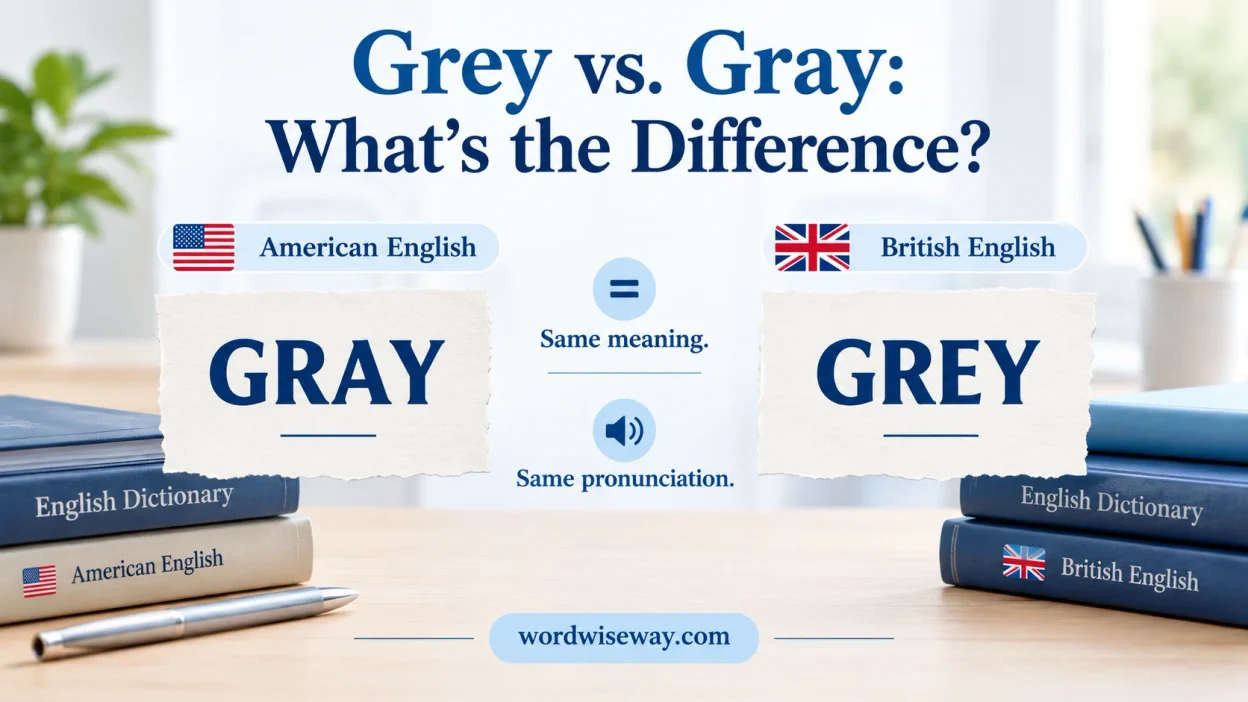
Grey vs. Gray: Difference, Correct Spelling, and Meaning can confuse learners because grey and gray are different spellings of the same color. Both words are correct and acceptable spellings, and they sound exactly the same. American English prefers gray, while British English commonly uses grey.
The difference depends on the English variants and the audience you’re writing for. Students, writers, and English learners may face uncertainty when choosing between these English varieties. However, the meaning, shade, and color remain the same in different places.
This article topic explains the key differences and highlights common mistakes and spelling mistakes through practical examples and simple explanations. Once you know the regional uses, you can spell the word confidently and understand these regional terms.
Quick Answer:
Gray and grey have the same meaning. The difference is mainly regional spelling.
- Gray is the preferred spelling in American English.
- Grey is the preferred spelling in British English.
- Both usually have the same pronunciation: /ɡreɪ/.
- Both can function as an adjective, noun, or verb.
- Neither spelling is universally “more correct.”
- Proper names and official titles may use either spelling regardless of regional preference.
| Feature | Gray | Grey |
| Meaning | A color between black and white | A color between black and white |
| Main usage | American English | British English |
| Pronunciation | /ɡreɪ/ | /ɡreɪ/ |
| Adjective | Yes | Yes |
| Noun | Yes | Yes |
| Verb | Yes | Yes |
| Example | a gray coat | a grey coat |
Cambridge’s current dictionary entries confirm that the two forms represent the same word with regional spelling differences.
What Does Gray Mean?
Gray is the standard American English spelling for a color produced by a mixture of black and white. It can describe objects, weather, hair, clothing, surfaces, and many other things.
For example:
- She bought a gray jacket.
- The gray clouds covered the sky.
- His hair is turning gray.
- The building has gray walls.
- The cat has soft gray fur.
The word can also describe something figuratively unclear or uncertain. The expression gray area refers to a situation where the rules, boundaries, or answers aren’t completely clear.
For example:
The law leaves a gray area that courts may need to interpret.
This figurative meaning has nothing to do with the literal color. Instead, it uses the idea of something sitting between two clearly defined extremes.
Gray as an Adjective
As an adjective, gray describes something that has the color or quality associated with gray.
Consider these examples:
- a gray shirt
- gray clouds
- gray hair
- a gray horse
- gray paint
- a gray winter morning
Cambridge lists gray as an adjective for the color formed from black and white. It also uses the word for weather with clouds and little light.
Gray as a Noun
Gray can also work as a noun when you mean the color itself.
For example:
- Gray is a neutral color.
- She chose gray for the bedroom.
- The artist used several shades of gray.
- The jacket is available in black and gray.
Here, the word doesn’t modify another noun. It names the color.
Gray as a Verb
The word can also function as a verb, particularly when describing hair becoming gray or white with age.
For example:
- His hair began to gray.
- Her beard is graying.
- The sides of his hair are graying.
American English commonly uses forms such as gray, graying, and grayed. Cambridge specifically identifies graying as the US spelling of greying.
What Does Grey Mean?
Grey means the same thing as gray. The important difference is spelling preference.
British English generally uses grey, while American English generally uses gray. Cambridge labels grey as the mainly UK spelling of gray.
You may see grey in sentences such as:
- She wore a grey coat.
- The sky became grey before the storm.
- His hair is turning grey.
- The old house had grey walls.
- The artist painted the background grey.
The meaning doesn’t change when the spelling changes.
Grey as an Adjective
As an adjective, grey describes something with the color or appearance associated with gray.
Examples include:
- a grey sweater
- grey hair
- grey clouds
- a grey building
- grey eyes
- a grey road
The British spelling works exactly like the American form grammatically.
Grey as a Noun
Grey can also name the color itself.
For example:
- Grey is often associated with cloudy weather.
- She chose grey for the walls.
- The painting contains several shades of grey.
Again, the difference is orthographic rather than semantic.
Grey as a Verb
British English commonly uses grey as a verb when describing hair becoming gray or white.
For example:
- His hair began to grey.
- She is greying naturally.
- His beard has started to grey.
The spelling changes in related forms as well. British English commonly uses greying, while American English uses graying. Cambridge confirms this regional distinction.
What Is the Main Difference?
The easiest way to remember the distinction is to think about audience rather than meaning.
If your readers primarily use American English, choose gray. If your readers primarily use British English, choose grey.
| Situation | Preferred spelling |
| American English article | gray |
| British English article | grey |
| American school assignment | gray |
| British school assignment | grey |
| American business writing | gray |
| British business writing | grey |
| American product description | gray |
| British product description | grey |
This doesn’t mean readers will misunderstand the other spelling. An American reader will recognize grey, and a British reader will understand gray immediately.
The difference is about convention and consistency, not comprehension.
Is Gray American or British English?
Gray is the standard American English spelling.
If you’re writing specifically for an American audience, gray should normally be your choice.
For example:
The designer selected a gray background for the website.
A gray sky covered the city that morning.
He noticed several gray hairs near his temples.
The same preference applies to related forms. American English commonly uses graying rather than greying. Cambridge identifies graying as the US spelling of greying.
For US-focused writing, consistency is especially useful. Switching randomly between gray and grey can make an article look like it follows two different style systems.
Is Grey American or British English?
Grey is the standard British English spelling.
British English commonly uses grey in ordinary writing:
The grey sky made the afternoon feel unusually dim.
She bought a grey coat for winter.
His hair had started to turn grey.
British English also uses greying where American English generally uses graying.
This pattern extends beyond Britain in some English varieties influenced by British spelling conventions. However, English usage varies across countries, so it’s better to follow the style guide or local convention relevant to your audience.
Why Are Grey and Gray Spelled Differently?
The difference comes from the long history of English spelling rather than from two completely different words.
English developed with substantial variation in spelling across regions and periods. American English later developed its own recognizable spelling conventions, while British English retained many traditional forms.
The result is a familiar pattern:
- color in American English vs. colour in British English
- favor vs. favour
- center vs. centre
- gray vs. grey
The important point is that gray and grey aren’t separate modern vocabulary items with different meanings. They’re regional spellings of the same word.
That distinction prevents a common misunderstanding. Seeing grey in an American publication doesn’t suddenly make the word a different color. Likewise, gray doesn’t become a different concept when a British reader encounters it.
Grey vs. Gray Pronunciation
One of the easiest parts of this comparison is pronunciation.
Grey and gray are normally pronounced the same way: /ɡreɪ/. Cambridge gives the same pronunciation for both entries.
The difference appears on the page, not normally in the spoken word.
Both are:
- one syllable
- pronounced with the same basic vowel sound
- spelled differently according to regional convention
So if someone says the word aloud, you usually can’t determine whether they would write gray or grey.
That makes this a spelling distinction rather than a pronunciation distinction.
When Should You Use Gray?
Choose gray when you’re writing in standard American English.
That includes most US-focused:
- blog posts
- websites
- school assignments
- business documents
- product descriptions
- marketing materials
- educational content
- general nonfiction
For example:
The company introduced a gray version of its popular backpack.
The gray walls made the room feel calm and understated.
The morning sky looked gray before sunrise.
If your entire article follows American English, keep related forms consistent too.
| American English | British English |
| gray | grey |
| graying | greying |
| grayish | greyish |
| grayness | greyness |
The exact derivative forms can vary by dictionary and context, so a reliable style guide remains useful for formal work.
When Should You Use Grey?
Choose grey when you’re following British English conventions.
For example:
The grey clouds gathered over the hills.
She wore a grey scarf during the winter.
His hair had begun to grey.
If the surrounding article uses British spellings such as colour, favourite, centre, and organise, using grey helps maintain a coherent style.
Mixing regional spellings isn’t always grammatically wrong. Still, it can make professional writing feel inconsistent.
Grey vs. Gray in Common Phrases
The spelling difference also appears in phrases.
A useful example is gray area in American English and grey area in British English.
A gray area or grey area describes something that isn’t clearly defined.
For example:
The policy creates a gray area for small businesses.
In British English:
The policy creates a grey area for small businesses.
The underlying expression remains the same.
Another important example is gray matter and grey matter, the terms used for a type of tissue in the brain and spinal cord. The regional spelling can change while the scientific meaning remains unchanged.
The same principle applies to many ordinary compounds. If a phrase contains gray/grey as a spelling variant, the surrounding English variety often determines which form looks natural.
Gray vs. Grey in Proper Names and Titles
Here’s where a simple regional rule needs an important qualification.
Don’t automatically change a proper name to match your preferred spelling.
A person’s surname might be Grey even in an American publication. A company, organization, fictional character, product, book, or film may also officially use one particular spelling.
In such cases, the established name takes priority.
For example, if an organization officially calls itself Grey Something, changing it to Gray Something would create a different name.
This rule applies broadly to proper nouns:
- personal names
- company names
- brand names
- book titles
- movie titles
- character names
- organization names
- official product names
Regional spelling conventions guide ordinary writing. They don’t give writers permission to rewrite established names.
Gray vs. Grey in Scientific and Technical Writing
Scientific and technical writing follows the same basic regional principle, but style consistency becomes even more important.
An American scientific publication may use gray, while a British publication may use grey. The underlying concept doesn’t change merely because the publication uses another spelling system.
One notable technical meaning deserves attention: gray is also the name of a unit used to measure absorbed radiation dose.
In that technical context, gray is the standard SI unit name. The symbol is Gy.
This is an important distinction because the technical unit isn’t simply another regional spelling of the color. The word gray here honors physicist Louis Harold Gray, whose work contributed significantly to radiation physics.
So context matters:
- gray/grey as a color → regional spelling difference
- gray as an SI radiation unit → technical unit name
That small detail prevents an easy vocabulary mix-up.
Common Mistakes
Mistake 1: Treating One Spelling as Universally Correct
It’s inaccurate to say that gray is always correct or grey is always correct.
Both are established English spellings.
The better question is:
Which English variety are you using?
Mistake 2: Switching Between Gray and Grey
Imagine an American article that starts with:
The gray clouds covered the city.
Later, it says:
Her grey jacket matched the weather.
The reader will understand both sentences. Still, the unexplained switch can look careless.
Choose one regional convention and stick with it.
Mistake 3: Changing a Proper Name
If someone’s name is Grey, don’t change it to Gray merely because the surrounding article uses American English.
Proper names have their own spelling.
Mistake 4: Assuming They Have Different Pronunciations
The spelling difference doesn’t normally create a pronunciation difference. Both are generally pronounced /ɡreɪ/.
Which Spelling Should You Use?
Use this simple rule:
Writing for Americans? Use gray.
Writing for a British audience? Use grey.
For other English-speaking audiences, check the relevant local convention or publication style guide. When a proper name or official title is involved, preserve its established spelling.
A practical decision table makes the choice easy:
| Your situation | Best choice |
| US English content | gray |
| UK English content | grey |
| US-focused website | gray |
| UK-focused website | grey |
| Official name containing Grey | Keep Grey |
| Official name containing Gray | Keep Gray |
| Mixed international audience | Choose a consistent house style |
| Academic or professional publication | Follow its style guide |
The key isn’t merely knowing the difference. It’s applying the difference consistently.
Examples of in Sentences
Here are paired examples that show how the spelling changes across English varieties.
| American English | British English |
| The sky was gray. | The sky was grey. |
| She wore a gray sweater. | She wore a grey sweater. |
| His hair is turning gray. | His hair is turning grey. |
| The building has gray walls. | The building has grey walls. |
| The road disappeared into the gray fog. | The road disappeared into the grey fog. |
| We discussed the gray area in the policy. | We discussed the grey area in the policy. |
| His beard is graying. | His beard is greying. |
Notice what stays constant: the meaning and sentence structure remain essentially unchanged.
Only the regional spelling changes.
Read More: Gases or Gasses: Correct Spelling, Meaning, and Usage
A Simple Memory Trick
If you regularly confuse the two, use the spelling of another common American English word as a memory aid.
Gray has an a, just like American.
That gives you:
A = American → gray
Meanwhile:
E = England → grey
This isn’t a historical rule. It’s simply a convenient memory trick.
For formal writing, however, don’t rely on memory alone. Check your document for consistency before publishing.
Quick Revision:
| Question | Answer |
| Do gray and grey mean the same thing? | Yes |
| Are they normally pronounced differently? | No |
| Which spelling does American English prefer? | Gray |
| Which spelling does British English prefer? | Grey |
| Is grey understandable in American English? | Yes |
| Is gray understandable in British English? | Yes |
| Should proper names be changed? | No |
| Which form should US content normally use? | Gray |
| Which form should UK content normally use? | Grey |
| Does the spelling change the color’s meaning? | No |
FAQs
1. Is gray or grey the correct spelling?
Both gray and grey are correct spellings. Gray is preferred in American English, while grey is more common in British English. The choice depends on the variety of English you’re using.
2. Does gray and grey have different meanings?
No. Gray and grey have the same meaning when they refer to the color. The spelling changes by regional English usage, not because the color itself has a different meaning.
3. Which spelling should I use in American English?
Use gray in American English. You’ll commonly see this spelling in American books, websites, schools, newspapers, and everyday writing.
4. Which spelling is preferred in British English?
Grey is generally preferred in British English. It also appears frequently in other varieties influenced by British English, so the spelling can depend on your target audience.
5. Why does gray have two different spellings?
The two spellings developed through different English language traditions. Over time, gray became strongly associated with American English, while grey remained common in British English.
6. Do gray and grey sound the same?
Yes. In standard pronunciation, gray and grey sound the same. Their difference appears in writing rather than pronunciation.
7. Should I use gray or grey throughout an article?
Choose one spelling based on your intended audience and keep it consistent. For American readers, gray is usually the better choice. For British readers, grey is generally more appropriate.
8. Can I use grey in American English?
You can encounter grey in American English, especially in names, proper terms, or material influenced by British usage. However, gray is the standard spelling for general American writing.
9. Does the spelling change the shade of the color?
No. The spelling doesn’t determine the shade. Gray and grey can describe the same range of neutral colors, depending on the context and the shade being discussed.
10. How can I remember the difference between gray and grey?
A simple memory trick is to associate gray with American English and grey with British English. More importantly, remember your audience and stay consistent throughout your writing.
Conclusion
Gray and grey may look different, but they represent the same color and have the same basic meaning. The main distinction comes from regional spelling preferences. American English generally uses gray, while British English commonly uses grey. Knowing this difference can help you avoid unnecessary spelling confusion.
When you’re writing for a specific audience, choose the spelling that matches its English variety. Consistency matters more than treating one form as universally correct. If your content targets American readers, gray is the natural choice. If you’re following British English conventions, grey usually fits better.
Once you understand this small regional difference, choosing between the two becomes straightforward. You don’t need to question the meaning or pronunciation every time you see the word. Just identify your audience, follow the appropriate English convention, and use your chosen spelling consistently.