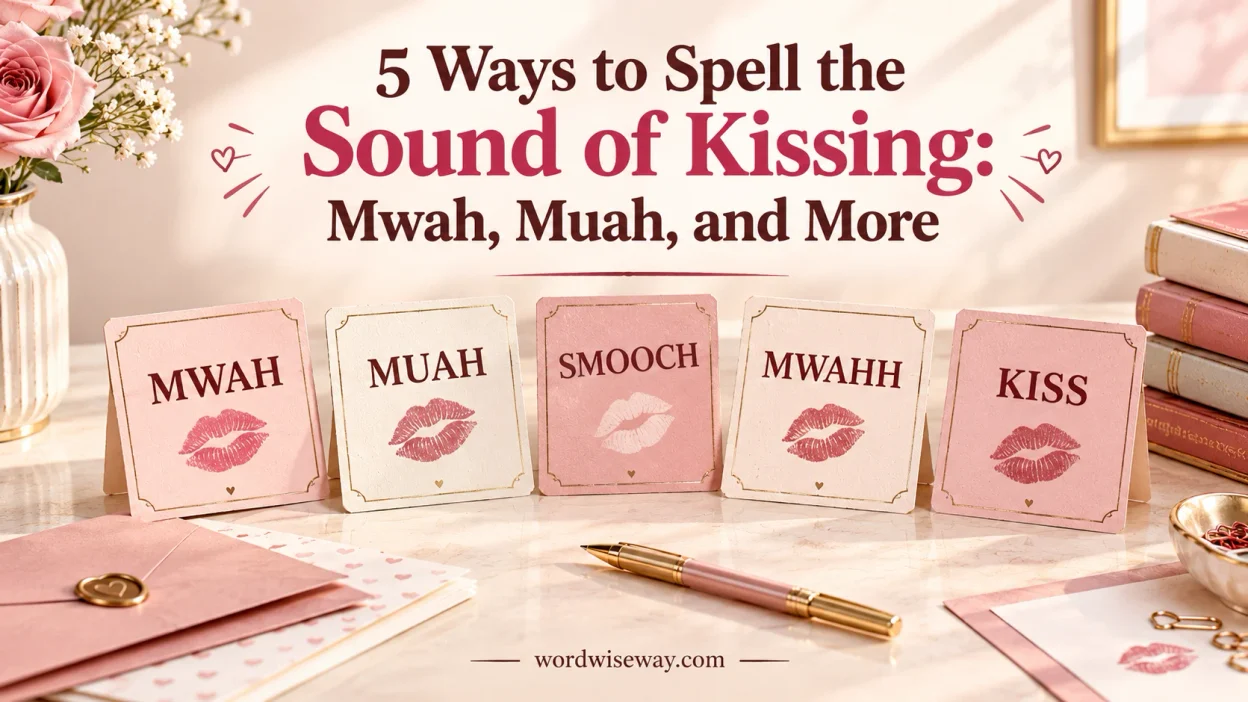
5 Ways to Spell the Sound of Kissing can help you choose natural spellings that improve clarity, tone, and readability in your writing.Onomatopoeia uses sound words to represent sounds without a mass of words. Writers, editors, and storytellers use different spellings to express the affectionate sound of a kiss.
The right choice can improve clarity, readability, and natural expression. Each version creates a slightly different tone, depending on the scene, audience, and text.This guide explores common ways to spell the sound of kissing in fiction, comics, subtitles, social media content, and broadcasting.
Understanding variations helps maintain consistency and authenticity. Even formal writing and business communication benefit from precision and clear usage conventions. By considering grammar, style, spelling, and writing purpose, you can select the right sound representation for your audience with confidence.
Quick Answer:
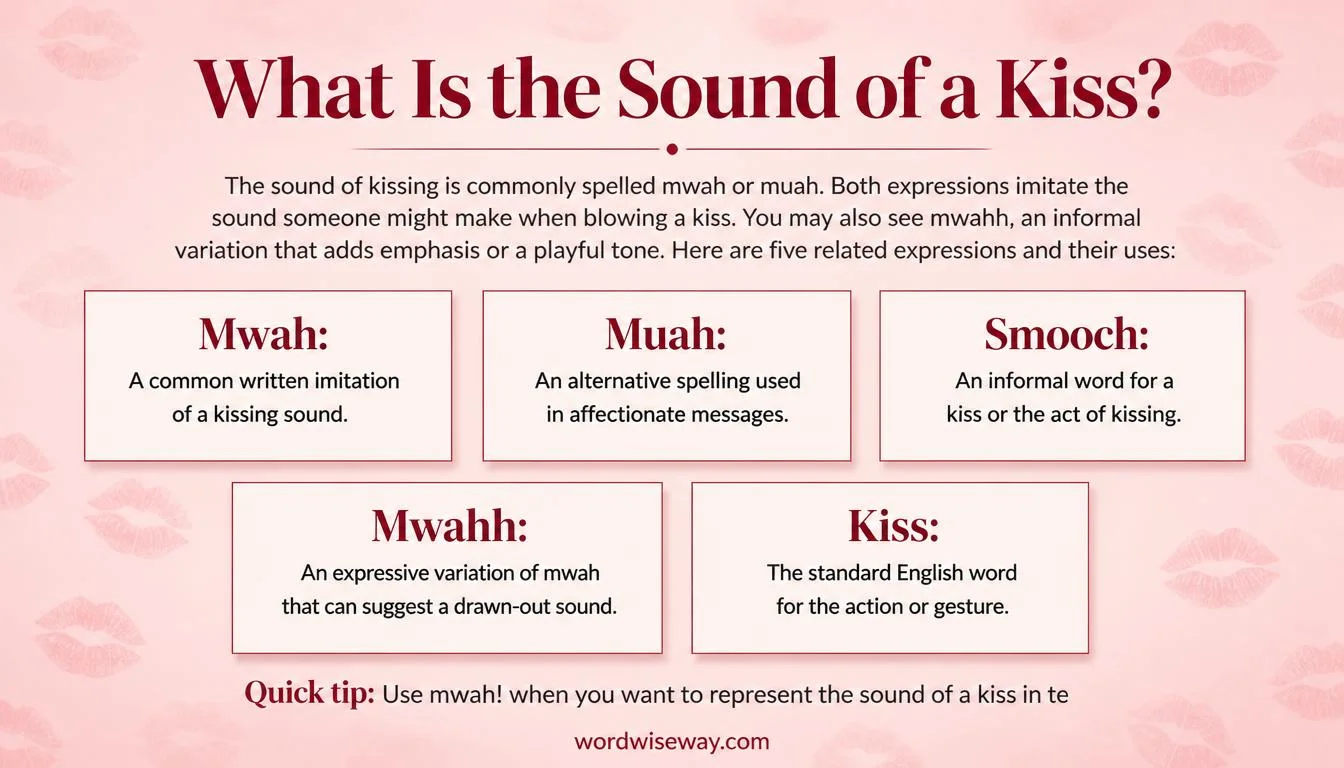
The sound of kissing is commonly spelled mwah or muah. Both expressions imitate the sound someone might make when blowing a kiss. You may also see mwahh, an informal variation that adds emphasis or a playful tone.
Here are five related expressions and their uses:
- Mwah: A common written imitation of a kissing sound.
- Muah: An alternative spelling used in affectionate messages.
- Smooch: An informal word for a kiss or the act of kissing.
- Mwahh: An expressive variation of mwah that can suggest a drawn-out sound.
- Kiss: The standard English word for the action or gesture.
Quick tip: Use mwah! when you want to represent the sound of a kiss in a text message, story, or caption. Choose kiss or smooch when you’re describing the action instead.
5 Ways to Spell the Sound of Kissing
English speakers use different spellings to represent sounds that don’t have a single standardized written form. These expressions are examples of onomatopoeia, a language feature in which words imitate or evoke sounds.
Let’s examine five options, including their meanings, examples, and most suitable contexts.
Mwah
Mwah is a widely recognizable way to write the sound of a kiss. It commonly appears in text messages, casual conversations, fictional dialogue, and playful captions.
The spelling imitates the sound someone might make when puckering their lips or blowing a kiss toward another person. The exact sound varies from person to person, so the spelling doesn’t represent a strict pronunciation rule.
For example, someone might write:
- “Good night, mwah!”
- “Sending you a big mwah!”
- “Thanks for helping me today. Mwah!”
- “Mwah! See you tomorrow.”
In each example, mwah adds an expressive touch that a plain goodbye might lack. It can communicate affection, warmth, or playful friendliness, depending on the relationship and situation.
Writers also use capital letters when they want to emphasize the sound. For example, “MWAH!” may appear in a comic panel where a character blows an exaggerated kiss.
However, mwah is informal. It usually fits casual messages and creative writing better than academic papers or professional reports.
When to use it: Choose mwah when you want to imitate a kiss sound directly and keep your writing expressive.
Muah
Muah is another common spelling of a kissing sound. Like mwah, it appears in affectionate messages, social conversations, and informal online communication.
The two forms serve much the same purpose. Their spelling differs, but both can represent the sound associated with blowing a kiss.
Consider these examples:
- “Take care of yourself, muah!”
- “Muah! Talk to you later.”
- “Sending you a virtual muah.”
- “Happy birthday! Big hugs and muah!”
The spelling muah may look more intuitive to some readers because the letters suggest a familiar vowel sound. Nevertheless, people don’t always pronounce or interpret these informal expressions identically.
There isn’t a universal rule requiring writers to choose muah over mwah. Both are creative representations of a sound rather than spellings governed by one fixed standard.
For example, one person might write “Good night, mwah!” while another prefers “Good night, muah!” The intended message remains easy to understand in most casual contexts.
Consistency matters more than choosing one form as the only correct option. If you’re writing a story and a character repeatedly uses muah, keeping that spelling throughout can make the dialogue feel more coherent.
When to use it: Choose muah when it matches your personal writing style or the tone of your conversation.
Smooch
Smooch differs from mwah and muah because it usually names a kiss rather than directly imitating its sound.
It’s an informal English word for a kiss or the act of kissing. Writers often use it in lighthearted descriptions, affectionate scenes, and everyday conversation.
For example:
- “She gave her little brother a smooch on the cheek.”
- “Grandma greeted the children with a warm smooch.”
- “He planted a quick smooch on her forehead.”
- “The cartoon character leaned forward for a dramatic smooch.”
Notice how each sentence describes an action. The word helps readers picture what happens rather than simply representing the noise.
Although smooch can sound playful, its meaning doesn’t depend on an audible kissing noise. A kiss may be quiet, and a writer can still describe it as a smooch.
You can also use the verb smooch to describe kissing. For instance, “The couple began to smooch” describes the activity rather than reproducing a sound effect.
In creative writing, this distinction makes a practical difference. If a character blows a kiss and you want readers to imagine the sound, mwah! may work well. If you want to describe the action, smooch may be more suitable.
When to use it: Choose smooch when you want to name or describe a kiss rather than write its sound.
Mwahh
Mwahh is an informal variation of mwah. The extra letter adds a stylistic effect that can make the expression appear more emphatic, playful, or drawn out.
People sometimes extend words in digital conversations to express emotion. For example, someone might write “heyyy” instead of “hey” or “nooo” instead of “no.” These extra letters don’t create a new grammatical rule. Instead, they change how the message feels.
The same principle applies to mwahh.
Here are a few examples:
- “Mwahh! Thanks for everything.”
- “Sending you hugs and mwahh!”
- “Goodnight, mwahhh!”
- “You’re the best. Mwahh!”
The number of repeated letters can vary. Some writers use mwahh, while others prefer mwahhh or simply mwah. These forms are informal choices, not separate standardized spellings with fixed meanings.
Context also matters. An extended spelling might suggest extra enthusiasm, but it doesn’t guarantee that every reader will interpret it the same way.
For example, “Mwahh!” at the end of a friendly message may communicate warmth. The same expression in a fictional scene might represent an exaggerated sound effect.
Avoid adding too many letters when clarity matters. A simple mwah! is usually sufficient, while an extended version can suit a deliberately expressive message.
When to use it: Choose mwahh when you want a more emphatic or playful variation of the familiar kissing sound.
Kiss
Kiss is the standard English word for the act of touching someone or something with the lips as a gesture of affection, greeting, respect, or another meaning determined by context.
Unlike mwah and muah, the word doesn’t usually imitate the sound of kissing. It identifies the action itself.
For example:
- “She blew him a kiss.”
- “He greeted his mother with a kiss on the cheek.”
- “The character sent a kiss through the air.”
- “She gave the baby a gentle kiss on the forehead.”
Each sentence communicates what happened without requiring a written sound effect.
The distinction becomes especially useful when choosing words for different writing styles. A casual text might end with “Mwah!” while a descriptive story might say, “She blew him a kiss before leaving.”
Both expressions can communicate affection, but they accomplish different things. One imitates a sound, while the other describes a gesture or action.
You can also use kiss as a verb, as in “She kissed her father goodbye.” This construction is direct and natural, making it useful when the sound itself isn’t important.
When to use it: Choose kiss when you want clear, standard wording that describes the action rather than imitates a noise.
What’s the Difference?
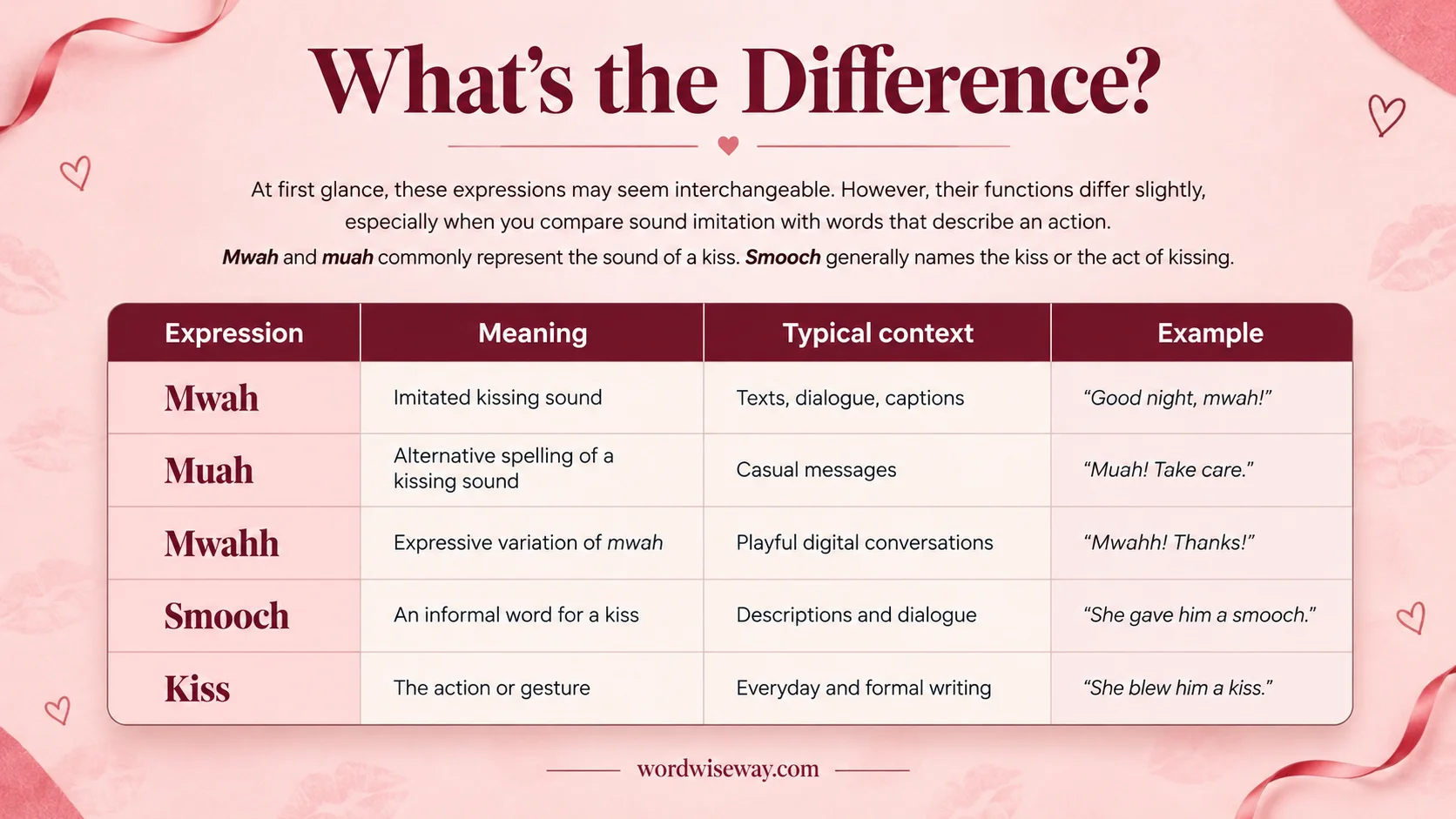
At first glance, these expressions may seem interchangeable. However, their functions differ slightly, especially when you compare sound imitation with words that describe an action.
Mwah and muah commonly represent the sound of a kiss. Smooch generally names the kiss or the act of kissing.
| Expression | Meaning | Typical context | Example |
| Mwah | Imitated kissing sound | Texts, dialogue, captions | “Good night, mwah!” |
| Muah | Alternative spelling of a kissing sound | Casual messages | “Muah! Take care.” |
| Mwahh | Expressive variation of mwah | Playful digital conversations | “Mwahh! Thanks!” |
| Smooch | An informal word for a kiss | Descriptions and dialogue | “She gave him a smooch.” |
| Kiss | The action or gesture | Everyday and formal writing | “She blew him a kiss.” |
The key distinction is straightforward: use a sound-based expression when the sound matters, and use an ordinary word when the action matters.
For example, consider these two sentences:
- “She waved goodbye and called, ‘Mwah!'”
- “She waved goodbye and blew him a kiss.”
The first sentence includes a written sound effect. The second describes a gesture without reproducing the sound.
Neither approach is automatically better. The most effective choice depends on the scene, audience, and tone.
Which Spelling of a Kissing Sound Is Most Common?
Mwah and muah are both familiar spellings in informal English communication. However, their relative popularity can vary across communities, platforms, and individual writing habits.
There isn’t one universal spelling that everyone must follow. These expressions imitate a sound, and people represent that sound differently in writing.
For general-purpose writing, mwah is a practical choice because readers commonly recognize it as a kissing sound. Still, muah is understandable in many of the same contexts.
Consider the following factors when choosing between them:
- Audience: Pick a form your intended readers will recognize.
- Tone: Use a simple spelling for a casual message or an extended version for added emphasis.
- Consistency: Keep the spelling consistent when the expression appears repeatedly in the same piece.
- Context: Use a sound effect in dialogue when you want readers to imagine a noise.
- Clarity: Replace an informal expression with a direct description when the sound isn’t important.
It’s also helpful to distinguish familiarity from measurable popularity. Without a defined dataset, platform, and time period, claims that one spelling is definitively the most popular would be difficult to verify.
The practical takeaway is simple: use mwah as a convenient default, but don’t treat muah as incorrect.
How to Write a Kissing Sound in Different Contexts
The best spelling depends on where you’re writing and what you want the expression to accomplish. A text message, a novel, and a comic panel don’t always follow the same conventions.
How to Spell a Kissing Sound in Text Messages
Text messages often use short expressions to communicate feelings quickly. In this setting, mwah and muah can add warmth to an otherwise ordinary message.
For example:
- “Good night, mwah!”
- “Thanks for checking on me. Muah!”
- “Happy birthday! Sending you a big mwah.”
- “See you soon. Mwahh!”
These expressions are informal, so they usually suit conversations with people who understand your tone. Depending on the relationship, the same wording might sound affectionate, friendly, or playful.
A sound effect isn’t necessary in every message. Sometimes “Take care!” or “Sending you a kiss” communicates the intended meaning more clearly.
Practical tip: Match the expression to your usual communication style. A natural message is more effective than one filled with exaggerated spellings.
How to Write a Kissing Sound in Stories and Dialogue
In fiction, sound effects help readers imagine what characters say or do. However, writers should use them purposefully rather than adding them to every affectionate moment.
Consider this example:
“She reached the doorway, turned back, and blew him a kiss. ‘Mwah! See you tomorrow.'”
Here, the word mwah represents the sound in the dialogue. The surrounding action explains why the character makes it.
Compare that with this version:
“She smiled, blew him a kiss, and stepped outside.”
The second version communicates the gesture without a sound effect. It may suit a quieter or more understated scene.
Both approaches are useful. Choose the first when the audible expression contributes to the character’s personality or the scene’s mood. Choose the second when the action alone carries enough meaning.
Writers can also use punctuation to shape the effect:
- “Mwah!” suggests an emphatic sound.
- “Mwah…” may suggest a trailing or fading expression.
- “Mwah?” could convey uncertainty or playful questioning, depending on the dialogue.
Punctuation influences interpretation, but it doesn’t establish a universal pronunciation. The surrounding sentence still guides the reader.
How to Spell a Kissing Sound in Comics and Captions
Comics rely on concise text and visual cues to communicate actions. A short sound effect can help readers understand what happens without interrupting the scene.
For example, a character might blow an exaggerated kiss while the panel displays MWAH! in large lettering.
Capital letters make the sound effect visually prominent. An exclamation point adds emphasis, while the illustration provides context.
Captions and social media graphics use similar techniques. A short expression such as mwah! can communicate a playful gesture without requiring a complete sentence.
Still, the visual treatment should match the intended effect. A large, bold sound effect might fit a humorous comic, while a small lowercase expression may work better in a subtle caption.
The spelling itself doesn’t need to change. Typography, punctuation, and context can provide much of the expression.
How to Write a Kissing Sound in Formal Writing
Informal sound effects rarely belong in formal academic or professional writing unless the subject specifically requires them.
For example, instead of writing “The character said ‘mwah’ before leaving,” a formal analysis might say, “The character blew a kiss before leaving.”
The second version focuses on the action and avoids an unnecessary sound effect.
However, informal expressions can still appear in formal work when they’re being analyzed as language. A linguistics paper, for instance, might discuss mwah as an example of onomatopoeia or informal digital communication.
The important point is to distinguish between using an expression and discussing it. Formal writing can examine informal language without adopting an informal tone throughout the document.
Is There a Correct Way to Spell a Kissing Sound?
There isn’t one universally required spelling for the sound of a kiss. Expressions such as mwah and muah are informal representations of a sound, so writers have some freedom in how they spell them.
That doesn’t mean every spelling is equally clear in every context. Readers rely on familiar patterns, and an unusual spelling may make them pause to work out the intended meaning.
For example, mwah! is readily recognizable to many readers as a kissing sound. A heavily altered version with numerous extra letters may communicate enthusiasm but could look distracting in a sentence.
A few practical principles can help:
- Choose recognizable wording. Familiar spellings reduce confusion.
- Keep your tone consistent. Avoid switching between several variations without a reason.
- Consider your audience. Younger readers, casual texters, and formal audiences may have different expectations.
- Use sound effects purposefully. Include them when they add something to the message.
- Prefer clarity over decoration. Extra letters should support the tone rather than obscure the meaning.
A spelling can be appropriate in one situation and unsuitable in another. For instance, mwahhh! might fit a playful message, while “She blew him a kiss” may work better in a serious story.
The goal isn’t to find a spelling that everyone must use. It’s to choose wording that communicates your intended meaning naturally.
A Practical Example
Imagine you’re writing three different pieces: a friendly text, a short story, and a descriptive article. Each requires a slightly different approach.
Situation: Sending a Friendly Text
You want to end a casual message warmly.
Example: “Thanks for everything! Mwah!”
Here, mwah works as a brief, expressive sound effect. The reader doesn’t need a full description of the gesture.
Situation: Writing a Fictional Scene
A character says goodbye to a family member before leaving home.
Example: “She kissed her mother on the cheek, grabbed her bag, and hurried outside.”
This sentence describes the action directly. A sound effect isn’t necessary because it doesn’t contribute much to the scene.
Situation: Creating a Comic Panel
A character dramatically blows a kiss toward the audience.
Example: “MWAH!”
The capital letters and exclamation point make the sound effect stand out. The illustration supplies the visual context.
These examples show why context matters more than searching for one perfect spelling. The best expression is the one that fits the job.
Common Mistakes
Even a short expression can become confusing when writers use it in the wrong context. Understanding a few common mistakes can help you avoid awkward wording.
Treating Mwah and Smooch as Identical
Although both relate to kissing, they don’t usually serve the same grammatical purpose.
Mwah imitates a sound, while smooch commonly names a kiss or describes the act of kissing.
Compare:
- “She blew him a kiss and said, ‘Mwah!'”
- “She gave him a quick smooch.”
The first example represents a sound. The second describes a kiss.
Assuming Muah Is Incorrect
Some writers believe mwah is the only acceptable spelling. However, muah is also used to represent a kissing sound in informal communication.
Neither spelling has a universally mandated form. The choice usually comes down to familiarity, personal preference, and context.
Adding Too Many Extra Letters
Extended forms such as mwahhh can add emphasis, but excessive repetition may distract readers.
For example, “Mwahhhhhhhhh!” might fit an intentionally exaggerated comic scene. In an ordinary message, however, “Mwah!” is usually easier to read.
Use extra letters when they contribute to the intended tone, not simply to make the expression longer.
Using Sound Effects When a Description Would Be Clearer
Sound-based spellings can make writing expressive, but they aren’t always necessary.
Compare “He gave his grandmother a kiss goodbye” with “He went, ‘Mwah!’ before leaving.”
The first version describes the action. The second emphasizes the sound or performance.
Neither sentence is inherently wrong, but each creates a different effect.
Forgetting the Audience
A playful spelling may work well among friends but seem out of place in a formal report.
Before using a sound effect, consider whether your readers will understand its purpose. If the expression doesn’t suit the setting, a straightforward description may be more effective.
Read More: 5 Words for the Sound of Glass Breaking: Meanings and Examples
FAQs
1. How do you spell the sound of a kiss?
You can spell the sound of a kiss as mwah, muah, smooch, chu, or kiss. Each spelling creates a slightly different feeling in dialogue or storytelling.
2. Is “mwah” the correct spelling for a kissing sound?
Yes, mwah is a common informal spelling of a kissing sound. Writers often use it in text messages, dialogue, and social media posts to express affection.
3. What is the difference between “mwah” and “muah”?
Both mwah and muah represent a kissing sound. Their meanings are nearly identical, so you can choose the spelling that best fits your writing style.
4. How do comic book writers represent a kissing sound?
Comic book writers often use words such as SMOOCH, MWAH, or CHU. Capital letters can make the sound stand out, especially in expressive scenes.
5. Can I use “smooch” to describe the sound of kissing?
Yes, smooch can represent a kiss or describe the act of kissing. It often feels playful and works well in casual dialogue and lighthearted stories.
6. How should I write a kissing sound in a romantic story?
Choose a spelling that matches the scene’s mood and characters. Mwah can suggest a quick, affectionate kiss, while smooch may suit a playful moment.
7. Are kissing sounds considered onomatopoeia?
Yes, written kissing sounds can be examples of onomatopoeia. They use words or word forms to represent sounds, helping readers imagine what is happening.
8. Should I use kissing sounds in formal writing?
Kissing sounds usually suit informal writing, fiction, comics, and dialogue better than formal documents. In professional writing, describing the action directly may be clearer.
9. How do I choose the best spelling for a kissing sound?
Consider your audience, writing purpose, and context. Read the sentence aloud and choose the version that sounds natural alongside your characters’ dialogue.
10. Can kissing sounds be written differently in text messages?
Yes, people use spellings such as mwah, muah, and xoxo in casual messages. However, xoxo usually represents hugs and kisses rather than an actual kissing sound.
Conclusion
Choosing the right spelling for a kissing sound may seem like a small detail, but it can make your writing feel more natural and expressive. Words such as mwah, muah, smooch, chu, and kiss offer different ways to represent this familiar sound. Each option brings its own tone, so consider the scene and the message you want to convey.
Whether you’re writing a story, creating comic dialogue, preparing subtitles, or sending a casual text, the best choice depends on your audience and writing style. There’s no single spelling that works perfectly in every situation. Try different options and read your sentences aloud to see which one fits best.
Ultimately, 5 Ways to Spell the Sound of Kissing gives you several practical options for expressing affection through words. Keep your wording simple, stay consistent with your chosen style, and let the context guide your decision.

Emma Smith has dedicated 14 years to Princeton University’s English Department, mentoring students in textual interpretation, literary movements, and critical frameworks. Her research explores Shakespearean drama, Victorian serial fiction, postcolonial narrative theory, and manuscript studies and probing how literary forms evolve across cultures and centuries. Emma has delivered lectures at international humanities congresses and published findings in distinguished academic journals, underscoring her commitment to scholarly depth and vibrant teaching.