What Does “Scrub” Mean in Slang? Definition, and Usage explains how this informal expression describes someone who lacks skills, ability, or a positive attitude. The word often serves as an insult for a person who fails to meet expectations or struggles to contribute to a team.
The term became widely recognized through “No Scrubs,” a popular hit song by TLC. The song helped make the expression a familiar cultural reference. However, the word also appears in everyday conversations about relationships, sports, work, and teamwork.
Calling someone a scrub may suggest poor performance, incompetence, or a lack of talent. For example, a player who struggles to contribute effectively might receive this label. Still, the term can sound disrespectful because it judges someone’s abilities. Consider the situation and tone before using this slang expression.
Quick Answer:
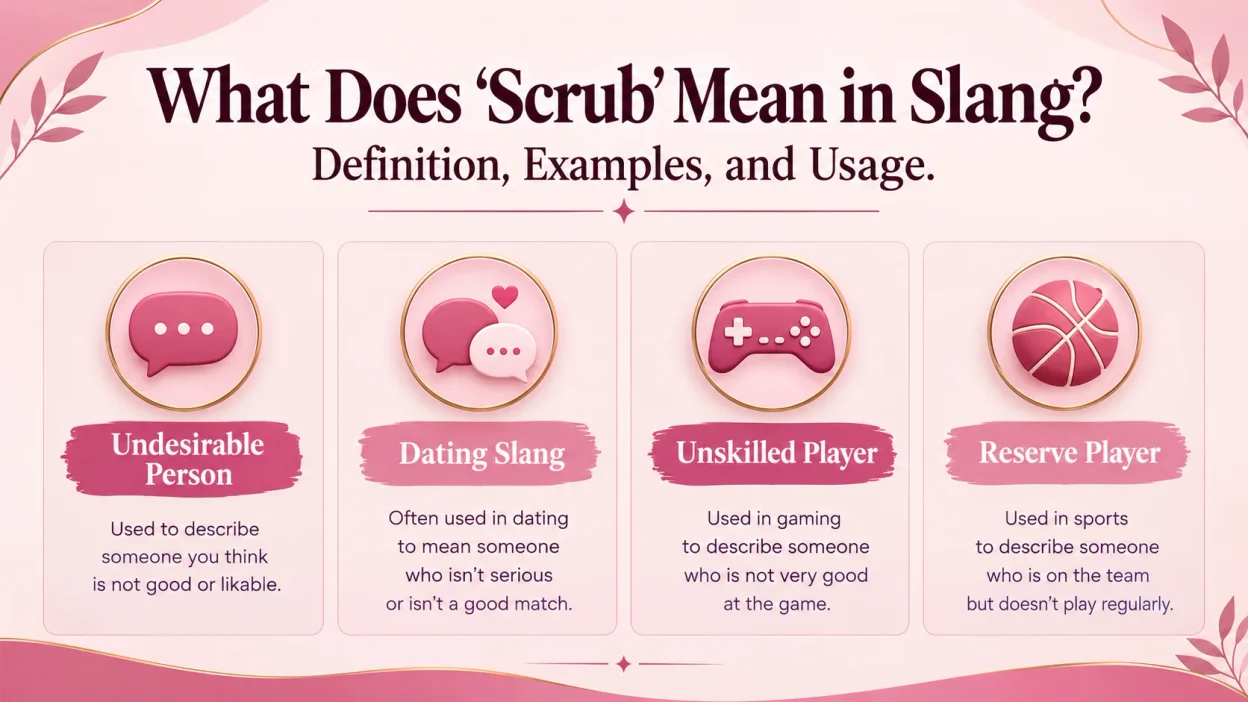
In slang, a scrub is someone viewed as unsuccessful, incompetent, unimpressive, or undesirable. The exact meaning depends on the context.
For example:
- In everyday conversation: Someone who repeatedly fails to follow through on commitments might be called a scrub.
- In dating: The word can describe someone perceived as irresponsible, dependent, or unwilling to make an effort.
- In gaming: It can refer to an unskilled player or someone who refuses to improve.
- In sports: It can describe a reserve or lower-ranked player, sometimes in a dismissive way.
The term usually carries a negative tone when directed at a person. Friends may also use it playfully when everyone understands the joke.
What Does “Scrub” Mean in Different Contexts?
Although the basic idea involves a perceived lack of ability, success, or desirable qualities, scrub doesn’t mean exactly the same thing everywhere. The surrounding conversation helps reveal the speaker’s intention.
Scrub as an Insult for an Unsuccessful Person
In everyday slang, a scrub is someone the speaker considers unimpressive or incapable. The criticism might relate to a person’s behavior, ambitions, reliability, or general attitude.
For instance, imagine someone who constantly promises to help their friends but never follows through. After several disappointments, a friend might describe that person as a scrub.
Example:
“Marcus keeps promising to finish the project, but he never does anything. He’s acting like a scrub.”
Here, the speaker criticizes Marcus’s lack of effort and reliability. The word doesn’t necessarily mean Marcus lacks talent. Instead, it reflects the speaker’s negative opinion of his behavior.
People sometimes use scrub more broadly to dismiss someone they consider unsuccessful. However, this is a subjective judgment rather than an objective description of a person’s worth.
Scrub in Dating and Relationships
In dating slang, a scrub is often someone perceived as an undesirable partner because they lack responsibility, effort, or independence.
The expression became especially recognizable through TLC’s 1999 song “No Scrubs.” The song describes rejecting a man who expects romantic attention while offering little in return. It helped popularize this relationship-related meaning.
In everyday conversations, people might use the word for someone who:
- Expects a partner to pay for everything without discussing expectations.
- Makes promises but rarely follows through.
- Wants the benefits of a relationship without contributing effort.
- Treats a partner poorly or repeatedly disregards their needs.
- Depends on someone else while refusing to take reasonable responsibility.
Example:
“She stopped dating him because he expected her to arrange everything and never made an effort himself.”
Someone discussing this situation might call the man a scrub. The label expresses disapproval of his behavior, not a universal standard for relationships.
It’s also important to separate genuine irresponsibility from someone’s financial situation. A person doesn’t automatically become a scrub because they earn little money, live with family, or need temporary support. In this context, the criticism usually concerns perceived attitudes and behavior rather than income alone.
Scrub in Online Gaming
Gaming communities use scrub to criticize players who perform poorly or demonstrate an unwillingness to improve. Depending on the community, the word can refer to a lack of skill, a poor attitude, or both.
For example, a player might repeatedly blame losses on the controls, opponents, or game mechanics instead of reviewing mistakes. Another player might call them a scrub because they refuse to learn from experience.
Example:
“Instead of practicing the new strategy, he blamed everyone else for losing. Stop acting like a scrub.”
In this situation, the criticism goes beyond performance. It targets the player’s response to failure.
However, a beginner isn’t automatically a scrub. New players naturally make mistakes while learning controls, strategies, and game mechanics. The insult often carries an additional judgment about attitude, effort, or competitiveness.
The distinction matters because calling every inexperienced player a scrub can discourage people who are simply trying to learn.
Scrub in Sports
In sports, scrub can describe a substitute, reserve, or lower-ranked player who receives limited playing time. The word may also carry a dismissive tone when someone considers the player less capable than the team’s regular starters.
Example:
“The coach gave the reserve players some minutes near the end of the game, but the commentators dismissed them as scrubs.”
Here, the term suggests that the players occupy a lower position within the team. It doesn’t establish that they lack athletic ability.
Sports usage can also overlap with the general insult. Someone might call an opponent a scrub to suggest that they aren’t skilled enough to compete seriously.
Context is especially important here. A coach, commentator, teammate, and rival might use the same word with different intentions.
Where Did the Slang Word “Scrub” Come From?
The slang meaning of scrub developed from a word with older uses in English. Historically, the word has referred to small, stunted growth and, in some contexts, a person considered insignificant or inferior.
Over time, related meanings appeared in settings where people compared ability, status, or performance. Sports and competitive environments helped establish scrub as a label for a reserve or supposedly inferior participant.
Popular music later brought another meaning into mainstream conversation.
How “No Scrubs” Influenced the Word’s Popularity
TLC released “No Scrubs” in 1999. The song became a major pop and R&B hit and helped cement scrub in popular culture as a term for an undesirable romantic prospect.
Its message focused on rejecting a man who sought a woman’s attention without bringing much effort or value to the relationship.
The song’s influence extended beyond music. People began using the expression more widely in conversations about dating standards, independence, and expectations between partners.
However, TLC didn’t invent every meaning of the word. The term already had a history, including uses connected with inferiority and limited athletic ability. The song helped popularize a particular modern interpretation.
How Hip-Hop, R&B, and Internet Culture Spread the Slang
Music often introduces informal expressions to audiences who might not encounter them in everyday conversation. Hip-hop and R&B have played an important role in spreading slang associated with relationships, confidence, competition, and social status.
The internet extended that reach. Gaming forums, social media posts, memes, and online arguments gave scrub additional opportunities to appear in new contexts.
Today, someone might encounter the term in a dating discussion, a video game chat, or a reference to the famous song. Each setting offers clues about its intended meaning.
Examples of “Scrub” in Everyday Conversations
The easiest way to understand slang is to see how people use it naturally. These examples illustrate several common meanings without relying on the same interpretation every time.
Examples of Scrub as an Insult
Example 1
“Jake keeps borrowing equipment but never returns anything on time. He’s such a scrub.”
Meaning: The speaker criticizes Jake’s irresponsible behavior.
Example 2
“Don’t call someone a scrub just because they made one mistake.”
Meaning: The speaker argues that one failure doesn’t justify a broad personal insult.
Example 3
“He talks confidently about every subject but never does the work. People are tired of his scrub behavior.”
Meaning: The criticism focuses on the gap between his claims and actions.
Examples of Scrub in Dating
Example 1
“She said she wanted a partner who contributed equally instead of someone who expected her to handle everything.”
Meaning: In slang, she might describe the person as a scrub because of his lack of effort.
Example 2
“He kept canceling plans at the last minute and expected her to accept every excuse.”
Meaning: The label would criticize his unreliability rather than his financial status.
Example 3
“Having a difficult month doesn’t make you a scrub. Refusing to communicate or take responsibility can create a different problem.”
Meaning: The speaker distinguishes temporary hardship from behavior that damages a relationship.
Examples of Scrub in Gaming
Example 1
“She practiced the difficult level until she improved. Her teammates stopped calling her a scrub.”
Meaning: Her performance improved through practice.
Example 2
“He lost one match and immediately blamed the game. His friend told him to stop acting like a scrub.”
Meaning: The criticism targets his reaction to losing.
Example 3
“Everyone starts somewhere, so don’t label a beginner a scrub for asking questions.”
Meaning: The speaker discourages insulting inexperienced players.
Examples of Scrub in Sports
Example 1
“The fans called the reserve players scrubs, even though they hadn’t seen them play much.”
Meaning: The fans dismissed players who received limited playing time.
Example 2
“The coach used the term jokingly, but the players didn’t appreciate it.”
Meaning: A remark intended as humor can still sound disrespectful.
Example 3
“He called his opponent a scrub before the tournament, but the match turned out to be much closer than expected.”
Meaning: The speaker underestimated the opponent.
These examples show why context matters. The same word can criticize someone’s skill, attitude, reliability, or standing within a group.
How to Understand “Scrub” From Context
When you encounter scrub, don’t rely on the word alone. Look at the surrounding sentence and consider what the speaker is discussing.
Three clues are particularly useful.
The topic: A conversation about dating probably uses the relationship-related meaning. A gaming discussion may focus on skill or competitive behavior.
The speaker’s tone: A serious argument suggests an insult, while a friendly exchange may involve playful teasing. Tone helps, although it doesn’t always reveal intent accurately.
The behavior being described: References to repeated excuses, poor performance, or dependence can help identify the specific criticism.
Consider these examples:
| Example | Likely meaning | Why |
| “He’s a scrub because he expects everyone to do his work.” | Irresponsible or unhelpful person | The focus is on effort and responsibility. |
| “That scrub can’t handle the final level.” | Unskilled player | The conversation concerns gaming ability. |
| “The coach put the scrubs on the field.” | Reserve or lower-ranked players | The setting is a team sport. |
| “No scrubs, please.” | Undesirable romantic prospects or people | The intended meaning depends on the conversation. |
Remember that slang is flexible. People may use a word differently from its usual meaning, particularly when joking with friends or referring to a specific community.
Is “Scrub” an Insult or a Playful Expression?
Scrub is generally derogatory when someone uses it to describe another person. It suggests that the person falls short in some way, whether in skill, behavior, success, or desirability.
Still, not every use carries the same level of hostility.
When Scrub Sounds Insulting
The word is more likely to offend when someone uses it to humiliate another person, question their abilities, or dismiss their personal circumstances.
For example, calling a coworker a scrub during a serious disagreement can sound contemptuous. Calling a new gamer a scrub for making ordinary mistakes can also make the environment less welcoming.
The insult may carry extra weight when it targets something the other person feels insecure about.
When Scrub Sounds Playful
Friends sometimes use the term jokingly during games, casual arguments, or lighthearted conversations.
For example:
“You forgot the rules again? You’re such a scrub!”
If both people understand the joke and feel comfortable with that kind of teasing, the remark might not cause offense.
However, familiarity doesn’t guarantee that everyone will appreciate it. A person’s reaction, the setting, and the relationship all influence how the word lands.
Is Scrub a Bad Word?
Scrub isn’t generally considered a profanity. Nevertheless, it can still be insulting because it expresses a negative judgment about someone.
If you want to criticize a specific action without attacking the person, describe the behavior directly. Saying “You didn’t prepare for the match” communicates more useful information than calling someone a scrub.
What Is the Difference Between “Scrub,” “Loser,” and “Noob”?
Scrub, loser, and noob overlap, but each term emphasizes something slightly different.
| Slang term | Main meaning | Common use | Typical tone |
| Scrub | Someone viewed as inferior, incompetent, or undesirable | Dating, gaming, everyday conversation, sports | Usually dismissive |
| Loser | Someone considered unsuccessful or unimpressive | General conversation and social criticism | Often insulting |
| Noob | A newcomer or inexperienced participant | Gaming and online communities | Can be neutral, playful, or insulting |
Scrub vs. Loser
A loser is someone the speaker considers unsuccessful or socially unimpressive. The judgment can apply broadly to a person’s achievements, decisions, or social standing.
A scrub often suggests that someone lacks ability, effort, responsibility, or desirable qualities. In gaming, it can also criticize how a person handles competition.
For example, “He’s a loser” expresses a broad negative judgment. “He’s a scrub because he refuses to practice” points toward a particular weakness.
The meanings can overlap, so the distinction isn’t absolute.
Scrub vs. Noob
A noob is commonly someone who is new to an activity or lacks experience. In gaming, the term often refers to a beginner who hasn’t yet learned the mechanics or strategies.
A scrub can refer to an unskilled player, but it may also criticize a person’s attitude or unwillingness to improve.
For instance, a new player who asks questions and practices regularly may be a noob without deserving the insult scrub.
The key difference is that inexperience doesn’t automatically imply a bad attitude.
Is “Scrub” Still Used Today?
Yes, scrub remains a recognizable slang term, although its frequency and meaning vary by community.
In gaming, people may use it to criticize a player’s performance or approach to competition. In dating conversations, it can describe someone viewed as an undesirable partner. The expression also appears in casual speech and references to popular culture.
Its continued recognition partly reflects the lasting cultural impact of “No Scrubs.” The song remains associated with the term’s relationship-related meaning, even for people who aren’t familiar with its older uses.
However, slang changes over time. Some speakers use scrub regularly, while others may understand it without choosing it in everyday conversation.
The setting matters as much as the word itself. A gaming community may interpret the term differently from a workplace or a conversation between romantic partners.
When Should You Avoid Calling Someone a Scrub?
Although the word is informal, it can create unnecessary tension when used carelessly. Consider the relationship, setting, and reason for making the comment before using it.
You may want to avoid the term when:
- You’re discussing a serious disagreement. Personal insults can distract from the actual issue.
- Someone is learning a new skill. Beginners need practice and guidance rather than ridicule.
- You’re speaking in a professional setting. The word may sound disrespectful or immature.
- You don’t know the person well. They may interpret your comment more seriously than you intend.
- You’re discussing financial hardship. A person’s income or temporary circumstances don’t establish their character.
Instead of using a broad label, explain what concerns you.
For example, replace “You’re a scrub” with “You agreed to help but didn’t follow through.” The second statement identifies the problem and gives the other person something specific to address.
This approach works in gaming, friendships, and relationships. It keeps the conversation focused on actions rather than reducing someone to an insult.
Read More: 7 Best Ways to Politely Ask Someone to Be Patient
FAQs
What does “scrub” mean in slang?
A “scrub” is someone viewed as unsuccessful, unskilled, or unable to meet certain expectations. People often use it as an insult in casual conversations.
Is calling someone a scrub an insult?
Yes, calling someone a scrub is usually insulting. It suggests that the person lacks ability, confidence, or the qualities others expect from them.
Where did the slang term “scrub” become popular?
The term gained widespread recognition through TLC’s 1999 hit song “No Scrubs.” The song helped introduce the expression to a broader audience.
What does “No Scrubs” mean?
“No Scrubs” refers to rejecting someone considered undesirable, especially a person who lacks ambition or expects others to support them without making an effort.
Can you use “scrub” to describe someone who is bad at sports?
Yes, people sometimes call an inexperienced or struggling player a scrub. However, the word can sound disrespectful, especially when used to embarrass someone.
Does “scrub” always mean someone is poor?
No, the slang term doesn’t necessarily describe a person’s financial situation. It more often criticizes someone’s behavior, abilities, attitude, or perceived lack of ambition.
What is another word for “scrub” in slang?
Depending on the context, alternatives include underperformer, loser, amateur, or failure. These words have different meanings and may also sound offensive.
Is “scrub” formal or informal English?
“Scrub” is informal when used as slang to criticize someone. You might hear it among friends, in online discussions, or in casual conversations, but it generally doesn’t suit professional communication.
Can “scrub” have a different meaning outside slang?
Yes, “scrub” has several meanings. It can mean cleaning something thoroughly, a scrubland area, or medical clothing worn by healthcare workers. Context helps you identify the intended meaning.
How can you tell whether someone is using “scrub” negatively?
Pay attention to the sentence, situation, and speaker’s tone. If someone uses the word to criticize another person’s skills, behavior, or ambition, it’s probably meant as an insult.
Conclusion
The slang term “scrub” describes someone perceived as unsuccessful, unskilled, or lacking ambition. Its exact meaning depends on the situation, but people usually use it to criticize someone’s abilities, behavior, or attitude. Understanding the context helps you recognize whether the word is meant as a joke or a genuine insult.
The expression became widely familiar through TLC’s hit song “No Scrubs,” which helped bring it into everyday conversations and popular culture. Today, you might hear it in discussions about relationships, sports, friendships, or teamwork. Someone might call a struggling player a scrub, for example, to suggest that the player isn’t contributing enough to the team.
Although “scrub” is common in informal English, it can hurt someone’s feelings when used disrespectfully. It’s helpful to understand its meaning before using it yourself, especially when speaking with people you don’t know well. Choosing more specific and respectful words can communicate your point clearly without putting someone down.