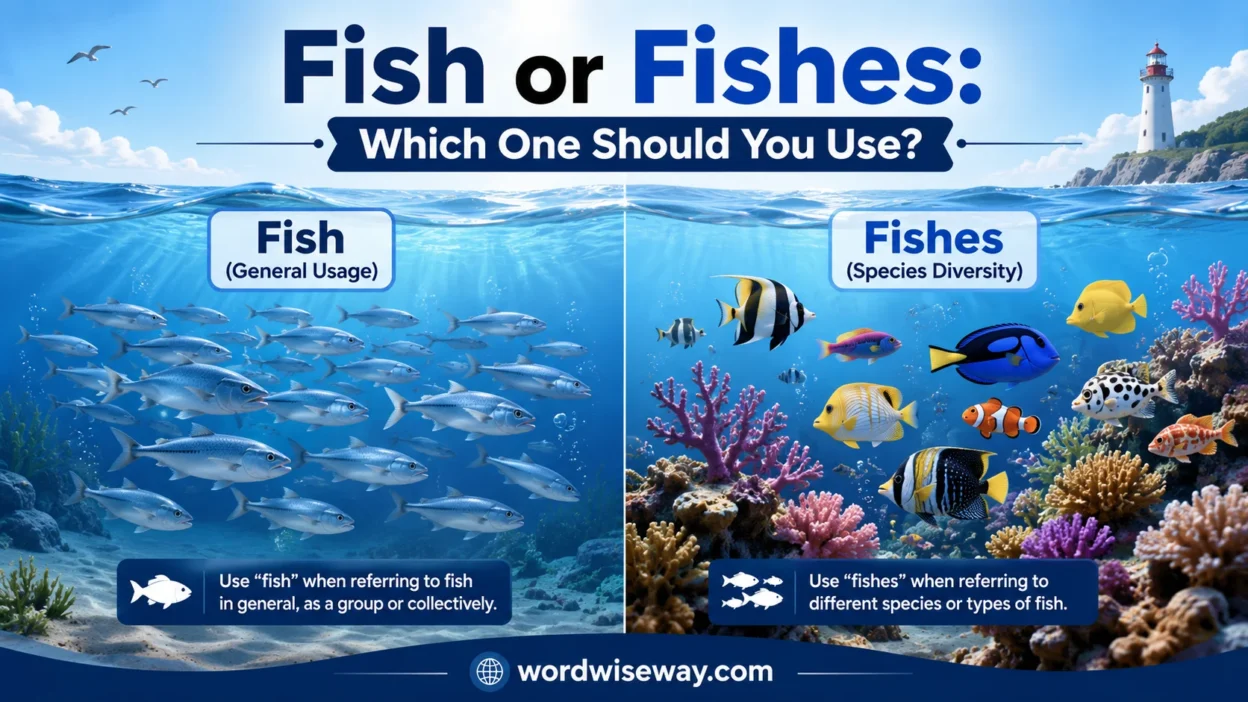
Fish or Fishes: Correct Spelling, Meaning, and Usage is a helpful guide for English learners, students, and writers who find fish and fishes confusing.
Both words describe aquatic animals, but their use depends on context. Fish is the common plural and plural of fish when talking about multiple animals. However, fishes is an acceptable plural when discussing different species of fish or types of fish.
In my experience helping learners improve their writing, I have seen this common question appear often in English grammar. The word fishes is mainly used by marine biologists to explain different species. Knowing these grammar rules helps avoid common mistakes in formal documents, news, and daily language.
This guide makes fish and fishes easier to understand, helping you choose the right word with confidence in every writing situation.
Quick Answer: Fish or Fishes? 🐟
When choosing between fish and fishes, the correct option depends on the meaning and situation. Both words are accepted in English, but they are used differently. In everyday writing, fish is the most common choice, while fishes is usually used in scientific contexts.
- ✅ Fish is the standard plural form when talking about more than one fish.
Example: I saw five fish swimming in the river. - ✅ Fishes is correct when referring to different species or types of fish.
Example: Marine biologists study many fishes around the world. - 📚 Fish can work as both singular and plural, which makes it different from many other nouns.
- 🌊 Fishes is less common in daily language but has a specific purpose in scientific discussions.
- ✍️ Understanding this difference helps students, writers, and English learners avoid grammar mistakes and use the right word confidently in writing.
Quick Comparison Table: Fish or Fishes Simplified
| Situation | Correct Form | Reason |
| Counting individuals | fish | Quantity-based usage |
| Multiple species | fishes | Scientific classification |
| Everyday speech | fish | Natural default form |
| Biology/ecology | fishes | Species diversity focus |
| Idioms | fish | Fixed expressions |
Fish or Fishes: Why This Confuses So Many People
At first glance, it looks simple. Add an “s” and you get plural. That works for cats, dogs, and books.
But English has a few rebellious words. Fish is one of them.
The confusion comes from three overlapping ideas:
- Countable vs collective nouns
- Scientific classification rules
- Everyday language simplification
So instead of one fixed rule, you get two overlapping systems. That’s where people get stuck.
Here’s the simplest truth:
Fish is usually both singular and plural in everyday English.
Fishes is used in specific scientific or descriptive contexts.
That’s the foundation everything else builds on.
Fish or Fishes: The Simple Rule You Should Learn First
Before diving into exceptions, lock this into memory:
- Fish = general plural and singular form
- Fishes = multiple species of fish
Think of it like this:
- Fish = quantity
- Fishes = diversity
Quick examples:
- I saw one fish in the pond.
- I saw many fish in the ocean.
- The aquarium contains several fishes from different habitats.
This simple split solves 90% of confusion.
Fish as Singular and Plural:The Default English Usage
The word fish behaves like a “zero-change plural” noun. That means it does not change form when plural.
You see this in a small group of English words:
- sheep → sheep
- deer → deer
- fish → fish
This structure is rare, but very natural in English.
Everyday usage examples:
- I caught one fish yesterday.
- We caught twenty fish during the trip.
- The market sells fresh fish daily.
Notice something important: context tells you whether it is singular or plural, not the word itself.
Why English works this way here
Historically, English speakers treated fish as a collective resource word, especially for food and hunting. Over time, the plural form simplified instead of evolving.
So instead of “fishes,” everyday speech settled on “fish.”
Fishes: When This Word Is Actually Correct
Now we enter the tricky zone.
The word fishes is not wrong, but it is specialized. It appears mainly in scientific, ecological, or classification contexts.
“Fishes” means:
Multiple species of fish, not just multiple individual fish.
Examples:
- The coral reef contains hundreds of fishes.
- Freshwater fishes differ from saltwater species.
- Scientists studied the fishes of the Amazon basin.
In each case, the focus is not quantity. It is variety.
Why this distinction exists
Biologists need precision. If they say “fish,” it could mean:
- One species
- A group of the same species
- Or fish in general
But fishes removes ambiguity by emphasizing species diversity.
Scientific Perspective: Why Biology Prefers “Fishes” in Some Cases
In the field of biology, classification matters. The word choice changes meaning.
Two key distinctions:
| Term | Meaning | Example |
| Fish | Individuals or general group | 10 fish in a tank |
| Fishes | Multiple species | reef fishes of different types |
Biologists often use fishes when describing ecosystems because ecosystems are about interaction between different species.
Example from ecological writing:
A marine researcher might say:
“The mangrove ecosystem supports many fishes that depend on varying salinity levels.”
Here, “fishes” signals complexity, not just numbers.
Fish or Fishes in Everyday Language
Let’s be honest. Most people rarely say fishes in daily conversation.
You will hear:
- “I caught fish.”
- “There are a lot of fish in the river.”
But you almost never hear:
- “I caught many fishes” (sounds unnatural in casual speech)
Why?
Because everyday communication values simplicity over precision.
Real-life usage breakdown:
- Conversations → fish
- Restaurants → fish
- Markets → fish
- Biology textbooks → fish and fishes
So if you are unsure, default to fish.
Idioms and Fixed Expressions: Why “Fish” Never Changes
English idioms are frozen in time. You cannot modify them without breaking their meaning.
Common expressions:
- A fish out of water
- There are plenty of fish in the sea
- Something smells fishy
- To drink like a fish
Now imagine changing them:
- “There are plenty of fishes in the sea” ❌
- “A fishes out of water” ❌
It just doesn’t work.
Why idioms resist change
Idioms are cultural memory units. They preserve older grammar forms even when language evolves.
Fish or Fishes in Academic and Formal Writing
Formal writing depends on context.
When to use “fish”:
- General research
- Environmental reports (non-taxonomic)
- Food industry writing
- Fisheries statistics
When to use “fishes”:
- Marine biology papers
- Species classification studies
- Biodiversity reports
- Ecological surveys
Example comparison:
- “The lake contains 200 fish.” (counting individuals)
- “The lake contains 40 fishes.” (counting species groups)
Common Mistakes with Fish or Fishes
Many learners make predictable errors. Let’s fix them.
Mistake 1: Using “fishes” for quantity
❌ I saw many fishes in the market
✔ I saw many fish in the market
Mistake 2: Overusing “fish” in scientific writing
❌ The river has 50 fish species
✔ The river has 50 fishes
Mistake 3: Mixing both incorrectly
❌ These fishes are tasty fish
✔ These fish are tasty
Memory Tricks to Never Confuse Fish or Fishes Again
Here are simple mental shortcuts:
1: The “Zoo vs Crowd” idea
- Fish = crowd of identical people
- Fishes = zoo with different animals
2: The “menu vs ecosystem” idea
- Fish = what you eat
- Fishes = what lives in nature systems
3: The one-letter logic
- No extra “e” = general
- Extra “es” = scientific variety
Mini Case Study: Why Misusing “Fishes” Changes Meaning
Imagine two sentences in a research report:
Version A:
“The lake contains many fish.”
This tells us only quantity exists.
Version B:
“The lake contains many fishes.”
This tells us multiple species exist.
Now the meaning changes completely. One version describes numbers. The other describes biodiversity.
That is why scientists care deeply about this distinction.
Expert Insight: How Linguists View Fish or Fishes
Linguists often classify “fish” as a zero plural noun, but they also recognize “fishes” as a semantic pluralization for species grouping.
One linguistics summary explains it like this:
“English retains dual plural behavior for fish due to functional separation between quantity and taxonomy.”
In simpler terms:
English keeps both forms because they serve different jobs.
Read More: Calves or Calfs: Correct Spelling, Meaning, and Difference
FAQs
What is the difference between fish and fishes?
Fish is the most common word used when talking about more than one fish. It can be used for a single fish and multiple fish without changing its form. For example, “I saw three fish in the pond” is the most natural sentence in everyday English.
Fishes is also correct, but it has a more specific meaning. It is mainly used when talking about different species or types of fish, especially in scientific writing and marine studies.
Is fish the correct plural form of fish?
Yes, fish is the correct and most common plural form of fish. English speakers usually use fish when they mean several animals of the same kind or when the exact species is not important.
For example, “There are many fish in the ocean” sounds natural because it refers to aquatic animals generally rather than different species.
When should I use fishes instead of fish?
You should use fishes when you are discussing different species or varieties of fish. This usage is common among marine biologists, researchers, and people studying aquatic life.
For example, if a scientist studies goldfish, guppies, and neon tetras together, they may describe them as different fishes because they belong to different groups.
Is fishes wrong in everyday English?
No, fishes is not wrong, but it is less common in normal conversations. Most people use fish when they talk about multiple aquatic animals.
Using fishes in a casual sentence may sound unusual unless you are explaining different species, habitats, or scientific classifications.
Can fish be both singular and plural?
Yes, fish can be both singular and plural. This makes it different from many other nouns that need an “-s” to become plural.
For example, “I caught a fish” refers to one animal, while “I caught five fish” refers to several animals.
Why do people confuse fish and fishes?
Many people confuse these words because English plural rules are not always simple. Most nouns add “-s” to become plural, but some words follow special patterns.
Since fish does not always change in plural form, students and English learners often wonder whether fishes is necessary or incorrect.
Do marine biologists use fishes more often?
Yes, marine biologists often use fishes because their work involves studying different species and classifications of aquatic animals.
In scientific contexts, fishes helps researchers clearly show that they are discussing multiple species rather than several individual fish from the same group.
Should I use fish or fishes in formal writing?
In most formal writing, fish is usually the better choice when referring to multiple fish in general. It is widely accepted and sounds natural.
However, if your topic involves biology, research, or different species, fishes may be the more accurate option.
Are fish and fishes pronounced differently?
No, fish and fishes are pronounced differently because fishes has an extra syllable. Fish has one syllable, while fishes has two syllables.
The pronunciation difference is simple, but choosing the correct word depends more on meaning and context.
How can I remember when to use fish and fishes?
A simple way to remember is that fish means multiple individual fish, while fishes usually means multiple types or species of fish.
Keeping the context in mind makes it easier to choose the correct word in writing and conversation.
Conclusion
Understanding the difference between fish and fishes helps you improve your English grammar and avoid common mistakes. Although both forms are correct, fish is the natural choice for everyday communication, while fishes has a special role in scientific and biological discussions.
Whether you are a student, writer, or English learner, knowing these small grammar differences can make your writing clearer and more professional.
This guide gives you the confidence to use fish and fishes correctly in any context.

Emma Smith has dedicated 14 years to Princeton University’s English Department, mentoring students in textual interpretation, literary movements, and critical frameworks. Her research explores Shakespearean drama, Victorian serial fiction, postcolonial narrative theory, and manuscript studies and probing how literary forms evolve across cultures and centuries. Emma has delivered lectures at international humanities congresses and published findings in distinguished academic journals, underscoring her commitment to scholarly depth and vibrant teaching.