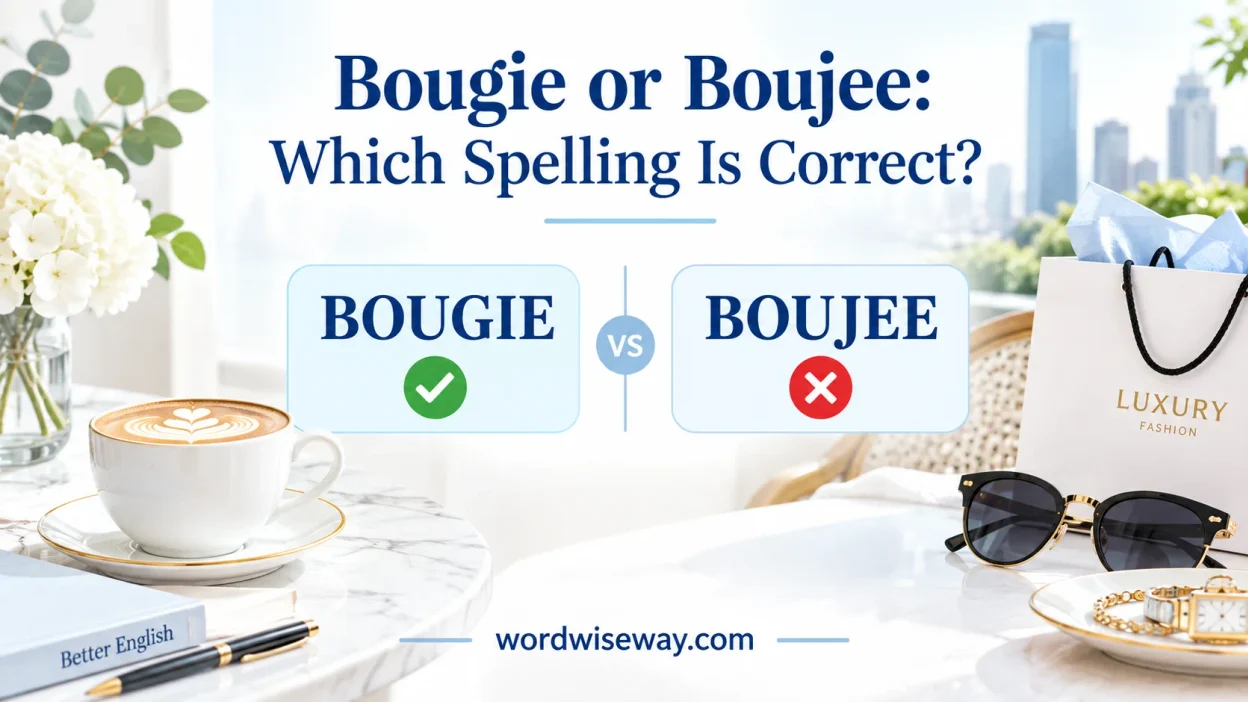
Bougie or Boujee: Correct Spelling, Meaning, and Usage can help you understand why these two words often confuse English speakers. Have you ever seen people write boujee or bougie and wondered which spelling is correct? They sound almost identical but are spelled differently, so the difference can seem small.
Many people search for boujee or bougie when describing someone or something fancy, stylish, or high-class. Social media, songs, and pop culture references make both forms appear frequently, which can cause people to mix them up. This article explains their meaning, correct usage, common mistakes, and helpful tips.
In plain English, bougie vs boujee have similar meanings connected to expensive things, luxury, and a love of luxury, although their style can differ. This guide covers their origins, pronunciation, and everyday use, so you can understand the right word, word choice, and context, and know when to use each spelling.
Quick Answer:
Bougie is generally the safer and more established spelling when you want to describe something luxurious, upscale, sophisticated, materialistic, or associated with an affluent lifestyle.
Boujee is an informal slang variant with essentially the same modern lifestyle-related meaning. It has a stronger connection to contemporary pop culture and casual online language.
| Word | Main Meaning | Typical Tone | Common Context |
| Bougie | Upscale, luxurious, fancy, materialistic, or pretentious | Casual, humorous, sometimes critical | Everyday conversation and informal writing |
| Boujee | Similar meaning, often emphasizing an affluent or stylish lifestyle | Very casual and playful | Social media, music, texting, casual speech |
If you’re writing something that needs the more established spelling, choose bougie. If you’re deliberately using a playful slang spelling, boujee works naturally in informal contexts.
The important point is that boujee isn’t simply a random spelling mistake. It has become a recognizable variant in modern slang.
What Does Bougie Mean?
In modern American slang, bougie describes something associated with luxury, sophistication, wealth, or an elevated lifestyle. It can refer to a person, place, object, habit, meal, vacation, or experience.
For example, someone might say:
- “That restaurant is so bougie.”
- “She bought a bougie coffee machine.”
- “Our hotel room was surprisingly bougie.”
- “Ordering sparkling water at dinner feels a little bougie.”
The word doesn’t automatically mean something is extremely expensive. Instead, it often suggests that something looks or feels fancier than necessary.
That’s where the humor comes in.
A person might call a $12 latte bougie even if they can comfortably afford it. The word can gently poke fun at someone’s taste without necessarily insulting them.
Bougie Can Be Positive or Negative
The meaning of bougie depends heavily on tone.
Someone might say:
“This place is so bougie, and I love it.”
Here, the speaker uses the word positively. They appreciate the stylish atmosphere.
However, another person could say:
“He refuses to eat anywhere that doesn’t look bougie.”
That statement may criticize someone for being overly concerned with status or appearances.
Therefore, bougie can suggest luxury, refinement, pretension, or unnecessary extravagance. The surrounding sentence usually tells you which meaning the speaker intends.
Bougie Can Describe Ordinary Things
One of the most interesting features of modern slang is how flexible it can become. Bougie doesn’t have to describe genuine wealth.
A person might jokingly call these things bougie:
- A candle that costs more than expected
- A tiny dessert served on an oversized plate
- A coffee shop with minimalist furniture
- A fancy reusable water bottle
- A hotel with a rooftop pool
- A restaurant with a dress code
- A homemade dinner served on expensive-looking plates
The humor comes from the contrast between the ordinary activity and the elevated presentation.
What Does Boujee Mean?
Boujee is an informal slang spelling closely associated with the modern meaning of bougie. It commonly describes someone or something that appears wealthy, luxurious, stylish, sophisticated, or concerned with an upscale lifestyle.
For example:
- “That new apartment looks boujee.”
- “We’re having a boujee dinner tonight.”
- “Her vacation photos look incredibly boujee.”
- “He has a pretty boujee taste in furniture.”
Like bougie, the word can carry either positive or negative undertones.
Calling something boujee may suggest admiration for its style and luxury. In another context, it can imply that someone is showing off or trying too hard to appear wealthy.
Why Does Boujee Sound More Playful?
The spelling boujee has a distinctly informal appearance. The extra letters make it visually resemble the kind of slang spelling commonly found in music, social media, texting, and internet culture.
That doesn’t mean every use of boujee has the same tone. However, the spelling often feels more deliberately casual than bougie.
Think of it as a stylistic choice rather than a completely separate word.
What’s the Difference?
The biggest difference between bougie and boujee isn’t their basic meaning. Both can describe luxury, status, expensive tastes, or an affluent lifestyle.
The distinction mainly involves spelling, history, tone, and context.
Bougie Is the More Established Form
Bougie has a longer history as a word in English. Its modern slang meaning developed from bourgeois, a French-derived word connected historically with the middle class and later with social attitudes surrounding material comfort and status.
Because of that history, bougie is the more established spelling for the modern slang usage.
Boujee Is a Slang Variant
Boujee developed as a playful slang form. It became particularly visible in contemporary popular culture and gained broad recognition through music and internet culture.
The two spellings now overlap heavily in everyday usage.
| Difference | Bougie | Boujee |
| Basic meaning | Luxury, upscale taste, status, or pretension | Luxury, upscale taste, status, or pretension |
| Historical connection | Strong connection to bourgeois | Modern slang variant |
| Tone | Informal and conversational | More playful and slang-oriented |
| Appearance | More established spelling | Deliberately informal-looking spelling |
| Common online | Yes | Yes |
| Suitable for formal writing | Usually limited because the slang itself is informal | Usually less suitable |
| Meaning always different? | No | No |
So, if you’re wondering whether bougie or boujee represents two completely different concepts, the answer is no. Their modern meanings overlap substantially.
Where Did Bougie Come From?
The story behind bougie reaches further back than modern social media.
The slang term connects to bourgeois, a French word historically associated with the middle class. Over time, bourgeois developed broader cultural associations with conventional respectability, material comfort, social status, and concern with possessions.
English speakers eventually shortened and reshaped the term in informal speech.
That evolution helped produce bougie, which gained a modern slang meaning related to luxury and status.
From Bourgeois to Modern Slang
The semantic journey is important because it explains why bougie can carry more than one idea.
At its core, the word isn’t simply a synonym for “expensive.” It can also suggest a particular attitude toward comfort, status, and lifestyle.
For example, calling a restaurant expensive simply describes its price. Calling it bougie can comment on its atmosphere, clientele, presentation, and perceived social identity.
That difference gives the word its bite.
What Does Bougie Mean in Slang?
In slang, bougie usually describes someone or something that seems fancy, upscale, luxurious, sophisticated, materialistic, or status-conscious.
However, the word often works humorously.
Imagine someone who normally drinks ordinary coffee suddenly ordering a carefully prepared espresso from a specialty café. Their friend might call the new habit “bougie.” The comment doesn’t necessarily accuse them of being wealthy. It simply highlights the change in lifestyle.
This flexible meaning explains why bougie works so well in everyday conversation.
Where Did Boujee Come From?
Boujee developed as a slang spelling connected to the same cultural idea as bougie. Its modern visibility grew substantially through popular culture, particularly music.
One major cultural reference was the 2016 hit “Bad and Boujee.” The phrase helped push the spelling into mainstream conversation and made boujee especially recognizable to a wider audience.
That cultural moment didn’t create the underlying concept from nothing. Slang surrounding wealth, status, and bourgeois identity existed before it. However, the song gave the -boujee spelling enormous visibility.
As a result, many people encountered boujee through music, social media, memes, and casual conversation.
Bougie and Boujee Pronunciation
In everyday American English, bougie and boujee are commonly pronounced essentially the same way.
The pronunciation resembles the sound of “boo-zhee.”
The spelling therefore creates an interesting situation: two written forms can represent virtually the same modern slang word.
The final -ie in bougie and the final -jee in boujee don’t normally create a major pronunciation distinction in casual American speech.
If you’re learning the word, focus more on the sound than on trying to force a spelling-based difference.
Bougie vs. Boujee Examples in Sentences
Seeing the words in context makes the distinction easier to understand.
Examples With Bougie
Bougie works naturally when talking about lifestyle, food, fashion, travel, and personal preferences.
- “That little café has such a bougie atmosphere.”
- “We stayed at a surprisingly bougie hotel.”
- “Her new apartment has a very bougie kitchen.”
- “I felt bougie ordering breakfast in bed.”
- “This restaurant looks fancy without feeling too bougie.”
- “He loves bougie coffee shops with quiet seating.”
- “The dinner was delicious, but the presentation was incredibly bougie.”
Notice that none of these examples requires the person to be genuinely wealthy. The word describes the impression or style.
Examples With Boujee
Boujee fits especially well in highly casual situations.
- “That rooftop restaurant looks so boujee.”
- “We’re having a boujee dinner tonight.”
- “Her new apartment is seriously boujee.”
- “This hotel feels way too boujee for me.”
- “They turned a simple brunch into a whole boujee experience.”
- “I got a boujee coffee just because I felt like treating myself.”
The spelling makes these sentences feel especially conversational and informal.
Is Bougie or Boujee More Correct?
If you’re choosing between bougie or boujee, bougie is generally the safer spelling when you want the more established form.
However, calling boujee “wrong” oversimplifies modern usage. It functions as a recognized slang variant and appears frequently in informal communication.
The better distinction is context rather than a simple right-versus-wrong rule.
Use bougie when you want the established modern slang spelling. Use boujee when the deliberately informal spelling suits the context.
For formal academic or professional writing, consider whether you need either slang term at all. A more precise word such as luxurious, upscale, pretentious, lavish, or materialistic may communicate the intended meaning more clearly.
Common Mistakes
Several misunderstandings regularly appear around these two spellings.
Treating Boujee as a Simple Typo
Boujee has established itself as an informal slang variant. It isn’t useful to treat every occurrence as accidental misspelling.
Context matters.
Assuming They Have Completely Different Meanings
The modern meanings overlap heavily. The spelling alone doesn’t guarantee a completely different interpretation.
Using Either Word Without Considering Tone
Both words can sound complimentary, humorous, or critical.
For example, “That hotel is bougie” could mean luxurious in one conversation and unnecessarily pretentious in another.
Confusing the Slang With the Technical Word
Bougie also exists as a technical term in medicine. In that context, it refers to a slender instrument used to dilate or examine a bodily passage.
That meaning has nothing to do with luxury or social status.
The context tells you which bougie you’re reading.
Bougie Has More Than One Meaning
The slang meaning gets most of the attention today, but bougie has an older technical use.
In medicine, a bougie is a flexible or slender instrument used in certain procedures involving the dilation or examination of passages in the body.
This technical sense is unrelated to the modern slang meaning.
That distinction matters because you may encounter the word in medical material where interpreting it as “fancy” would make absolutely no sense.
| Context | Meaning of Bougie |
| Slang | Fancy, upscale, luxurious, materialistic, or pretentious |
| Medical | An instrument used for dilation or examination |
| Social media | Usually slang |
| Casual conversation | Usually slang |
The surrounding context acts as the signpost.
Bougie or Boujee in American English
Both bougie and boujee have become familiar in contemporary American English. Their popularity reflects the way slang evolves through conversation, music, entertainment, and online communities.
Modern slang doesn’t always follow the neat rules found in formal dictionaries. A spelling can become recognizable because enough people use it consistently.
That’s part of what happened with boujee.
At the same time, bougie remains an important form because of its connection to the older bourgeois word family and its established use as modern slang.
Bougie vs. Boujee in Formal and Informal Writing
The choice becomes easier when you consider your audience.
Informal Writing
Both forms can work in:
- Text messages
- Social media captions
- Casual blogs
- Personal conversations
- Informal entertainment writing
- Humorous posts
Your choice can depend on the tone you want.
Formal Writing
Neither term is usually the best choice when a precise formal word would work better.
For example, instead of:
“The resort has a bougie atmosphere.”
Formal writing might say:
“The resort has an upscale atmosphere.”
Instead of:
“The restaurant feels boujee.”
You could write:
“The restaurant has an unusually luxurious setting.”
The replacement isn’t always necessary. If you’re discussing slang itself, however, bougie and boujee may be exactly the words you need.
Read More: Welcome or Wellcome: Correct Spelling, Meaning, and Usage
Which One Should You Use?
When the choice comes down to bougie or boujee, consider the purpose of your writing first.
Choose bougie when:
- You want the more established spelling.
- You’re discussing the modern slang term generally.
- You want a form with a clearer connection to bourgeois.
- You’re writing edited informal content.
Choose boujee when:
- You want a deliberately casual slang style.
- You’re writing dialogue or social media content.
- The cultural or playful tone fits the context.
- You’re intentionally using the familiar variant spelling.
The safest general choice is bougie, especially when you aren’t trying to create a particular slang effect.
A Simple Comparison
| Feature | Bougie | Boujee |
| Meaning | Fancy, upscale, luxurious, materialistic, or pretentious | Similar |
| Modern slang | Yes | Yes |
| Historical connection | Related to bourgeois | Modern slang development |
| Style | Informal | Highly informal |
| Tone | Can be positive, neutral, humorous, or critical | Often playful or slang-heavy |
| Common in conversation | Yes | Yes |
| Common in social media | Yes | Yes |
| Best general choice | Yes | Use when the informal style fits |
FAQs
Is bougie or boujee the correct spelling?
Bougie and boujee are both used in English, but they can carry slightly different style and usage depending on context. Bougie is the more established spelling, while boujee is a popular informal form often seen in social media and pop culture.
What does bougie mean?
Bougie describes someone or something associated with luxury, expensive tastes, or an upscale lifestyle. It can describe a fancy restaurant, costly clothing, elegant surroundings, or someone who enjoys these things.
What does boujee mean?
Boujee generally carries the same basic idea as bougie. It often describes something fancy, fashionable, or luxurious, especially in casual online conversations. The spelling gives the word a more playful, modern feel.
Are bougie and boujee pronounced the same?
In many everyday conversations, bougie and boujee are pronounced almost the same. Their spelling differs, but that difference usually doesn’t create a noticeable difference in ordinary speech.
Is bougie a formal English word?
Bougie is generally informal rather than formal. You’ll commonly encounter it in casual conversations, social media posts, entertainment, and lifestyle discussions. In formal writing, a clearer descriptive phrase may sometimes work better.
When should you use bougie?
Use bougie when you want to describe something as luxurious, upscale, or associated with expensive tastes. For example, you might call an upscale café or an elaborate event bougie in a casual conversation.
When is boujee more appropriate?
Boujee works well in relaxed, informal writing, particularly when the tone is playful or influenced by internet culture. It frequently appears in social media captions and casual messages where spelling can be more flexible.
Is bougie a positive or negative word?
The meaning depends heavily on context and tone. Someone might use bougie positively to describe elegance or luxury, while another person might use it teasingly to suggest that someone is overly concerned with expensive or high-class things.
Why are bougie and boujee so easy to confuse?
They look and sound remarkably similar, and both forms refer to similar ideas. Social media has also helped spread boujee, while bougie remains a familiar spelling, so seeing both versions can make the choice feel confusing.
How can I remember the difference between bougie and boujee?
A simple way to remember them is to associate bougie with the more established spelling and boujee with the more playful, informal style. When you’re writing casually, either may appear depending on the tone and context.
Conclusion
Choosing between bougie and boujee doesn’t have to feel complicated. Both forms are used to describe something connected with luxury, expensive tastes, style, or an upscale lifestyle. Their meanings overlap, but the spelling and tone can vary depending on where you see the word and how casually it’s being used.
If you’re writing something more standard, bougie is a useful choice because it’s the more established form. Boujee is especially common in casual conversations, social media, and pop culture, where playful spelling often adds personality. Paying attention to the context can help you decide which version fits naturally.
The key is to remember that spelling isn’t the only thing that matters. Think about your audience, the tone of your writing, and what you’re trying to express. Once you understand how bougie and boujee work in everyday English, you can use them more comfortably without getting caught in the spelling trap.

Evelyn Shaw has spent 14 years at Yale University’s English Department, leading students through close readings, genre studies, and interpretive methodologies. Her scholarly interests include Renaissance drama, gothic fiction, feminist literary criticism, and archival research and examining how texts generate meaning across historical periods. Evelyn has presented at major academic conferences and published essays in peer-reviewed journals, reflecting her passion for rigorous analysis and student-centered learning.