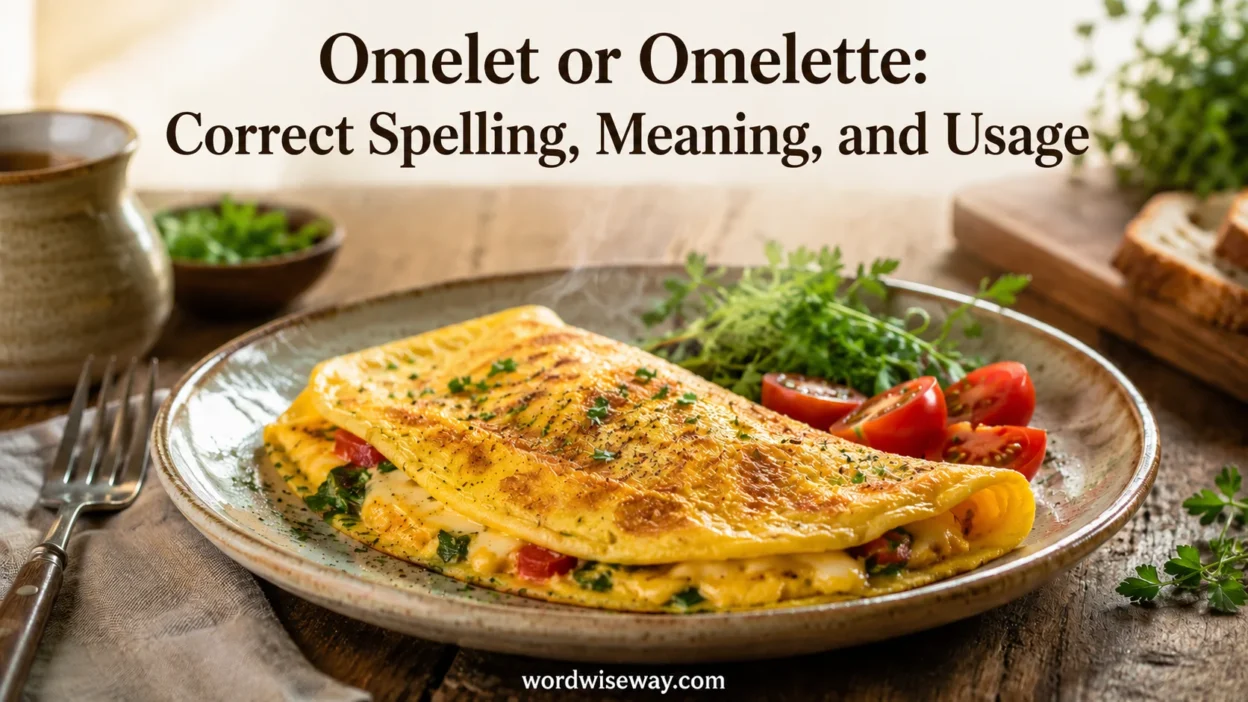
Omelet or Omelette: Correct Spelling, Meaning, and Usage explains why both forms exist and how regional language rules affect the choice.
Have you ever typed omelet and wondered if omelette is the correct spelling? This spelling difference creates confusion because people often search through recipes, menus, blogs, and cookbooks for answers. Even native English speakers can feel unsure because English follows different spelling rules in different regions. Similar to color and colour, or favorite and favourite, this word changes between American English and British English, but the meaning stays the same despite the spelling changes.
The common spelling in American writing is omelet, while omelette is often preferred in British English, French-influenced writing, and restaurant-style writing. From my experience studying writing patterns, I have noticed that both forms are widely accepted. Your choice depends on your audience, writing style, and purpose. For a U.S. audience or United States audience, choose omelet, while a U.K. audience or United Kingdom audience may prefer omelette. Both are correct spellings, and the dish remains the same thing whether it is spelled one way or another.
Quick Answer:
✅ Omelet is the more common spelling in American English.
✅ Omelette is the preferred spelling in British English and some French-influenced writing.
✅ Both spellings are correct and have the same meaning.
✅ The dish remains the same whether you write omelet or omelette.
✅ The choice depends on your audience, region, and writing style.
❌ There is no difference in taste, recipe, or food type because of the spelling.
❌ Neither spelling is wrong, so you do not need to worry when choosing between them.
In everyday writing, select the spelling that matches your readers. Use omelet for a U.S. audience and omelette for a U.K. audience or a more traditional style. Once you understand this small spelling variation, choosing the right form becomes easy and confident.
Comparison Table: Omelet vs Omelette
| Feature | Omelet | Omelette |
| Region | United States | UK, France, Commonwealth |
| Meaning | Egg dish | Same egg dish |
| Origin | Simplified English form | French origin |
| Usage | Informal + formal US writing | Formal British writing |
| Pronunciation | Same | Same |
What “Omelet or Omelette” Actually Means in the Kitchen
Before diving into spelling, it helps to ground the word in something familiar: food.
An omelet (or omelette) is a dish made by:
- Beating eggs
- Cooking them in a pan
- Folding them, often around fillings like cheese, vegetables, or meat
That’s it. No mystery ingredient. No hidden technique. Just eggs doing their best impression of a soft golden blanket.
Across countries, omelets can look slightly different:
- In France, they’re soft, pale, and often lightly runny inside
- In the United States, they’re usually firmer and stuffed generously
- In parts of Asia, you might find rolled or layered versions
So while the spelling changes, the concept stays the same: eggs transformed into something warm, quick, and endlessly customizable.
Where the Word Comes From (And Why That Matters)
The word traces back to French: “omelette.”
French cuisine had a massive influence on English cooking vocabulary. Words like:
- “ballet”
- “menu”
- “cuisine”
- “soufflé”
…all came from French, and “omelette” joined that list through culinary exchange.
Originally, the French word likely evolved from older forms like alemette or alemelle, which referred to a thin plate or blade shape. Over time, it shifted into the egg dish we know today.
When English adopted it, something interesting happened: it started reshaping the spelling based on region and preference.
That’s where the split begins.
Omelet vs Omelette: The Real Difference
Let’s get straight to the point.
There is no difference in meaning between the two spellings.
They both refer to the same egg dish.
The difference is purely regional spelling preference:
- Omelet → American English
- Omelette → British English and French-influenced usage
Think of it like this:
Same dish. Different handwriting.
How Different Regions Use It in Real Life
Language doesn’t live in dictionaries. It lives in menus, cookbooks, and everyday typing. Here’s how usage actually breaks down:
United States
- “Omelet” dominates nearly all writing
- Major dictionaries like Merriam-Webster list it as the primary form
- Restaurants almost always use “omelet”
United Kingdom
- “Omelette” is standard in most writing
- British cookbooks and menus prefer the double “t” and “e”
- Strong French culinary influence remains intact
Canada and Australia
- Mixed usage depending on context
- Formal writing often leans British (“omelette”)
- Informal or American-influenced spaces may use “omelet”
Global food branding
- Chains often choose based on target market
- US menus → omelet
- UK/EU menus → omelette
Language here behaves like fashion. It adapts to the audience.
What Dictionaries Actually Say
Let’s ground this in authority instead of opinion.
- Merriam-Webster (US)
Lists “omelet” as the standard American spelling and notes “omelette” as a variant. - Oxford English Dictionary (UK)
Uses “omelette” as the standard British spelling and recognizes “omelet” as an American form. - Cambridge Dictionary
Includes both forms, labeling them regionally appropriate.
The takeaway is simple:
Both spellings are correct in their own context.
No dictionary treats one as wrong.
Why English Has Two Spellings for the Same Dish
This isn’t random. There’s a pattern behind it.
1. American simplification tendency
American English often trims borrowed words:
- colour → color
- theatre → theater
- centre → center
“Omelette” became “omelet” under the same pressure for simplicity.
2. Printing and publishing standards
Early American newspapers standardized shorter spellings to save space and cost. That habit stuck.
3. Cultural independence
Post-colonial language evolution encouraged American English to develop its own identity.
4. Digital reinforcement
Search engines and auto-correct systems now reinforce regional norms. Type “omelet” in the US, and your device likely won’t question it.
Language didn’t split overnight. It drifted slowly, like continents.
Common Misunderstandings About Omelet vs Omelette
People often assume things that aren’t true. Let’s clear them up.
Myth 1: One spelling is more correct
False. Both are correct in their regions.
Myth 2: The spelling changes the recipe
False again. A French omelette and an American omelet differ in style, not spelling rules.
Myth 3: “Omelette” sounds more fancy
This is perception, not grammar. The extra letters come from French tradition, not sophistication.
Myth 4: Restaurants must follow one global rule
No global authority regulates food spelling. Branding decides.
Which Spelling Should You Use?
Here’s the practical answer you actually need.
Use this guide:
- Writing for US audience → omelet
- Writing for UK or Commonwealth audience → omelette
- Writing globally → pick one and stay consistent
Consistency matters more than choice. Readers notice switching more than spelling.
Real Usage Examples (So You Can See It in Action)
Let’s make this feel real.
American usage:
- “I ordered a cheese omelet for breakfast.”
- “The diner serves a three-egg omelet with peppers.”
British usage:
- “She cooked a mushroom omelette for brunch.”
- “The café is known for its fluffy omelettes.”
Both sound natural in their own regions. Nothing feels “wrong.”
Case Study: Menu Design Choices
Let’s look at how language becomes branding.
Case: International café chain menu adaptation
A café operating in New York and London faced a naming decision:
- In New York: “Cheese Omelet”
- In London: “Cheese Omelette”
They tested customer response and found:
- US customers preferred shorter spelling visually
- UK customers expected French-style spelling on menus
Result:
They localized spelling instead of forcing one global version.
This shows something important:
Language adapts to expectation, not correctness.
Why This Small Spelling Difference Actually Matters
At first glance, this looks like a tiny grammar detail. But it reveals something bigger about English.
English doesn’t behave like a strict rulebook. It behaves like a living ecosystem.
Words:
- travel across cultures
- change shape
- keep meaning intact
“Omelet vs omelette” is just one example of this constant evolution.
You see the same pattern in:
- “donut” vs “doughnut”
- “organize” vs “organise”
- “gray” vs “grey”
Language doesn’t break here. It branches.
Key Takeaways
Let’s make this simple:
- Omelet and omelette mean the same dish
- The difference comes from regional spelling traditions
- American English prefers “omelet”
- British English prefers “omelette”
- Neither is incorrect
- Consistency matters more than choice
If you remember only one thing, let it be this:
Language follows people, not the other way around.
Read More: License or Licence: Correct Spelling, Meaning, and Usage
FAQs
What is the correct spelling: omelet or omelette?
Both omelet and omelette are correct spellings. The difference comes from regional English usage. Omelet is common in American English, while omelette is more common in British English.
Is omelet the American spelling?
Yes, omelet is the preferred spelling in the United States. Most American dictionaries, restaurants, and food websites use this shorter form.
Is omelette the British spelling?
Yes, omelette is widely used in the United Kingdom and other regions influenced by British English. It is also common in more traditional or French-style writing.
Do omelet and omelette have different meanings?
No, both words have the same meaning. They describe the same breakfast dish made from beaten eggs cooked until set, often with additional ingredients.
Why do people confuse omelet and omelette?
People get confused because both spellings appear in menus, recipes, blogs, and cookbooks. English changes spelling in different regions, just like color and colour.
Should I use omelet or omelette in my writing?
Choose the spelling based on your audience. Use omelet when writing for American readers and omelette when writing for British readers or using a more traditional style.
Is omelet wrong in British English?
No, omelet is not completely wrong, but omelette is the more familiar spelling in British English. The preferred choice depends on the region and writing style.
Is omelette wrong in American English?
No, omelette can still be understood in American English. However, omelet is the more common and standard spelling in the United States.
Do restaurants use both omelet and omelette?
Yes, restaurants may use either spelling. Some menus choose omelet for an American style, while others use omelette to create a traditional or elegant impression.
How can I remember the difference between omelet and omelette?
A simple way to remember is that omelet connects with American English, while omelette connects with British English. Both spellings are correct, so focus on matching your writing to your readers.
Conclusion:
In conclusion, omelet and omelette are two accepted spellings of the same delicious egg dish. The main difference is not in the meaning, recipe, or food itself, but in regional English preferences. Omelet is widely used in American English, while omelette remains popular in British English and more traditional writing styles. Understanding this small spelling variation helps you choose the right form for your readers.
Whether you are writing a recipe, creating a menu, publishing a blog, or communicating in everyday English, both spellings are correct. The best choice depends on your audience, location, and preferred writing style. Once you know the difference between omelet and omelette, you can use either spelling with confidence and avoid unnecessary confusion.

Emma Smith has dedicated 14 years to Princeton University’s English Department, mentoring students in textual interpretation, literary movements, and critical frameworks. Her research explores Shakespearean drama, Victorian serial fiction, postcolonial narrative theory, and manuscript studies and probing how literary forms evolve across cultures and centuries. Emma has delivered lectures at international humanities congresses and published findings in distinguished academic journals, underscoring her commitment to scholarly depth and vibrant teaching.