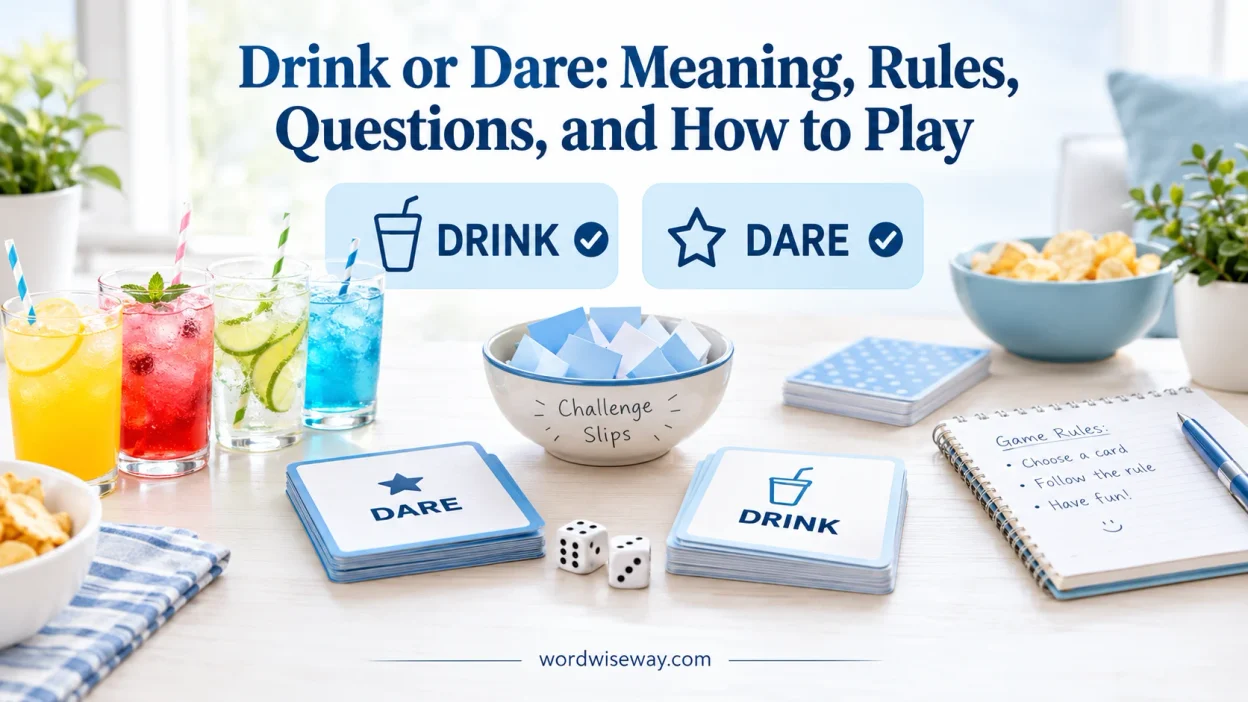
Drink or Dare turns a simple group gathering into a fast-moving game of choices, challenges, laughter, and unexpected moments. One player gets two options: take a drink of a chosen beverage or accept a dare. That simple decision creates enough suspense to keep everyone watching the next turn.
The game works particularly well because you don’t need complicated equipment. A few friends, suitable drinks, and a list of creative challenges can turn an ordinary evening into something much more memorable. You can also play it entirely without alcohol by using water, juice, soda, or another suitable beverage.
Unlike games that depend heavily on personal questions, Drink or Dare puts the emphasis on quick decisions and playful challenges. The best version isn’t the one with the wildest dares. It’s the one where everyone feels comfortable joining in and nobody gets pressured into doing something unsafe.
Quick Answer:
Drink or Dare is a group game in which a player chooses between taking a sip of a beverage and completing a dare. If the player chooses the drink option, they take the agreed amount of a suitable non-alcoholic drink. If they choose dare, another player gives them a challenge.
The basic format looks like this:
| Choice | What Happens |
| Drink | Take a sip of the chosen beverage |
| Dare | Complete a safe challenge |
| Skip | Use a previously agreed harmless alternative |
The rules can change depending on the group. Some players use prepared dare cards. Others let the person sitting beside the player invent the challenge. You can also create themed rounds involving acting, storytelling, drawing, memory, music, or quick-thinking challenges.
The key idea remains the same: choose your path, complete the turn, and keep the game moving.
How to Play Drink or Dare
Drink or Dare doesn’t require an elaborate setup. In fact, keeping the rules simple usually makes the game better because players spend more time playing and less time explaining it.
What You Need for Drink or Dare
Before starting, gather:
- A group of players
- Suitable non-alcoholic beverages
- Cups or bottles
- A list of safe dares
- A timer if some challenges have time limits
- Optional paper slips or cards for random challenges
You can prepare the dares beforehand or create them during the game. A prepared list helps when the group runs out of ideas. Spontaneous challenges, however, can make individual rounds feel more personal and unpredictable.
Basic Drink or Dare Rules
Start by deciding who goes first. The first player chooses Drink or Dare.
If they choose Drink, they take the agreed amount of their beverage. If they choose Dare, another player gives them a challenge. Once the player completes the challenge, the turn ends and the next person plays.
A simple sequence looks like this:
- Choose the first player.
- Ask, “Drink or Dare?”
- Let the player choose.
- Give them the corresponding action.
- Complete the turn.
- Move to the next player.
- Continue until the group decides to stop.
The game doesn’t need complicated scoring. However, you can add points if you want a competitive version. For example, successful dares could earn one point while particularly creative challenges could earn bonus points.
Set the Rules Before Starting
A few ground rules prevent awkward situations later.
Everyone should agree that a player can decline a challenge. No dare should involve dangerous stunts, harmful substances, illegal behavior, harassment, property damage, or revealing private information.
You should also decide whether players can repeat challenges. Usually, preventing immediate repeats keeps the game fresher.
A good rule is simple: the challenge should be funny because of what happens, not because someone feels trapped.
Drink or Dare Questions
Questions add another layer to the game. Instead of giving every player a physical challenge, you can mix questions with dares.
For example, the group can create categories such as:
- Funny questions
- Friendship questions
- Quick-thinking questions
- Embarrassing-but-safe questions
- Creative challenges
- Acting challenges
- Memory challenges
This variety prevents the game from becoming a parade of nearly identical dares.
Funny Drink or Dare Questions
Funny prompts work because they don’t require elaborate preparation. They can also involve the entire group.
Try prompts such as:
- What is the strangest food combination you’d actually try?
- Which fictional character would make the worst roommate?
- What useless talent would you like to have?
- What would your imaginary restaurant serve?
- What ridiculous law would you create for one day?
For dares, players can perform a dramatic reading of an ordinary sentence, invent a ridiculous advertisement, or act like a robot for 30 seconds.
The humor comes from commitment. A simple challenge can become hilarious when someone takes it seriously.
Embarrassing but Safe Drink or Dare Questions
A little awkwardness can make a party game memorable. However, embarrassment should remain harmless.
Examples include:
- Tell the group about a funny mistake you made.
- Give yourself a ridiculous superhero name.
- Perform your best imaginary award speech.
- Describe your favorite snack as if you’re presenting a luxury product.
- Let another player choose a harmless phrase you must use in your next sentence.
Avoid challenges that demand personal secrets, expose private conversations, or embarrass someone against their wishes.
Easy Drink or Dare Questions
Easy challenges work especially well when players are meeting for the first time.
Examples include:
- Name five animals in ten seconds.
- Make three different facial expressions.
- Draw a house with your eyes closed.
- Name five foods beginning with the same letter.
- Act out a common household activity without speaking.
- Tell a short story using three random words.
These challenges keep everyone involved without putting excessive pressure on one player.
Harder Drink or Dare Challenges
A harder dare doesn’t need to be dangerous. Difficulty can come from creativity, memory, speed, or concentration.
For example:
- Tell a story using five required words.
- Draw an object while another player describes it.
- Memorize and repeat a short list of objects.
- Create a fictional advertisement in 30 seconds.
- Explain a simple object without saying its name.
These challenges test mental flexibility rather than physical risk.
Best Drink or Dare Challenges
The strongest challenges have three qualities: they’re understandable, achievable, and entertaining to watch.
Acting Challenges
Acting challenges are easy to run because they require almost nothing.
Try:
- Mimic a fictional character.
- Pretend you’re a news reporter covering an absurd event.
- Act like you’re selling an ordinary spoon for a huge price.
- Perform a dramatic reaction to receiving an imaginary award.
- Act out a familiar household activity without speaking.
Speaking Challenges
Speaking games can create surprisingly funny moments.
Try:
- Explain how to make a sandwich like you’re teaching a class of aliens.
- Tell a 20-second story containing three random words.
- Describe an everyday object without naming it.
- Give a dramatic speech about losing a sock.
- Invent a fictional product and pitch it to the group.
Creativity Challenges
Creative dares reward imagination rather than bravery.
You could ask someone to:
- Create a new holiday.
- Invent a fictional country.
- Design a strange new app.
- Write a two-line poem about an ordinary object.
- Create a slogan for a completely useless product.
- Draw an imaginary creature and explain its abilities.
Group Challenges
Not every dare needs one person.
Group challenges can include:
- Create a synchronized movement.
- Build a short story one sentence at a time.
- Have two players act out a scene without speaking.
- Let three players invent a fictional restaurant together.
- Complete a memory challenge as a team.
Group challenges are especially useful when you want to prevent one player from becoming the center of attention for too long.
Rules for Different Group Sizes
The number of players changes the game’s rhythm.
Small Groups
With three or four players, personalized challenges work well. Players can remember previous answers and build new challenges around them.
However, avoid making every dare dependent on inside jokes. A good challenge should still make sense to everyone.
Large Groups
Large groups need faster turns. Keep individual challenges short and use group activities occasionally.
A useful structure is:
| Group Size | Useful Approach |
| 2–4 players | Personal questions and creative challenges |
| 5–8 players | Mixed questions and individual dares |
| 9+ players | Short challenges and group rounds |
With a large group, a timer can prevent one challenge from consuming half the game.
Drink or Dare Without Alcohol
You don’t need alcohol to play Drink or Dare. In fact, the game’s central mechanic works perfectly well with ordinary beverages.
Use:
- Water
- Juice
- Lemonade
- Soda
- Milk
- Flavored water
- Another suitable non-alcoholic drink
The beverage is simply one side of the choice. The entertainment comes from the decision and the challenge that follows.
A non-alcoholic version also makes the game easier to use at school-friendly gatherings, family events, daytime parties, and other settings where alcohol isn’t appropriate.
You can even remove the beverage entirely and rename the choice categories. For example, players could choose Sip or Dare, Snack or Dare, or simply Choice or Dare.
Safe Drink or Dare Rules
Safety should be part of the game’s design rather than an afterthought.
Dares to Avoid
Don’t use challenges involving:
- Dangerous physical stunts
- Unsafe substances
- Forced consumption
- Fire or other hazards
- Trespassing
- Property damage
- Harassment
- Humiliation
- Private information
- Illegal activities
- Contact with strangers
- Anything a player clearly doesn’t want to do
A dare isn’t better because it carries more risk. Clever challenges usually create better stories anyway.
How to Handle a Refusal
Every player should have a simple way to decline a challenge.
You can establish a skip rule before the game begins. A player who doesn’t want to complete a dare can use their skip without having to explain why.
If the group wants a consequence, keep it harmless. The player might lose a point or receive a replacement challenge chosen from a safe list.
This keeps the game voluntary rather than turning it into a pressure contest.
Drink or Dare vs. Truth or Dare
Although the names sound similar, the games emphasize different experiences.
| Feature | Drink or Dare | Truth or Dare |
| Main choice | Beverage or challenge | Truth or challenge |
| Main focus | Quick decisions and activities | Questions and activities |
| Beverage component | Yes, with a suitable drink | Not required |
| Personal questions | Optional | Central to the format |
| Creative challenges | Common | Common |
| Best feature | Fast-paced choices | Personal conversations |
Drink or Dare tends to move quickly because players don’t need to answer a long personal question before continuing.
Truth or Dare, meanwhile, puts more weight on revealing information and personal stories.
How to Make Drink or Dare More Fun
A little structure can dramatically improve the game.
Create Themed Rounds
Instead of mixing everything together, give each round a theme.
Possible themes include:
- Movies and characters
- Food
- School memories
- Creativity
- Acting
- Random objects
- Quick thinking
- Friendship
Themes make it easier to create relevant challenges.
Mix Easy and Difficult Prompts
If every challenge is difficult, players may become tired. If every challenge is extremely easy, the game can lose its spark.
A better rhythm alternates between quick challenges and more creative ones.
Give Players Limited Vetoes
A veto lets someone reject a challenge without turning the game into an argument.
For example, everyone could receive one or two vetoes per game. Once used, the player gets another safe challenge.
Avoid Repetition
Repeating the same challenge too often drains the energy from the room.
Keep several categories available so the game can jump from acting to memory, then from storytelling to drawing.
Variety is the game’s fuel.
A Sample Drink or Dare Round
Imagine six friends sitting around a table. Player One chooses Dare.
The challenge is:
“Create a 20-second advertisement for a pencil as if it were a luxury invention.”
The player delivers an exaggerated sales pitch. Everyone laughs, then the next player chooses Drink.
That player takes a sip of their chosen beverage and the turn ends.
Player Three chooses Dare and receives a memory challenge. They must remember five objects named by the group.
Nothing complicated happened. Yet the round worked because each turn changed the rhythm.
That’s the real strength of Drink or Dare. The choice creates anticipation while the challenge creates the payoff.
Common Mistakes
Making Every Dare Extreme
Extreme challenges quickly become repetitive and can create unnecessary risks.
A clever challenge can be much harder to forget than a reckless one. Creativity gives players room to surprise each other without crossing boundaries.
Pressuring Players
A player who doesn’t want to participate in a particular challenge should be able to skip it.
Pressure changes the atmosphere. Instead of laughing together, everyone starts watching whether someone will give in.
That’s not a useful trade-off for a party game.
Using Repetitive Dares
If every challenge involves singing, acting, or answering personal questions, the game becomes predictable.
Rotate categories. Let one round focus on memory, another on creativity, and another on group challenges.
Ignoring the Group’s Comfort Level
Different groups have different boundaries.
A challenge that seems hilarious to one group may feel uncomfortable to another. Before starting, agree on the basic limits and respect them throughout the game.
Read More: Cue or Que: Meaning, Difference, and Correct Usage
FAQs
What does Drink or Dare mean?
Drink or Dare is a group game where players choose between taking a drink or completing a dare. The rules can change depending on the group.
How do you play Drink or Dare?
Players take turns choosing an option. One person can give a question or dare, and the player decides which challenge they want to accept.
Is Drink or Dare the same as Truth or Dare?
Not exactly. Truth or Dare usually gives players a choice between answering honestly and doing a dare, while Drink or Dare adds a drink as one of the choices.
Can you play Drink or Dare without alcohol?
Yes. You can use water, juice, soda, or another non-alcoholic drink. This keeps the basic game format while making it suitable for more players.
What are good Drink or Dare questions?
Good questions are simple, funny, and comfortable for the group. You can ask about favorite memories, unusual habits, funny experiences, or harmless preferences.
What makes a good dare in the game?
A good dare should be safe, reasonable, and easy to understand. Funny actions, short performances, or harmless challenges can keep the game lively without putting anyone under pressure.
How many people can play Drink or Dare?
There isn’t a fixed number of players. A small group can make the game more personal, while a larger group can create more variety in questions and dares.
Can players make their own Drink or Dare rules?
Yes. Groups can create simple rules before starting, such as setting turn limits, choosing suitable challenges, or allowing players to skip anything that makes them uncomfortable.
How can you make Drink or Dare more enjoyable?
Use creative questions, varied dares, and clear rules. Most importantly, let everyone participate voluntarily and respect personal boundaries throughout the game.
What should you avoid during Drink or Dare?
Avoid dangerous, humiliating, or overly personal challenges. The goal should be friendly interaction and fun, not pressure. A good game leaves everyone comfortable when the final turn ends.
Conclusion
Drink or Dare is a flexible party game that brings questions, dares, and simple choices into one social activity. Its easy format makes it suitable for game nights, casual gatherings, celebrations, and groups looking for something interactive without complicated equipment or preparation. Players can shape the experience by creating their own questions, challenges, and rules.
The best version of the game isn’t about making every dare extreme. It’s about keeping the activity enjoyable for everyone involved. Funny questions, creative challenges, and clear boundaries can turn an ordinary gathering into a collection of memorable moments. Players should always have the freedom to skip a challenge they don’t want to complete.
Whether you’re discovering Drink or Dare for the first time or looking for fresh ways to play, a little creativity can keep each round interesting. Choose suitable prompts, respect everyone’s comfort level, and focus on friendly interaction rather than pressure. With those simple principles, the game can remain fun, accessible, and easy to enjoy.