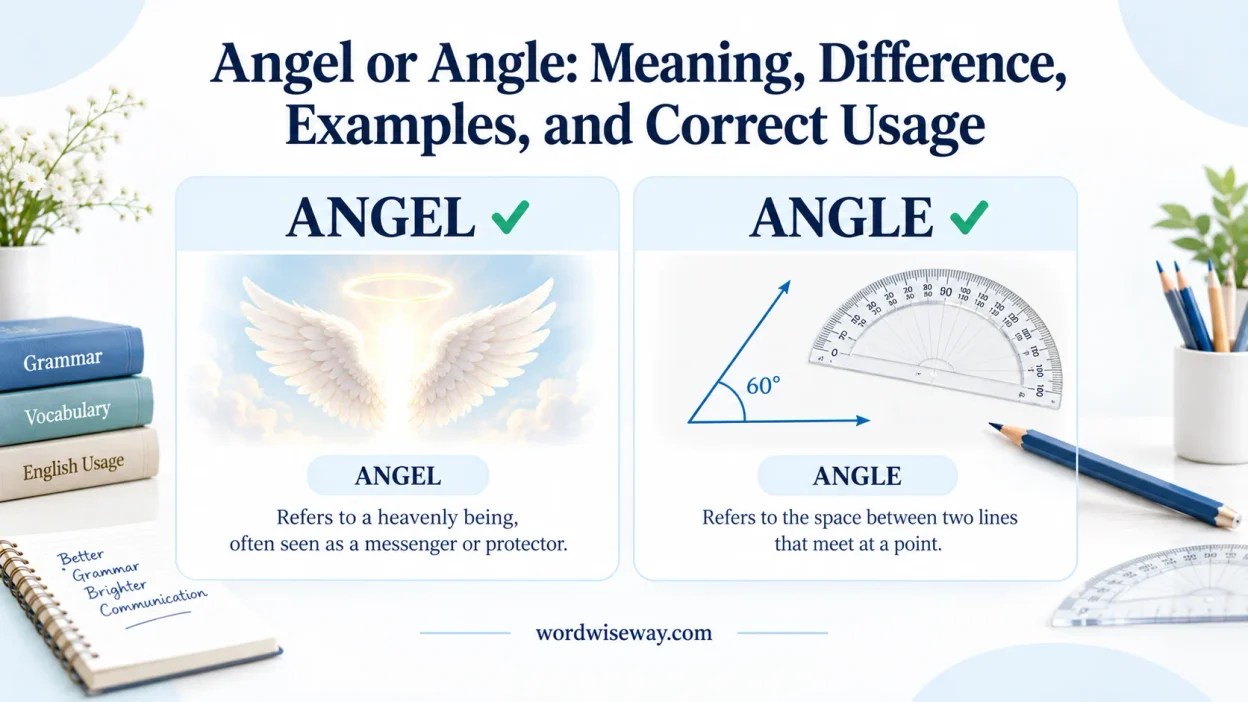
Angel or Angle: Meaning, Difference, and Correct Usage helps English learners understand why these words look nearly the same but have different meanings. Angel and angle are two words that are easy to mix up because of a small spelling difference. A typo can change the whole sentence and create confusion in writing or speaking.
You might have saw an angel in a dream, while in math you drew a 90-degree angle. Angel is connected to spirituality, religion, and religious texts, while angle belongs to mathematics and geometry. Their meaning, pronunciation, and usage are therefore very different, even though the words look almost alike.
When typing quickly, people may accidentally use one word in place of the other. Autocorrect and spell-check tools don’t always catch this mistake because both are real English words. Simple examples, rules, tables, FAQs, and memory tricks can help you remember the correct choice and improve clear communication.
Quick Answer:
Angel and angle are different words with different meanings.
- Angel usually means a supernatural or heavenly being. It can also describe a very kind person or serve as a personal name.
- Angle usually means the space or figure formed by two lines, rays, or surfaces meeting. It can also mean a particular viewpoint, perspective, or approach.
| Word | Main Meaning | Example |
| Angel | A heavenly or spiritual being | The painting shows an angel with wings. |
| Angle | A geometric figure or viewpoint | Measure the angle between the two lines. |
A simple memory trick works well: angel has “EL” at the end, while angle has “LE.” If you’re talking about heaven, think angel. If you’re talking about geometry, position, or perspective, think angle.
Angel: Meaning and Definition
Angel is primarily a noun that refers to a supernatural or spiritual being. In many religious traditions, angels appear as heavenly messengers, servants, protectors, or intermediaries between the divine and human worlds.
The exact role of angels varies across religious and cultural traditions. However, the word generally carries an association with the spiritual or heavenly realm.
For example:
The story describes an angel delivering a message from heaven.
The word also has a familiar informal meaning. People sometimes call someone an angel when that person has been exceptionally kind, helpful, generous, or considerate.
For instance:
You’re an angel for helping me finish this project.
Here, nobody is suggesting that the person is literally a supernatural being. The speaker uses angel as a warm expression of appreciation.
Examples of Angel in a Sentence
Here are several contexts where angel is the correct word:
- The child drew an angel with large wings.
- According to the story, an angel appeared in the dream.
- Thanks for bringing my books. You’re an angel.
- The statue represents an angel.
- Angel is also used as a personal name.
Notice how each example connects the word with either a spiritual being, a kind person, or a name.
Angel as a Name
Angel can also function as a personal name. In English-speaking contexts, it can be used as a given name, although naming patterns vary by region and culture.
When Angel appears as someone’s name, capitalization distinguishes it from the ordinary noun:
- The angel appeared in the story.
- Angel joined the class today.
The spelling remains the same, but capitalization and context tell you whether the word functions as a name.
Angle: Meaning and Definition
Angle has several meanings, but geometry provides its most fundamental use.
In mathematics, an angle forms when two rays or line segments meet at a common endpoint. That common point is called the vertex. Angles are commonly measured in degrees.
For example:
The two lines form a 90-degree angle.
An angle can also describe a particular direction or position from which you view something.
For example:
Move the camera to a different angle.
Here, angle doesn’t refer to a mathematical calculation. It describes the position or perspective from which the camera captures the subject.
The word also has a figurative meaning. If someone says, “What’s your angle?” they may be asking about your approach, perspective, motive, or strategy.
Examples of Angle in a Sentence
- The triangle contains three angles.
- Measure the angle with a protractor.
- The photographer chose an unusual angle.
- Try looking at the problem from another angle.
- The article takes a fresh angle on the issue.
- The journalist searched for a strong angle for the story.
These examples demonstrate why angle extends beyond mathematics. You can encounter the word in photography, journalism, writing, problem-solving, and everyday conversation.
Key Differences
The easiest way to understand angel vs. angle is to focus on what each word represents.
| Feature | Angel | Angle |
| Spelling | A-N-G-E-L | A-N-G-L-E |
| Primary meaning | Heavenly or spiritual being | Geometric figure or viewpoint |
| Typical part of speech | Noun | Noun; sometimes verb |
| Common contexts | Religion, spirituality, names, informal speech | Mathematics, photography, writing, perspective |
| Example | The angel appeared in the story. | The angle measures 45 degrees. |
| Memory clue | Think heavenly being | Think lines or viewpoint |
The crucial difference appears in the final two letters.
Angel → EL
Angle → LE
That’s the spelling distinction worth memorizing.
Angel vs. Angle Spelling
The words share four letters in the same general sequence:
A-N-G-L
The difference comes from where the E appears.
- Angel = A-N-G-E-L
- Angle = A-N-G-L-E
That tiny rearrangement changes the meaning completely.
A useful proofreading trick is to stop at the final two letters. If you’re describing a heavenly being, check for -el. If you’re describing a geometric figure or viewpoint, check for -le.
Angel vs. Angle Pronunciation
In standard US English, angel and angle don’t have identical pronunciations.
Angel contains an extra vowel sound after the initial consonant sequence. Angle moves more directly into the ending sound.
That distinction can help when you’re speaking, although spelling remains the more important issue when writing. Because both words begin with ang-, a learner who focuses only on the first part may still confuse them.
The best approach is to connect sound, spelling, and meaning rather than relying on pronunciation alone.
Which One Should You Use?
Choosing between the two becomes straightforward once you identify what you’re describing.
When to Use Angel
Use angel when you mean:
- A heavenly or supernatural being
- A spiritual messenger or protector
- A person who behaves with exceptional kindness
- Someone being praised affectionately
- A person named Angel
Consider this sentence:
My grandmother was an angel to our family.
The word describes her kindness rather than a literal supernatural identity.
When to Use Angle
Use angle when you’re talking about:
- Geometry
- Lines or rays meeting at a point
- Direction or position
- Photography
- Perspective
- A viewpoint
- An approach to a problem
- A particular focus in writing or journalism
For example:
The photographer changed the angle to capture the entire building.
Here, angle refers to the camera’s position.
Another example shows the figurative meaning:
The writer approached the topic from an economic angle.
The writer isn’t discussing degrees or geometric lines. Instead, the writer chose a particular perspective.
Common Mistakes
Because the words differ by only one letter position, spelling errors can happen quickly.
Writing Angel When You Mean Angle
This mistake often appears when someone is discussing geometry or perspective.
Incorrect:
The triangle has three angels.
Correct:
The triangle has three angles.
The first sentence accidentally refers to three heavenly beings. The second correctly describes the three geometric figures formed by the triangle’s sides.
Here’s another example:
Incorrect:
Take the picture from another angel.
Correct:
Take the picture from another angle.
Changing just one letter position turns a camera position into a heavenly being.
Writing Angle When You Mean Angel
The reverse mistake happens just as easily.
Incorrect:
The story tells of an angle sent from heaven.
Correct:
The story tells of an angel sent from heaven.
The first sentence uses the geometric word angle, which doesn’t fit the meaning.
Confusing the Meanings
Sometimes the problem isn’t spelling alone. A writer may understand the two words as interchangeable because they look so similar.
They aren’t.
Compare these sentences:
The angel protected the traveler.
The angle protected the traveler.
The first sentence can make sense in a spiritual story. The second doesn’t make sense unless Angle happens to be someone’s name.
Likewise:
The photographer changed the angle.
makes perfect sense.
The photographer changed the angel.
would mean something entirely different and probably unintended.
Easy Ways to Remember
A good memory trick should connect spelling with meaning rather than force you to memorize two isolated words.
The EL vs. LE Trick
Remember the endings:
Angel → EL
Angle → LE
The letters E and L switch places.
When proofreading, look at those final two letters. That quick check can prevent an embarrassing substitution.
The Heaven vs. Geometry Trick
Create a mental pairing:
Angel = heaven
Angle = geometry
Then expand the second association:
Angle = geometry, position, perspective
This works because the meanings are so different. You don’t need a complicated mnemonic when the concepts already live in separate mental rooms.
A Simple Sentence Test
When you’re unsure, ask:
Am I talking about a being or a viewpoint/shape?
If the answer is a being, choose angel.
If you’re describing a shape, direction, position, or perspective, choose angle.
For example:
She saw an ___ in the painting.
A spiritual being makes sense, so choose angel.
The camera needs a wider ___.
A position or perspective makes sense, so choose angle.
This method works particularly well when you’re proofreading quickly.
Angel vs. Angle in Different Contexts
The surrounding context usually makes the correct word obvious.
Religion and Spirituality
Angel is the appropriate word when discussing heavenly or spiritual beings.
Examples include:
- an angelic messenger
- a guardian angel
- an angel in religious art
- a story about an angel
- an angel appearing in a vision
The word carries a spiritual meaning in these contexts.
Mathematics and Geometry
Angle belongs in mathematical discussions.
A few common types include:
- Acute angle: greater than 0° and less than 90°
- Right angle: exactly 90°
- Obtuse angle: greater than 90° and less than 180°
- Straight angle: exactly 180°
For example:
A right angle measures 90 degrees.
Using angel here would completely change the sentence.
Photography
Photographers use angle to describe the position or direction from which they capture a subject.
You might hear phrases such as:
- camera angle
- viewing angle
- low angle
- high angle
- shooting angle
- wide angle
For example:
The photographer used a low angle to make the building appear taller.
The word has nothing to do with spirituality in this context.
Writing and Journalism
An angle can describe the particular perspective or focus used to approach a subject.
Suppose several writers cover the same event. One might focus on its economic effects, another on local families, and another on technological changes.
Each writer has chosen a different angle.
This figurative use is especially useful because it connects the literal idea of viewing something from a particular position with the broader idea of examining a subject from a particular perspective.
Everyday Conversation
In casual speech, angel can describe someone who’s exceptionally helpful.
You remembered my birthday? You’re an angel.
Meanwhile, angle can describe an approach or perspective:
Let’s look at the problem from another angle.
The surrounding words usually provide enough clues to identify the intended meaning.
Examples Side by Side
| Context | Correct Word | Example |
| Spiritual story | Angel | The angel appeared in the story. |
| Kind person | Angel | You’re an angel for helping me. |
| Religious artwork | Angel | The painting depicts an angel. |
| Geometry | Angle | The angle measures 60 degrees. |
| Photography | Angle | Try shooting from a lower angle. |
| Perspective | Angle | Consider the issue from another angle. |
| Journalism | Angle | The reporter found an interesting angle. |
| Problem-solving | Angle | Let’s approach the problem from a different angle. |
A Real-World Editing Example
Imagine you’re editing a sentence about photography:
The photographer found the perfect angel for the portrait.
At first glance, the sentence might look reasonable because angel and angle share nearly the same letters.
However, the context reveals the error. A photographer chooses a position or perspective, not a heavenly being.
The corrected sentence is:
The photographer found the perfect angle for the portrait.
Now imagine the context changes:
The artist painted a beautiful angle with wings.
That sentence doesn’t fit a spiritual scene. The intended word is almost certainly:
The artist painted a beautiful angel with wings.
This is why context acts like a compass when two spellings look nearly identical.
Related Words
Understanding related vocabulary can strengthen the distinction.
Words Related to Angel
Common related terms include:
- Angelic: resembling or characteristic of an angel
- Archangel: a high-ranking angel in certain religious traditions
- Guardian angel: an angel believed to protect or guide someone
- Celestial: relating to the heavens or sky
- Heavenly: associated with heaven or the divine
These words belong to the same conceptual family as angel.
Words Related to Angle
Words associated with angle include:
- Angular: having angles or sharp corners
- Angled: positioned at an angle
- Angle bisector: a line or ray that divides an angle into two equal parts
- Vertex: the common endpoint of the rays forming an angle
- Perspective: a particular way of viewing or understanding something
These terms belong to mathematical, spatial, or figurative discussions.
Angel or Angle in American English
In US English, angel and angle remain distinct words with separate meanings and spellings.
Neither spelling is simply an American alternative to the other. The choice depends on what you mean.
Use angel for the spiritual or figurative sense of a heavenly being or exceptionally kind person.
Use angle for a geometric figure, physical position, or figurative viewpoint.
That distinction remains consistent across ordinary American writing, including school assignments, professional communication, journalism, and everyday messages.
Quick Comparison
| Point | Angel | Angle |
| Spelling | A-N-G-E-L | A-N-G-L-E |
| Meaning | Heavenly or spiritual being | Geometric figure, position, or viewpoint |
| Spiritual context | ✓ Correct | ✗ Incorrect |
| Geometry | ✗ Incorrect | ✓ Correct |
| Photography | Usually incorrect | ✓ Correct |
| Kind-person expression | ✓ Correct | ✗ Incorrect |
| Perspective | ✗ Incorrect | ✓ Correct |
| Key ending | EL | LE |
The fastest rule is simple: angel belongs to the spiritual world, while angle belongs to geometry, position, and perspective.
Read More: Latter or Former: Meaning, Difference, and Usage
FAQs
What is the main difference between angel and angle?
An angel is a spiritual or religious being, while an angle is a shape or measurement used in mathematics and geometry. Although the words look similar, they have completely different meanings.
Is angel or angle the correct spelling?
Both angel and angle are correct English spellings. The right choice depends on what you mean. Use angel for a spiritual being and angle for a geometric shape or measurement.
How can I remember the difference between angel and angle?
A simple trick is to connect angel with religion or spirituality. Think of angle when you see mathematics, geometry, shapes, or measurements. This mental connection can make the spelling easier to remember.
Why do people confuse angel and angle?
People often confuse these words because they contain almost the same letters. When you’re typing quickly, a small spelling mistake can easily turn one word into the other, especially because both are real English words.
What does angel mean in a sentence?
Angel usually refers to a spiritual or heavenly being. For example, you might describe a religious figure as an angel or use the word figuratively to describe someone who is exceptionally kind or helpful.
What does angle mean in math?
In mathematics, an angle is formed when two lines or rays meet at a point. Angles can be measured in degrees, such as a 90-degree angle, and are an important part of geometry.
Do angel and angle sound the same?
No. Their pronunciation is different even though their spelling is similar. Saying the words aloud can help you notice the difference and choose the correct one when writing.
Can autocorrect fix angel and angle mistakes?
Not always. Autocorrect and spell-check tools may miss the error because angel and angle are both legitimate English words. They usually cannot determine which word you intended from spelling alone.
Which word should I use for religious texts?
Use angel when referring to a spiritual being in religious texts. Angle has a mathematical meaning, so using it in a religious context would normally change the intended meaning.
How do I avoid mixing up angel and angle?
Pause briefly and consider the context before choosing the word. If you’re discussing spirituality, religion, or a heavenly being, choose angel. If you’re discussing geometry, measurements, or shapes, choose angle.
Conclusion
Understanding the difference between angel and angle can save you from a surprisingly common spelling mistake. Although these words look almost alike, their meanings belong to completely different areas. Angel relates to spirituality, religion, or a kind and helpful person, while angle refers to a geometric shape, measurement, or position.
The easiest way to keep them apart is to focus on context rather than spelling alone. When you’re writing about religious ideas, spiritual beings, or heavenly figures, angel is the word you need. When your sentence involves geometry, degrees, shapes, or measurements, choose angle. This simple connection makes the distinction much easier to remember.
Once you recognize how angel and angle work in real sentences, the confusion becomes much less troublesome. A quick check of the meaning before submitting an assignment, writing an email, or publishing an article can prevent an awkward typo. With a little practice, choosing the correct word will become almost automatic..

Evelyn Shaw has spent 14 years at Yale University’s English Department, leading students through close readings, genre studies, and interpretive methodologies. Her scholarly interests include Renaissance drama, gothic fiction, feminist literary criticism, and archival research and examining how texts generate meaning across historical periods. Evelyn has presented at major academic conferences and published essays in peer-reviewed journals, reflecting her passion for rigorous analysis and student-centered learning.