Latter or Former: Meaning, Difference, and Usage is clear when you read sentence with former or latter. Words point in opposite directions: former refers to the first of two things, while latter means the second of two. Their position gives each word its exact meaning and lets you compare choices.
For English learners, students, writers, and professionals, this usage prevents confusion, misuse, and misunderstanding. In simple terms, the former option means the first choice, while the latter means the second. This comparison works in British English and American English, with no differences.
These terms suit formal writing, academic writing, professional writing, business communication, emails, articles, and exam questions. Checking the context, word choice, and sentence structure improves clarity, while real-life examples build writing skills and help you use terms confidently.
Quick Answer:
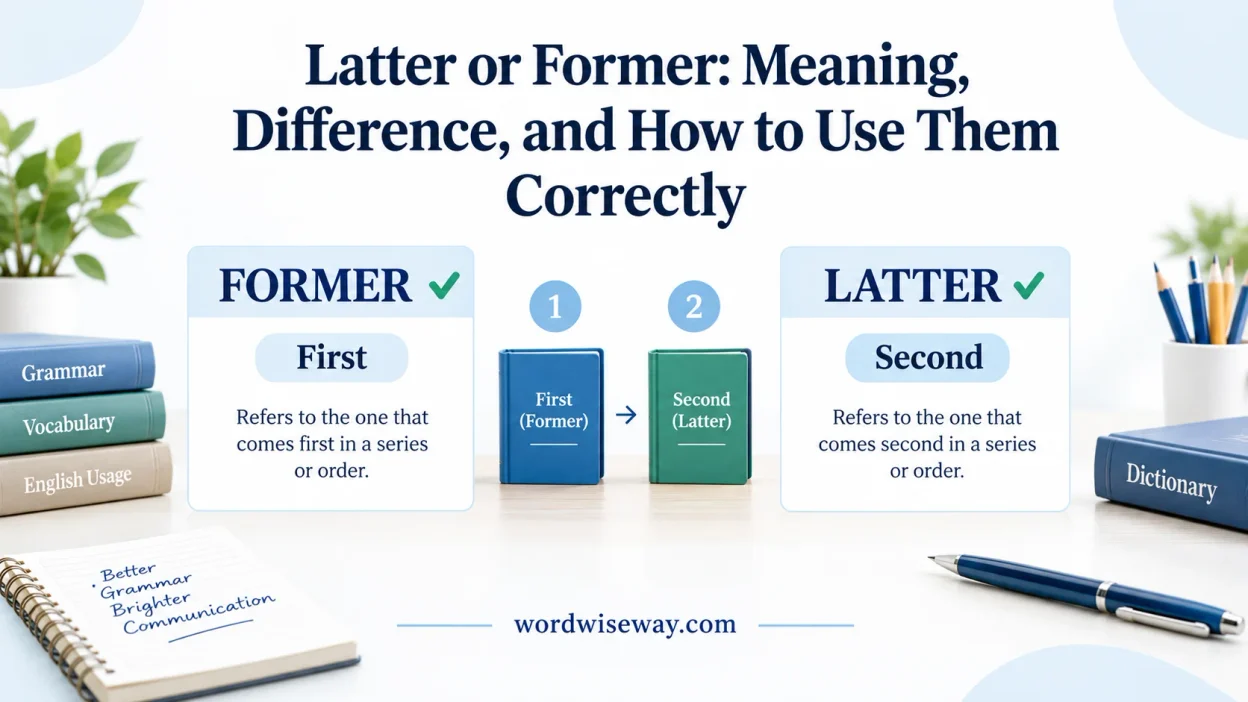
Former refers to the first of two people, things, choices, or ideas mentioned.
Latter refers to the second of two people, things, choices, or ideas mentioned.
Consider this example:
“The company offers remote work and flexible hours. The former benefits employees who live far away, while the latter helps workers manage changing schedules.”
Here, former refers to remote work because it appears first. Latter refers to flexible hours because it appears second.
| Word | Refers to | Easy way to remember |
| Former | The first of two | First |
| Latter | The second of two | Last of the two |
| Later | A subsequent time | Time |
There is one important wrinkle: former can also mean “previous” or “once held.” For instance, “former manager” means someone who used to be a manager.
What Does “Former” Mean?
Former has two major meanings, and context tells you which one applies.
First, it can identify the first of two things mentioned. Second, it can describe something that belonged to an earlier period.
When you see former in a comparison involving two items, look backward through the sentence. The first item is the former.
Former Refers to the First of Two Things
Suppose someone says:
“Between fiction and nonfiction, I prefer the former.”
The two choices are fiction and nonfiction. Fiction comes first, so former refers to fiction.
The word doesn’t mean “better,” “older,” or “more important.” It only identifies position in the sequence.
That distinction matters. A reader shouldn’t interpret former as a judgment about the two choices.
For example:
“The restaurant serves pasta and rice, but I usually order the former.”
The former is pasta, simply because pasta appeared first.
Examples of “Former”
You can use former with people, objects, ideas, choices, and other clearly defined pairs.
- “James and Daniel applied for the position. The former had more experience.”
- “The study compares traditional and digital learning. The former relies heavily on physical materials.”
- “We discussed buying a laptop or tablet. She preferred the former.”
- “The article examines speed and accuracy. The former matters most during the initial stage.”
- “The two plans offer different benefits. The former costs less.”
In each example, the word points to the first-mentioned item.
“Former” as an Adjective
The second meaning of former has nothing to do with two-item comparisons.
When former means previous, earlier, or once held, it describes something that existed in the past.
Examples include:
- former employee
- former president
- former owner
- former student
- former home
- former colleague
- former champion
Consider the sentence:
“She met her former teacher at the library.”
Here, former teacher doesn’t mean “the first of two teachers.” It means the person used to be her teacher.
Likewise:
“The building was a former factory.”
This means the building used to function as a factory.
Context makes the intended meaning clear.
What Does “Latter” Mean?
Latter refers to the second of two people, things, ideas, or choices mentioned.
It usually works as a reference word. Instead of repeating the second noun, you can use latter.
For example:
“The course covers grammar and vocabulary. The latter receives more attention.”
Vocabulary appears second, so latter refers to vocabulary.
The word doesn’t mean “recent,” “future,” or “later in time.” That’s where confusion with later often begins.
Latter Refers to the Second of Two Things
Imagine that two options appear in a sentence:
“You can submit the assignment online or in person.”
If the next sentence says:
“The latter option requires a physical copy.”
Latter means in person because that option appeared second.
The trick is simple: find the pair, then identify the second member.
Examples of “Latter”
Here are several examples across different contexts:
- “The company sells laptops and monitors. The latter are popular with designers.”
- “We considered driving and taking the train. The latter seemed more convenient.”
- “The two chapters discuss grammar and pronunciation. The latter includes several practical exercises.”
- “Sarah and Emma joined the project. The latter handled the research.”
- “The proposal focuses on cost and efficiency. The latter became the main concern.”
In every case, latter points to the second item.
The Main Difference
The central difference is about position.
Think of two stepping stones placed in a row. The first stone represents former. The second represents latter.
| Feature | Former | Latter |
| Basic reference | First of two | Second of two |
| Position | Earlier in the pair | Later in the pair |
| Main comparison use | Identifies the first item | Identifies the second item |
| Can describe the past? | Yes | No |
| Example | “Tea and coffee; the former” | “Tea and coffee; the latter” |
Consider this complete example:
“The museum displays paintings and sculptures. The former occupy the main gallery, while the latter fill the smaller rooms.”
Former = paintings.
Latter = sculptures.
Nothing else determines the answer. The order does.
Examples in Sentences
The fastest way to master these words is to see them operating in different situations.
Examples With People
When two people appear in a sentence, either word can identify one of them.
“David and Marcus attended the meeting. The former presented the report.”
David appeared first, so former refers to David.
Now reverse the reference:
“David and Marcus attended the meeting. The latter presented the report.”
Marcus appeared second, so latter refers to Marcus.
The names haven’t changed. Only the reference word has changed.
Examples With Things
These words also work naturally with physical objects.
“The store sells notebooks and planners. The former are cheaper.”
Former means notebooks.
“The store sells notebooks and planners. The latter are more popular.”
Latter means planners.
Examples With Choices
This is one of the most useful applications in everyday writing.
“You can pay by card or cash. The former is faster.”
Here, former means card.
“You can pay by card or cash. The latter is preferred by some customers.”
Here, latter means cash.
These constructions can make formal writing more concise because they prevent unnecessary repetition.
Examples With Ideas
You can also use the terms when comparing abstract concepts.
“Good writing requires clarity and precision. The former makes ideas accessible, while the latter makes them exact.”
Clarity comes first, so it is the former. Precision comes second, so it is the latter.
This use appears frequently in academic and professional writing.
How to Remember Latter and Former
A simple memory trick can turn this pair from a grammar nuisance into an automatic reflex.
The “First vs. Second” Memory Trick
Associate former with first.
Both words begin with a similar f sound:
Former → First
Then remember that latter refers to the second item.
A useful mental sequence is:
First = former → Second = latter
Don’t treat this as a definition of the words in every context. It’s simply a memory aid for their two-item comparison use.
A Simple Sentence Test
Whenever you encounter former or latter, use this three-step check:
- Find the two items being discussed.
- Identify which item appears first.
- Match former with the first and latter with the second.
For example:
“The writer compared print books and e-books before choosing the latter.”
The pair is print books and e-books.
Print books come first.
E-books come second.
Therefore, latter = e-books.
This method works even when the sentence becomes complicated.
Common Mistakes
Although the rule is simple, several mistakes appear repeatedly in everyday and formal writing.
Using “Latter” for More Than Two Items
Traditionally, latter refers to the second of two items.
For example:
“The course covers reading, writing, speaking, and listening. The latter is the most challenging.”
This sentence creates a problem. What exactly does latter identify? The reader may interpret it as the final item, but the traditional two-item distinction doesn’t support that use.
For three or more items, direct wording is usually clearer:
“The course covers reading, writing, speaking, and listening. Listening is the most challenging.”
You can also use explicit sequence words such as first, second, third, and fourth.
Confusing “Latter” With “Later”
This mistake often comes from their similar spelling.
Latter identifies the second of two things.
Later relates to time.
Compare these sentences:
“Between the two options, I chose the latter.”
Here, latter identifies the second option.
“I finished the assignment later.”
Here, later means at a subsequent time.
A quick comparison makes the distinction clearer:
| Word | Meaning | Example |
| Latter | Second of two | “I prefer the latter.” |
| Later | At a subsequent time | “I’ll finish it later.” |
Assuming “Former” Always Means “Past”
This mistake happens because former commonly describes previous roles or situations.
However, former can also mean first of two.
Compare:
“She chose tea over coffee and selected the former.”
Here, former = tea.
Now consider:
“She spoke with her former teacher.”
Here, former = previous, meaning the person used to be her teacher.
The surrounding sentence determines the meaning.
Using Former and Latter Without Clear Antecedents
These words depend heavily on context.
Consider:
“The company discussed two proposals. The latter was rejected.”
This works because the reader knows there are two proposals.
Now imagine:
“It was rejected because the latter was expensive.”
What does latter refer to? If the previous sentence contains several possible nouns, the reference can become muddy.
Clarity comes first. If readers have to reconstruct the sentence like a detective assembling scattered clues, repeating the noun may be better.
Using Them When Repeating the Noun Would Be Clearer
Former and latter can reduce repetition, but that doesn’t mean you should use them whenever possible.
Compare:
“The first proposal focuses on cost, while the second focuses on speed. The latter requires more staff.”
This is clear.
However:
“The committee reviewed the budget, timeline, staffing plan, and safety proposal before discussing the latter.”
The reader may not know which item “latter” refers to because four possibilities exist.
In such cases, simply name the subject:
“The committee reviewed the budget, timeline, staffing plan, and safety proposal before discussing the safety proposal.”
The repetition is worth it because the meaning stays unmistakable.
Latter and Former in Formal Writing
Former and latter often appear in academic, business, legal, and analytical writing because they provide a compact way to refer to two previously mentioned subjects.
For example:
“The study compares individual learning with collaborative learning. The latter approach emphasizes interaction between students.”
This construction avoids repeating “collaborative learning” immediately.
However, formal writing doesn’t automatically become better when it uses more formal vocabulary. These words work best when the relationship between the two nouns is obvious.
A useful rule is:
Use former and latter when they improve precision, not simply when they make a sentence sound formal.
That distinction matters because overly frequent use can make prose feel stiff.
For longer passages, repeating a noun can sometimes improve readability. Readers shouldn’t have to look backward several lines to determine what a reference word means.
Can You Use Former and Latter for More Than Two Things?
Generally, you should reserve former and latter for situations involving two clearly identified items.
Suppose a sentence mentions:
- apples
- oranges
- bananas
Calling bananas the “latter” may seem intuitive because bananas appear last. However, the traditional distinction between former and latter concerns two items, not an arbitrary list.
Instead, write:
“Of the three fruits, bananas were the most popular.”
Or use explicit sequence language:
“The first option is apples, the second is oranges, and the third is bannanas.”
This approach eliminates ambiguity.
Why the Two-Item Rule Matters
The words work because they create a binary relationship:
First item → former
Second item → latter
Once you introduce a third or fourth item, that neat relationship disappears.
Clear writing shouldn’t make readers calculate what a reference means.
Former vs. Latter vs. Later
These three words deserve special attention because they look and sound similar while serving different purposes.
| Word | Meaning | Example |
| Former | First of two, or previous | “I chose the former.” |
| Latter | Second of two | “I chose the latter.” |
| Later | At a subsequent time | “I chose it later.” |
Here’s another useful set of examples:
“The store offered tea and coffee. I chose the former.”
Former = tea.
“The store offered tea and coffee. I chose the latter.”
Latter = coffee.
“I didn’t choose anything until later.”
Later = a point in time after the earlier moment.
The spelling may tempt you to connect latter and later, but their meanings follow different paths.
Which One Should You Use?
Choosing between them takes only a few seconds.
Ask yourself what you want to identify.
- If you mean the first of two, use former.
- If you mean the second of two, use latter.
- If you mean something that happened at a subsequent time, use later.
- If you mean something that existed or was true in the past, former may describe it.
For example:
“The article compares traditional education and online education. The former uses more physical classroom interaction, while the latter relies more heavily on digital communication.”
Traditional education appears first, so it is the former.
Online education appears second, so it is the latter.
The rule remains stable even when the subject becomes more sophisticated.
A Practical Case Study: Choosing Between Two Plans
Imagine a company is considering two plans.
Plan A reduces operating costs.
Plan B increases production capacity.
A report states:
“The company considered reducing costs and increasing production. The former would improve short-term efficiency, while the latter could support future expansion.”
The meaning is clear because the two options appear in a fixed order.
- Former → reducing costs
- Latter → increasing production
Now imagine the report discusses five strategies before saying “the latter.” The reference becomes harder to follow.
The lesson is simple: former and latter work best when the reader can instantly identify the two-item pair.
Read More: Wonder or Wander: Meaning, Difference, and Correct Usage
FAQs
What does “former” mean?
Former refers to the first of two people, things, choices, or ideas mentioned in a sentence. If you mention tea and coffee, tea is the former.
What does “latter” mean?
Latter refers to the second of two things previously mentioned. If a sentence mentions tea and coffee, coffee is the latter.
Is “latter or former” the same in American and British English?
Yes. Latter and former have essentially the same meaning and grammatical usage in both American English and British English.
How can I remember the difference between former and latter?
Think of former as the first choice and latter as the last or second choice. This simple association can make the distinction easier to remember.
Can I use former and latter for more than two things?
Traditionally, former and latter refer to two things. When discussing three or more items, it’s usually clearer to name the specific item instead.
Can former and latter refer to people?
Yes. They can refer to two people when the context clearly identifies them. For example, if you mention two professionals, former identifies the first person and latter identifies the second.
Are former and latter suitable for formal writing?
Yes. These words are common in formal writing, academic work, professional communication, and other contexts where concise references improve sentence clarity.
What is a common mistake with former and latter?
A common mistake is reversing their meanings. Some writers remember that both indicate position but forget that former points to the first item and latter points to the second.
Should I use former and latter in everyday writing?
You can, but clarity should come first. In casual writing, repeating the noun may sound more natural, especially when using former or latter could make the reader stop and think.
When should I avoid using former and latter?
Avoid them when you mention several items, when the referenced choices are far apart in the text, or when the reader could easily lose track of which item is former or latter.
Conclusion
Understanding latter or former becomes much easier once you remember their basic order. Former points to the first of two things, while latter points to the second. Although these words can seem confusing at first, their meanings stay consistent across different types of English writing.
The key is to pay attention to context and the order in which the two things appear. Whether you’re reading an article, writing an email, answering an exam question, or preparing formal content, identifying the first and second choices will help you use these terms correctly.
With regular practice, you won’t need to pause every time you encounter former or latter. Keep the simple rule in mind, use clear sentence structure, and choose these words when they genuinely make your writing more concise and precise. Over time, this small distinction becomes an effortless part of your English vocabulary.

Emma Smith has dedicated 14 years to Princeton University’s English Department, mentoring students in textual interpretation, literary movements, and critical frameworks. Her research explores Shakespearean drama, Victorian serial fiction, postcolonial narrative theory, and manuscript studies and probing how literary forms evolve across cultures and centuries. Emma has delivered lectures at international humanities congresses and published findings in distinguished academic journals, underscoring her commitment to scholarly depth and vibrant teaching.