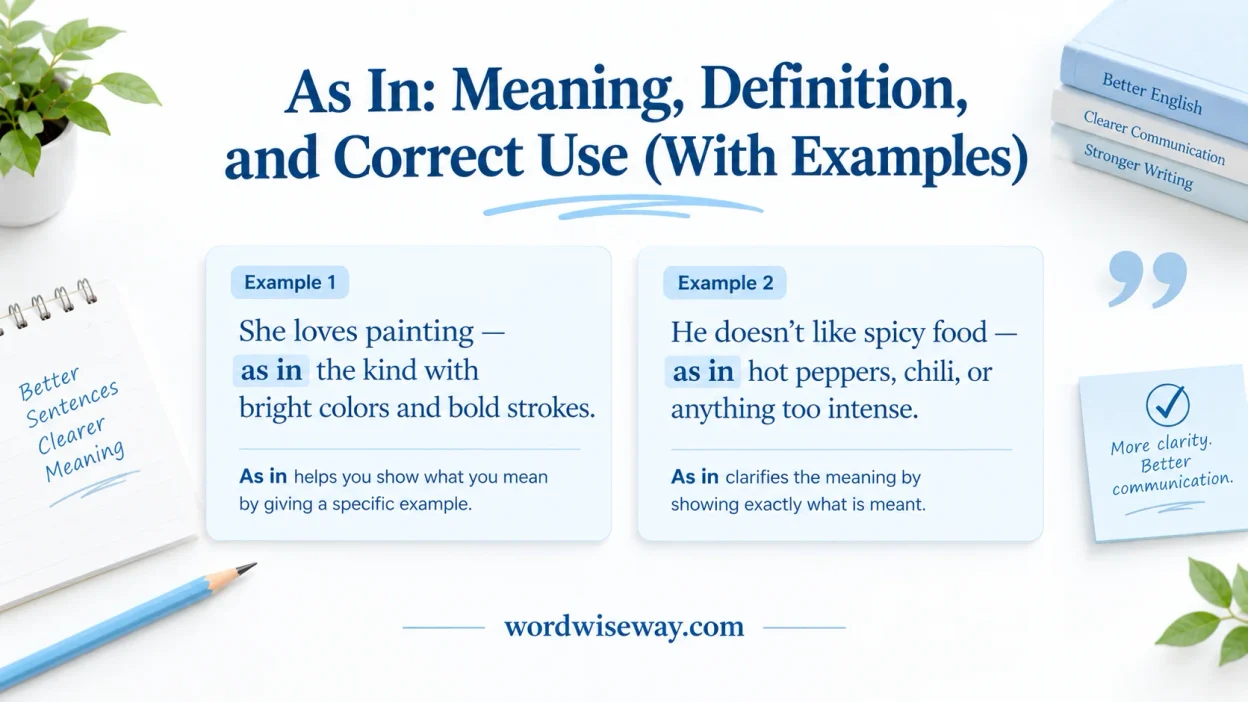
The phrase as in helps clarify meaning, specify ideas, and introduce examples. Understanding As In: Meaning, Definition, and Correct Use With Examples improves your English usage and communication skills.
In everyday conversations, professional emails, and academic writing, this small expression makes explanations clearer. For example, “I enjoy creative work, as in designing websites” gives readers a specific example. Both English learners and native speakers can use this phrase to improve grammar and express ideas naturally.
In professional settings, business communication, meetings, and project management, as in helps maintain accuracy and consistency. You can also use it in scheduling, time management, online booking, broadcasting, and workplace communication. Learn its meaning, usage rules, practical examples, and common mistakes to write confidently and communicate clearly.
Quick Answer:
“As in” is an English expression used to clarify, specify, or explain the intended meaning of something. It often introduces a particular example, identifies a specific reference, or distinguishes between two possible interpretations.
For example:
- “I study Java, as in the programming language, not coffee.”
- “Her name is Sara, as in Sara with one R.”
- “I enjoy outdoor activities, as in hiking and camping.”
In each sentence, “as in” helps the reader or listener understand exactly what the speaker means.
The expression consists of two separate words, as and in. You generally write them together as a phrase without a hyphen. Its meaning depends on the surrounding sentence and the relationship between the information before and after it.
What Does “As In” Mean?
The phrase “as in” introduces information that explains, narrows, or identifies something mentioned earlier. It helps you move from a broad statement to a more specific meaning without rewriting the entire sentence.
For instance, consider this sentence:
“I like Python, as in the programming language.”
The word Python could refer to a programming language or a type of snake. The phrase “as in the programming language” removes that uncertainty and identifies the intended subject.
Depending on the situation, “as in” can serve several related purposes.
- Clarification: Explaining what a particular word or statement means.
- Specification: Identifying a particular type, version, or interpretation.
- Illustration: Introducing an example that makes a broader idea easier to understand.
- Identification: Helping someone recognize a name, spelling, reference, or subject.
- Distinction: Separating one meaning from another possible meaning.
These functions often overlap. A single sentence can clarify a word while identifying the exact thing the speaker has in mind.
How “As In” Works in a Sentence
The expression usually connects an initial statement with an explanation or example.
A common structure is:
General statement + as in + clarification or example
For example:
- “I need a charger, as in a USB-C charger.”
- “We discussed Mercury, as in the planet.”
- “She works in development, as in software development.”
The first part introduces a subject. The second part narrows its meaning.
However, this structure isn’t a strict grammatical formula. You can also use “as in” in questions, short conversational replies, and other constructions when the context makes the intended meaning clear.
Does “As In” Have One Fixed Meaning?
Not exactly. The phrase has a consistent general purpose, but its precise function depends on context.
Consider these examples:
| Sentence | Function of “as in” |
| “I mean a bat, as in the animal.” | Clarifies the intended meaning |
| “I enjoy winter sports, as in skiing and skating.” | Introduces examples |
| “Her name is Ann, as in A-N-N.” | Identifies the spelling |
| “You mean next Friday, as in October 16?” | Confirms a specific reference |
The common thread is precision. In each example, “as in” helps the other person understand the intended meaning more accurately.
Is “As In” Correct English?
Yes. “As in” is a standard English expression when you use it to clarify meaning, identify a reference, or introduce an appropriate example.
You can use it in everyday conversations, explanatory writing, workplace discussions, and technical communication. The main consideration isn’t whether the expression is correct. It’s whether it fits the sentence and communicates the intended relationship clearly.
For example, this sentence works naturally:
“Please select a secure password, as in one that’s difficult to guess.”
The phrase introduces an explanation of what the speaker means by secure.
However, the following sentence is less effective:
“I like fruit, as in fruit.”
The second occurrence doesn’t clarify anything. It merely repeats the original idea.
A clearer version would be:
“I like fruit, as in apples, oranges, and pears.”
Now the phrase introduces specific examples that help the reader understand the broader category.
When Is “As In” Appropriate?
Use the expression when your audience might misunderstand a word, need a specific example, or benefit from a more precise explanation.
It works particularly well when:
- A word has multiple meanings.
- You need to distinguish between similar names or terms.
- You want to identify a specific type of something.
- You’re explaining an unfamiliar subject in a conversation.
- A short clarification makes your sentence easier to follow.
For example, a software developer might say, “I’m learning Rust, as in the programming language.” The additional words prevent confusion with the ordinary English word rust.
When Should You Choose Another Expression?
Sometimes a different phrase communicates your meaning more directly.
Compare these sentences:
- “I enjoy several sports, as in tennis and basketball.”
- “I enjoy several sports, such as tennis and basketball.”
Both are understandable. However, such as is often the more natural choice when you simply want to list examples from a category.
Similarly, “The meeting starts at noon, meaning 12 p.m.” may sound more direct than “The meeting starts at noon, as in 12 p.m.”
The best choice depends on your sentence, audience, and intended meaning. Good writing isn’t about avoiding common expressions. It’s about choosing the clearest one.
How to Use “As In” Correctly
Choosing the right context makes this expression more effective. These practical rules will help you use it naturally.
Use “As In” to Clarify an Ambiguous Word
When a word has several meanings, follow it with the intended interpretation.
Examples:
- “I mean the seal, as in the marine animal.”
- “We’re discussing the mouse, as in the computer accessory.”
- “She wants a light bag, as in one that weighs very little.”
Each clarification removes a possible misunderstanding.
Use “As In” to Explain a Specific Reference
Sometimes you need to identify a particular person, place, spelling, or subject.
Examples:
- “My name is Anne, as in Anne with an E.”
- “I’m talking about Jordan, as in the country in the Middle East.”
- “The letter is P, as in Peter.”
This use is especially helpful during phone calls, interviews, and conversations where people can’t see what you’re referring to.
Use “As In” to Explain What You Mean by a Description
You can also use the phrase to make a description more concrete.
Examples:
- “We need a flexible schedule, as in one that allows remote work.”
- “The assignment is challenging, as in it requires independent research.”
- “She wants a quiet vacation, as in somewhere without crowds.”
The explanation after “as in” shows how the speaker understands the preceding description.
Similar Expressions
Several English expressions can clarify meaning or introduce examples. However, their grammatical roles and natural uses differ.
| Expression | Primary purpose | Example |
| As in | Clarifies a particular meaning or interpretation | “I mean light, as in not heavy.” |
| For example | Introduces an example | “Try a hobby. For example, painting is inexpensive.” |
| Such as | Introduces examples within a category | “I enjoy hobbies such as painting and gardening.” |
| Meaning | Explains or restates an idea | “The road is closed, meaning you can’t drive through.” |
| Specifically | Narrows the focus | “I’m interested specifically in web development.” |
| In other words | Restates an idea more clearly | “The offer expires today. In other words, you must act now.” |
“As In” vs. “For Example”
Use “as in” when you want to clarify the intended meaning of a word or statement. Use “for example” when you want to illustrate a general point.
As in: “I mean spring, as in the season.”
For example: “I enjoy the changing seasons. For example, spring brings warmer weather.”
The first sentence identifies the intended meaning of spring. The second gives an example supporting a broader statement.
“As In” vs. “Such As”
“Such as” generally introduces examples belonging to a larger category. “As in” often connects an expression to its intended interpretation.
Compare:
- “I enjoy fruits such as apples, pears, and peaches.”
- “I mean the color orange, as in the shade rather than the fruit.”
The first sentence lists members of a category. The second distinguishes between two meanings of a word.
“As In” vs. “Meaning”
Both expressions can clarify an idea, but they don’t always fit the same sentence.
As in: “I want a light meal, as in something easy to digest.”
Meaning: “I want a light meal, meaning something small and easy to digest.”
The two sentences communicate similar ideas. However, “meaning” directly introduces an explanation, while “as in” often sounds more conversational.
“As In” vs. “Specifically”
“Specifically” narrows a statement or identifies a precise detail. “As in” often introduces the detail that explains an earlier expression.
For example:
- “I want to learn programming, specifically Python.”
- “I mean Python, as in the programming language.”
The first sentence identifies a particular interest. The second clarifies which meaning of Python the speaker intends.
Punctuation Rules
Punctuation depends on the sentence structure, not simply on the presence of the phrase.
Should You Put a Comma Before “As In”?
A comma often helps separate a clarification from the main statement, especially when the explanation functions as an aside. However, the comma isn’t mandatory in every construction.
Compare these examples:
- “I mean light, as in not heavy.”
- “Choose a material such as cotton or wool.”
The first sentence uses a comma to introduce a clarification. The second uses such as to introduce examples without needing a comma.
When you use “as in,” consider whether the pause improves readability. Don’t add punctuation automatically.
Should It Be Capitalized?
In ordinary sentences, capitalize as only when it begins the sentence.
- “I mean spring, as in the season.”
- “As in the season, not the metal coil.”
The second example is a conversational fragment. It can work as a response when the surrounding conversation supplies the missing context.
In titles, capitalization depends on the style you follow. For example, title case may capitalize both words in “As In: Meaning and Correct Use,” while sentence case generally capitalizes only the first word and proper nouns.
Can You Start a Sentence With “As In”?
Yes, in conversational contexts where the meaning is clear.
For example:
“She’s moving abroad.”
“As in, she’s leaving the country permanently?”
The second speaker uses the phrase to confirm the intended meaning. This construction is common in dialogue and informal writing.
However, a sentence that begins with “as in” may sound incomplete without context. In formal writing, consider providing a complete explanation instead.
Is “As In” One Word or Two?
“As in” is written as two separate words. You don’t normally hyphenate it or combine it into a single word.
Correct forms:
- as in
- “I mean the bank, as in the financial institution.”
- “B as in boy.”
Incorrect forms include asin and as-in when you intend the ordinary English expression.
The distinction is straightforward: as and in remain separate words even when they work together to convey a particular meaning.
Common Mistakes to Avoid When Using “As In”
The phrase is easy to learn, but a few common mistakes can make your writing awkward.
- Using it without clarification: The information following “as in” should explain something meaningful.
- Confusing it with “such as”: Both expressions can introduce examples, but they don’t always serve the same purpose.
- Adding unnecessary repetition: Avoid restating the same idea without providing new information.
- Overusing it in formal writing: Replace it with a more precise expression when that improves clarity.
- Using awkward sentence structures: If the sentence sounds unnatural, try rewriting it with meaning, specifically, or for example.
- Adding commas mechanically: Use punctuation that reflects the sentence’s structure and makes the meaning easier to follow.
Consider this example:
Weak: “I like animals, as in animals such as cats.”
Better: “I like animals such as cats and dogs.”
The revised sentence removes repetition and expresses the idea more directly.
Read More: 7 Words for Someone Who Uses Other People: With Meaning
FAQs
1. What does “as in” mean?
“As in” is a phrase used to clarify meaning or give a specific example. It helps readers or listeners understand exactly what you mean. For example, “I love desserts, as in cakes and cookies” gives examples of the desserts you enjoy.
2. When should you use “as in” in a sentence?
Use “as in” when you want to explain an idea more clearly or show what you mean. For example, “I prefer warm colors, as in red, orange, and yellow.” The phrase makes your meaning more specific.
3. Is “as in” grammatically correct?
Yes, “as in” is grammatically correct when you use it in the right context. It commonly introduces examples or clarifies a word or statement. Make sure the information following it connects naturally to the original idea.
4. What is an example of “as in” in everyday conversation?
You might say, “I enjoy outdoor activities, as in hiking and cycling.” Here, “as in” explains which activities you enjoy. People often use this phrase in casual conversations to avoid confusion.
5. Can you use “as in” in formal writing?
Yes, you can use “as in” in formal writing when it improves clarity. It can introduce examples in reports, explanations, and academic discussions. However, choose more precise wording when your sentence requires a highly formal tone.
6. What is the difference between “as in” and “such as”?
“As in” often clarifies what someone means, while “such as” directly introduces examples. For instance, “I enjoy team sports, such as soccer and basketball” lists examples. “I enjoy team sports, as in soccer rather than individual sports” clarifies the intended meaning.
7. Can “as in” appear in professional emails?
Yes, “as in” can make professional emails easier to understand when you need to clarify a detail. For example, “Please schedule the meeting for next Friday, as in October 23.” For important dates, stating the full date directly can prevent misunderstandings.
8. Should you put a comma before “as in”?
A comma often appears before “as in” when the phrase introduces an additional clarification or example. For instance, “I prefer simple designs, as in clean layouts with minimal decoration.” However, punctuation depends on the sentence structure and how the phrase connects to the surrounding words.
9. What common mistakes should you avoid when using “as in”?
Avoid using “as in” when the connection between your original statement and the explanation is unclear. Don’t add examples that fail to support your point, either. Instead, make sure the phrase introduces a relevant clarification that helps readers understand your intended meaning.
10. Can “as in” be used in spoken and written English?
Yes, “as in” works in both spoken and written English. You can use it during conversations, meetings, emails, and academic discussions. When used naturally, it helps you explain ideas, provide examples, and communicate your meaning with greater clarity.
Conclusion
Understanding “as in” can make your English clearer and more natural. This simple phrase helps you explain what you mean, add specific examples, and prevent confusion. Whether you’re chatting with friends, writing emails, or working on academic assignments, knowing its meaning and correct use helps you express your ideas more effectively.
The key is to use “as in” when you want to clarify a statement or show what a particular word or idea refers to. For example, saying “I enjoy creative hobbies, as in painting and drawing” gives your reader a clearer picture of your interests. Pay attention to the context, sentence structure, and punctuation to keep your writing easy to follow.
With regular practice, you’ll become more confident using “as in” in everyday conversations and professional writing. Try including it in your own sentences, and notice how other people use it to explain their ideas. Small improvements in English usage can make a meaningful difference in how clearly you communicate.

Amelia Sanders has spent 14 years in Harvard University’s English Department, helping students navigate literary analysis, interpretive theory, and narrative techniques. Her academic pursuits center on 18th-century British prose, romantic poetry, diasporic writing, and digital editing exploring how textual choices influence cultural perspectives. Amelia has spoken at major international meetings and contributed essays to respected academic volumes, demonstrating her dedication to thoughtful scholarship and effective teaching.