Brake vs Break: Difference, Meaning, and Usage Explained shows why these words create confusion in English.
Both words sound the same when spoken or read out loud, but they have different meanings. They are homophones, which means they are spelled differently but have different uses. Many learners, native speakers, and writers get them mixed up because their pronunciation is identical.
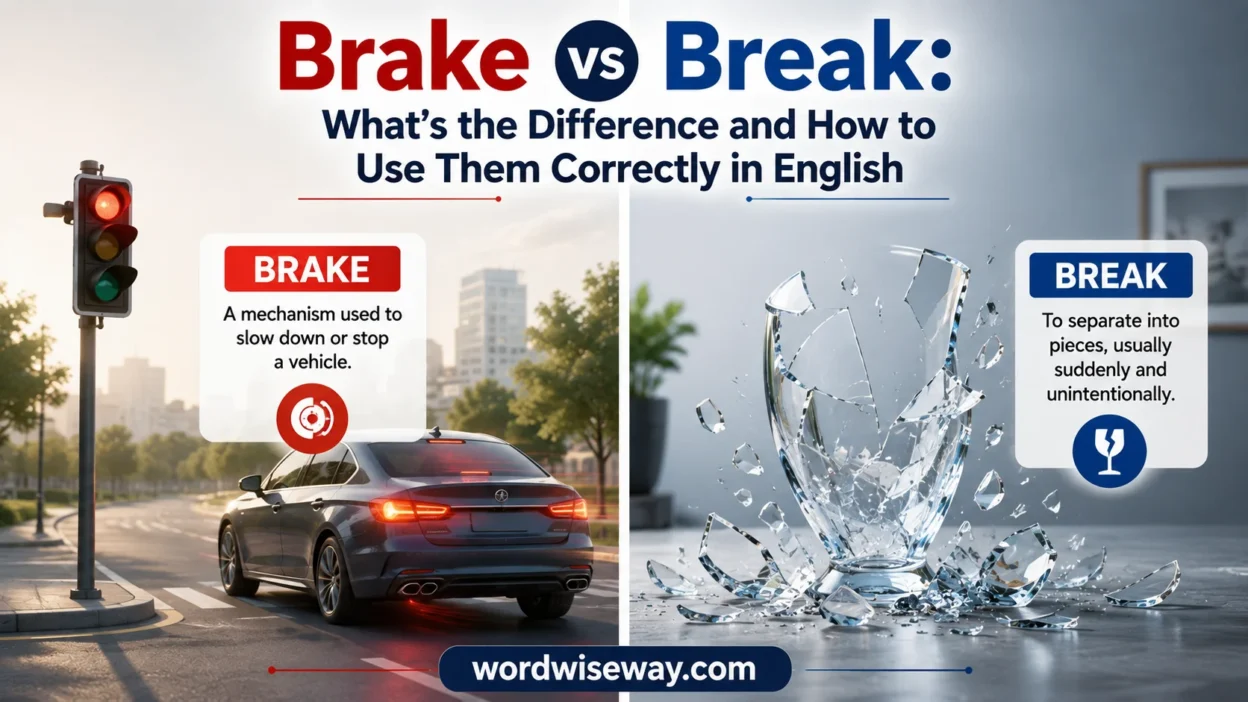
Understanding their grammar, grammar usage, and difference helps you use the correct word confidently.A Brake relates to slowing or stopping the movement of a vehicle, while Break means to damage, separate into parts or pieces, or take a pause.
Common mistakes like writing take a brake instead of take a break appear in everyday writing, emails, and documents. Learning this difference improves clear communication and helps you avoid confusing mistakes every time.
Quick Answer:
1.✅ Brake means to slow down or stop movement, especially in vehicles.
2. ❌ Break means to damage something, separate it into parts, or pause an activity.
✅ Use brake for stopping or controlling speed.
❌ Do not use break when talking about vehicle stopping.
✅ Example: “The driver pressed the brake to stop the car.”
✅ Example: “I took a break after finishing my work.”
Why “Brake vs Break” Confuses So Many People
The confusion starts with pronunciation. Both words sound like /breɪk/. Your brain hears one sound but has to choose between two spellings.
That’s where mistakes creep in.
People often:
- Write “break” when talking about driving
- Write “brake” when talking about pauses
- Mix them up in texting, emails, and exams
The issue isn’t intelligence. It’s pattern overload. English uses many homophones, and brake vs break is one of the most common traps.
Think of it like two doors that sound the same when knocked. Only one opens into the garage. The other opens into a room full of broken glass.
The Core Difference in One Line
Here’s the cleanest way to understand it:
- Brake = to slow down or stop movement
- Break = to damage, separate, or interrupt something
That’s it. Everything else builds from this.
A quick mental shortcut:
- Brake → vehicles and control
- Break → damage, pause, or interruption
Understanding “Brake” in Depth
The word brake stays tightly connected to motion control. It appears most often in transport, machinery, and safety contexts.
Brake as a Verb
When used as a verb, brake means to slow down or stop movement.
You apply it in situations involving speed, direction, or momentum.
Examples:
- You must brake before entering a sharp curve.
- The driver braked too late at the intersection.
- She braked suddenly when the child crossed the road.
Notice something important: braking is always intentional. It’s an action taken to control motion.
Brake as a Noun
As a noun, brake refers to the device that does the stopping.
You’ll find it in:
- Cars
- Motorcycles
- Bicycles
- Trains
- Industrial machines
Examples:
- The brake on his bicycle stopped working.
- Modern cars use advanced disc brakes for safety.
- He pressed the brake with full force.
Real-Life Contexts Where “Brake” Appears
Brake is not a general-purpose word. It shows up in structured environments:
- Driving and traffic rules
- Mechanical engineering
- Safety instructions
- Physics (motion and friction concepts)
Simple Insight
If something is moving and you want it to stop, you brake it.
If something is already still or needs to stop moving, you apply a brake.
Understanding “Break” in Depth
Now we step into the more chaotic twin: break. Unlike “brake,” this word spreads across many meanings and contexts.
It deals with damage, interruption, and separation.
Break as a Verb
The most common meaning of break is to damage or split something into pieces.
Examples:
- Be careful not to break the glass.
- He broke his phone by dropping it.
- The hammer broke the stone into fragments.
But break doesn’t stop at physical damage. It also includes non-physical interruption.
Examples of abstract use:
- She broke her silence after years.
- Don’t break the rules.
- He broke his habit of waking up late.
So break can be:
- Physical (breaking objects)
- Emotional (breaking hearts, breaking down)
- Structural (breaking systems or rules)
Break as a Noun
As a noun, break means a pause or interruption.
Examples:
- Let’s take a break.
- The class has a lunch break.
- We need a short break from work.
This is where confusion often spikes. People mix up:
- ❌ “take a brake”
- ✅ “take a break”
A brake stops a car. A break stops your schedule.
Common Contexts for “Break”
Break shows up everywhere:
- Work and study routines
- Emotional expressions
- Sports interruptions
- Social expressions (break the ice)
Comparison Table
Let’s simplify the difference visually:
| Word | Type | Core Meaning | Common Use Area | Example Sentence |
| Brake | Noun/Verb | Slow or stop movement | Vehicles, machines | Press the brake before the turn |
| Break | Verb/Noun | Damage or interrupt something | Daily life, emotions | Take a break after studying |
This table captures the entire conflict in one glance.
Common Mistakes People Make with Brake vs Break
Even fluent speakers slip up under pressure. Here are the most frequent errors:
1. Mistake in Driving Context
- ❌ I need to break at the signal
- ✅ I need to brake at the signal
2. Mistake in Rest Context
- ❌ Let’s take a brake
- ✅ Let’s take a break
3. Mistake in Emotional Context
- ❌ He had a brake down
- ✅ He had a breakdown (note: “breakdown” is one word)
Why These Mistakes Happen
Your brain relies on sound, not spelling. Since both words sound identical, context becomes the only guide. When context is unclear or rushed, errors happen.
Memory Tricks That Actually Work
Instead of memorizing rules, use mental hooks.
The Vehicle Trick
- Brake has “A” like automobile
- Think: A for stop, A for brake pedal
The Damage Trick
- Break = broken glass
- If it shatters, it breaks
The Action Trick
- Brake = control motion
- Break = destroy or interrupt motion
Visual Shortcut
- Brake → foot pressing pedal
- Break → glass hitting floor
These images stick better than grammar rules.
Real-Life Scenarios That Lock in Understanding
Let’s bring this into everyday situations.
Driving Scenario
You are approaching a red light.
- You brake gently to stop the car.
- If you don’t brake, you risk an accident.
Here, brake is about control and safety.
Study or Work Scenario
You’ve been working for hours.
- You take a break to rest your mind.
- That break helps you reset focus.
Here, break is about interruption of activity.
Accident Scenario
A phone slips from your hand.
- The screen breaks on impact.
- Now it’s damaged.
Here, break is physical destruction.
Mini Case Study: The Email Mistake That Went Viral
A well-known office example often shared in writing forums involves a manager sending a message:
“Please take a short brake before continuing work.”
Employees laughed because the message unintentionally sounded like everyone needed to “press a car pedal” during work.
The intended meaning was:
“Please take a short break before continuing work.”
One missing letter changed tone, meaning, and professionalism instantly.
Quick Practice Quiz:
Try filling in the blanks:
- Please ___ the glass carefully.
- Don’t forget to take a ___ during work.
- You should ___ before the sharp turn.
- He will ___ the silence first.
Answers:
- break
- break
- brake
- break
Advanced Usage of “Break”
Once you understand basics, break becomes even more flexible.
Idioms with Break
- Break the ice → start conversation in a social situation
- Break a habit → stop doing something repeated
- Break the news → share important information
Emotional and Psychological Use
- Break down → lose emotional control
- Break up → end a relationship
Break is powerful because it describes both physical and emotional disruption.
Technical and Mechanical Use of “Brake”
In engineering, brakes are critical safety systems.
Modern vehicles use:
- Disc brakes for heat resistance
- Drum brakes in older systems
- Electronic braking systems in advanced cars
The core idea stays simple:
A brake converts motion energy into stopping force.
Even in physics, the concept is consistent. It is all about reducing velocity.
Final Recap: Brake vs Break Made Simple
Let’s lock it in one last time:
- Brake = stop or slow movement (cars, machines)
- Break = damage, separate, or interrupt (objects, time, rules, emotions)
One letter changes everything.
Final Thought
English doesn’t always play fair, but it does stay logical once you see the patterns. When you write brake vs break, don’t rush. Pause for a second. Picture the situation. Ask yourself: am I stopping motion or interrupting something?
That small pause often saves you from a big mistake.
Read More: Persue or Pursue: Correct Spelling, Meaning, and Usage Explained
FAQs
What is the main difference between brake and break?
Brake refers to slowing or stopping movement, especially in vehicles, while break means to damage something, separate it into parts, or take a pause.
Are brake and break pronounced the same?
Yes, brake and break are homophones because they have the same pronunciation but different spellings and meanings.
When should I use the word brake?
Use brake when talking about stopping or reducing speed, such as applying a vehicle’s brake while driving.
When should I use the word break?
Use break when referring to damage, separation, interruption, or a short rest from an activity.
Why do people confuse brake and break?
People often confuse them because they sound identical when spoken, even though their meanings and spellings are different.
Is “take a brake” a correct phrase?
No, “take a brake” is usually incorrect when you mean a rest. The correct phrase is “take a break.”
Can brake be used outside vehicles?
Yes, brake can also refer to devices or actions that slow movement in machines or systems, not only vehicles.
What type of words are brake and break?
Brake and break are homophones because they sound the same but have different meanings and spellings.
How can I remember the difference between brake and break?
Remember that brake is connected with stopping, like a car brake, while break is connected with damage, separation, or a pause.
Why is learning brake and break important?
Knowing the difference helps improve writing accuracy, grammar usage, and clear communication in school, work, and everyday situations.
Conclusion
Understanding the difference between brake and break makes English writing clearer and more accurate. These two words may sound identical, but their meanings are completely different. A brake is connected with stopping or controlling movement, especially in vehicles, while break describes damage, separation, or taking a short pause. Since these words are common in everyday conversations, emails, assignments, and professional documents, using the correct spelling is important.
Many writers and learners make mistakes with these homophones because pronunciation can be misleading. By focusing on the meaning and context of the sentence, you can easily decide which word fits correctly. Remembering that a brake helps you stop and a break gives you rest or shows something is damaged will help you use both words confidently every time. Learning small differences like this improves grammar skills and builds stronger communication.

Evelyn Shaw has spent 14 years at Yale University’s English Department, leading students through close readings, genre studies, and interpretive methodologies. Her scholarly interests include Renaissance drama, gothic fiction, feminist literary criticism, and archival research and examining how texts generate meaning across historical periods. Evelyn has presented at major academic conferences and published essays in peer-reviewed journals, reflecting her passion for rigorous analysis and student-centered learning.