Knowing how to describe someone who uses others helps you recognize unhealthy relationships. 7 Words for Someone Who Uses Other People: With Meanings introduces useful terms for identifying harmful behavior. A person who repeatedly takes advantage of others may display selfishness, manipulation, and other negative traits.
Their actions might involve using others for personal gain, causing unfair treatment and emotional harm. In interpersonal relationships, notice whether people respect boundaries or offer help only when expecting something in return. These patterns can reveal important character traits and signs of exploitative behavior in human relationships.
The English language offers descriptive words and expressions for explaining such behavior. Learning their meanings and studying practical examples can expand your vocabulary. Choosing the best words for different situations helps you describe people who use others, recognize deliberate exploitation, and communicate clearly and accurately.
Quick Answer:
A user is someone who maintains a relationship primarily to gain personal benefits from another person. However, several other words describe more specific forms of this behavior.
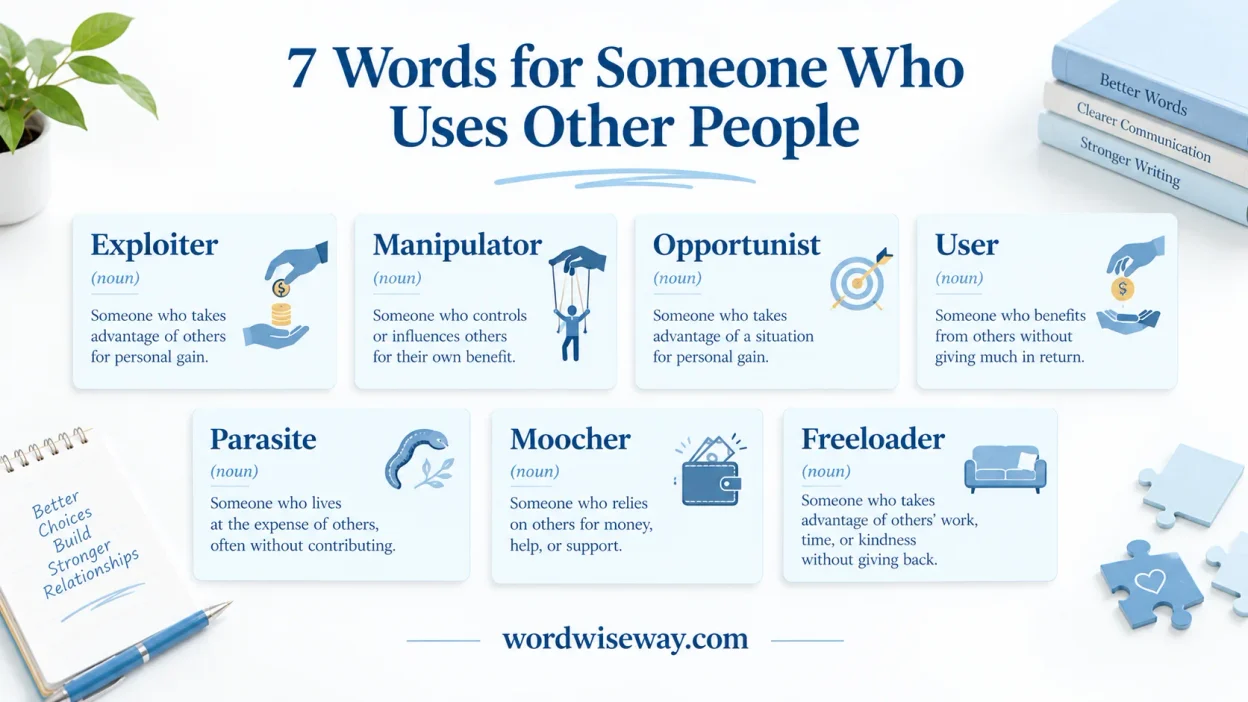
Here are seven words for someone who uses other people:
| Word | Meaning | When to Use It |
| Exploiter | Someone who takes unfair advantage of others | When a person benefits at someone else’s expense |
| Manipulator | Someone who influences others through deceptive or unfair tactics | When someone uses guilt, pressure, or deception |
| Opportunist | Someone who pursues personal gain whenever an opportunity arises | When someone takes advantage of situations or people |
| User | Someone who treats relationships mainly as a source of personal benefit | When someone values what others provide more than the relationship |
| Parasite | Someone who depends on others while contributing little in return | When dependence becomes persistently one-sided |
| Moocher | Someone who repeatedly seeks favors or benefits without fair reciprocation | When someone regularly expects others to provide things |
| Freeloader | Someone who receives benefits without making an expected contribution | When someone avoids paying or sharing responsibilities |
The best word depends on the behavior you’re describing. For example, a person who pressures friends into doing favors might be a manipulator, while someone who repeatedly expects others to pay their bills might be a freeloader.
7 Words for Someone Who Uses Other People
Each word highlights a different aspect of self-serving behavior. Understanding the distinctions helps you choose language that fits the situation without exaggerating what happened.
Exploiter
An exploiter is someone who takes unfair advantage of another person’s circumstances, resources, efforts, or vulnerability for personal benefit. The word often suggests an imbalance in which one person gains while another suffers a disadvantage.
Exploitation can happen in workplaces, friendships, business arrangements, and family relationships. For example, a manager might repeatedly demand unpaid work while taking credit for an employee’s contributions. Similarly, someone might take advantage of a friend’s financial generosity without making any effort to repay them.
The defining feature is unfair advantage. An exploiter doesn’t simply benefit from another person’s help. Instead, the person benefits in a way that takes advantage of the other individual’s position or goodwill.
Example sentences:
- The manager was an exploiter who took credit for his employees’ hard work.
- She realized that her friend was exploiting her generosity for personal gain.
- The company faced criticism for exploiting workers who had few alternatives.
When to use “exploiter”:
Use this word when someone benefits unfairly from another person’s labor, trust, vulnerability, or resources. It works especially well when the behavior involves a clear imbalance of power or an unfair arrangement.
Related word: Exploit is the verb, while exploitation is the noun describing the practice.
For example, “He exploited their trust” describes the action, while “His exploitation of their trust damaged the relationship” describes the practice.
Manipulator
A manipulator is someone who tries to influence another person’s decisions or behavior through deceptive, unfair, or controlling tactics. Rather than making a straightforward request, the person may rely on guilt, pressure, misleading information, or emotional leverage.
Manipulation can make people feel responsible for problems they didn’t create. Someone might repeatedly remind a friend of past favors to make refusal seem selfish. Another person might exaggerate a difficult situation to obtain money or attention.
However, not every attempt to persuade someone counts as manipulation. Honest persuasion allows people to understand the situation and make their own decisions. Manipulation becomes a concern when someone uses unfair tactics to influence those decisions.
Example sentences:
- He was a manipulator who used guilt to get his friends to do what he wanted.
- She recognized the manipulator’s pattern of making promises and shifting blame.
- The employee refused to let a manipulator pressure her into accepting extra responsibilities.
When to use “manipulator”:
Choose this word when someone uses emotional pressure, deception, or controlling behavior to get what they want. It focuses on how the person gains an advantage rather than simply what they receive.
Related terms: Emotional manipulator, controlling person, and deceiver can fit particular situations, although their meanings aren’t identical.
For instance, a deceiver relies on dishonesty, while a manipulator may use a mixture of truthful statements, misleading suggestions, and emotional pressure.
Opportunist
An opportunist is someone who takes advantage of available opportunities to advance personal interests. The word often describes a person who places personal benefit above loyalty, fairness, or the needs of others.
Consider a colleague who supports a coworker’s proposal when it looks likely to succeed, then claims the idea as their own after it becomes popular. The colleague recognizes an opportunity and uses it to gain professional credit.
Opportunism isn’t always harmful. An entrepreneur who notices an unmet need and creates a useful business is also taking advantage of an opportunity. The word becomes negative when the person pursues personal gain at another person’s expense or abandons important principles whenever a better offer appears.
Example sentences:
- The opportunist joined the project only after it attracted public attention.
- He acted like an opportunist by taking credit for another employee’s success.
- An opportunist may change positions whenever doing so offers a personal advantage.
When to use “opportunist”:
Use this term when someone takes advantage of favorable circumstances to benefit themselves, especially when their loyalty or principles seem to change with the situation.
Opportunist vs. exploiter: An opportunist looks for advantageous circumstances, while an exploiter takes unfair advantage of people or resources. One person can display both behaviors, but the words emphasize different aspects.
User
A user is someone who treats another person primarily as a means of obtaining personal benefits. In relationships, the word suggests that the person values what someone provides more than the relationship itself.
A user might contact a friend whenever they need transportation, homework assistance, money, or emotional support. Yet when the friend needs help, the user may become unavailable or suddenly lose interest in the conversation.
The important distinction is the repeated pattern of one-sided behavior. Asking for help doesn’t automatically make someone a user. Healthy relationships naturally involve periods when one person needs more support than the other.
The concern arises when someone consistently takes without showing reasonable consideration, appreciation, or willingness to reciprocate.
Example sentences:
- She realized he was a user who called only when he needed something.
- A genuine friend values your company, not just the favors you provide.
- He stopped lending money to a user who repeatedly ignored their repayment agreements.
When to use “user”:
This is one of the most direct, everyday words for someone who takes advantage of relationships. It works particularly well for friendships, dating relationships, family interactions, and professional connections.
Related expression: Using someone means benefiting from that person while disregarding their interests or treating their goodwill as a resource.
For example, “She felt he was using her for professional connections” suggests that he valued the opportunities she offered more than their relationship.
Parasite
A parasite is an organism that lives on or inside another organism and benefits at its host’s expense. In everyday language, people also use the word figuratively to describe someone who depends heavily on others while giving little or nothing in return.
Imagine a roommate who regularly eats everyone else’s food, refuses to share household expenses, and expects other people to handle every responsibility. If the pattern continues despite reasonable opportunities to contribute, someone might describe the roommate as a parasite.
The figurative meaning is strongly negative. It emphasizes dependence and the imbalance between what a person receives and what they contribute.
Nevertheless, dependence alone doesn’t make someone a parasite. People may need substantial assistance because of illness, disability, financial hardship, or other circumstances. The term usually implies a pattern of unfairly benefiting from others rather than simply needing support.
Example sentences:
- He called his roommate a parasite because she repeatedly took supplies without contributing.
- Their relationship became exhausting when one person expected constant support without showing consideration.
- The character in the novel behaved like a parasite by living off other people’s efforts.
When to use “parasite”:
Use this figurative term when you want to emphasize persistent dependence and a one-sided relationship. Because it can sound insulting or dehumanizing, more neutral wording may be appropriate in sensitive conversations.
Related word: Parasitic describes behavior or relationships characterized by one-sided benefit.
For example, “Their arrangement became parasitic” describes the relationship without directly labeling either person.
Moocher
A moocher is someone who repeatedly asks for or accepts money, food, favors, or other benefits without making a fair effort to give something back. The word is informal and often appears in casual conversations.
Unlike someone who occasionally needs help, a moocher may develop a habit of relying on other people’s generosity. They might always expect friends to buy meals, lend money, provide transportation, or cover shared expenses.
The defining feature is repeated taking without fair reciprocation. A moocher may not use elaborate manipulation or deliberately deceive anyone. They might simply become comfortable receiving benefits while allowing others to carry the burden.
Example sentences:
- He was tired of being the only person paying for lunch while his friend acted like a moocher.
- Everyone stopped lending money to the moocher who never repaid his debts.
- She didn’t want to be seen as a moocher, so she offered to help with the preparations.
When to use “moocher”:
Use this informal word when someone repeatedly expects favors or material benefits without reciprocating fairly. It works well in conversations about friends, roommates, acquaintances, and shared expenses.
Moocher vs. freeloader: A moocher often seeks favors or small benefits repeatedly, while a freeloader is more closely associated with receiving benefits without making an expected contribution. Their meanings overlap considerably.
Freeloader
A freeloader is someone who receives benefits from others without paying, contributing, or accepting a fair share of responsibility when a contribution is reasonably expected.
Freeloading often appears in situations involving shared expenses, accommodation, meals, transportation, or group activities. For example, one person might regularly join group dinners but never offer to pay their share. Another might live with roommates while refusing to contribute to agreed household costs despite having the means to do so.
The word emphasizes receiving something for free at other people’s expense. Unlike manipulator, it doesn’t necessarily suggest deception or emotional pressure.
Context matters, though. A person who receives help during a difficult period isn’t automatically a freeloader. Friends and family often support each other without expecting immediate repayment. The term generally fits better when someone repeatedly avoids a fair contribution despite a reasonable expectation to participate.
Example sentences:
- His roommates considered him a freeloader because he refused to pay his agreed share.
- She didn’t want to be a freeloader, so she offered to contribute to the groceries.
- The group grew frustrated with a freeloader who expected everyone else to cover the costs.
When to use “freeloader”:
Choose this word when someone regularly enjoys shared benefits while avoiding an expected contribution. It is particularly useful when the issue involves money, resources, or responsibilities.
Related expression: Freeloading describes the behavior itself.
For example, “Freeloading became a problem when one roommate stopped contributing to shared expenses” identifies the issue without making a permanent judgment about someone’s character.
Which Word Best Describes Someone Who Uses Others?
The seven words overlap, but their differences become clearer when you consider the behavior involved. The most accurate choice identifies the specific pattern rather than relying on the harshest available label.
| Word | Main Behavior | Typical Context | Tone |
| Exploiter | Takes unfair advantage | Work, business, relationships | Strongly negative |
| Manipulator | Uses unfair influence or deception | Personal and professional relationships | Strongly negative |
| Opportunist | Pursues personal gain through opportunities | Careers, social situations, business | Neutral or negative |
| User | Treats relationships as a source of benefits | Friendships, dating, family | Negative |
| Parasite | Depends on others while contributing little | Shared living, relationships | Harsh and insulting |
| Moocher | Repeatedly seeks favors without fair reciprocation | Friends, money, everyday favors | Informal and negative |
| Freeloader | Receives benefits without an expected contribution | Shared expenses, housing, group activities | Informal and negative |
Here are some common situations and the words that may fit them.
- Someone contacts you only when they need help: User
- Someone pressures you with guilt to get their way: Manipulator
- Someone takes credit for your work: Exploiter or opportunist, depending on the circumstances.
- Someone repeatedly asks you to pay for things: Moocher or freeloader
- Someone depends on your resources while unfairly taking advantage of your generosity: Parasite in a strongly negative, figurative sense.
- Someone changes their loyalty whenever personal benefits change: Opportunist
These descriptions aren’t rigid categories. One person may display several patterns, and a single incident rarely tells you everything about someone’s character.
Examples of Someone Who Uses Other People
Realistic examples make it easier to distinguish these words in everyday conversations. The situations below illustrate different behaviors without assuming that every person who asks for help has selfish intentions.
Example: A Friend Who Calls Only for Favors
Maya has a friend who regularly calls when she needs notes, transportation, or help with assignments. However, whenever Maya needs support, her friend rarely responds.
Maya begins to notice that their conversations revolve almost entirely around what her friend wants.
Best-fitting word: User.
The word fits because the friendship appears to serve one person’s interests disproportionately. However, Maya would need to consider the broader pattern before deciding that every request was selfish.
Example: A Coworker Who Takes Credit
Daniel spends several days preparing a presentation for a workplace project. During the meeting, his colleague presents Daniel’s ideas as their own and receives praise from the manager.
The colleague benefits from Daniel’s effort without giving him appropriate credit.
Best-fitting word: Exploiter.
The word emphasizes the unfair advantage the colleague gained from Daniel’s work. Opportunist might also fit if the colleague deliberately seized a favorable chance to advance professionally.
Example: A Person Who Uses Guilt
Sara’s friend frequently asks her to cancel her plans and provide assistance. When Sara declines, the friend reminds her of every favor they have exchanged and suggests that a real friend would always agree.
Sara begins to feel pressured to say yes, even when helping would create problems for her.
Best-fitting word: Manipulator.
The defining behavior is the use of guilt to influence Sara’s decisions. A direct request would allow Sara to decide freely without being made to feel responsible for the other person’s disappointment.
Example: A Roommate Who Avoids Shared Expenses
Three roommates agree to divide household expenses. One roommate repeatedly uses shared supplies and benefits from household services but refuses to pay their agreed share despite having the means to contribute.
The other roommates must cover the difference.
Best-fitting word: Freeloader.
The term highlights the roommate’s repeated failure to contribute to shared costs. Moocher could also fit if the roommate regularly asks others for smaller favors or material benefits.
Example: Someone Who Appears Only When Success Is Likely
A student ignores a classmate’s project until it begins receiving recognition. Once the project attracts attention, the student suddenly offers to help and later tries to associate themselves with its success.
Best-fitting word: Opportunist.
The student’s behavior suggests a willingness to pursue personal benefits when the circumstances become favorable. The label becomes more convincing if the student repeatedly follows this pattern rather than simply showing interest in a successful project.
What These Examples Teach Us
The same action can have different explanations depending on the circumstances. Someone who borrows money once may genuinely need help, while someone who repeatedly avoids repayment may be taking unfair advantage.
Before choosing a label, consider three questions:
- Is the behavior repeated? A consistent pattern offers more information than an isolated incident.
- Is the arrangement unfair? Look at whether one person receives benefits while another carries an unreasonable burden.
- How does the person respond to reasonable boundaries? Their response may help clarify whether they respect the relationship and the other person’s needs.
These questions help you describe behavior more accurately without jumping to conclusions about motives.
Read More: Can an Opinion Be Wrong or Right? Full Explanation
FAQs
1. What do you call someone who uses other people?
You can call someone who uses other people an exploiter, manipulator, or opportunist. The best word depends on whether they seek personal gain, control others, or take advantage of someone’s kindness.
2. What is another word for someone who takes advantage of others?
An exploiter is someone who benefits unfairly from other people. This person might take advantage of someone’s generosity, trust, skills, or resources without offering fair treatment in return.
3. What do you call a person who only contacts you when they need something?
You might describe this person as an opportunist. They often approach others when they need help, money, attention, or support but rarely show the same interest when others need them.
4. What is the difference between an exploiter and a manipulator?
An exploiter uses someone for personal benefit, while a manipulator influences another person’s decisions or feelings to achieve a goal. One person can display both behaviors, depending on the situation.
5. What is a polite word for someone who uses others?
Self-serving is a relatively neutral expression for someone who puts their own interests first. It describes behavior without automatically suggesting that the person deliberately deceives or harms others.
6. How can you describe someone who takes advantage of kindness?
You could call this person an exploiter or describe them as someone who takes people for granted. These expressions fit situations where someone repeatedly benefits from another person’s generosity without showing appreciation.
7. What do you call someone who pretends to care for personal gain?
A manipulator may pretend to care to gain someone’s trust or receive a personal benefit. However, it’s best to consider repeated actions and patterns rather than judge someone’s intentions from one incident.
8. What is a word for someone who uses friends for personal benefit?
An opportunist may use friendships to access favors, resources, or useful connections. You might also describe this person as selfish if they consistently expect support without giving anything in return.
9. How can you recognize someone who uses other people?
Look for repeated patterns, such as asking for favors without reciprocating, ignoring boundaries, or appearing only when they need something. One incident doesn’t necessarily define someone, but consistent behavior can reveal an unhealthy relationship.
10. How should you deal with someone who takes advantage of you?
Set clear boundaries, communicate your expectations, and avoid agreeing to requests that make you uncomfortable. Pay attention to how the person responds. Healthy relationships involve mutual respect, honesty, and consideration for both people’s needs.
Conclusion
Finding the right words for someone who uses other people helps you describe their behavior more clearly. Terms such as exploiter, manipulator, and opportunist each carry a different meaning. Choosing the right expression depends on the person’s actions, intentions, and treatment of others. Understanding these differences also strengthens your vocabulary and helps you communicate your thoughts more accurately.
Recognizing harmful patterns matters just as much as knowing the words. Someone who repeatedly takes advantage of kindness, ignores boundaries, or expects favors without giving anything back may create an unhealthy relationship. However, one mistake doesn’t always define a person’s character. Look at their behavior over time before deciding which description fits best.
Ultimately, language gives you a practical way to explain difficult social situations. Use these seven words thoughtfully when discussing people who exploit others, manipulate relationships, or put personal gain first. Most importantly, remember that you can treat others with kindness while maintaining healthy boundaries and expecting mutual respect.

Emma Smith has dedicated 14 years to Princeton University’s English Department, mentoring students in textual interpretation, literary movements, and critical frameworks. Her research explores Shakespearean drama, Victorian serial fiction, postcolonial narrative theory, and manuscript studies and probing how literary forms evolve across cultures and centuries. Emma has delivered lectures at international humanities congresses and published findings in distinguished academic journals, underscoring her commitment to scholarly depth and vibrant teaching.