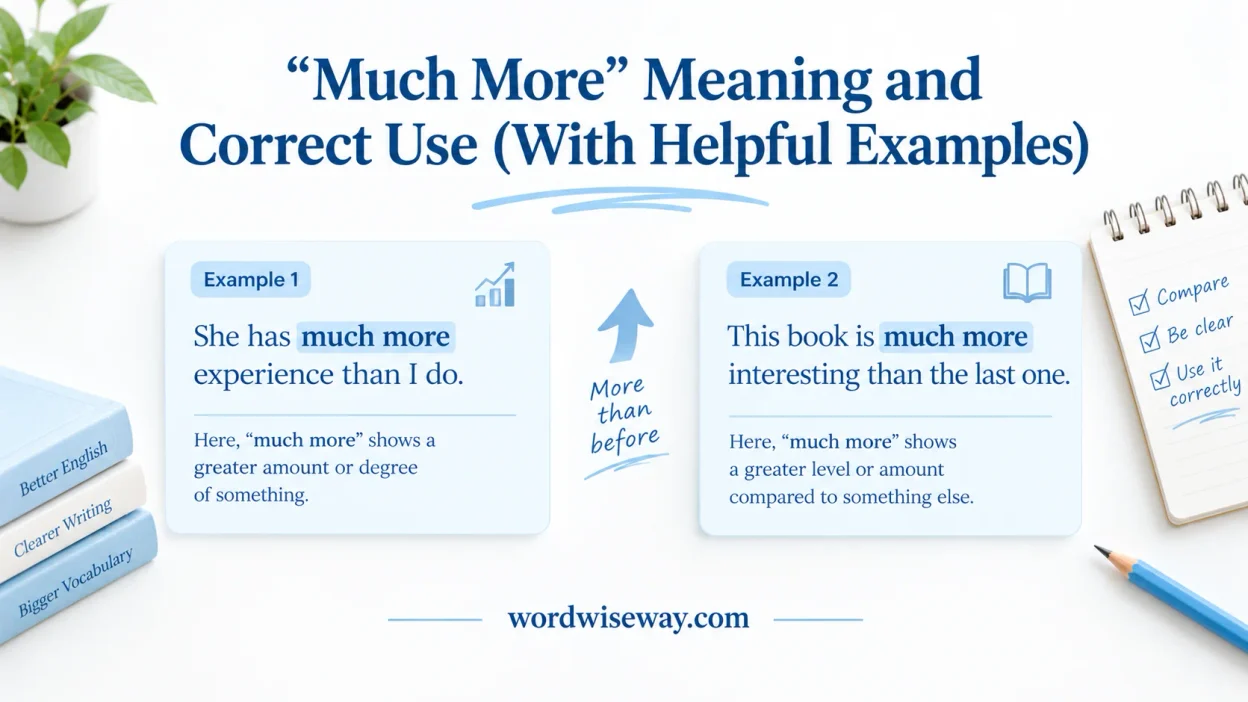
Much More Meaning and Correct Use With Helpful Examples explains how “much” and “more” work together in English. This useful phrase expresses a greater amount, quantity, or degree.
“Much more” adds emphasis when comparing things or describing an increased amount. For example, “I need much more time” expresses a need for additional time. Similarly, “This book is much more interesting” highlights a clear difference.
In English grammar, context determines correct usage. Learning helpful examples improves vocabulary, sentence structure, and communication. You can use “much more” naturally in everyday conversations and writing.
Quick Answer
“Much more” means a considerably greater amount or degree of something. Speakers use it to emphasize a difference between two quantities, qualities, actions, or situations.
Examples:
- Quantity: I need much more time to finish this project.
- Degree: This book is much more interesting than the previous one.
- Manner: She works much more carefully now.
- Comparison: The second option costs much more than the first.
- Additional information: There’s much more to this story than you realize.
Use much more with uncountable nouns, comparative adjectives, and comparative adverbs. When referring to additional countable items, use many more instead.
What Does “Much More” Mean?
The expression “much more” emphasizes an increase in quantity, degree, extent, or intensity. It tells readers that the difference matters or is relatively large in the given context.
Consider these two sentences:
- The new laptop is more expensive.
- The new laptop is much more expensive.
Both sentences compare the laptop’s price with another price. However, the second sentence places greater emphasis on the difference.
The expression doesn’t establish an exact numerical increase. A speaker might use it for a difference of a few dollars or several thousand dollars, depending on the situation. Context determines what counts as a substantial difference.
Simple Definition of “Much More”
In simple words, “much more” means a lot more or considerably more.
The word much strengthens more. Together, they emphasize that something exceeds a previous amount or level.
For example:
- We need much more water.
- This assignment requires much more effort.
- Her explanation was much more helpful.
- The train travels much more quickly than the bus.
In each sentence, “much more” emphasizes a greater quantity, degree, or manner. The exact meaning depends on the word or phrase that follows it.
Examples of “Much More” in Everyday English
You can use “much more” in many familiar situations.
| Example sentence | What it means |
| I need much more sleep. | I need considerably more sleep. |
| This jacket is much more expensive. | Its price is considerably higher. |
| The second lesson was much more useful. | The second lesson provided greater value. |
| He speaks much more confidently now. | His confidence when speaking has increased. |
| We have much more work to do. | A considerably larger amount of work remains. |
| The journey became much more difficult. | The journey became considerably harder. |
Notice how the expression adapts to different situations. It doesn’t always refer to physical quantities or money. It can also describe abstract qualities, personal progress, and changes in behavior.
Is “Much More” Grammatically Correct?
Yes. “Much more” is grammatically correct in standard English when you use it in an appropriate sentence structure.
The phrase combines two words with different functions. More expresses an increase or comparison, while much intensifies that comparison or emphasizes the additional quantity.
For example:
- Correct: This exercise is much more challenging.
- Correct: We need much more information.
- Correct: She completed the task much more efficiently.
- Incorrect: This exercise is much more easier.
The last example contains a common comparative error. Easier already expresses comparison, so adding more creates an unnecessary double comparative.
Instead, write “much easier” or “much more difficult,” depending on the intended meaning.
Remember that much more doesn’t work identically with every noun. For countable plural nouns, expressions such as many more books and many more questions are generally appropriate.
How to Use “Much More” Correctly
The easiest way to master “much more” is to understand what comes after it. The following patterns cover its most useful grammatical applications.
Much More + Uncountable Noun
Use “much more” before an uncountable noun when you want to emphasize a greater quantity.
Uncountable nouns refer to things that English speakers don’t normally count as separate units in the relevant meaning. Examples include water, money, time, information, patience, and equipment.
Common combinations include:
- Much more time
- Much more money
- Much more information
- Much more energy
- Much more patience
- Much more work
- Much more research
- Much more attention
Here are some examples in complete sentences:
- We need much more information before making a decision.
- Learning a new language requires much more patience than I expected.
- The garden needs much more water during hot weather.
- This project will take much more time than our original plan allowed.
- The company invested much more money in research this year.
The phrase works because each noun represents an amount rather than a straightforward count of individual objects.
However, some nouns can be countable or uncountable depending on their meaning. For instance, experience can refer to knowledge gained over time or to individual events.
Compare these examples:
- She has much more experience than I do.
- She has many more experiences to share.
The first sentence refers to accumulated knowledge or skill. The second refers to individual events or experiences that can be counted.
Much More + Adjective
Use “much more” before a comparative adjective to emphasize a greater degree of a quality.
A comparative adjective describes how one person, thing, or situation differs from another. Common examples include more useful, more comfortable, more important, and more expensive.
Examples:
- This chair is much more comfortable than the old one.
- Regular practice makes difficult tasks much more manageable.
- Her latest explanation is much more convincing.
- The new design looks much more attractive.
- Reliable information is much more valuable than a quick guess.
The structure follows this pattern:
Subject + verb + much more + comparative adjective
For example, “This route is much more convenient than the alternative.”
You can also use “much more” without explicitly stating the comparison when readers can understand it from context.
For example, after testing two designs, you might say, “The second design is much more practical.”
The listener already knows which design serves as the comparison.
Much More + Adverb
“Much more” can also modify a comparative adverb. This construction emphasizes how an action happens or how its manner has changed.
Comparative adverbs describe differences in the way actions occur. Examples include more carefully, more quickly, more efficiently, and more confidently.
Consider these sentences:
- She checks her work much more carefully now.
- The updated software processes information much more efficiently.
- He answered the questions much more confidently during the second interview.
- The delivery arrived much more quickly than expected.
- Students often understand difficult ideas much more easily after seeing an example.
In each sentence, “much more” strengthens the comparison expressed by the adverb.
Pay attention to the difference between adjectives and adverbs. An adjective describes a noun, while an adverb often describes a verb or action.
Compare:
- The explanation is much more clear.
- She explained the process much more clearly.
The second sentence uses an adverb because clearly describes how she explained the process. In many contexts, “much clearer” would sound more natural in the first sentence than “much more clear.”
Much More Than
The expression “much more than” emphasizes a substantial difference between two quantities, qualities, or ideas.
The word than introduces the comparison. It connects the thing being discussed with the alternative or reference point.
Examples:
- This project requires much more effort than we anticipated.
- The new phone costs much more than my previous one.
- She knows much more about astronomy than I do.
- The revised plan is much more practical than the original proposal.
- The course teaches much more than basic grammar.
The final example shows that “much more than” can introduce a broader idea rather than a simple quantity.
You can also use the expression to emphasize that something exceeds an initial expectation.
For example:
“Starting a business requires much more than a good idea.”
Here, the speaker means that a good idea alone isn’t sufficient. Other factors also matter.
Much More Without an Explicit Comparison
You don’t always need to state both sides of a comparison. Sometimes, the surrounding conversation already makes the reference point clear.
For example:
- This version costs much more.
- We need much more.
- The situation has become much more complicated.
- She understands the subject much more now.
These sentences can work when readers or listeners already know what you’re comparing.
Imagine comparing two laptops with a friend. After discussing their prices, you might say, “The first one costs much more.”
There’s no need to repeat the second laptop’s name if the comparison is obvious.
However, an unclear context can make a sentence confusing. If readers don’t know what “much more” refers to, include the missing information.
Much More at the End of a Sentence
The expression can appear near the end of a sentence when the remaining information is understood from context or when it forms part of a longer phrase.
For example:
- We expected the repair to cost more, but it ended up costing much more.
- The guide explains the basics and much more.
- She has learned much more since joining the program.
In “and much more,” the phrase often suggests that additional things, benefits, topics, or possibilities exist beyond those already mentioned.
For instance, a course description might say, “You’ll study grammar, vocabulary, pronunciation, and much more.”
This construction works as a concise summary, but it can be vague in detailed informational writing. When the extra items matter, naming them gives readers a clearer picture.
Also distinguish “much more” from “many more.” The first often refers to uncountable quantities or degrees. The second commonly refers to additional countable items.
Examples:
- The course offers much more information.
- The course includes many more practice questions.
“Much More” vs. “More”: What’s the Difference?
Although “more” and “much more” express an increase or comparison, they don’t place the same emphasis on that difference.
“More” expresses an increase, while “much more” emphasizes a greater difference. The word much adds strength to the comparison without changing its basic meaning.
| Expression | Example | Meaning |
| More | This book is more interesting. | The book has greater interest than the comparison suggests. |
| Much more | This book is much more interesting. | The difference in interest receives stronger emphasis. |
| More time | We need more time. | Additional time is necessary. |
| Much more time | We need much more time. | A considerably greater amount of additional time is necessary. |
Neither expression provides an exact measurement. The surrounding context determines how significant the difference actually is.
For example, “The new system is more efficient” states a comparison. Saying “The new system is much more efficient” emphasizes that the improvement feels substantial.
Use more when a neutral comparison is enough. Choose much more when you want readers to notice the difference.
“Much More” vs. “Much” vs. “Many More”
These three expressions look similar, but each serves a different purpose. Choosing the right one depends on whether you’re describing an amount, emphasizing an increase, or counting additional items.
Much More vs. Much
The word much usually describes an amount of something uncountable. The phrase much more emphasizes an increase in that amount or degree.
Compare these examples:
- Much: We don’t have much time.
- Much more: We need much more time.
- Much: There isn’t much information available.
- Much more: We need much more information before deciding.
The first sentence in each pair describes an amount. The second emphasizes that a greater amount is needed.
Much More vs. Many More
The difference between these expressions comes down to countability.
Use much more with uncountable nouns and many more with plural countable nouns.
| Much more | Many more |
| Much more information | Many more questions |
| Much more furniture | Many more chairs |
| Much more research | Many more studies |
| Much more traffic | Many more vehicles |
| Much more equipment | Many more machines |
| Much more advice | Many more suggestions |
Notice that information and advice are uncountable in standard English. You wouldn’t normally say “many informations” or “many advices.”
However, you can count individual pieces of information or specific suggestions.
For example:
- Correct: We need much more advice.
- Correct: We need many more suggestions.
- Incorrect: We need much more suggestions.
- Incorrect: We need many more advice.
The last two sentences use the wrong quantity expressions for their nouns.
Much More vs. A Lot More
Both expressions emphasize an increase, and they often communicate the same basic idea.
For example:
- We need much more time to complete the project.
- We need a lot more time to complete the project.
Both sentences suggest that the available time isn’t sufficient.
However, a lot more often sounds conversational, while much more works comfortably in everyday, academic, and professional contexts. Neither expression is automatically wrong or unsuitable for formal writing.
Choose the phrase that fits your tone and sentence.
Common Mistakes
A few recurring errors can make an otherwise clear sentence sound unnatural. Understanding these mistakes will help you use the expression confidently.
Using “Much More” With the Wrong Noun Type
The most important distinction is whether the noun is countable or uncountable.
- Incorrect: Much more books are needed.
- Correct: Many more books are needed.
Books refers to individual countable items, so many more is the appropriate choice.
However, you can correctly say “much more reading is needed” because reading refers to an activity or amount of work rather than individual books.
Using Double Comparatives
A double comparative occurs when a sentence unnecessarily combines two forms of comparison.
- Incorrect: This method is much more easier.
- Correct: This method is much easier.
- Correct: This method is much more effective.
The word easier already expresses comparison. Therefore, adding more before it creates a grammatical problem.
With adjectives that naturally use more, however, the structure is correct. For example, “much more effective” combines the intensifier much with the comparative phrase more effective.
Confusing “Much More” With “Very More”
The word very usually intensifies adjectives and adverbs in their basic forms. It doesn’t normally replace much before a comparative construction.
- Incorrect: This task is very more difficult.
- Correct: This task is much more difficult.
- Correct: This task is very difficult.
Remember the distinction:
- Very difficult: emphasizes the degree of difficulty.
- Much more difficult: emphasizes how much greater the difficulty is compared with something else.
Using “Then” Instead of “Than”
Although then and than sound similar, their meanings differ.
- Incorrect: This option costs much more then the other.
- Correct: This option costs much more than the other.
Use than when comparing things. Use then when referring to time, sequence, or what happens next.
For example, “We finished the first task and then started the second.”
“Much More” in Different Contexts
The expression fits a wide range of situations. Its meaning remains consistent, but the surrounding words determine how it sounds and what it emphasizes.
Much More in Everyday Conversations
In everyday English, “much more” helps people describe differences naturally and clearly.
Examples:
- I’d like much more time to prepare.
- This restaurant is much more affordable than the other one.
- The weather feels much more comfortable today.
- She seems much more relaxed after the exam.
- This recipe needs much more salt than I expected.
These examples cover time, price, comfort, emotions, and quantities. They show why the phrase is useful in ordinary conversation.
Much More in Academic and Professional Writing
You can also use “much more” in essays, reports, presentations, and workplace communication.
Examples:
- The revised method is much more efficient than the original approach.
- This conclusion requires much more evidence.
- The second experiment produced much more reliable results.
- Our department needs much more information before approving the proposal.
- The updated process is much more consistent across different teams.
In formal writing, make sure the comparison has a clear basis. If you claim that one method is much more effective, explain the evidence or conditions that support that conclusion.
For example, “The revised method is much more efficient because it reduces processing time from 20 minutes to 8 minutes.”
This sentence provides measurable evidence instead of relying on emphasis alone.
Much More in Negative Sentences and Questions
You can use “much more” in negative statements and questions when discussing additional amounts or degrees.
Examples:
- We don’t have much more time.
- There isn’t much more information to share.
- Do you need much more assistance?
- Will the new system require much more maintenance?
- Is this version much more expensive than the previous one?
These constructions are useful when discussing limited resources, checking requirements, or comparing alternatives.
Notice the difference between “We don’t have much time” and “We don’t have much more time.”
The first describes a limited amount of time. The second suggests that little additional time remains beyond what was already available or expected.
15 Example Sentences Using “Much More”
The following examples demonstrate how “much more” works in different situations.
| Example sentence | Usage |
| 1. I need much more time to finish my assignment. | Uncountable noun |
| 2. This route is much more convenient than the highway. | Comparative adjective |
| 3. She speaks much more confidently during presentations now. | Comparative adverb |
| 4. We need much more information before making a decision. | Uncountable noun |
| 5. The second proposal is much more practical. | Comparative adjective |
| 6. This machine operates much more quietly than the older model. | Comparative adverb |
| 7. The repair cost much more than we expected. | Price comparison |
| 8. Learning mathematics requires much more practice. | Uncountable noun |
| 9. His explanation was much more detailed this time. | Comparative adjective |
| 10. The updated application loads much more quickly. | Comparative adverb |
| 11. We have much more work ahead of us. | Amount of work |
| 12. This decision is much more important than it first appeared. | Degree of importance |
| 13. The new policy requires much more attention to detail. | Uncountable noun |
| 14. She feels much more confident about her interview. | Change in degree |
| 15. There is much more to learn about the subject. | Additional knowledge |
When reviewing these examples, pay attention to the words immediately following “much more.” They help determine whether the phrase describes an amount, a quality, or the manner of an action.
Read More: As In: Meaning, Definition, and Correct Use With Examples
FAQs
What does “much more” mean?
“Much more” means a noticeably greater amount, degree, or quantity. For example, “I need much more time” means you need additional time to finish something.
Is “much more” grammatically correct?
Yes, “much more” is grammatically correct. We commonly use it to emphasize differences in quantity, quality, degree, or extent.
What is an example of “much more” in a sentence?
Here’s a simple example: “This exercise is much more difficult than the previous one.” The phrase emphasizes the difference in difficulty.
What is the difference between “more” and “much more”?
“More” indicates an additional amount or a higher degree. “Much more” emphasizes a bigger difference, such as “This book is much more interesting.”
Can I use “much more” with uncountable nouns?
Yes, you can use “much more” with uncountable nouns. For example, “We need much more information before making a decision.”
Can “much more” describe people or things?
Yes, it can describe people, objects, experiences, and situations. For example, “She feels much more confident after practicing her presentation.”
Is “much more better” correct English?
No, “much more better” is generally incorrect because “better” already expresses a comparison. Say “much better” instead to emphasize the difference.
Can I use “much more” in formal writing?
Yes, “much more” works well in formal writing, academic assignments, emails, and everyday communication. Just make sure it fits the sentence’s meaning and tone.
What words can follow “much more”?
Depending on the sentence, “much more” can come before nouns, adjectives, and adverbs. Examples include “much more time,” “much more useful,” and “much more quickly.”
How can I learn to use “much more” correctly?
Practice writing sentences about everyday comparisons. Try examples such as “This explanation is much more helpful” or “I need much more practice.” Reading English regularly can also improve your understanding of the phrase.
Conclusion
Understanding “much more” is easier when you focus on how people use it in everyday English. This phrase emphasizes a greater amount, a stronger degree, or a noticeable difference between two things. Whether you need more time, want to describe an experience, or compare two ideas, it helps you express your thoughts clearly and naturally.
The key to using “much more” correctly is understanding the context. You can say, “I need much more practice” or “This explanation is much more helpful.” Both examples show how the phrase adds emphasis without making your sentence complicated. However, remember that expressions such as “much more better” are generally incorrect because “better” already makes a comparison.
To build confidence, try using “much more” in your conversations, school assignments, and everyday writing. Pay attention to how it works with nouns, adjectives, and adverbs. With regular practice, you’ll recognize the right situations for this useful phrase and make your English clearer, smoother, and more precise.

Emma Smith has dedicated 14 years to Princeton University’s English Department, mentoring students in textual interpretation, literary movements, and critical frameworks. Her research explores Shakespearean drama, Victorian serial fiction, postcolonial narrative theory, and manuscript studies and probing how literary forms evolve across cultures and centuries. Emma has delivered lectures at international humanities congresses and published findings in distinguished academic journals, underscoring her commitment to scholarly depth and vibrant teaching.