Many people feel confused about skillset vs skill set because both forms appear in articles, resumes, job descriptions, and business communication. You’re not alone if you wonder whether to write it as one word or a two-word version. Some writers treat it as one word, while others prefer the two-word form. This article will break down the differences, origins, and correct spelling in simple terms.
A skill set refers to a group of abilities, competencies, and expertise that a person has. These skills help you perform tasks, grow your career, and improve your personal development, whether you are a student or a working professional. If you have the right meaning and understand the term, you can use it confidently in different situations.
By the end of this guide, you’ll know which word to write, how the term appears in real-world examples, and why the correct usage matters. Search results often show both forms, but learning the step by step explanation will help improve your writing. This approach lets people see the difference, learn from practical examples, and understand the topic with confidence.
Skill Set vs Skillset: Why This Confusion Exists in the First Place
Language does something interesting over time. It compresses. It merges. It simplifies. Words that once lived as separate units slowly fuse into single terms.
That is exactly what happened here.
“Skill set” started as two separate words. Over time, writers began using “skillset” as a faster, cleaner-looking alternative. The internet accelerated that shift. Job boards, startup blogs, and social media posts embraced the compact form.
But formal grammar rules did not move at the same speed.
So now we have two versions living side by side:
- Skill set (traditional, widely accepted in formal writing)
- Skillset (modern, informal compound form)
This overlap is the root of the confusion.
And honestly, it’s not going away anytime soon.
What “Skill Set” Actually Means in Real Usage
At its core, a skill set refers to a collection of abilities that work together for a specific purpose.
Let’s break it down in a simple way:
- Skill = one ability (like writing, coding, or designing)
- Set = a grouped collection of those abilities
Put together, a skill set becomes a bundle of capabilities that define what someone can do.
Simple Example
A digital marketer’s skill set might include:
- Content writing
- Data analysis
- Social media strategy
Individually, these are skills. Together, they form a skill set.
That grouping idea is what makes the term so widely used in hiring and career discussions.
Where You Commonly See “Skill Set”
- Job descriptions
- Professional resumes
- Career assessments
- Performance reviews
- Academic writing
In formal contexts, this version feels more precise and grammatically traditional.
What “Skillset” Means and Why It Became Popular
Now let’s talk about the compact version: skillset.
This form appears because English tends to simplify frequently used phrases. When people write something often, they start merging it. It feels faster, cleaner, and more modern.
So instead of typing two words, writers compress it into one.
Where “Skillset” Is Commonly Used
- Blog posts
- Startup websites
- LinkedIn updates
- Casual business communication
- Marketing copy
Example in Use
“He has a strong technical skillset in cloud engineering and backend development.”
This version is widely understood. No confusion there. But it carries a slightly more informal tone.
Think of it like this:
- “Skill set” feels like a neatly labeled folder
- “Skillset” feels like a quick tag slapped onto that folder
Same content. Different presentation style.
Read More: Breaker or Braker: Correct Spelling, and Meaning
Skill Set vs Skillset: The Real Difference That Actually Matters
At first glance, the only difference is spacing. But in writing, spacing can signal tone, authority, and even editorial standards.
Here’s a clean breakdown:
Core Differences
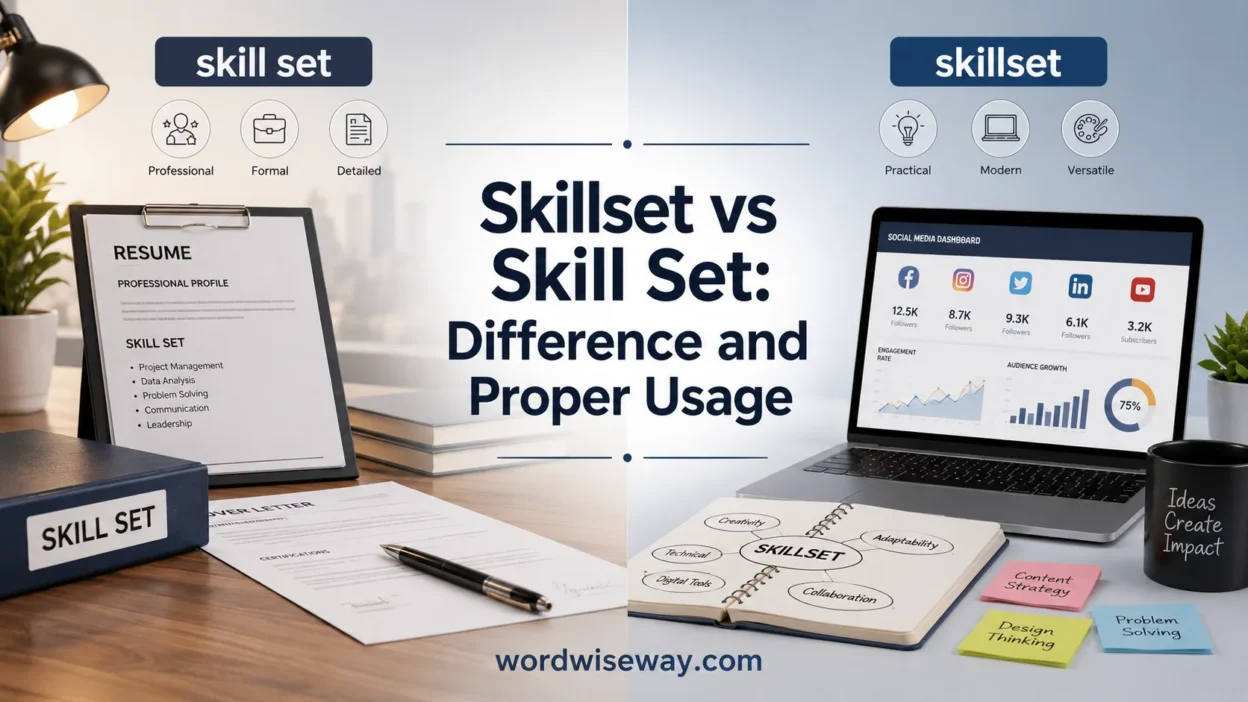
- Skill set
- Two-word phrase
- More formal
- Preferred in academic and professional writing
- Aligns with traditional grammar rules
- Skillset
- Compound word
- More casual and modern
- Common in digital content
- Accepted in everyday usage
Comparison Table
| Feature | Skill set | Skillset |
| Structure | Two words | Single compound word |
| Tone | Formal | Informal to neutral |
| Usage | Academic, resumes | Blogs, web content |
| Grammar status | Standard form | Accepted variation |
| Reader impact | Professional polish | Modern readability |
Key Insight
Neither version changes the meaning. The difference lives in tone, not definition.
That is why both survive in modern writing.
Which One Should You Actually Use? A Practical Guide
Here’s where most confusion gets solved.
You do not choose based on “right or wrong.” You choose based on context.
Use “Skill Set” When You Want Formal Precision
Choose this form when writing:
- Resumes
- Academic essays
- Cover letters
- Corporate documents
- Official job descriptions
It signals structure and professionalism.
Use “Skillset” When You Want Modern Flow
Choose this form when writing:
- Blog posts
- Social media content
- Startup branding
- Informal communication
- Marketing copy
It feels smoother and more conversational.
Simple Rule You Can Remember
If the document feels like it belongs in a boardroom, use skill set.
If it feels like it belongs on a website or feed, use skillset.
That’s it. No overthinking needed.
Why Both Forms Exist: The Evolution of English in Action
English does not stay still. It constantly reshapes itself.
One of the most common language shifts is compounding, where two words merge into one over time.
We’ve seen this happen repeatedly:
- “Web site” → “website”
- “E mail” → “email”
- “To day” → “today”
Now “skill set” is going through the same transition.
However, not all language authorities update at the same pace.
For example:
- Many dictionaries now accept “skillset” as a valid variant
- Style guides still often prefer “skill set” in formal writing
This gap creates a transitional phase where both forms coexist.
And during transitions like this, consistency matters more than strict rules.
Common Mistakes People Make
Even experienced writers slip up here. Let’s fix the most common errors.
Mixing Both Forms in One Document
This is the biggest mistake.
❌ “She has a strong skillset in design. Her skill set includes UX research.”
✔ “She has a strong skill set in design. Her skill set includes UX research.”
Pick one form and stay consistent.
Using “Skillset” in Highly Formal Writing
It can make writing feel slightly less polished.
Example:
❌ “The candidate possesses a strong skillset in accounting.”
✔ “The candidate possesses a strong skill set in accounting.”
Overthinking the Meaning
Some writers assume the two forms have different meanings. They don’t.
Both refer to the same concept:
A combination of skills used for a task or profession
The difference is stylistic, not conceptual.
Real-World Examples That Show Proper Usage
Let’s ground this in real scenarios so it feels practical, not theoretical.
Resume Example
A software developer writes:
“My skill set includes Python, JavaScript, and cloud infrastructure management.”
This version feels professional and recruiter-friendly.
Job Posting Example
A company writes:
“We are looking for candidates with a diverse skill set in digital marketing and analytics.”
This signals clarity and structure.
Blog Content Example
A tech blog writes:
“Her design skillset helped the startup improve user engagement dramatically.”
This feels more conversational and modern.
Style Guide Perspective: What Experts Tend to Prefer
Different editorial standards lean in slightly different directions.
General Trends
- AP Style and many academic guides prefer skill set
- Modern web publishers often accept skillset
- Corporate writing varies depending on internal guidelines
What This Means for You
There is no universal enforcement. Instead, there is preference based on formality.
So the safest approach is:
- Formal document → skill set
- Informal or digital content → skillset
Golden Rule of Editorial Consistency
Pick one form per document and stick to it.
Consistency often matters more than choice.
Case Study: How One Word Choice Changes Perception
Let’s look at a realistic hiring scenario.
Candidate A (Formal Resume)
“Developed a strong skill set in data analysis, Python programming, and machine learning.”
Candidate B (Casual Resume)
“Developed a strong skillset in data analysis, Python programming, and machine learning.”
Both candidates are equally qualified. However:
- Candidate A feels more structured and formal
- Candidate B feels more modern and relaxed
Neither is wrong. But perception shifts slightly based on tone.
In competitive fields, those small signals can influence first impressions.
Quick Reference Cheat Sheet
Here’s a simple way to decide fast:
- Writing a resume? → skill set
- Writing a blog? → skillset
- Writing an academic paper? → skill set
- Writing marketing copy? → skillset
- Not sure? → Choose skill set for safety
FAQs
Q1. What is the difference between skillset and skill set?
The main difference is spelling and style. Skill set is the traditional and widely accepted form in standard English. Skillset is a newer variation that appears more often in business writing, HR documents, and online content.
Q2. Is skillset one word or two words?
Both forms exist, but skill set is generally preferred in formal English. If you are writing an academic paper, resume, or professional document, using skill set is usually the safer choice.
Q3. Which spelling should I use on my resume?
For most resumes, skill set is the better option because it follows standard English conventions. However, if a company consistently uses skillset in its job description, matching its style can also be acceptable.
Q4. Is skillset considered incorrect?
Not exactly. Many dictionaries and style guides recognize skillset as an accepted variant, but some editors still view it as informal or business jargon. The choice often depends on your audience and writing style.
Q5. What does skill set mean?
A skill set is a collection of abilities, knowledge, and expertise that a person has. These skills help someone complete tasks effectively and succeed in education or a career.
Q6. Why do people confuse skillset and skill set?
The confusion comes from the growing popularity of skillset in corporate communication and online writing. Since both forms are widely seen, many writers are unsure which one is more appropriate.
Q7. Is skill set better for academic writing?
Yes. Most academic institutions and formal style guides recommend skill set because it follows traditional English usage and is more widely accepted in formal contexts.
Q8. Can I use skillset in business communication?
Yes. Many businesses, HR teams, and marketing professionals use skillset in emails, reports, and job postings. It is common in corporate environments, even though skill set remains the more formal choice.
Q9. How can I remember the correct spelling?
Think of skill set as a set of skills. Since it describes a collection, writing it as two words is easy to remember and works well in most formal situations.
Q10. Which version should I use most of the time?
If you are unsure, choose skill set. It is the more widely accepted spelling, works in nearly every context, and helps maintain a professional tone in your writing.
Conclusion
Choosing between skillset and skill set becomes much easier once you understand their usage and context. Although both forms express the same idea, skill set remains the preferred spelling in standard English. It is the best choice for resumes, academic papers, professional documents, and formal communication. Meanwhile, skillset has gained popularity in business, HR, and marketing, making it acceptable in many modern workplace settings.
The key is to stay consistent throughout your writing. Consider your audience, the purpose of your document, and the level of formality before deciding which version to use. By learning the difference and applying the correct form consistently, you can improve the clarity of your writing, avoid common spelling mistakes, and present a more professional image.

Emma Smith has dedicated 14 years to Princeton University’s English Department, mentoring students in textual interpretation, literary movements, and critical frameworks. Her research explores Shakespearean drama, Victorian serial fiction, postcolonial narrative theory, and manuscript studies and probing how literary forms evolve across cultures and centuries. Emma has delivered lectures at international humanities congresses and published findings in distinguished academic journals, underscoring her commitment to scholarly depth and vibrant teaching.