I remember sitting through my first formal parliamentary meeting and feeling completely thrown off when the chair asked for a vote using archaic terminology. I stood there wondering if they meant a simple yes or no, realizing how easily this old fashioned phrase confuses newcomers. As an expert who frequently reviews legal settings, books, politics, and congressional procedural records, I know why so many people search for the exact meaning, origin, pronunciation, and proper usage of yea and nay. It still appears regularly in movies, everyday conversations, and official decision making environments. The confusion is completely understandable when you see similar words, casual variations, and distinct differences like yay, which completely differs from the formal versions we hear in voting chambers.
Although these words look unusual today, the English language has a long history where they were once common ways to express agreement or disagreement. In my years of writing, this guide and article explains how to navigate these terms, helping you feel confident using the correct style and tradition. Whether you are drafting a professional email, introducing a motion, evaluating a proposal, enforcing a rule, or finalizing a major decision, mastering this lexicon ensures absolute clarity. In this text, we see how the affirmative stance supports a decision, while a negative voice stands against it, ensuring your formal communication remains flawless.
This comprehensive guide highlights the distinct functions of each word, using clear sentence examples and structured tables to break down the exact grammar patterns industry professionals rely on to communicate effectively.
Quick Answer:
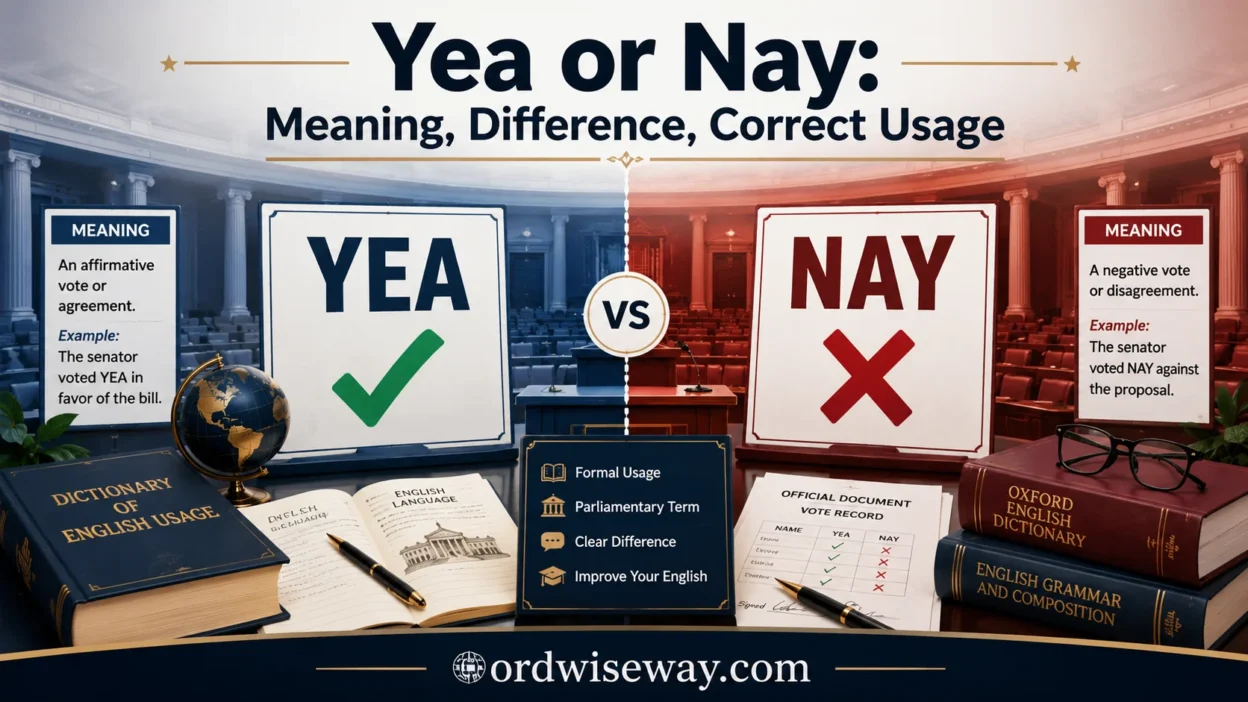
Yea means yes, approval, or agreement, while nay means no, disagreement, or rejection. Both words are correct, but they sound formal, traditional, or old-fashioned in modern English. You’ll mostly see yea and nay in official voting, legal discussions, historical writing, and formal debates.
For everyday conversations, people usually say yes and no instead.
Example:
- The committee members voted yea to approve the proposal.
- The committee members voted nay to reject the proposal.
Think of yea as a formal “yes” and nay as a formal “no.”
What Does Yea Mean?
Yea Meaning and Definition
Yea means yes, agreement, or approval. It shows that someone supports an idea, decision, statement, or proposal.
The word often appears when people vote or make formal decisions.
Unlike the everyday word yes, yea has a more official tone.
Examples:
- “The motion passed with 45 yeas and 10 nays.”
- “She voted yea because she supported the new rules.”
- “The members answered yea when asked for approval.”
In normal conversation, saying:
“Yea, I’ll come with you.”
can sound unusual because most people would simply say:
“Yes, I’ll come with you.”
Common Uses of Yea
You’ll usually find yea in these situations:
- Government voting
- Corporate meetings
- Legal discussions
- Historical texts
- Formal debates
- Religious writing
For example, lawmakers may record votes as:
| Vote Term | Meaning |
| Yea | Approval or support |
| Nay | Opposition or rejection |
| Abstain | Choosing not to vote |
What Does Nay Mean?
Nay Meaning and Definition
Nay means no, disagreement, or rejection.
It expresses the opposite idea of yea.
When someone votes “nay,” they are saying they do not support a decision or proposal.
Examples:
- “Five members voted nay against the plan.”
- “The senator answered nay during the final vote.”
- “The proposal received more nays than yeas.”
Like yea, the word nay sounds formal today.
Most people would say:
- “No, I disagree.”
- “No, that isn’t correct.”
instead of:
- “Nay, that isn’t correct.”
Common Uses of Nay
The word nay appears in:
- Parliamentary voting
- Formal objections
- Historical documents
- Literature
- Traditional expressions
A person might write:
“The answer was not merely no, but nay.”
Here, nay creates a stronger formal or dramatic feeling.
Yea vs Nay: Key Differences Explained
The simplest difference is:
- Yea = Yes
- Nay = No
However, their usage depends heavily on context.
| Feature | Yea | Nay |
| Meaning | Yes or approval | No or rejection |
| Tone | Formal/traditional | Formal/traditional |
| Opposite word | Nay | Yea |
| Common modern replacement | Yes | No |
| Main usage | Voting and official decisions | Voting and objections |
Example Comparison
Yea:
“The council voted yea on the construction plan.”
Meaning:
The council approved the plan.
Nay:
“The council voted nay on the construction plan.”
Meaning:
The council rejected the plan.
The words work like two buttons on a decision machine: one moves the idea forward, while the other pushes it back.
The History and Origin of Yea and Nay
Where Did Yea Come From?
The word yea has roots in Old English. It developed from earlier forms that expressed agreement and confirmation.
Over centuries, English speakers used different words for “yes,” depending on the situation. Some forms disappeared, while others survived in specific environments.
Today, yea survives mainly because official voting systems preserved it.
Where Did Nay Come From?
Nay also comes from Old English traditions. It developed as a way to express disagreement or refusal.
Historically, people used words like yea and nay when making public decisions.
Before modern voting systems, communities often expressed agreement or disagreement verbally. These simple words became part of formal decision-making.
How Yea and Nay Became Voting Terms
Voting created a permanent home for these words.
When groups needed a clear way to record decisions, they used:
- Yea for approval
- Nay for opposition
This practice continues today in many legislative bodies and organizations.
How to Pronounce Yea and Nay Correctly
Pronunciation of Yea
Yea is usually pronounced:
/jeɪ/
It sounds like:
- “yay”
- the first sound in “year” is not used
Example:
“The vote was yea.”
Pronunciation:
“The vote was yay.”
Pronunciation of Nay
Nay is pronounced:
/neɪ/
It sounds like:
- “day”
- “say”
- “way”
Example:
“The final count included ten nays.”
Pronunciation:
“The final count included ten nays.”
Yea vs Yeah: Are They the Same?
Many people confuse yea and yeah because they look similar.
They are not the same word.
Yea
- Formal
- Used for voting
- Means yes
Example:
“The members voted yea.”
Yeah
- Informal
- Common in conversations
- Means yes
Example:
“Yeah, I watched that movie.”
The difference is mostly about style and setting.
| Word | Meaning | Tone |
| Yea | Yes/approval | Formal |
| Yeah | Yes | Casual |
Using yeah in a government vote would sound strange. Using yea with friends may sound overly formal.
Yea vs Yes: When Should You Use Each Word?
Using Yes in Everyday Speech
For normal conversations, yes is almost always the best choice.
Examples:
- “Yes, I understand.”
- “Yes, I can help.”
- “Yes, that’s correct.”
It sounds natural and modern.
Using Yea in Formal Writing
Use yea when discussing:
- Official votes
- Historical events
- Formal records
Example:
“The final vote recorded 200 yeas and 50 nays.”
Writing Tip
If you are writing an email, essay, or article for a modern audience, choose yes unless the context specifically requires yea.
Read More: Niece vs Neice: Correct Spelling, Meaning, and Usage
Nay vs No: Are They Interchangeable?
Similar Meaning, Different Style
Both words communicate rejection.
However:
- No is modern and common.
- Nay is formal and traditional.
Compare:
Modern:
“No, I don’t agree.”
Formal:
“Nay, I do not agree.”
The meaning remains similar, but the feeling changes.
Common Mistakes
Using Yea Like Yeah
A common mistake is assuming yea means the same as casual yeah.
Although both can mean agreement, they belong to different situations.
Incorrect:
“Yea, that movie was awesome.”
Better:
“Yeah, that movie was awesome.”
Using Nay in Casual Conversations
Saying:
“Nay, I don’t want pizza.”
is grammatically understandable but sounds unusual.
A natural speaker would say:
“No, I don’t want pizza.”
Confusing Yea With Yay
The words yea and yay sound the same but have different meanings.
| Word | Meaning | Example |
| Yea | Yes/approval | “The vote was yea.” |
| Yay | Excitement or happiness | “Yay! We won.” |
Frequently Asked Questions About Yea and Nay
Q1. What does “yea or nay” mean?
“Yea” means yes (an affirmative vote) and “nay” means no (a negative vote). Together, the phrase represents a choice between agreeing or disagreeing with a proposal, typically used in formal voting contexts.
Q2. Is it “yea or nay” or “yay or nay”?
The correct formal phrase is “yea or nay.” While “yay” is an everyday exclamation used to express excitement (e.g., “Yay, we won!”), it is technically incorrect when referring to a traditional vote or decision-making process.
Q3. Where did the terms “yea” and “nay” originate?
Both words have deep roots in Old English and Middle English. Historically, “yea” and “nay” were used to answer simple questions, while “yes” and “no” were reserved for more complex framing, a distinction that faded over centuries.
Q4. Why do politicians still use “yea” and “nay” in Congress?
United States congressional bodies and various parliamentary systems use these terms out of legal tradition and institutional style. It maintains a formal, structured environment for recording official voice votes on motions and bills.
Q5. Can I use “yea or nay” in everyday conversations?
Yes, but it will sound highly formal, old-fashioned, or intentionally dramatic. In casual, modern English conversations, simply using “yes or no” sounds much more natural.
Q6. How do you properly pronounce “yea”?
“Yea” is pronounced exactly like the word “yay” (rhyming with say or day). It is a common mistake to pronounce it like “yeah,” which is a casual variation of yes.
Q7. What is a “voice vote” in relation to this phrase?
A voice vote is a parliamentary procedure where the presiding officer asks those in favor to say “yea” and those opposed to say “nay,” judging the outcome based on which side makes the most volume.
Q8. Is “yea or nay” used in written legal contracts?
While legal settings respect the tradition of the phrase, modern legal drafting favors precise, modern English. You are more likely to see “in favor or opposed” rather than the archaic “yea or nay” in modern contracts.
Q9. What is the difference between “yea” and “yeah”?
“Yea” is a formal, historical word for an affirmative vote or statement. “Yeah” is a casual, twentieth-century colloquialism used globally in relaxed, informal speech.
Q10. How should I use this phrase in a professional email?
Unless you are purposely invoking a dramatic or traditional tone, it is best to avoid it. Opt for modern alternatives like “Please let me know your decision by Friday” instead of asking for their “yea or nay.”
Conclusion:
In summary, understanding the exact meaning, difference, and correct usage of yea or nay helps demystify an otherwise confusing, old-fashioned phrase. While these terms have a long history rooted in parliamentary tradition and official decision-making, they are often mixed up with casual variations like yay or yeah. By recognizing that yea stands for the affirmative and nay represents a negative vote, you can easily navigate formal linguistic landscapes, whether you encounter them in politics, movies, or legal settings.
Ultimately, while the phrase remains an iconic staple of congressional voice votes and traditional rules of order, it is rarely necessary for everyday conversations or professional emails. Choosing plain English alternatives like yes or no ensures your communication is clear and natural without losing any semantic intent. Armed with this knowledge, you can now confidently decode this classic linguistic custom whenever a motion or crucial proposal calls for a definitive decision.

Emma Smith has dedicated 14 years to Princeton University’s English Department, mentoring students in textual interpretation, literary movements, and critical frameworks. Her research explores Shakespearean drama, Victorian serial fiction, postcolonial narrative theory, and manuscript studies and probing how literary forms evolve across cultures and centuries. Emma has delivered lectures at international humanities congresses and published findings in distinguished academic journals, underscoring her commitment to scholarly depth and vibrant teaching.