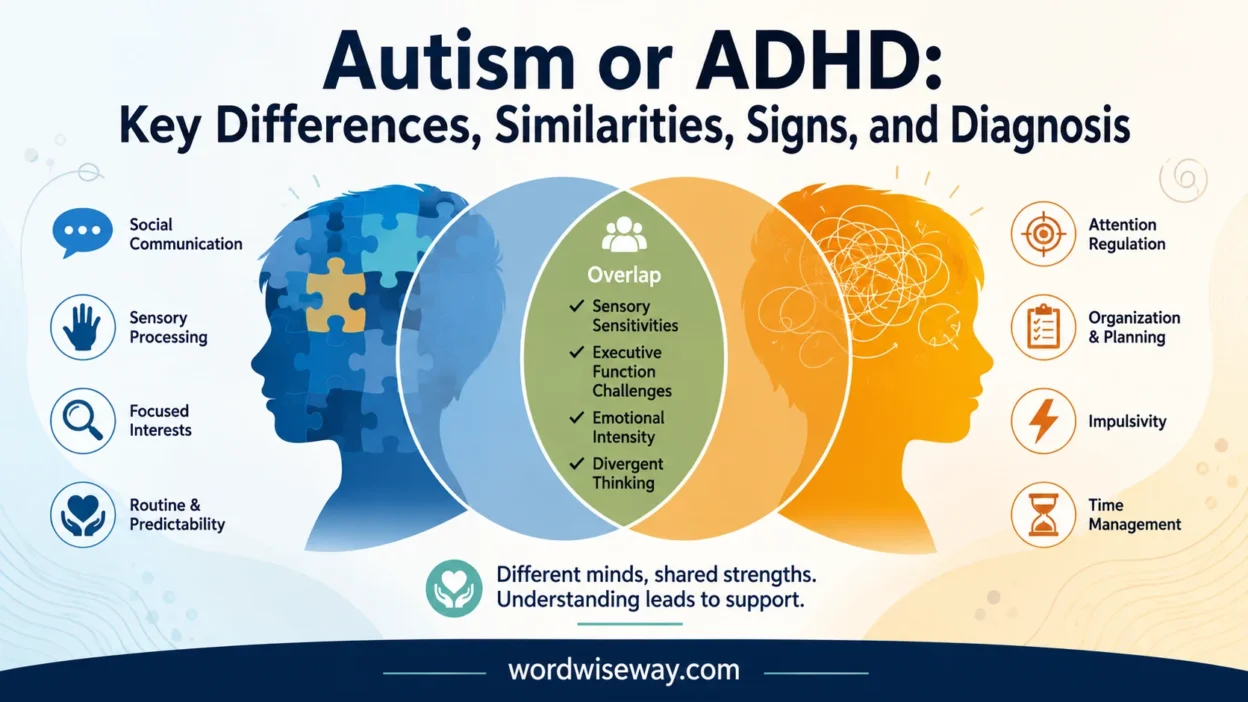
Autism or ADHD: Differences, Similarities, and Signs can be easier to understand when you look at neurodiversity and neurodevelopmental conditions in simple terms.
Autism Spectrum Disorder (ASD) and Attention Deficit Hyperactivity Disorder (ADHD) are distinct diagnoses, but both conditions can have overlapping traits. Individuals may experience difficulty focusing, social challenges, or hyperactivity. Their diagnostic criteria, developmental presentations, and support needs can differ.
For parents, teachers, educators, clinicians, adults, and other professionals, understanding these similarities and differences can provide clarity and reduce confusion. Some individuals may have AuDHD, meaning they meet the criteria for both autism and ADHD.
Learning about British English, American English, usage, writing, communication, and daily usage can also improve awareness and practical understanding.
Quick Answer
Autism and ADHD overlap, but they aren’t the same condition. Autism is characterized mainly by differences in social communication and interaction plus restricted or repetitive patterns of behavior, interests, or activities. ADHD is characterized by persistent inattention and/or hyperactivity and impulsivity.
A useful way to remember the distinction is this: autism often centers on how a person experiences social communication, routines, interests, and sensory information, while ADHD often centers on regulating attention, activity, and impulses. However, real-life symptoms aren’t always neatly separated into two boxes.
For example, an autistic person might become deeply focused on a particular interest and find an unexpected change in plans difficult. A person with ADHD might struggle to finish a routine task because their attention keeps shifting or because getting started feels unusually difficult. Both people may appear distracted, but the underlying pattern can be different.
Autism vs ADHD at a Glance
| Feature | Autism | ADHD |
| Main diagnostic areas | Social communication and interaction, restricted or repetitive behaviors | Inattention and/or hyperactivity-impulsivity |
| Attention | Deep or sustained focus on preferred interests may occur | Attention can be inconsistent and easily diverted |
| Social difficulties | Often connected to social communication differences | May result from impulsivity, inattention, or difficulty regulating behavior |
| Routines | Predictability and sameness can be especially important | Creating and maintaining routines may be difficult |
| Repetitive behaviors | Can be a core feature | Not a defining feature |
| Focused interests | Can be unusually intense or restricted | Interests may shift frequently |
| Hyperactivity | Not a defining feature | One of the major symptom areas |
| Impulsivity | Not a defining feature | One of the major symptom areas |
| Sensory differences | Common and relevant to autism | Can occur but aren’t a defining diagnostic feature |
| Executive-function difficulties | Can occur | Very common |
| Can both occur? | Yes | Yes |
These distinctions come from the different diagnostic features of ASD and ADHD. Importantly, neither condition looks identical in every person. Autism is a spectrum, while ADHD can also present in different ways.
What Is Autism?
Autism spectrum disorder is a neurological and developmental condition that affects how a person communicates, interacts with others, learns, and behaves. Symptoms generally appear during early development, although some people aren’t diagnosed until adolescence or adulthood.
Autism includes a broad range of characteristics. One autistic person may need substantial daily support, while another may live independently and mainly need help with specific challenges. The word spectrum reflects this variation.
Core Characteristics of Autism
The two major diagnostic areas include:
- Differences in social communication and social interaction
- Restricted or repetitive behaviors, interests, or activities
Autistic people may also experience sensory differences. Sounds, lights, textures, smells, or physical sensations can feel unusually intense or unusually weak.
Common characteristics can include:
- Difficulty interpreting facial expressions or body language
- Differences in conversational style
- Strong or highly focused interests
- Repetitive movements or behaviors
- Preference for predictable routines
- Difficulty adjusting to unexpected changes
- Sensory sensitivity or reduced sensitivity
- Difficulty understanding certain indirect forms of communication
Not every autistic person experiences all of these traits. Autism can affect people in very different ways.
What Is ADHD?
ADHD is a developmental disorder involving persistent patterns of inattention, hyperactivity, and impulsivity. Some people mainly experience inattentive symptoms, while others primarily experience hyperactive-impulsive symptoms. Some experience both.
ADHD isn’t simply about being energetic or easily distracted once in a while. Symptoms need to be persistent, occur across relevant settings, and interfere with everyday functioning.
Common ADHD Symptoms
A person with ADHD may experience:
- Difficulty maintaining attention
- Trouble completing tasks
- Forgetfulness
- Poor organization
- Difficulty managing time
- Losing important items
- Restlessness
- Excessive talking
- Interrupting others
- Acting without considering consequences
- Difficulty waiting for a turn
ADHD symptoms begin during childhood, although the condition can continue into adolescence and adulthood. For diagnosis, symptoms must have started before age 12 and meet other clinical requirements.
Autism or ADHD: Key Differences
The clearest differences appear when you look beyond the surface behavior.
Attention and Focus
Both autism and ADHD can affect attention, but attention doesn’t necessarily work the same way.
An autistic person may become intensely focused on a particular subject, activity, or interest. They might spend a long time learning everything they can about something they find meaningful.
With ADHD, attention often feels more inconsistent. A person may focus intensely on something interesting while struggling to concentrate on a repetitive or less rewarding task.
This can create a confusing situation. Someone might spend two hours absorbed in a favorite activity and then struggle to spend ten minutes on homework.
The behavior looks contradictory, but attention isn’t simply an on-or-off switch.
Social Interaction
Social differences can appear in both autism and ADHD, but the reasons may differ.
Autism can involve difficulty interpreting or using social communication. A person might struggle with subtle facial expressions, tone of voice, body language, sarcasm, or the unspoken rules of conversation.
With ADHD, social problems may happen because of impulsivity or inattention. Someone might interrupt, forget part of a conversation, change topics quickly, or miss details because their attention wandered.
Consider this example:
Autism: A person may have difficulty understanding an indirect social cue.
ADHD: A person may understand the cue but miss it because they weren’t paying attention at that moment.
Real life can be more complicated, especially when both conditions occur together.
Routines and Change
Autism and ADHD can produce completely different relationships with routines.
An autistic person may find predictable routines comforting and unexpected changes stressful. A sudden change in plans can create significant difficulty because predictability has been disrupted.
A person with ADHD may struggle to maintain routines because organization, time management, task initiation, and consistency can be difficult.
So two people might both struggle when plans change, but for different reasons.
Repetitive Behaviors and Interests
Restricted or repetitive behaviors are part of the diagnostic picture of autism. These may include repetitive movements, repeated actions, strong preferences for sameness, or highly focused interests.
ADHD doesn’t have repetitive behavior as a defining diagnostic feature. However, someone with ADHD might repeat an activity because it provides stimulation, reduces boredom, or keeps them engaged.
The distinction matters because similar-looking behavior doesn’t automatically have the same explanation.
Sensory Differences
Sensory differences are common in autism. A person may find certain sounds, lights, textures, smells, or physical sensations overwhelming. Others may seek particular sensory experiences or respond less strongly to certain sensations.
Sensory sensitivity can also occur in people with ADHD. However, sensory differences aren’t one of the defining diagnostic criteria for ADHD.
That means sensory experiences can provide useful context, but they can’t independently determine whether someone has autism.
Impulsivity and Hyperactivity
Impulsivity and hyperactivity are central features of ADHD.
A person may interrupt conversations, act quickly without thinking through the consequences, have trouble sitting still, or feel internally restless. Not everyone with ADHD is visibly hyperactive, especially as they get older.
Autism itself isn’t defined by hyperactivity or impulsivity. An autistic person can certainly experience either, particularly when ADHD also occurs.
Similarities Between Autism and ADHD
The question “autism or ADHD?” becomes difficult because several traits can overlap.
Executive-Function Difficulties
Both conditions can affect executive functioning, which includes skills such as:
- Planning
- Organizing
- Starting tasks
- Switching between tasks
- Managing time
- Remembering information
- Controlling responses
- Completing multi-step activities
For example, someone might know exactly what they need to do but still struggle to begin.
That difficulty doesn’t automatically identify the condition causing it.
Emotional Regulation
People with autism or ADHD can experience strong emotional reactions and difficulty shifting away from frustration or stress.
However, emotional regulation isn’t enough by itself to distinguish the two conditions. A proper evaluation considers the broader pattern of symptoms and development.
Social Challenges
Both autism and ADHD can affect relationships.
A person with ADHD might interrupt, forget plans, lose track of conversations, or act impulsively. An autistic person might have difficulty reading social cues, understanding indirect communication, or adapting to unwritten social expectations.
The result may look similar from the outside. The underlying pattern can be very different.
Overstimulation
Busy environments can be challenging for people with either condition.
A crowded classroom, noisy room, bright lights, or several simultaneous demands can make concentration and regulation harder. Autism may involve more pronounced sensory processing differences, while ADHD may involve difficulty filtering distractions and regulating attention.
Can You Have Autism and ADHD Together?
Yes. A person can have both autism and ADHD.
Older diagnostic practices created barriers to recognizing both conditions together. Modern diagnostic standards allow clinicians to diagnose autism in someone who also meets criteria for ADHD. Research has since shown substantial overlap between the two conditions.
One U.S. study using national survey data found that about 13% of children currently diagnosed with ADHD also had an autism diagnosis. The study also found that children with both conditions had greater treatment needs than children with ADHD alone.
Another population-based study found that children with both ASD and ADHD had higher rates of several co-occurring conditions than children with either condition alone.
These figures vary between studies because researchers use different samples, definitions, and assessment methods. They shouldn’t be treated as one universal percentage.
What Having Both Can Look Like
Someone with both conditions may experience a mixture of traits such as:
- Strong focused interests alongside rapidly shifting attention
- A need for routine alongside difficulty maintaining routines
- Social communication differences alongside impulsive interruptions
- Sensory sensitivities alongside distractibility
- Executive-function difficulties alongside repetitive behaviors
- Difficulty switching tasks for more than one reason
This combination can make diagnosis more complicated. It can also explain why one diagnosis sometimes doesn’t fully describe someone’s experiences.
Autism vs ADHD in Children
Children can show overlapping behaviors, which makes careful evaluation particularly important.
Signs That May Point Toward Autism
Potential indicators include:
- Persistent differences in social communication
- Difficulty understanding social cues
- Restricted or highly focused interests
- Repetitive behaviors
- Strong preference for sameness
- Sensory differences
- Difficulty adapting to unexpected changes
Signs That May Point Toward ADHD
Potential indicators include:
- Persistent difficulty paying attention
- Frequent forgetfulness
- Difficulty following through on tasks
- Impulsive behavior
- Restlessness
- Excessive talking
- Difficulty waiting
- Disorganization
A child doesn’t need to display every possible symptom. What matters is the overall developmental pattern, how persistent the difficulties are, and how much they affect daily functioning.
Autism or ADHD in Adults
Autism and ADHD can both be diagnosed in adulthood.
Adult autism assessment can be challenging because a person’s current behavior may not fully reveal their early developmental history. NIMH notes that adult autism evaluations may examine social communication, sensory issues, repetitive behaviors, restricted interests, and early development.
ADHD assessment in adults also looks backward. Because symptoms must have begun before age 12, clinicians may review childhood experiences, school records, family reports, and other historical information.
ADHD in Adults
Adult ADHD may appear as:
- Chronic disorganization
- Difficulty completing large projects
- Poor time management
- Forgetting appointments
- Restlessness
- Difficulty staying on task
- Impulsive decisions
- Problems managing multiple responsibilities
Hyperactivity may become less obvious with age. Instead of constantly running around, an adult may experience internal restlessness or difficulty staying engaged in quiet activities.
Autism in Adults
Autistic adults may experience:
- Social communication differences
- Difficulty with unexpected changes
- Strong interests
- Repetitive behaviors
- Sensory differences
- Preference for predictable environments
- Challenges understanding certain indirect social cues
Some adults develop effective strategies for navigating situations that once felt difficult. Those strategies don’t necessarily mean the underlying traits disappeared.
Case Study: Why the Same Behavior Can Mean Different Things
Imagine two students who regularly avoid group projects.
Student A finds group conversations confusing. They struggle to know when to speak, interpret subtle reactions, and follow rapidly changing social exchanges. This pattern could warrant evaluation for autism.
Student B understands group conversations but keeps losing track of what everyone is saying. They interrupt, forget assigned tasks, and have difficulty organizing their part of the project. That pattern could warrant evaluation for ADHD.
Now imagine a Student C who experiences both sets of difficulties. They struggle with social communication while also dealing with distractibility and impulsivity.
The lesson is simple: behavior alone doesn’t provide the full answer. Context matters.
How Autism and ADHD Are Diagnosed
Neither autism nor ADHD can be confirmed through a single online quiz.
Autism Assessment
An autism evaluation may consider:
- Developmental history
- Social communication
- Social interaction
- Repetitive behaviors
- Restricted interests
- Sensory experiences
- Daily functioning
- Medical and developmental history
NIMH explains that autism evaluation can involve behavioral observation, developmental information, cognitive and language assessments, and discussions with caregivers or other people who know the person well.
ADHD Assessment
An ADHD evaluation may examine:
- Current symptoms
- Childhood history
- School or work functioning
- Symptoms across different settings
- Duration of symptoms
- Medical and mental health history
- Standardized rating scales
- Possible alternative explanations
ADHD symptoms need to persist for at least six months, occur in at least two settings, interfere with functioning, and have begun during childhood.
Sleep problems, anxiety, depression, and some other conditions can produce symptoms that resemble ADHD. That’s one reason a thorough evaluation matters.
Common Misconceptions About Autism or ADHD
“Autism Means Someone Doesn’t Want Friends”
That’s an oversimplification.
Autistic people can want friendships and relationships while experiencing differences in social communication or interaction.
“ADHD Just Means Being Hyper”
Not true.
ADHD can involve primarily inattentive symptoms. Some people experience hyperactivity and impulsivity, while others experience a combination of symptom areas.
“You Can’t Have Autism and ADHD Together”
You can.
Research has repeatedly documented co-occurrence between the two conditions.
“Good Grades Rule Out ADHD or Autism”
Academic performance alone doesn’t establish or exclude either condition.
A student may perform well academically while still experiencing significant difficulties with organization, social communication, sensory demands, attention, or daily functioning.
“Everyone With Autism or ADHD Looks the Same”
Neither condition has one universal appearance.
People can have different strengths, challenges, symptom patterns, and support needs.
When Should You Seek an Evaluation?
If attention, communication, behavior, sensory experiences, or daily functioning consistently cause difficulties, discussing those concerns with a qualified health professional can be useful.
Helpful information may include:
- When the difficulties first appeared
- Where they occur
- How often they occur
- What situations make them better or worse
- School or work observations
- Childhood developmental history
- Feedback from parents, teachers, or other trusted adults
A professional can look at the complete pattern instead of relying on one isolated behavior.
What Happens After Diagnosis?
A diagnosis isn’t the finish line. It can help identify useful support.
For autism, support may focus on communication, daily living skills, sensory needs, education, employment, or other individual goals. NIMH notes that services and supports can help people build skills, manage difficulties, and strengthen functioning.
For ADHD, treatment can include behavioral approaches, psychotherapy, school-based support, workplace accommodations, and medication when prescribed and monitored by an appropriate healthcare professional.
When both autism and ADHD occur together, support may need to address both sets of needs. Treating only one side of the picture may leave important difficulties unaddressed.
Key Facts About Autism or ADHD
- Autism and ADHD are both neurodevelopmental conditions.
- Autism involves social communication differences and restricted or repetitive patterns.
- ADHD involves persistent inattention and/or hyperactivity-impulsivity.
- Both conditions can affect executive functioning.
- Sensory differences are common in autism and can also occur with ADHD.
- Autism and ADHD can occur in the same person.
- ADHD symptoms must begin before age 12 for diagnosis.
- Autism can be diagnosed in childhood, adolescence, or adulthood.
- Online screening tools cannot replace a professional evaluation.
- Symptoms should be considered in context rather than judged from one behavior.
Read More: ADHD or Anxiety:Difference, Symptoms, Causes, and Treatment
FAQs
1. What is the main difference between autism and ADHD?
Autism and ADHD are different neurodevelopmental conditions. Autism mainly affects social communication, interaction, sensory processing, and patterns of behavior, while ADHD is commonly associated with attention difficulties, impulsivity, and hyperactivity. Some traits can overlap, which can make the two conditions confusing to compare.
2. Can someone have both autism and ADHD?
Yes. A person can meet the diagnostic criteria for both autism and ADHD. The term AuDHD is often used informally to describe this combination. Having both conditions can create a mix of traits that may not fit neatly into a single diagnosis.
3. Can autism and ADHD look similar?
Yes, some behaviors can look similar on the surface. Both may involve difficulty with attention, organization, social situations, emotional regulation, or daily routines. However, the reasons behind these experiences can differ, so one shared trait doesn’t automatically indicate either condition.
4. Is difficulty focusing a sign of autism or ADHD?
Difficulty focusing is commonly associated with ADHD, but it can also occur in autistic people for different reasons. For example, attention may become strongly focused on an interest, while distractions, sensory input, or changes in routine may affect concentration.
5. Is hyperactivity always related to ADHD?
No. Hyperactivity is strongly associated with ADHD, but restlessness or constant movement can have other causes. Autism, anxiety, stress, sensory needs, and other factors may sometimes influence a person’s activity level.
6. How are autism and ADHD diagnosed?
Professionals consider a person’s developmental history, behaviors, experiences, and symptoms when assessing these conditions. Diagnosis isn’t based on one behavior or a single test. Clinicians use established diagnostic criteria to determine whether someone meets the requirements for autism, ADHD, or both.
7. Can autism and ADHD occur in adults?
Yes. Both conditions can be identified in adults. Some people aren’t recognized during childhood because their traits were less noticeable, misunderstood, or managed through coping strategies. An adult assessment can provide greater clarity about long-standing experiences.
8. Why are autism and ADHD sometimes confused?
The confusion often comes from overlapping traits. Both conditions can affect communication, attention, routines, organization, and social experiences. Looking only at one symptom can therefore be misleading. A broader developmental picture provides a more useful understanding.
9. Can someone have autistic traits without having autism?
Yes. Having one or several traits associated with autism doesn’t necessarily mean someone has autism. Many human behaviors exist across a broad range. A diagnosis depends on the overall pattern of traits, their impact, developmental history, and professional diagnostic criteria.
10. Why is it useful to understand autism and ADHD?
Understanding the differences can reduce confusion and encourage better support. It can also help parents, educators, professionals, and individuals communicate more clearly about their needs. Learning about both conditions promotes awareness without assuming that every person will experience them in the same way.
Conclusion
Autism and ADHD share some features, but they remain distinct neurodevelopmental conditions with different diagnostic criteria and developmental patterns. Autism is generally associated with differences in social communication, interaction, sensory experiences, and repetitive or restricted patterns, while ADHD commonly involves attention regulation, impulsivity, and hyperactivity. Some people meet the criteria for both conditions, which is why AuDHD has become a useful term in everyday conversations. Looking beyond individual behaviors is important because the same outward behavior can have very different underlying reasons.
A clearer understanding of autism and ADHD can make conversations more respectful and practical. Whether you’re a parent, student, educator, clinician, or adult exploring your own experiences, it’s helpful to avoid quick assumptions based on a single trait. Professional assessment considers the wider pattern of development, behavior, and daily experiences. With accurate information and appropriate support, people can better understand their strengths, challenges, and individual needs.

Emma Smith has dedicated 14 years to Princeton University’s English Department, mentoring students in textual interpretation, literary movements, and critical frameworks. Her research explores Shakespearean drama, Victorian serial fiction, postcolonial narrative theory, and manuscript studies and probing how literary forms evolve across cultures and centuries. Emma has delivered lectures at international humanities congresses and published findings in distinguished academic journals, underscoring her commitment to scholarly depth and vibrant teaching.