Drier vs Dryer: Meaning, Difference, and correct usage explains a common English confusion. The meaning and difference between drier and dryer affect correct usage in writing. I made a mistake in a product description by using a drier for a machine. That changed the message completely and helped me realize why it is important to understand these two words.
After researching and practicing, I learned that drier relates to a comparison. It is a comparative adjective meaning more dry than something else. A dryer refers to a device, an electrical appliance, or one of many types of electrical appliances. These are used for drying things in homes and workplaces.
Many people have faced similar confusion because these words were once interchangeable in the English language. The distinction became clearer during the 20th century and has recently solidified. Some dictionaries still list both forms as variants. However, most modern 21st-century publications keep them separate.
This guide makes the rule easier to remember through technical descriptions, emails, and online content. Clear rules and practical examples help you write correctly in everyday situations. The choice may have looked difficult at first, but practice builds confidence. You can now apply both words naturally in real-world usage.
Quick Answer
Let’s clear the fog immediately.
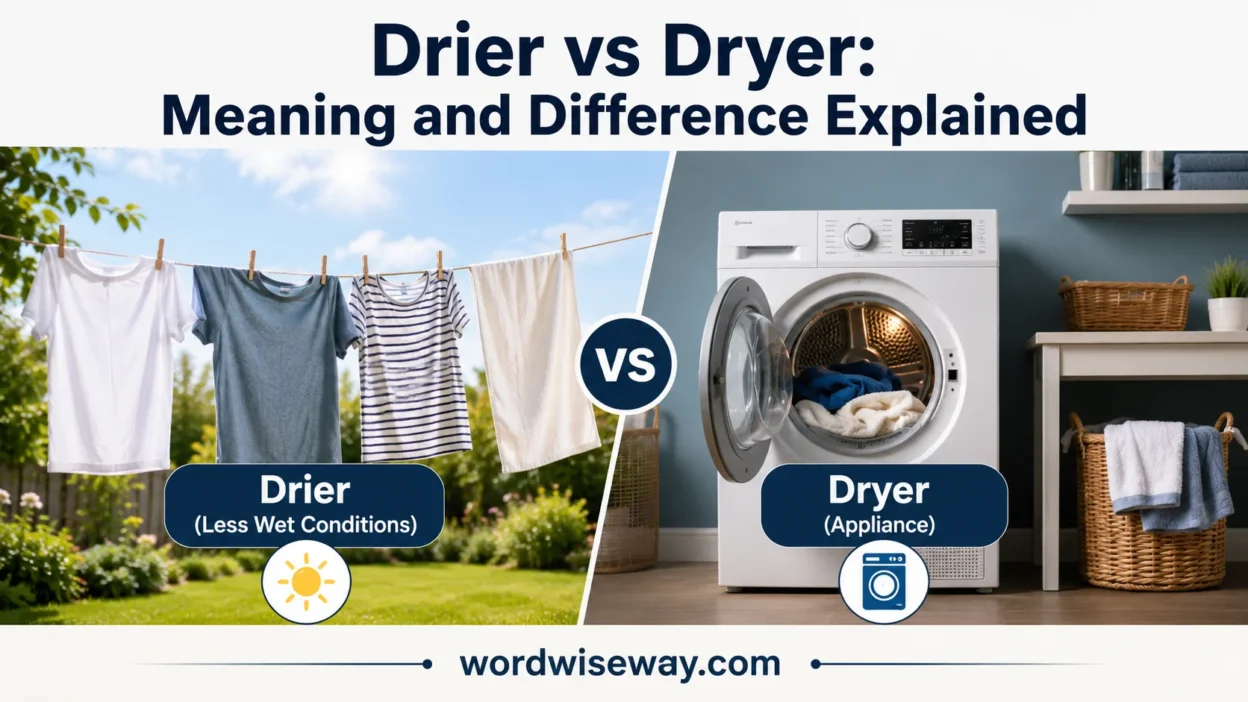
- Drier → an adjective meaning less wet
- Dryer → a noun meaning a machine or device that removes moisture
Simple rule that sticks:
Drier describes. Dryer does.
If you remember nothing else, remember that line. It works like a mental shortcut every time.
Understanding “Drier” in Drier vs Dryer
When people say drier, they are comparing levels of moisture. It is the comparative form of the adjective “dry.”
Think of it like a sliding scale:
Dry → Drier → Driest
What “drier” actually means
“Drier” means something has less water or moisture compared to something else.
It never refers to a machine. It never refers to an object that performs drying. It only describes a condition.
Everyday examples of “drier”
You’ll see it used in simple, familiar situations:
- “This towel is drier than the one I used yesterday.”
- “The air feels drier in winter.”
- “My clothes are drier after being outside for an hour.”
Weather example (very common usage)
Weather reports often use this word:
- “Today will be drier than the weekend.”
Here, it compares humidity levels. No machines involved.
A useful mental picture
Imagine squeezing a sponge.
- Wet sponge → dry sponge → even drier sponge
You are not adding any tool. You are only changing moisture levels.
That is drier in action.
Understanding “Dryer” in Drier vs Dryer
Now we step into a completely different world.
A dryer is a thing. A device. A machine. Something that performs an action.
What “dryer” means
A dryer is a noun referring to equipment that removes moisture from something.
It is used in homes, salons, laundromats, and even public bathrooms.
Common types of dryers
You encounter dryers more often than you think:
- Clothes dryer → dries laundry using heat and rotation
- Hair dryer → blows hot air to dry wet hair
- Hand dryer → found in public washrooms
Each one performs the same core job: removing moisture using energy.
Everyday examples of “dryer”
- “I forgot to empty the dryer after laundry.”
- “She used a hair dryer before leaving.”
- “The hand dryer was too loud.”
Important distinction
A dryer does something. It is an actor in the sentence.
- Dryer = machine = performs action
- Drier = description = compares condition
Read More: Cubical vs Cubicle: Difference, Examples, and Mistakes
Drier vs Dryer: Side-by-Side Comparison
To make things crystal clear, here’s a structured breakdown.
| Word | Part of Speech | Meaning | Function in Sentence | Example |
| Drier | Adjective | Less wet than something else | Describes condition | “The soil is drier today.” |
| Dryer | Noun | Machine that removes moisture | Acts as an object/tool | “The dryer stopped working.” |
This table alone solves most confusion instantly.
Why People Confuse Drier vs Dryer So Easily
English is full of traps like this. The confusion happens for three main reasons:
They sound identical
Both are pronounced the same way in most accents. Your ears can’t help you here.
They look almost the same
Only one letter separates them, which is easy to overlook while writing fast.
They appear in similar contexts
Laundry, weather, and moisture-related conversations often include both words.
So your brain tries to simplify them into one idea. That’s where mistakes happen.
Memory Tricks for Drier vs Dryer
Let’s lock this into memory with simple techniques.
Trick 1: The “E” rule
- Dryer has an E → think Electric machine
- Drier has I → think Intensity of dryness
Trick 2: The action test
Ask yourself:
“Is something doing the drying?”
- Yes → dryer
- No → drier
Trick 3: The replacement test
Try swapping the word:
- “My clothes are dryer than yesterday” → sounds wrong
- “My clothes are drier than yesterday” → correct
- “Put it in the drier” → wrong
- “Put it in the dryer” → correct
Your instincts will start catching errors quickly.
Real-Life Confusion Scenarios (Where People Mess Up)
Let’s step into situations where this confusion actually happens.
Laundry room mistake
A student once wrote:
“I left my clothes in the drier overnight.”
Technically incorrect. The machine is a dryer, not “drier.”
Correct version:
“I left my clothes in the dryer overnight.”
Weather app misunderstanding
Another common mistake:
“Tomorrow will be dryer than today.”
Weather reports describe conditions, not machines.
Correct:
“Tomorrow will be drier than today.”
Text message confusion
People often type fast and mix them:
- “Use the hair drier”
- “My shirt got dryer after sun”
These small slips can change meaning completely.
Mini Case Study: The Student Who Lost Marks Over One Letter
A high school essay described a summer scene:
“The weather was dryer than usual, and the fields looked dusty.”
The teacher marked it wrong.
Why?
Because “dryer” implies a machine. The correct word should describe climate conditions, not objects.
Correct sentence:
“The weather was drier than usual, and the fields looked dusty.”
This single-letter mistake changed grammatical accuracy.
It’s a small example, but it shows how precision matters in writing.
Grammar Breakdown of Drier vs Dryer
Let’s break the mechanics down simply.
Drier: Comparative adjective
- Base word: dry
- Comparative form: drier
- Superlative: driest
Rule:
When a word ends in a consonant + y, change y → i and add -er.
Example:
- dry → drier
- happy → happier
- heavy → heavier
Dryer: Noun formation
Many English nouns use the suffix “-er” to show:
- a person who does something
- a tool that performs an action
Examples:
- teacher → teaches
- driver → drives
- dryer → dries
So “dryer” naturally fits into the category of tools and machines.
Quick Comparison Table: Drier vs Dryer in Real Context
| Situation | Correct Word | Why |
| Laundry machine | Dryer | It is a device |
| Weather condition | Drier | It describes climate |
| Hair styling tool | Dryer | It is an appliance |
| Soil after sun | Drier | It describes moisture |
| Public restroom tool | Dryer | It is a machine |
Practice Section: Test Yourself
Fill in the blanks:
- The clothes are much ___ after an hour in the sun.
- I turned on the ___ to dry my hair.
- The air feels ___ in winter than in summer.
- The ___ stopped working suddenly.
- This towel is ___ than the one on the rack.
Answer key
- drier
- dryer
- drier
- dryer
- drier
If you got all five right, you’ve basically mastered the concept.
FAQs
Q1. What is the difference between drier and dryer?
Drier is the comparative form of dry, while dryer is a machine or device used to remove moisture from clothes, hair, food, or other items. The spelling depends on whether you are making a comparison or referring to an appliance.
Q2. Is drier a correct English word?
Yes, drier is a correct English word. It is the comparative adjective of dry and is used when comparing one thing with another, such as “Today’s weather is drier than yesterday.”
Q3. When should I use dryer instead of drier?
Use dryer when talking about a machine or appliance, such as a clothes dryer or hair dryer. It is never used as the comparative form of the adjective dry.
Q4. Why do people confuse drier and dryer?
The two words look almost identical and have similar pronunciation. Since both relate to the idea of dryness, many writers accidentally choose the wrong spelling.
Q5. Is dryer a noun or an adjective?
Dryer is primarily a noun because it refers to a device or machine. In some specialized contexts, it may also function as an adjective, but the noun form is the most common.
Q6. Can drier and dryer be used interchangeably?
No. Modern English treats them as separate words with different meanings. Using one in place of the other can change the meaning of a sentence.
Q7. Which spelling is more common in modern writing?
Both spellings are common, but they appear in different contexts. Drier is common in comparisons, while dryer is more common when discussing appliances and equipment.
Q8. How can I remember the difference between drier and dryer?
A simple trick is to remember that dryer contains “er” like many machine names, while drier is the comparative form of dry used for comparisons.
Q9. Do dictionaries accept both drier and dryer?
Yes. Most dictionaries recognize both spellings, but they clearly define different meanings and recommend using each word in its proper context.
Q10. Can using the wrong spelling affect professional writing?
Yes. Using the wrong word in emails, reports, product descriptions, or technical documents can confuse readers and reduce the credibility of your writing.
Conclusion
Understanding the difference between drier and dryer makes your writing clearer and more accurate. Although the words look similar, each has a distinct purpose, and choosing the correct one helps readers understand your message without confusion.
With a little practice, the correct spelling becomes easy to remember. Whether you are writing emails, articles, product descriptions, or technical content, using drier and dryer correctly will improve both your grammar and your confidence.