Elses or Else’s: Which Is Correct?and Difference depends on the correct form, meaning, and context. In English, else’s is normally the possessive form of else, while elses is not standard. The apostrophe matters in apostrophe usage because it can show possession.
For English grammar, understanding the grammar rules helps you place the apostrophe correctly and know when you need an apostrophe. This small detail can change the sentence meaning and affect how the word is understood. Phrases like someone else, anyone else, and nobody else can use else’s.
The grammatical usage depends on contextual meaning. Else’s usually shows possession, not a plural form. Elses may be a mistake involving the possessive structure. This guide helps you use the right version in real life and every time, including phrases about something else.
Quick Answer:
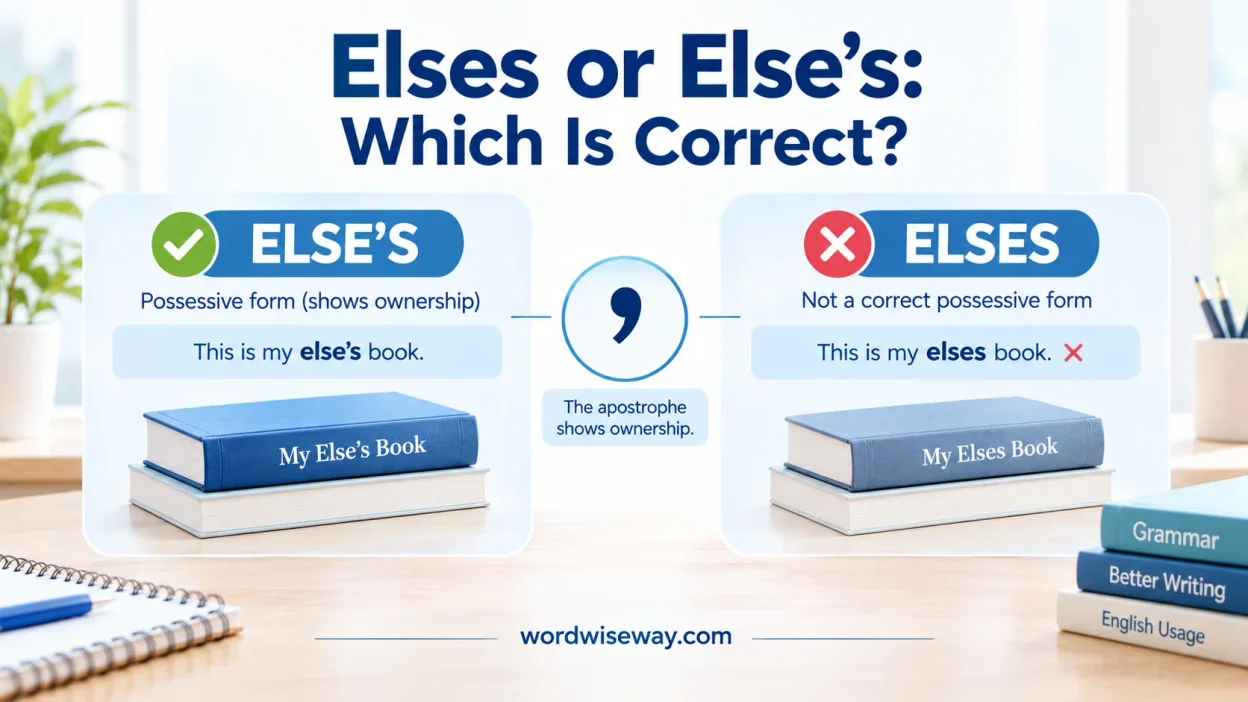
Else’s is correct when you need the possessive form.
Elses is not the standard spelling for showing possession. If something belongs to another person, use else’s.
| Form | Correct? | Use | Example |
| else | ✓ | Refers to another, different, or additional person or thing | Who else is coming? |
| else’s | ✓ | Shows possession or association | That is someone else’s bag. |
| elses | ✗ | Not the standard possessive form | Someone elses bag |
| someone’s else | ✗ | Incorrect word order | Someone’s else bag |
A simple rule will help you remember it:
else = another or different
else’s = belonging to another
So:
someone else → someone else’s
anyone else → anyone else’s
everyone else → everyone else’s
What Does Else’s Mean?
Else’s is the possessive form used when something belongs to, comes from, or is associated with someone or something else.
The word else generally means another, different, or additional. When you add ’s, the expression becomes possessive.
Compare these sentences:
Someone else called me.
Someone else’s phone is ringing.
In the first sentence, else means another person. In the second sentence, else’s tells you that the phone belongs to that other person.
That small apostrophe changes the grammatical function of the phrase.
Examples of Else’s in Sentences
Here are several natural examples:
- This isn’t my jacket. It’s someone else’s.
- Someone else’s car is parked outside.
- We shouldn’t use anyone else’s account.
- Everyone else’s answer was different.
- I accidentally picked up somebody else’s notebook.
- Nobody else’s opinion changed my decision.
- Was this someone else’s idea?
- The responsibility belongs to someone else.
- I think this is somebody else’s seat.
- Did you take anyone else’s pen?
In every possessive example, the apostrophe appears after else.
Is Elses a Correct Word?
When you’re trying to express possession, elses isn’t the correct form.
For example:
❌ Someone elses phone is on the table.
The correct sentence is:
✓ Someone else’s phone is on the table.
The mistake happens because elses may look like a natural plural form. However, that’s not how this grammatical construction works.
You don’t create the possessive by simply adding s to else. Instead, you add an apostrophe followed by s:
else + ’s = else’s
This distinction matters because the apostrophe signals possession.
The same rule applies to larger expressions:
- someone else’s
- somebody else’s
- anyone else’s
- anybody else’s
- everyone else’s
- everybody else’s
- nobody else’s
- no one else’s
So if you see someone elses, check whether the sentence is trying to show ownership. If it is, the apostrophe belongs before the s.
Understanding the Possessive Form
The difference between else and else’s becomes simple when you focus on meaning.
Use else when you mean another, different, or additional.
Use else’s when you mean belonging to another person or thing.
Consider these examples:
| Sentence | What It Means |
| Who else is coming? | Which other person is coming? |
| Who else’s bag is this? | Which other person owns this bag? |
| I need something else. | I need another thing. |
| I need someone else’s help. | I need help from another person. |
| Where else can we go? | What other place can we visit? |
| We visited someone else’s house. | The house belongs to another person. |
| Everyone else left. | All the other people left. |
| Everyone else’s work was finished. | The work belonged to the other people. |
The apostrophe isn’t simply a spelling decoration. It communicates a grammatical relationship.
Someone Else vs. Someone Else’s
Someone else means another person.
Example:
Someone else will answer the question.
Someone else’s means belonging to another person.
Example:
That is someone else’s answer.
The difference is easy to spot once you ask what the sentence means.
Someone else identifies another person.
Someone else’s identifies something belonging to that person.
Somebody Else vs. Somebody Else’s
The same rule applies to somebody.
Somebody else left a message.
Here, else means another person.
Somebody else’s message was confusing.
Here, else’s shows possession.
The apostrophe doesn’t go after somebody. It goes after the complete phrase somebody else.
Correct:
somebody else’s
Incorrect:
somebody elses
Incorrect:
somebody’s else
Anyone Else vs. Anyone Else’s
Anyone else means any other person.
Does anyone else know the answer?
Anyone else’s shows possession.
Did you take anyone else’s notebook?
The first sentence asks whether another person knows something. The second asks about a notebook belonging to another person.
Everyone Else vs. Everyone Else’s
Everyone else refers to all the other people in a particular group.
Example:
Everyone else finished the assignment.
Add the possessive form when something belongs to those other people:
Example:
Everyone else’s assignment was complete.
The correct structure is everyone else’s.
Not everyone elses.
Not everyone’s else.
Why Do We Write Someone Else’s Instead of Someone Elses?
The easiest way to understand this is to treat someone else as a complete phrase.
First, you have:
someone else
This means another person.
When that person becomes the possessor of something, add ’s to the end:
someone else’s
Then add the thing being possessed:
someone else’s phone
The structure looks like this:
someone + else + ’s + noun
For example:
someone + else + ’s + book
anyone + else + ’s + idea
everyone + else + ’s + opinion
nobody + else + ’s + responsibility
This pattern makes the rule much easier to remember.
Think of Someone Else as One Unit
Imagine that someone else is one grammatical package. When you make the entire package possessive, the apostrophe goes at the end.
You don’t split the phrase apart.
You don’t write:
❌ someone’s else
You write:
✓ someone else’s
This is why the apostrophe appears after else.
Common Mistakes
Apostrophe mistakes involving else are common because the incorrect versions often look almost right. Here are the forms you should watch for.
Someone Elses
Incorrect:
❌ I borrowed someone elses book.
Correct:
✓ I borrowed someone else’s book.
The book belongs to another person, so else’s is possessive.
Somebody Elses
Incorrect:
❌ That is somebody elses jacket.
Correct:
✓ That is somebody else’s jacket.
The apostrophe goes between else and s.
Anyone Elses
Incorrect:
❌ I don’t want anyone elses opinion.
Correct:
✓ I don’t want anyone else’s opinion.
The phrase anyone else becomes possessive as a whole.
Everyone Elses
Incorrect:
❌ Everyone elses answers were different.
Correct:
✓ Everyone else’s answers were different.
Again, the apostrophe appears after else.
Else’s in Questions
Questions often use else’s when asking about ownership.
For example:
- Is this someone else’s phone?
- Could this be somebody else’s jacket?
- Did you take anyone else’s notebook?
- Who else’s name is on the list?
- Was this someone else’s idea?
- Whose else’s work was included?
The difference becomes especially clear when you compare two similar questions.
Who else is coming?
This asks about another person.
Who else’s bag is this?
This asks which other person’s bag it is.
The word else identifies another person or thing. The possessive else’s connects that person or thing to something they own or are associated with.
Else’s vs. Else: Side-by-Side Examples
A side-by-side comparison can make the distinction almost effortless.
| Correct Sentence | Explanation |
| Who else is attending? | Else means another person. |
| Who else’s ticket is missing? | Else’s shows possession. |
| I need something else. | Else means another thing. |
| I used someone else’s computer. | The computer belongs to another person. |
| Everyone else left. | Else refers to all other people. |
| Everyone else’s work was finished. | The work belongs to the other people. |
| Is this somebody else’s seat? | The seat belongs to another person. |
| Nobody else knew. | No other person knew. |
| Nobody else’s answer matched mine. | No other person’s answer matched it. |
When you compare the sentences this way, the apostrophe has a clear job.
How to Choose Between Else and Else’s
When you’re unsure, ask one simple question:
Does the sentence show possession?
If the answer is yes, you probably need else’s.
For example:
I found someone else ___ notebook.
Ask:
Whose notebook?
The answer is another person’s notebook.
Therefore:
I found someone else’s notebook.
Now look at this sentence:
Who ___ should we invite?
There is no possession. You’re asking about another person.
Therefore:
Who else should we invite?
This quick test works in everyday writing, school assignments, emails, and professional communication.
The Ownership Test
Try replacing the phrase with belonging to another person.
If the replacement makes sense, else’s is likely appropriate.
For example:
someone else’s phone
means:
a phone belonging to another person
But:
Who else is here?
doesn’t express ownership.
It means:
Which other person is here?
Therefore, use else.
Can Else’s Appear Without a Noun?
Yes. You don’t always need to write a noun after else’s.
For example:
This isn’t my pen. It’s someone else’s.
The word pen isn’t repeated because the reader already knows what you’re discussing.
You could write:
This isn’t my pen. It’s someone else’s pen.
However, the shorter version sounds more natural because the repeated noun isn’t necessary.
Another example:
That isn’t my jacket. It’s somebody else’s.
The missing noun is understood from context.
This is a useful feature of English. Once the meaning is clear, you can leave repeated information out.
Else’s Does Not Mean “Else Is”
The ending ’s can represent different grammatical forms in English. Sometimes it creates a contraction:
It’s cold.
Here, it’s means it is.
In a possessive expression, however, ’s can show ownership:
someone else’s phone
Here, else’s doesn’t mean else is.
The surrounding words make the meaning clear.
This distinction is worth remembering because apostrophes can perform different jobs. In someone else’s, the apostrophe marks possession.
Why “Someone’s Else” Is Incorrect
Another common mistake is placing the apostrophe after someone:
❌ someone’s else
The standard construction is:
✓ someone else’s
Why? Because someone else forms the complete phrase referring to the person.
When you make that phrase possessive, the possessive ending goes at the end.
The same pattern applies to:
- somebody else’s
- anyone else’s
- anybody else’s
- everyone else’s
- everybody else’s
- nobody else’s
- no one else’s
The rule stays consistent even when the first word changes.
A Simple Grammar Pattern to Remember
You can remember the entire rule with one formula:
Indefinite pronoun + else + ’s + noun
Here are some examples:
someone + else + ’s + phone
Someone else’s phone is ringing.
anyone + else + ’s + idea
I don’t want anyone else’s idea.
everyone + else + ’s + opinion
Everyone else’s opinion was different.
nobody + else + ’s + responsibility
It wasn’t anybody else’s responsibility.
Once you recognize this pattern, you don’t have to memorize every phrase separately.
Facts
Keep these points in mind when writing:
- Else can mean another, different, or additional.
- Else commonly follows words such as someone, somebody, anyone, anybody, everyone, everybody, nobody, and no one.
- Else also appears after question words such as who, what, where, when, why, and how.
- Else’s is used to create a possessive expression.
- Someone else’s is the standard possessive form.
- Someone elses is incorrect when you mean possession.
- Someone’s else is also incorrect in standard usage.
- Else’s can appear without a noun when the missing noun is already understood.
- The apostrophe comes after else, not after the preceding pronoun.
These rules cover most situations where writers confuse elses and else’s.
A Practical Example: Correcting a Sentence
Suppose you write:
❌ I accidentally took someone elses notebook.
The sentence has a missing apostrophe.
Correct it to:
✓ I accidentally took someone else’s notebook.
Now try another:
❌ Everyone elses opinion was different.
Correct it to:
✓ Everyone else’s opinion was different.
One more example:
❌ Is this somebody elses seat?
Correct it to:
✓ Is this somebody else’s seat?
The correction is the same each time. Add the apostrophe before the s in else’s.
How to Remember Else’s
Here’s the easiest rule:
If something belongs to someone else, put the apostrophe after else.
Think of the basic transformation:
someone else → someone else’s
Then apply the same pattern:
somebody else → somebody else’s
anyone else → anyone else’s
everyone else → everyone else’s
nobody else → nobody else’s
You can also use the “whose?” test.
If the sentence answers whose, the possessive form may be needed.
Whose phone is this?
Someone else’s.
If the sentence asks about another person or thing without showing possession, use else.
Who else is coming?
This simple test can save you from many apostrophe mistakes.
Read More: Dove or Dived: Correct Spelling, Meaning, and usage
FAQs
Is “elses” a correct English word?
No, elses is generally not considered the standard form in English. If you want to show possession, else’s is usually the correct choice.
When should I use “else’s”?
Use else’s when something belongs to someone or something described with else. For example, you might refer to another person’s idea or property.
What does the apostrophe in “else’s” mean?
The apostrophe usually marks possession. In else’s, it helps show that something belongs to another person or thing.
Is “else’s” a possessive form?
Yes. Else’s is commonly used as a possessive form. It can follow expressions such as someone else, anyone else, or nobody else.
Can “else’s” be used with someone else?
Yes. Someone else’s is a common grammatical structure when you want to show that something belongs to another person.
Is “someone elses” grammatically correct?
No. The standard possessive spelling is someone else’s, with the apostrophe before the s.
Does “else’s” mean more than one person?
No. Else’s does not normally indicate a plural. The apostrophe is used to express possession rather than to make the word plural.
How can I remember the difference between “elses” and “else’s”?
Think about possession. If you mean that something belongs to someone else, use else’s. The apostrophe is the useful clue.
Why do people write “elses” by mistake?
People may omit the apostrophe because they treat else like an ordinary word that simply receives an s. However, the intended possessive form is normally else’s.
What is the correct form in everyday writing?
For standard English grammar, use else’s when expressing possession. Check the surrounding context and sentence meaning to make sure the apostrophe is serving the intended grammatical purpose.
Conclusion
Choosing between elses and else’s is easier once you understand what the apostrophe is doing. Else means another, different, or additional person or thing, while else’s is used when you want to show possession or association. For example, someone else is calling and someone else’s phone is ringing have different grammatical functions.
The form elses is not the standard spelling when you mean possession. If something belongs to another person, the apostrophe should come before the s: someone else’s, anyone else’s, everyone else’s, or nobody else’s. Remember that the entire phrase comes first, and the possessive ending is added to else, not to someone, anyone, or another preceding word.
A simple way to remember the rule is someone else → someone else’s. If you can ask “Whose?”, you may need the possessive form else’s. Once you recognize this pattern, you can avoid common mistakes such as someone elses or someone’s else and use the correct form confidently in everyday writing.

Emma Smith has dedicated 14 years to Princeton University’s English Department, mentoring students in textual interpretation, literary movements, and critical frameworks. Her research explores Shakespearean drama, Victorian serial fiction, postcolonial narrative theory, and manuscript studies and probing how literary forms evolve across cultures and centuries. Emma has delivered lectures at international humanities congresses and published findings in distinguished academic journals, underscoring her commitment to scholarly depth and vibrant teaching.