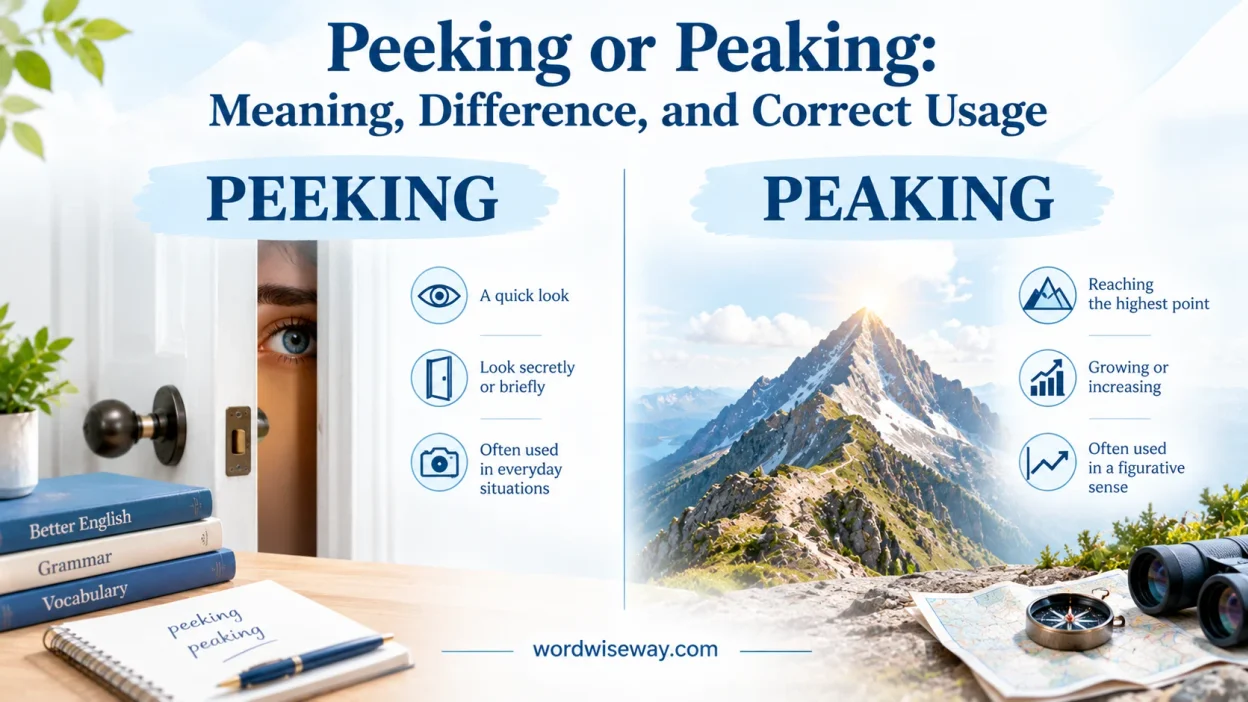
English learners and native speakers often confuse peeking and peaking because the words sound almost the same, yet they have different meanings. Peeking means looking quickly or secretly, often through a window, while peaking means reaching the highest level or point. Understanding the spelling, context, origin, and spelling differences makes the difference easier to recognize.
A useful guide is to remember the situation before you use either word. In writing, emails, social media posts, and school assignments, the correct word matters. For example, “She was peeking through the window,” but “Sales are peaking this month.” A small mistake can change the sentence meaning.
Spellcheck may not catch these common mistakes because both are correct spellings. Check the context instead of relying on sound. These examples and usage trends help speakers and writers choose the right spelling and keep writing mistakes under control.
Quick Answer:
Peeking means looking quickly, briefly, or secretly at something.
Peaking means reaching the highest point, level, stage, or degree of something.
| Word | Base Word | Meaning | Example |
| Peeking | Peek | Looking quickly or secretly | She was peeking through the curtain. |
| Peaking | Peak | Reaching a highest point or level | Sales are peaking this month. |
A simple memory trick can settle the question instantly:
- Peek → Look
- Peak → Top
- Peeking → Looking
- Peaking → Reaching the top
So, if you mean taking a look, choose peeking. If you mean reaching a maximum, choose peaking.
What Does Peeking Mean?
Peeking is the present participle and gerund form of the verb peek. To peek means to take a quick or cautious look at something, often without being fully seen or noticed.
The action usually involves a short glance rather than prolonged observation. Someone might peek through a doorway, peek around a corner, peek at a message, or peek inside a box.
For example:
She was peeking through the window to see who had arrived.
Here, peeking describes the act of looking through the window.
The word can also suggest curiosity. A child might peek inside a wrapped present because they want to discover what’s inside before the proper time. Someone waiting for an announcement might peek at a screen to check whether new information has appeared.
Peeking Definition and Meaning
The core meaning of peeking is simple: looking quickly or secretly.
Depending on the context, it can describe:
- Taking a brief glance
- Looking through a small opening
- Looking around an obstacle
- Secretly checking something
- Looking at something before you’re supposed to
- Taking a quick look out of curiosity
The word doesn’t necessarily imply bad intentions. A person can peek because they’re curious, cautious, playful, or simply trying to see something that isn’t immediately visible.
For example:
- The cat was peeking around the corner.
- I caught him peeking at the answer.
- She was peeking through the doorway.
- The child kept peeking inside the gift box.
- He opened the door slightly and started peeking outside.
In each sentence, the action involves looking.
How to Use Peeking in a Sentence
Peeking commonly appears with verbs such as was, were, is, are, and keep when describing an ongoing or repeated action.
Consider these examples:
- “The students were peeking at the clock.”
- “She is peeking through the blinds.”
- “The puppy kept peeking out from under the table.”
- “He was peeking around the door.”
- “Stop peeking at my screen.”
The surrounding words usually make the meaning obvious. If the sentence describes eyes, windows, doors, screens, corners, or hidden objects, peeking may be the word you need.
Peeking as a Verb
As a verb, peeking describes an action.
For example:
The little boy was peeking through the keyhole.
The subject is performing the action of looking.
The base verb is peek, and its present participle form is peeking.
| Verb Form | Example |
| Peek | I peek through the window. |
| Peeks | She peeks around the corner. |
| Peeked | He peeked inside the room. |
| Peeking | They were peeking through the door. |
Notice the spelling carefully. The word peek already ends with two vowels followed by k, so the -ing form becomes peeking, not peaking.
Peeking as a Gerund
Peeking can also function as a gerund, meaning the word acts like a noun while retaining its verb-like meaning.
For example:
Peeking at the answers won’t help you understand the lesson.
Here, peeking names an activity. It isn’t simply describing what someone is doing at that moment.
Another example is:
Peeking through the curtains became her habit.
The word refers to the activity itself.
What Does Peaking Mean?
Peaking is the present participle and gerund form of the verb peak. It means reaching or approaching the highest point, level, amount, intensity, or stage.
Unlike peeking, this word has nothing to do with looking.
For example:
The athlete is peaking at exactly the right stage of the season.
The sentence means the athlete’s performance is reaching its highest level.
The word peak can describe both physical and abstract extremes. You can talk about the peak of a mountain, but you can also discuss peak performance, peak demand, peak popularity, or peak activity.
Peaking Definition and Meaning
The central idea behind peaking is maximum level or highest point.
You might use it when discussing:
- Athletic performance
- Career development
- Popularity
- Sales
- Traffic
- Demand
- Energy
- Temperature
- Production
- Population
- Seasonal activity
- Performance levels
For example:
- “Traffic is peaking during the evening rush.”
- “The athlete is peaking before the championship.”
- “Demand for the product is peaking this week.”
- “Her career was peaking during that period.”
- “Tourist activity is peaking during the summer.”
Each sentence involves something reaching a high or maximum level.
How to Use Peaking in a Sentence
The word peaking often appears when something is increasing toward its highest point or has reached a particularly strong stage.
For example:
Customer demand is peaking during the holiday season.
Here, demand is reaching its maximum level.
Similarly:
The runner appears to be peaking just before the final race.
The sentence refers to performance rather than physical height.
The word can describe a temporary high point or a stage within a longer process. That’s why you’ll often see it in discussions about sports, business, trends, careers, and seasonal patterns.
Peaking as a Verb
As a verb, peaking describes the process of reaching a peak.
Consider the progression:
| Verb Form | Example |
| Peak | Sales may peak in December. |
| Peaks | Demand peaks during the holidays. |
| Peaked | Traffic peaked at noon. |
| Peaking | Demand is peaking this week. |
The meaning remains connected to reaching a maximum point.
Peaking as a Gerund
Like peeking, peaking can function as a gerund.
For example:
Peaking too early can affect an athlete’s performance later.
Here, peaking names the process of reaching maximum performance.
Another example:
The company’s peaking in popularity attracted new customers.
In this construction, the word functions grammatically as a noun.
The Key Difference
The easiest way to understand peeking vs. peaking is to focus on their base words.
Peek relates to looking.
Peak relates to a highest point.
That distinction remains intact when you add -ing.
| Feature | Peeking | Peaking |
| Base word | Peek | Peak |
| Main meaning | Looking quickly | Reaching a high point |
| Related idea | Sight | Maximum level |
| Common contexts | Windows, doors, screens, corners | Sports, sales, demand, performance |
| Example | She was peeking through the door. | Sales are peaking this month. |
The difference becomes especially clear when you place the words in similar sentences.
The child was peeking through the curtain.
The team’s performance was peaking before the tournament.
The first sentence describes an action involving sight. The second describes an increase toward maximum performance.
Peeking Means Looking
Think of peeking as an action involving your eyes.
You might:
- Peek through a window.
- Peek around a corner.
- Peek inside a box.
- Peek at a text message.
- Peek through a doorway.
The common thread is always looking.
Peaking Means Reaching a High Point
Think of peaking as movement toward the top of a scale.
Something can peak in:
- Quality
- Performance
- Popularity
- Demand
- Volume
- Temperature
- Activity
- Production
For example, if a store experiences its greatest number of customers during December, customer traffic may be said to peak in December.
The word doesn’t mean something is physically tall. It means something reaches its maximum or highest level.
Why Are Peeking and Peaking Confused?
The biggest reason for confusion is pronunciation.
In standard English, peek and peak are homophones. They have the same pronunciation but different spellings and meanings. Consequently, their -ing forms also sound alike.
That creates a classic spelling trap.
When you hear someone say the word, you can’t determine the spelling from sound alone. You need to understand the sentence.
For example, imagine hearing:
“Traffic is ___ during the afternoon.”
The meaning points toward peaking because traffic can reach a high level.
Now consider:
“She was ___ through the window.”
The meaning clearly points toward peeking because someone is looking.
Context is the deciding factor.
Examples
Seeing the words in real sentences makes the difference much easier to remember.
Examples With Peeking
- The kitten was peeking around the sofa.
- She kept peeking at her phone during the meeting.
- He was peeking through the partially open door.
- The child was peeking inside the gift.
- I saw someone peeking through the curtains.
- Stop peeking at my notes.
- The puppy started peeking out from behind the chair.
- She opened the box slightly and began peeking inside.
Every example involves looking.
Examples With Peaking
- Demand is peaking during the holiday season.
- The athlete is peaking at the right time.
- Online traffic is peaking in the evening.
- The singer’s popularity was peaking after the album’s release.
- Temperatures are peaking in the afternoon.
- Production is peaking this quarter.
- The team’s performance appears to be peaking before the finals.
- Tourist activity is peaking during the summer months.
Every example involves reaching a high or maximum level.
Side-by-Side Comparison
| Peeking | Peaking |
| She was peeking through the window. | Demand was peaking in December. |
| He kept peeking at the answer. | The athlete was peaking before the event. |
| The cat was peeking around the corner. | Traffic was peaking during rush hour. |
| I caught her peeking inside the box. | Sales were peaking during the promotion. |
| The child was peeking through the doorway. | His performance was peaking that season. |
This comparison reveals the entire distinction: peeking involves looking, while peaking involves reaching a high point.
Peek, Peak, Peeking, and Peaking
Understanding the base words makes the four forms much easier to separate.
Peek
Peek means to take a quick or secret look.
Example:
“She decided to peek through the doorway.”
It can function as both a verb and a noun.
“He took a quick peek inside.”
Peak
Peak refers to the highest point or level. It can also function as a verb meaning to reach that point.
Example as a noun:
“The mountain’s peak was covered in snow.”
Example as a verb:
“Sales usually peak during the holiday season.”
Peeking
Peeking means performing the action of looking quickly.
“She was peeking through the blinds.”
Peaking
Peaking means reaching or approaching a highest level.
“Demand is peaking this week.”
A useful four-word distinction is:
| Word | Think |
| Peek | Look |
| Peak | Top |
| Peeking | Looking |
| Peaking | Reaching the top |
Which Spelling Is Correct?
Both “peeking” and “peaking” are correct spellings. The correct choice depends entirely on the meaning you want.
Use peeking when the sentence involves looking.
She was peeking through the door.
Use peaking when something reaches its highest level or point.
Sales are peaking this month.
Neither spelling is simply an alternative version of the other. They represent different words derived from different base verbs.
A Quick Decision Test
Ask yourself one question:
Does the sentence involve looking?
- Yes: Use peeking.
- No, it involves reaching a maximum: Use peaking.
For example:
“The students were ___ at the test answers.”
They’re looking, so the correct word is peeking.
“The team’s performance is ___ before the final.”
The performance is reaching a high level, so the correct word is peaking.
Common Mistakes
Using Peaking When You Mean Looking
Incorrect:
She was peaking through the window.
Correct:
She was peeking through the window.
Why? The person is looking through the window. Nothing is reaching a maximum level.
Using Peeking When You Mean Reaching a High Point
Incorrect:
Sales are peeking during December.
Correct:
Sales are peaking during December.
Why? The sentence describes sales reaching their highest level.
Confusing Peek With Peak
The same mistake often starts with the base words.
Incorrect:
“Take a peak inside the box.”
Correct:
“Take a peek inside the box.”
Here, the intended meaning is a quick look.
Conversely:
“The mountain’s peek is covered with snow.”
Correct:
“The mountain’s peak is covered with snow.”
A mountain has a peak, meaning its highest point.
Choosing the Word by Sound Alone
This is where many spelling mistakes happen.
Because peek and peak sound alike, pronunciation won’t tell you which spelling to choose. Instead, identify the meaning first.
Think about the sentence before you think about the letters.
If you’re talking about eyes, peek is probably involved. If you’re talking about a maximum, peak is likely the right family.
Easy Ways to Remember
Remember Peeking With “Look”
Associate peek with a quick look.
Imagine someone quietly looking around a door.
Peek → Look → Peeking
That chain connects the spelling to its meaning.
Remember Peaking With “High Point”
Associate peak with the top of a mountain.
A mountain has a peak, which represents its highest point.
Peak → Top → Peaking
This mental picture can prevent the two spellings from getting tangled.
A Simple Memory Trick
Use this compact rule:
Peek with your eyes. Peak at the top.
The extra e in peek can remind you of eyes and looking. Meanwhile, peak connects naturally with the top of a mountain.
It doesn’t need to be complicated. One strong mental image can do more work than memorizing a paragraph of definitions.
Peeking or Peaking in Different Contexts
Everyday Situations
Peeking appears frequently in everyday situations involving curiosity or quick observation.
You might peek through a door, peek inside a package, or peek at a notification. These uses all center on the act of looking.
School and Work
The distinction can also appear in academic and professional contexts.
For example:
“The student was peeking at another student’s answers.”
That’s about looking.
However:
“The company’s sales are peaking this quarter.”
That’s about reaching a high level.
The surrounding context changes everything.
Sports
Sports writing often uses peaking to describe an athlete or team reaching a particularly strong level of performance.
“The runner is peaking at the right point in the season.”
Meanwhile, peeking can describe someone taking a quick look.
“The player was peeking at the scoreboard.”
One letter changes the meaning dramatically.
Business and Trends
Businesses often use peak and peaking when discussing demand, traffic, sales, production, or seasonal activity.
For example:
“Website traffic is peaking in the evening.”
This means traffic reaches its highest level around that period.
On the other hand:
“The manager was peeking at the website statistics.”
This means the manager was taking a quick look at the statistics.
Case Study: How Context Solves the Spelling Problem
Consider this short situation.
A company notices that its website receives the most visitors between 7 p.m. and 9 p.m. A manager checks the analytics dashboard during that period.
Two sentences could describe what happened:
The manager was peeking at the analytics dashboard.
The manager was taking a quick look.
Website traffic was peaking between 7 p.m. and 9 p.m.
The traffic was reaching its highest level.
Both sentences use words that sound alike. Yet their meanings remain completely separate.
This is why context beats pronunciation when choosing between peeking or peaking.
Facts
- Peek and peak are different words with different meanings.
- Peeking comes from peek.
- Peaking comes from peak.
- Peek relates to taking a quick look.
- Peak relates to the highest point or level.
- Peeking can describe an ongoing act of looking.
- Peaking can describe something reaching its maximum level.
- The two words are pronounced alike in standard English.
- Their meanings must therefore be determined from context.
- Both peeking and peaking are legitimate English spellings.
Read More: NOOK or Kindle: Which E-Reader Should You Choose?
FAQs
What does peeking mean?
Peeking means taking a quick or secret look at something. You might peek through a window, peek at a gift, or peek around a door.
What does peaking mean?
Peaking means reaching the highest point, level, or stage. For example, a person’s performance may be peaking when they are performing at their highest level.
What is the difference between peeking and peaking?
The main difference is their meaning. Peeking relates to looking, while peaking relates to reaching a maximum or highest point.
Is peeking the correct spelling for looking?
Yes. Peeking is the correct spelling when you mean taking a quick look. For example, “The child was peeking through the window.”
Is peaking related to the word peak?
Yes. Peaking comes from peak, which refers to the highest point or level. When something is peaking, it is reaching or approaching that point.
Why do people confuse peeking and peaking?
People often confuse them because they sound very similar when spoken. Their different meanings and spellings become clearer when you look at the sentence’s context.
Is “peeking through the window” correct?
Yes, peeking through the window is correct when someone is taking a quick look through it. The word peaking wouldn’t fit this meaning.
Is “sales are peeking” correct?
No, not if you mean sales have reached their highest level. In that situation, sales are peaking is the correct expression.
Does spellcheck catch peeking and peaking mistakes?
Not always. Both peeking and peaking are correctly spelled words, so spellcheck may not recognize that you’ve chosen the wrong one for your sentence.
How can I remember when to use peeking or peaking?
Connect peeking with looking and peaking with a peak or highest point. Checking the meaning of the sentence before choosing the spelling can also prevent this common mistake.
Conclusion:
The difference between peeking and peaking comes down to one simple question: Are you talking about looking or reaching a high point?
Understanding peeking and peaking becomes much easier when you focus on what the sentence actually means. Although these words sound alike, they serve completely different purposes. Peeking describes taking a quick look, while peaking describes reaching the highest point or level. That small spelling difference carries a big change in meaning.
The easiest way to choose the right word is to pause and consider the situation. If someone is looking through a door, curtain, or window, peeking fits. If sales, performance, interest, or another measurable thing reaches its maximum, peaking is the word you need. This simple habit can help you avoid confusing them in everyday writing.
Once you connect each spelling with its meaning, these two words stop being such a troublesome pair. Keep the context in mind, check the sentence before publishing or submitting it, and you’ll have a reliable way to use peeking and peaking correctly.

Emma Smith has dedicated 14 years to Princeton University’s English Department, mentoring students in textual interpretation, literary movements, and critical frameworks. Her research explores Shakespearean drama, Victorian serial fiction, postcolonial narrative theory, and manuscript studies and probing how literary forms evolve across cultures and centuries. Emma has delivered lectures at international humanities congresses and published findings in distinguished academic journals, underscoring her commitment to scholarly depth and vibrant teaching.