Afterward vs Afterwards: Differences, Meaning, and Correct Usage helps explain why people feel confused about similar spellings and pronunciations.
Afterward and afterwards have different functions in writing and speech. Afterward shows something happening later after a point mentioned, while afterword means a specific section at the end of a book. North American writers often favor afterward, while British usage may prefer afterwards. These words have no strict rule, but examples make the difference clear.
A key tip is understanding -ward and -wards form patterns. Forward and forwards can overlap, but subtle differences appear in contexts. Through real-life examples, learners can grasp correct usage and improve fluency.
Small nuances help users choose either word without losing clarity or causing confusion in formal writing.
Quick Answer:
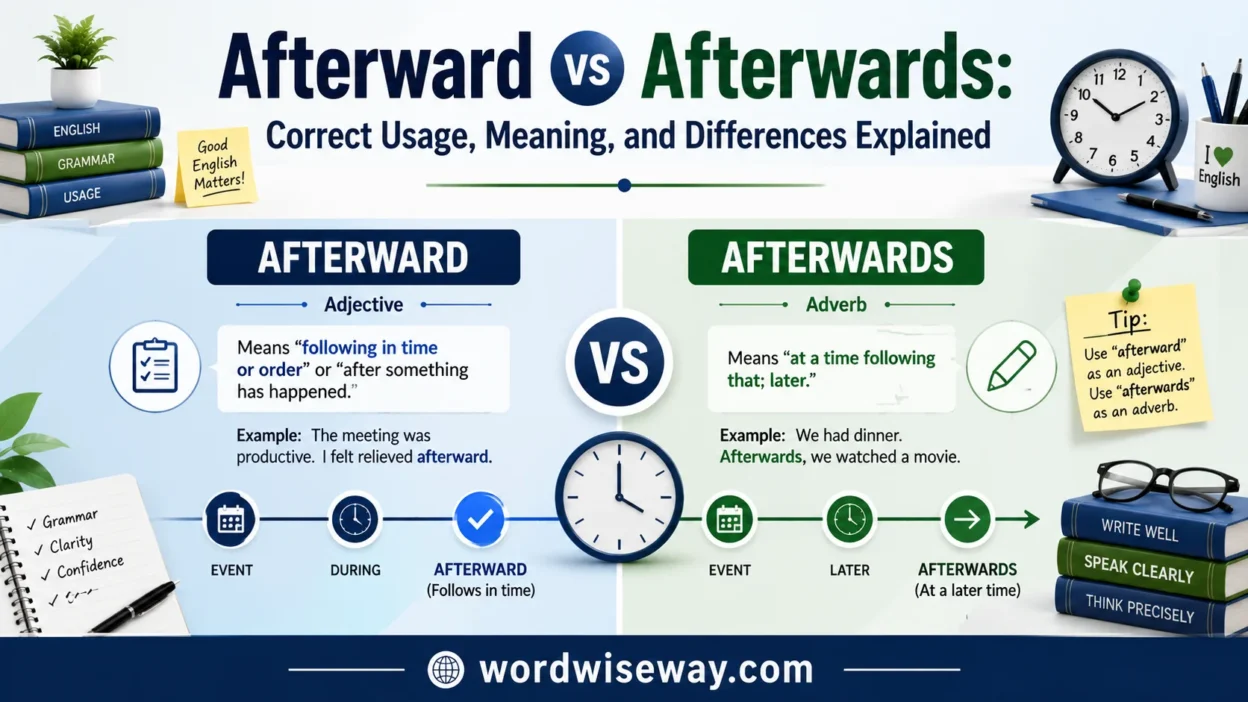
Afterward and afterwards are both correct words. They are adverbs used to describe something that happens later.
The only difference is usage style:
| Word | Common Usage | Example |
| Afterward | More common in American English | “We went for dinner afterward.” |
| Afterwards | More common in British English | “We went for dinner afterwards.” |
If you are writing for a US audience, afterward usually sounds more natural. For a British audience, afterwards may fit better.
What Does Afterward Mean?
Afterward means something happens after an event or action. It shows the order of events and tells readers that one thing happened later than another.
For example:
- “I finished my homework and played video games afterward.”
- “The team celebrated afterward.”
- “She apologized afterward.”
In these examples, afterward connects the first action with the event that follows.
You can think of afterward as a small timeline marker. It tells the reader, “This happened next.”
Afterward Meaning and Usage
The simple meaning of afterward includes:
- Later
- After that
- Following an event
- At a future point after something mentioned
Examples:
- “We visited the museum and ate lunch afterward.”
- “The rain stopped, and the children went outside afterward.”
In both sentences, the word points to a later moment.
How to Use Afterward in a Sentence
Afterward usually appears at the end of a sentence:
- “They talked about the problem afterward.”
- “I called my friend afterward.”
It can also appear at the beginning:
- “Afterward, we decided to continue the journey.”
Starting with afterward can make the timeline clearer because it immediately tells the reader that the next action happened later.
What Does Afterwards Mean?
Afterwards has the same meaning as afterward. The added letter “s” does not change the definition or function of the word.
Examples:
- “We watched a movie afterwards.”
- “He felt happy afterwards.”
- “They discussed the results afterwards.”
The word simply explains that something happened after another event.
Afterwards Meaning and Usage
The meaning of afterwards can be explained as:
- Later on
- After something has happened
- Following a previous action
Example:
“Sarah finished her presentation. Afterwards, she answered questions.”
The sentence tells us that answering questions happened after the presentation.
How to Use Afterwards Correctly
You can use afterwards when describing a sequence of events:
- “We went shopping afterwards.”
- “The students completed the test and checked their answers afterwards.”
- “The company made an announcement and explained the details afterwards.”
Afterward vs Afterwards: Main Difference
The biggest difference between afterward vs afterwards is regional preference, not meaning.
| Feature | Afterward | Afterwards |
| Meaning | At a later time | At a later time |
| Word type | Adverb | Adverb |
| Grammar | Correct | Correct |
| Common in | American English | British English |
| Meaning difference | None | None |
Both forms are widely understood by English speakers around the world.
Is Afterward or Afterwards More Correct?
Many people search for the “correct” spelling, but both forms are correct. English often has words with different accepted forms because languages naturally change over time.
The best choice depends on your audience.
Use:
- Afterward for American English writing.
- Afterwards for British English writing.
The important thing is consistency. A document feels more professional when it follows one style from beginning to end.
Afterward vs Afterwards in American English
In American English, afterward is generally preferred.
Examples:
- “We can discuss the details afterward.”
- “The guests left afterward.”
- “He returned home afterward.”
American writers often choose shorter versions of words when both options are acceptable.
Similar examples include:
| American English | British English |
| Toward | Towards |
| Forward | Forwards |
| Backward | Backwards |
| Afterward | Afterwards |
Afterward vs Afterwards in British English
British English commonly uses afterwards in everyday speech and writing.
Examples:
- “We went for coffee afterwards.”
- “She called her family afterwards.”
- “They cleaned the room afterwards.”
British speakers naturally include the extra s in several words that often appear shorter in American English.
Common Mistakes With Afterward and Afterwards
Thinking Afterwards Is Wrong
Some learners believe that afterwards is incorrect because it contains an extra letter.
That is not true.
Afterwards is a standard English word.
Using Afterward as an Adjective
A common mistake is treating afterward like an adjective.
Incorrect:
- “The afterward meeting was important.”
Correct:
- “The following meeting was important.”
- “The later meeting was important.”
Afterward works as an adverb, so it describes an action rather than a noun.
Mixing Different English Styles
Using both forms in the same piece of writing can make your style look inconsistent.
For example:
- “We walked toward the park and talked afterwards.”
This sentence is understandable, but a US English writer may prefer:
- “We walked toward the park and talked afterward.”
Afterward vs Afterwards Examples
| Sentence | Explanation |
| “I will contact you afterward.” | American English style |
| “I will contact you afterwards.” | British English style |
| “The meeting ended, and everyone left afterward.” | Shows a later action |
| “She felt relaxed afterwards.” | Shows a feeling after an event |
| “They celebrated afterward.” | Shows event sequence |
How to Choose Between Afterward and Afterwards
Choosing the right word depends on who will read your writing.
Use afterward when:
- You follow US English rules.
- Your audience is mainly American.
- You want a shorter spelling.
Use afterwards when:
- You follow British English rules.
- Your audience uses UK English.
- You prefer that style.
For global audiences, either word works. Most readers understand both without confusion.
Case Study: Afterward vs Afterwards in Real World Writing
Case Study: Choosing the Right Word for an International Blog
A content writer was creating an English learning article for readers from different countries. During editing, the writer noticed that the article used both afterward and afterwards in different sections.
For example:
- “Students reviewed their mistakes afterward.”
- “They practiced new examples afterwards.”
Although both sentences were grammatically correct, the mixed usage made the article feel inconsistent. The writer decided to identify the target audience before making a final choice.
Because most readers came from the United States, the writer changed all uses to afterward:
- “Students reviewed their mistakes afterward.”
- “They practiced new examples afterward.”
This small adjustment created a more consistent reading experience and matched the expectations of the audience.
Key Lessons From the Case Study
| Challenge | Solution |
| Both spellings appeared in one article | Selected one style and used it consistently |
| Readers came from different regions | Considered the main target audience |
| Writer thought one version was incorrect | Learned that both forms are grammatically correct |
| Content looked inconsistent | Followed one English variety throughout |
Takeaway
The choice between afterward vs afterwards is not about finding a “right” or “wrong” word. It is about understanding your readers and maintaining a consistent writing style. A small spelling preference can make content feel more natural and professional.
Read More: Forward vs Forwards: Difference, Meaning, and Correct Usage
FAQs
What is the main difference between afterward and afterwards?
Afterward and afterwards have the same basic meaning, referring to something that happens later. The main difference is regional preference, with afterward being more common in American English and afterwards often preferred in British English.
Is afterward considered a correct word?
Yes, afterward is a completely correct word. It is commonly used in North American English and works as an adverb to describe an event that happens later.
Is afterwards only used in British English?
No, afterwards is not limited to British English. It is also understood and used in other English-speaking regions, although some areas prefer afterward.
Can afterward and afterwards be used in the same sentence?
Yes, both words can usually replace each other because they share the same meaning. The choice depends mostly on writing style, audience, and regional preference.
What does afterword mean compared to afterward?
An afterword is different from afterward. An afterword is a section at the end of a book where an author or another person provides comments, explanations, or additional insights about the text.
Which word is better for formal writing?
Both afterward and afterwards are acceptable in formal writing. Writers should choose the form that matches their audience, location, or preferred style guide.
Why do people confuse afterward and afterwards?
People often confuse them because they have similar spellings, pronunciations, and meanings. The small difference in ending makes many writers pause and question which word sounds more natural.
Are afterward and afterwards interchangeable?
In most contexts, yes. They are interchangeable when describing something that happens later, but regional habits may influence which version sounds more familiar.
How can I remember when to use afterward?
A simple way is to remember that afterward means “later” or “after something happens.” It works well when describing a later event, action, or situation.
Does using afterward instead of afterwards change the meaning?
No, using one instead of the other usually does not change the meaning. The difference is mainly about preference, style, and regional English usage.
Conclusion
Understanding Afterward vs Afterwards: Differences, Meaning, and Correct Usage becomes easier when you focus on meaning rather than small spelling differences. Both words describe something that happens later, and both are accepted in English. The main variation comes from regional preferences, where American writers often choose afterward, while British writers frequently use afterwards. Learning this difference helps writers avoid unnecessary confusion and choose words confidently in everyday conversations, articles, and formal documents.
English contains many words that look almost identical but carry different uses, and afterward, afterwards, and afterword are good examples. By paying attention to context, audience, and purpose, anyone can use these terms naturally. Once you understand the pattern behind these words, writing becomes smoother, clearer, and more accurate without relying on complicated grammar rules.

Emma Smith has dedicated 14 years to Princeton University’s English Department, mentoring students in textual interpretation, literary movements, and critical frameworks. Her research explores Shakespearean drama, Victorian serial fiction, postcolonial narrative theory, and manuscript studies and probing how literary forms evolve across cultures and centuries. Emma has delivered lectures at international humanities congresses and published findings in distinguished academic journals, underscoring her commitment to scholarly depth and vibrant teaching.