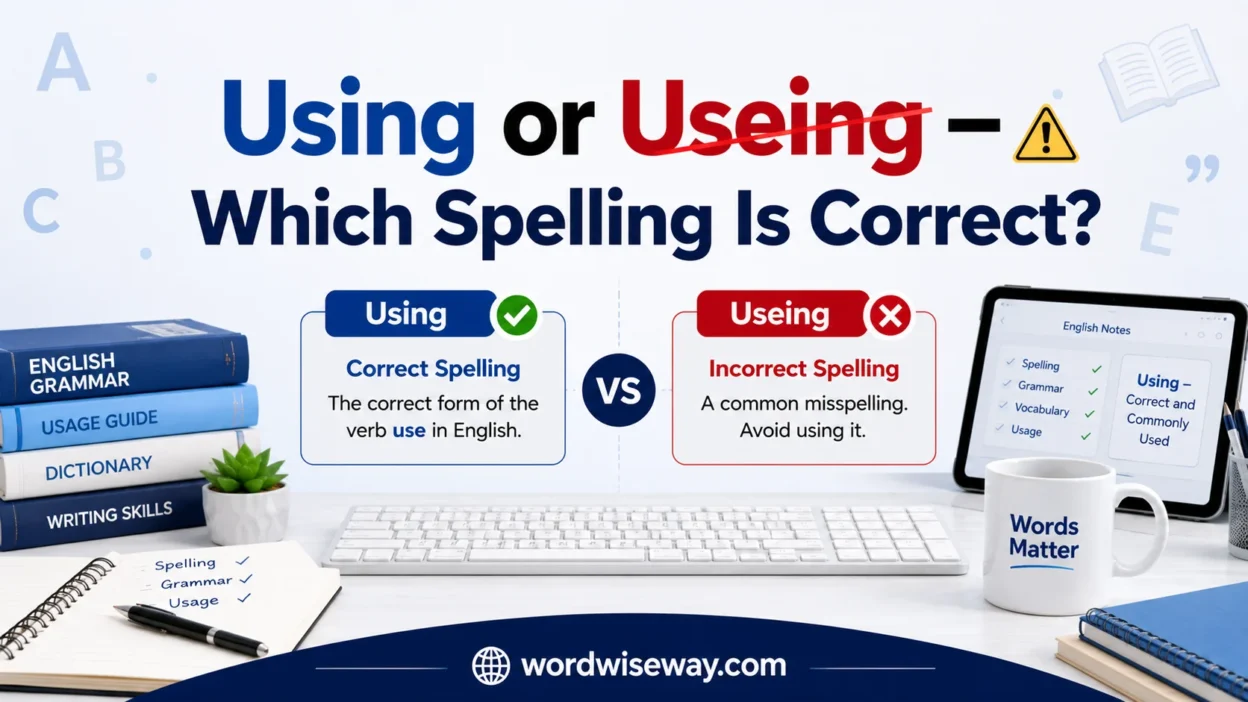
Using or Useing: Correct Spelling, Meaning, and Usage is a common question among students, bloggers, professionals, and native English speakers during typing or everyday writing.
The correct form is Using, while Useing is an incorrect spelling in standard English. This article explains the word use change into the -ing form, where verbs follow a spelling rule by dropping or changing letters. Learning this pattern helps improve writing skills and avoid spelling error in emails, exams, texts, assignments, and social media posts.
The Use and Usage difference can also create confusion because both words have related meanings. A quick Google search may give a simple explanation, but noun use and noun usage have different roles, pronunciation, and parts of speech. Both come from the Latin word usus, linked with employment, practice, custom, and behaviour.
Understanding English language, vocabulary, and word origin makes these spelling doubts easier to solve.
Quick Answer:
The correct spelling is:
✔ using
❌ useing (incorrect)
There is no variation between British English and American English here. Both use using only.
The form useing is a spelling error and is not recognized in any standard dictionary, academic writing system, or professional grammar framework.
Why “Using or Useing” Causes So Much Confusion
The confusion comes from a mix of pronunciation and overgeneralized grammar rules.
English learners often assume:
- If the base word is use
- And we add -ing
- Then the result should be use + ing = useing
That logic feels correct, but English spelling has a hidden rule that quietly removes the “e” in many cases.
This is where the correct form using comes from.
The Correct Spelling: Why “Using” Is the Standard Form
The word using is the present participle and gerund form of the verb use.
It appears in:
- Continuous tenses (I am using)
- Gerund phrases (Using tools helps)
- Active descriptions (using technology)
Real Examples of Correct Usage
- She is using her laptop for homework.
- They are using advanced software in the lab.
- Using a dictionary improves vocabulary.
- He was using the wrong method.
Every standard form in English follows this spelling.
Why “Useing” Is Always Incorrect
The spelling useing breaks a core English grammar rule involving silent “e” deletion.
What makes it wrong?
- English avoids double vowel clashes like “ueing”
- The final “e” in “use” is dropped before adding “-ing”
- It does not appear in any official language standard
In simple terms:
English cleans up the word before attaching “-ing”
So:
- use → using ✔
- make → making ✔
- write → writing ✔
But never:
- use → useing ❌
The Grammar Rule Behind “Using”
The transformation from use → using follows a well-known spelling rule:
Drop the silent “e” before adding “-ing”
This rule applies to thousands of English verbs.
Examples of the Rule in Action
| Base Verb | Correct -ing Form | Incorrect Form |
| use | using | useing ❌ |
| make | making | makeing ❌ |
| write | writing | writeing ❌ |
| come | coming | comeing ❌ |
| drive | driving | driveing ❌ |
This rule is one of the most important spelling foundations in English writing.
Important Exceptions to the Rule
English loves exceptions more than consistency.
Exception 1: Verbs ending in double “e”
- see → seeing ✔ (not seing)
- agree → agreeing ✔
Why? Dropping “e” would destroy pronunciation clarity.
Exception 2: Words where pronunciation would change
- age → ageing (British usage often keeps the “e”)
- singe → singeing (not singing, which has a different meaning)
These exceptions exist to avoid confusion in meaning.
Meaning of “Using” in Real Contexts
The word using is incredibly flexible. It works in multiple grammatical roles.
As a Verb (Action in Progress)
This is the most common use.
- I am using my phone.
- She is using a new app.
- They are using the system correctly.
Here, it shows an ongoing action.
As a Gerund (Verb Acting Like a Noun)
- Using tools saves time.
- Using public transport is efficient.
- Using AI helps productivity.
Here, “using” behaves like a noun.
In Continuous Tenses
- Present continuous: I am using
- Past continuous: I was using
- Future continuous: I will be using
This structure is central to English grammar fluency.
Why People Write “Useing” (Real Linguistic Reasons)
The mistake is surprisingly predictable.
Reason 1: Phonetic thinking
People write what they “hear” in their head.
Reason 2: Overgeneralization
Learners apply:
“just add -ing”
without learning the drop-E rule.
Reason 3: Lack of exposure
Incorrect forms survive in informal texting environments.
Reason 4: Auto-correction gaps
Some devices fail to flag it strongly in casual writing.
Common Similar Spelling Mistakes
The “useing” mistake belongs to a bigger family of spelling errors.
Frequent errors:
- writeing ❌ → writing ✔
- comeing ❌ → coming ✔
- takeing ❌ → taking ✔
- makeing ❌ → making ✔
Once you recognize the pattern, most errors disappear.
Quick Comparison Table: Using vs Useing
| Feature | Using | Useing |
| Correct spelling | ✔ Yes | ❌ No |
| Dictionary valid | ✔ Yes | ❌ No |
| Grammar accepted | ✔ Yes | ❌ No |
| Used in writing | ✔ Everywhere | ❌ Never |
Practical Writing Tips to Avoid the Mistake
Tip 1: Learn the Drop-E Rule
Remember:
If a verb ends in “e”, drop it before “-ing”
Tip 2: Read your writing aloud
Your brain catches inconsistencies faster when spoken.
Tip 3: Use correction tools wisely
Grammarly and similar tools detect this instantly.
Tip 4: Build pattern awareness
Once you see:
- use → using
you will never forget it.
Read More: Separate or Seperate: Correct Spelling, Meaning, and Usage
FAQs
Q1. Is “Using” or “Useing” the correct spelling?
Using is the correct spelling in standard English. Useing is a common spelling mistake because the word “use” changes when adding -ing.
Q2. Why do people confuse Using and Useing?
People often get confused because English spelling rules are not always predictable. When adding -ing to verbs, some words drop letters or change their form.
Q3. What is the meaning of the word Using?
Using means applying, taking advantage of, or making something work for a specific purpose. It is the -ing form of the verb use.
Q4. Is Useing accepted in English grammar?
No, Useing is not accepted in standard English. It is considered an incorrect spelling error in writing.
Q5. What is the difference between Use and Usage?
Use usually refers to the act or purpose of using something, while Usage describes the way something is used, especially in language and communication.
Q6. Is Use a verb or a noun?
Use can work as both a verb and a noun. As a verb, it means to apply something, and as a noun, it refers to the purpose or function of something.
Q7. Why is Usage considered a noun?
Usage is a noun because it describes a practice, method, or common way of doing something, especially in language and behavior.
Q8. How can I remember the spelling of Using?
Remember that when adding -ing to “use,” the final e is removed, creating using, not useing.
Q9. Do British and American English use Using differently?
No, both British English and American English use Using as the correct spelling. The spelling rule remains the same.
Q10. How does correct spelling improve writing?
Correct spelling makes your emails, assignments, articles, and professional communication clearer. It also helps readers understand your message easily.
Conclusion
Understanding the difference between Using and Useing helps you avoid a common spelling mistake in everyday communication. The correct spelling is always Using, and knowing the -ing form rule makes it easier to remember why the final e is removed. Whether you are writing emails, assignments, articles, or social media posts, accurate spelling improves clarity and confidence.
The difference between Use and Usage also becomes easier when you understand their meanings, grammar roles, and word origins. By learning these small English grammar details, you can improve your vocabulary, strengthen your writing skills, and choose the right words in every situation.

Emma Smith has dedicated 14 years to Princeton University’s English Department, mentoring students in textual interpretation, literary movements, and critical frameworks. Her research explores Shakespearean drama, Victorian serial fiction, postcolonial narrative theory, and manuscript studies and probing how literary forms evolve across cultures and centuries. Emma has delivered lectures at international humanities congresses and published findings in distinguished academic journals, underscoring her commitment to scholarly depth and vibrant teaching.