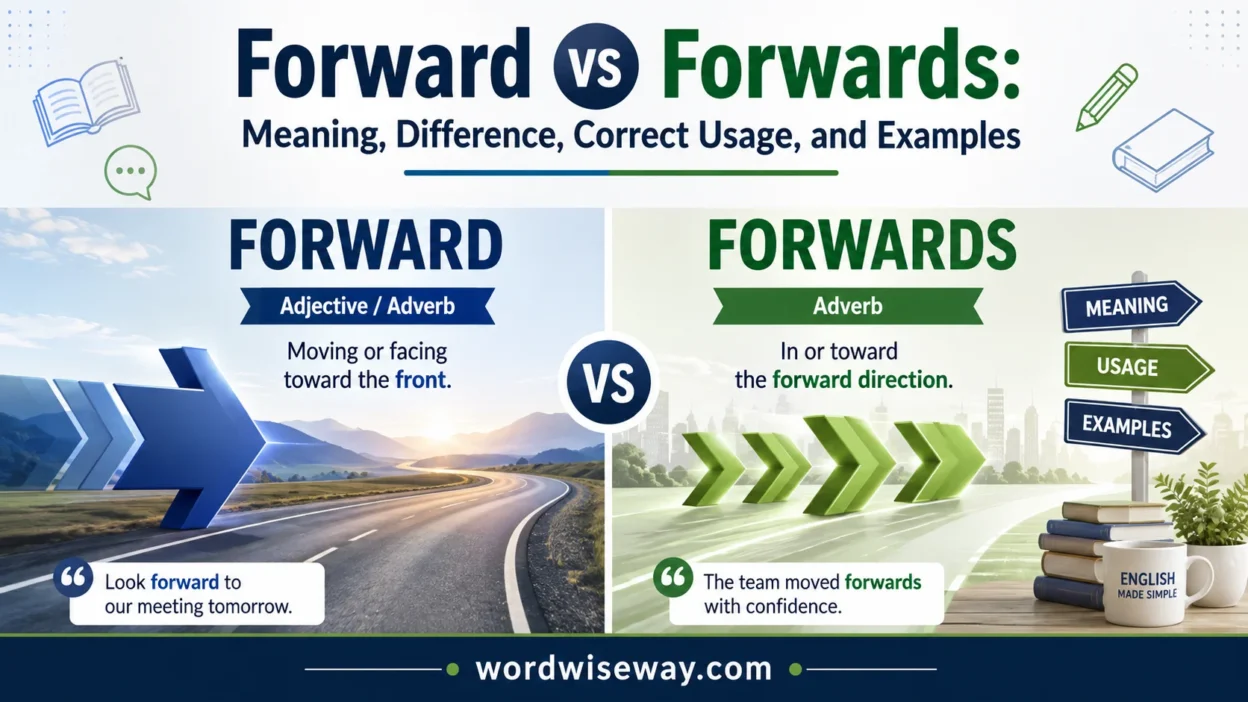
Forward vs Forwards: Difference, Meaning, and Correct Usage explains how these words differ in English grammar, usage, and context.
Forward and forwards often confuse English learners because they look similar and seem interchangeable. Both show movement toward the front, but the key difference depends on region. In American English, forward is the standard form, while British English often uses forwards as an adverb.
Many writers, students, and professionals wonder about these words because they sound similar. Understanding regional usage, grammar structure, and correct form improves clarity in writing and speaking.
Learning their difference helps avoid common mistakes and creates more confident communication in different situations.
Quick Answer:
Forward and forwards usually have the same meaning when they act as adverbs and describe movement toward the front or progress toward a goal. However, forward is the preferred form in American English, while forwards is more common in British English.
The biggest difference is that forward has more uses. It can work as an adverb, adjective, noun, and verb. Forwards mainly works as an adverb.
Examples:
- She stepped forward to help. ✅
- She stepped forwards to help. ✅ (more common in British English)
- Please forward the email to me. ✅
- Please forwards the email to me. ❌
For most American English writing, choosing forward is the safest option.
Key Difference Explained
The words forward and forwards come from the same idea: moving ahead or toward the front. The extra “s” in forwards does not create a completely different meaning. Instead, it mainly reflects a difference in English style and regional preference.
| Word | Main Function | Meaning | Common Usage |
| Forward | Adverb, adjective, noun, verb | Toward the front, ahead, progress, send | Most common in American English |
| Forwards | Mostly adverb | Toward the front or ahead | More common in British English |
A simple way to remember it:
- Forward = the common choice in US English
- Forwards = an acceptable British English variation
Think of them as two paths leading to the same destination. One path is used more often in America, while the other appears more frequently in Britain.
Meaning of Forward
The word forward has several meanings depending on how you use it. It can describe physical movement, future progress, a position, or even sending information.
Forward as an Adverb
As an adverb, forward describes movement toward the front or toward a future goal.
Examples:
- The player moved forward with the ball.
- She took one step forward before answering.
- The company plans to move forward with the new project.
In these examples, forward shows movement or progress.
Common meanings of forward as an adverb include:
- Moving ahead physically
- Making progress
- Continuing toward a goal
- Facing the future
For example, when someone says, “Let’s move forward,” they usually do not mean walking in a direction. They mean continuing, improving, or making progress.
Forward as an Adjective
Forward can also describe something located at the front.
Examples:
- The forward seats provide a better view.
- The airplane’s forward section has more space.
- The team’s forward player scored the goal.
Here, forward describes position rather than movement.
Forward as a Verb
One of the most important uses of forward is as a verb. It means to send something from one person to another.
Examples:
- Please forward this message to your teacher.
- I will forward the documents tomorrow.
- She forwarded the invitation to her friends.
This use is especially common in workplaces because people regularly forward emails, files, and information.
Remember:
Forward = send something onward
You cannot use forwards as a verb.
Incorrect:
- I forwards the email.
Correct:
- I forward the email.
Forward as a Noun
In sports, forward can describe a player position.
Examples:
- The basketball forward scored the final points.
- The soccer forward created several chances.
A forward usually plays an attacking role and focuses on creating scoring opportunities.
Meaning of Forwards
Forwards is mainly used as an adverb. It describes movement toward the front or ahead.
Examples:
- The child walked forwards slowly.
- He leaned forwards to hear the conversation.
- The project moved forwards despite challenges.
The meaning is almost identical to forward when describing movement.
The main difference is not meaning. It is preference.
British speakers often add the -s ending to direction words:
- Forward → Forwards
- Backward → Backwards
- Toward → Towards
- Upward → Upwards
American English often prefers the shorter forms:
- Forward
- Backward
- Toward
- Upward
Forward vs Forwards in American and British English
English changes slightly depending on where it is spoken. The difference between forward and forwards is a good example of this natural variation.
| Region | Common Choice | Example |
| United States | Forward | We need to move forward with the plan. |
| United Kingdom | Forward or Forwards | We need to move forwards with the plan. |
| Canada | Forward is common | The company is moving forward. |
| Australia | Both forms appear | They moved forwards toward the goal. |
Neither word is automatically wrong. The important thing is matching your writing style with your audience.
For example:
A US business email would usually say:
“I look forward to hearing from you.”
A British writer might also use:
“I look forwards to hearing from you.”
However, the first version is widely accepted internationally and is the standard phrase in professional communication.
Forward vs Forwards Grammar Differences
Although these words seem interchangeable, grammar creates some important differences.
| Use | Forward | Forwards |
| Describing movement | ✅ Yes | ✅ Yes |
| Showing progress | ✅ Yes | ✅ Sometimes |
| Sending emails/files | ✅Yes | ❌ No |
| Describing a position | ✅ Yes | ❌ No |
| Sports position | ✅ Yes | ❌ No |
The flexibility of forward makes it much more useful.
For example:
- Move forward with your plans.
- The forward door is open.
- Please forward the message.
But:
- Move forwards with your plans. ✅ (British style)
- The forwards door is open. ❌
- Please forwards the message. ❌
When to Use Forward
You should use forward in many everyday and professional situations.
Use Forward for Progress
When talking about improvement, goals, or future plans, forward is the standard choice.
Examples:
- The team is moving forward after the setback.
- She wants to move forward with her career.
- The project is finally moving forward.
Use Forward for Sending Information
In digital communication, always use forward as a verb.
Examples:
- Forward the email to the department.
- I forwarded the file yesterday.
- Can you forward this link?
Use Forward for Positions
When something is located at the front, use forward.
Examples:
- The forward part of the vehicle was damaged.
- They reserved the forward seats.
Use Forward in Sports
Examples:
- The forward scored two goals.
- The coach changed the forward position.
When to Use Forwards
Use forwards mainly when describing physical movement, especially if you follow British English conventions.
Examples:
- The dog ran forwards.
- She leaned forwards to look closer.
- The child fell forwards while playing.
In American English, these sentences would usually use forward instead:
- The dog ran forward.
- She leaned forward.
- The child fell forward.
Both are understandable. The difference is style rather than meaning.
Common Mistakes With Forward and Forwards
Understanding common errors makes it easier to avoid them.
Mistake: Thinking Forwards Is Always Wrong
Some people believe forwards is incorrect. That is not true.
Forwards is a correct English word. It is simply less common in American English.
Example:
- British English: The car moved forwards.
- American English: The car moved forward.
Both sentences work.
Mistake: Using Forwards as a Verb
Incorrect:
She forward the email every morning.
Correct:
She forwards the email every morning.
Explanation:
In the present tense, with she/he/it (third-person singular), the verb forward takes -s, so forwards is the correct verb form. Forwards can also be used as an adverb meaning “toward the front,” but in this sentence it is a verb.
Examples:
- She forwards emails to her team. ✅
- He forwards important documents. ✅
The difference comes from grammar:
- forward = base verb
- forwards = third-person singular verb form
Mistake: Mixing Regional Styles
A writer may use American and British forms randomly.
Example:
- The company moved forwards with the project.
- We are looking forward to success.
This is not a serious mistake, but consistent style creates smoother writing.
Forward vs Forwards Examples
| Sentence | Explanation |
| He stepped forward to speak. | Movement toward the front |
| She moved forward in her career. | Progress |
| Please forward the email. | Sending information |
| The player moved forwards quickly. | British-style movement |
| The forward seats are reserved. | Position |
| The soccer forward scored. | Sports position |
Forward vs Forwards in Professional Writing
Professional writing usually favors forward because American business English dominates many international workplaces.
Common phrases include:
- Looking forward to your response
- Moving forward with the project
- Forward this information
- Forward-thinking ideas
The phrase “looking forward to” is especially important. It means feeling excited or expecting something in the future.
Example:
- I look forward to meeting you.
This phrase appears frequently in emails, applications, and formal messages.
Related Direction Words Similar to Forward and Forwards
Many English words follow the same pattern.
| Short Form | Extended Form |
| Forward | Forwards |
| Backward | Backwards |
| Toward | Towards |
| Upward | Upwards |
| Downward | Downwards |
American English often chooses shorter versions, while British English often accepts both.
This pattern shows that English is flexible. Small spelling changes can reflect different speech communities without changing the core meaning.
How to Remember Forward vs Forwards
Use these simple memory tips:
- Choose forward for American English writing.
- Choose forwards when following British movement descriptions.
- Use forward when sending emails or files.
- Use forward for adjectives, nouns, and most professional phrases.
A quick rule:
If you are unsure, choose forward.
It works in more situations and is widely accepted around the world.
Read More:Content vs Context: Meaning, Differences, and Why They Matter
FAQs
What is the main difference between forward and forwards?
The main difference between forward and forwards is based on regional usage and writing style. Both words describe movement toward the front, but forward is more commonly used in American English, while forwards appears more often in British English conversations.
Is forward or forwards more correct in English?
Both forms can be correct depending on the situation. Forward is generally considered the safer choice because it is widely accepted in modern writing, professional communication, and international English.
Can forward and forwards be used interchangeably?
In many sentences, forward and forwards can replace each other without changing the meaning. However, the preferred choice may depend on the speaker’s region, style, and the type of writing being used.
Why do people confuse forward and forwards?
People often confuse these words because they look almost identical and have similar meanings. The small difference in usage creates uncertainty for learners who are trying to improve their grammar and writing skills.
Is forward better for formal writing?
Yes, forward is usually preferred in formal writing because it sounds more standard and is understood globally. Many professionals, writers, and businesses choose it to maintain clear and consistent communication.
When should I use forwards?
Forwards is commonly used as an adverb, especially in British English and casual speech. It can be used when describing movement or progress toward a specific direction.
Do native English speakers use both forward and forwards?
Yes, native speakers use both forms. Their choice often depends on their location, personal style, and whether they are speaking or writing in a formal setting.
Does using forwards instead of forward make a sentence wrong?
Not always. Using forwards instead of forward may not make a sentence grammatically incorrect, but it can make the sentence sound different depending on the audience and region.
How can I remember the difference between forward and forwards?
A simple way to remember is that forward is the more universal option, especially in formal writing. Forwards is often linked with British English and informal communication.
Why is understanding forward vs forwards important?
Understanding this difference helps learners write clearer sentences, avoid grammar confusion, and communicate confidently. Correct word choice improves the quality of both professional and everyday English.
Conclusion
The difference between forward and forwards is small but important for anyone learning English. Both words describe movement toward the front, yet their usage changes depending on region, context, and writing style. While forward is widely accepted across the world and works well in formal writing, forwards remains a correct and common choice in many British English situations. Knowing these small language details helps writers choose words with greater accuracy.
Learning the correct use of forward vs forwards improves grammar knowledge and makes communication smoother. Whether you are a student, blogger, professional, or everyday English user, understanding regional variations allows you to write naturally and confidently. By practicing real examples and paying attention to context, choosing between these two similar words becomes easier and more natural over time.

Evelyn Shaw has spent 14 years at Yale University’s English Department, leading students through close readings, genre studies, and interpretive methodologies. Her scholarly interests include Renaissance drama, gothic fiction, feminist literary criticism, and archival research and examining how texts generate meaning across historical periods. Evelyn has presented at major academic conferences and published essays in peer-reviewed journals, reflecting her passion for rigorous analysis and student-centered learning.