Bellow or Below: Correct Spelling, Meaning and Correct Usage helps explain why English learners confuse these commonly confused words.
Small minor spelling differences can completely change the meaning of common words. A typo can damage a sentence and affect polished prose. Below is a preposition showing a lower spatial position, while bellow is a noun for a deep roar or a verb meaning to make a loud hollow noise.
This word confusion happens because below and bellow have a similar sound but are not homophones. To remember the distinction, think of bell and bull, as a bull bellows with a deep roar.
Learning the correct spelling, correct usage, and proper usage of these 2 words improves grammar, communication, and helps English speakers avoid mistakes in emails, news articles, and formal documents.
Quick Answer:
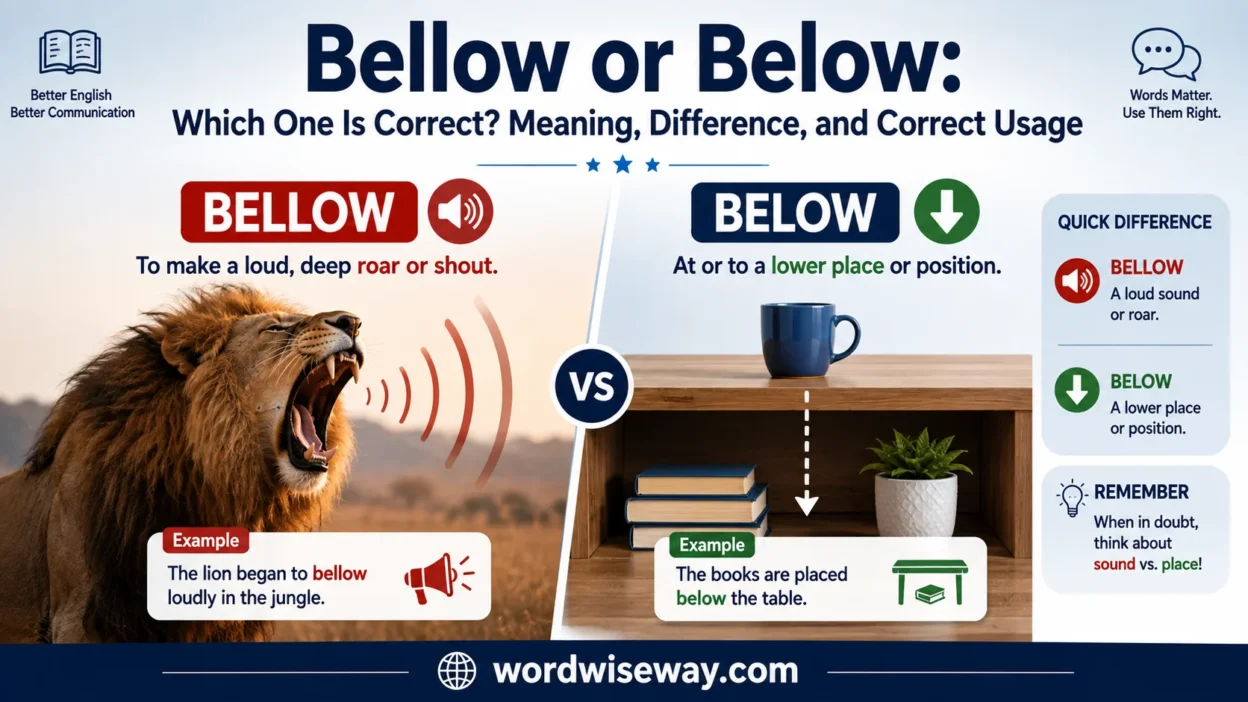
Both bellow and below are correct English words, but they have different meanings.
Bellow means to make a loud, deep sound or to shout loudly.
Below means in a lower position, level, place, or amount.
| Word | Meaning | Example |
| Bellow | A loud roar, cry, or shout | The lion began to bellow across the jungle. |
| Below | Lower than something else | The temperature fell below zero. |
A simple way to remember the difference:
- Bellow = Big sound
- Below = Bottom position
Key Difference
Although bellow and below look similar, they belong to different categories of meaning.
Bellow connects with noise and voices. It describes a strong, deep, or powerful sound. People, animals, and even machines can bellow.
Below connects with position and measurement. It tells you that something is under another thing or lower than a certain point.
Consider these examples:
- The teacher had to bellow instructions because the room was noisy.
- The information is written below the picture.
The first sentence focuses on sound. The second sentence focuses on placement.
What Does Bellow Mean?
It means to produce a loud, deep, and powerful sound. It often describes sounds that are difficult to ignore.
The word is commonly used for animals such as bulls, cows, elephants, and lions. However, it can also describe humans who shout with great force.
Bellow as a Verb
As a verb, it describes the action of making a loud noise.
Examples:
- The bull began to bellow when it saw another animal.
- The coach had to bellow across the field to get the players’ attention.
- The child began to bellow after losing the game.
The word usually suggests more than simply speaking loudly. A person who bellows often sounds angry, excited, upset, or extremely forceful.
Compare these words:
| Word | Meaning | Strength |
| Speak | Use your voice normally | Low |
| Shout | Speak very loudly | Medium |
| Bellow | Produce a powerful, deep, booming sound | High |
A person can shout without bellowing, but bellowing usually creates a stronger image.
Bellow as a Noun
Bellow can also work as a noun. In this form, it refers to the loud sound itself.
Examples:
- The bellow of the wild animal echoed through the forest.
- A sudden bellow came from the old building.
Here, bellow is not describing an action. It names the sound.
Common Uses of Bellow
It appears in several situations.
Animal Sounds
Many animals make deep, powerful sounds that can be described as bellows.
Examples:
- A bull may bellow during a confrontation.
- An elephant may bellow to communicate with others.
These sounds often travel long distances and carry strong emotions.
Human Voices
People may bellow when they want their voice to reach others.
Examples:
- The captain bellowed orders during the emergency.
- He bellowed her name from across the street.
Writing and Storytelling
Writers often use bellow to create vivid descriptions.
Example:
The monster’s bellow shook the quiet village.
The word helps readers imagine a deep and frightening sound.
What Does Below Mean?
The word below means lower than something else. It can describe physical location, numbers, standards, or written information.
Unlike bellow, it has nothing to do with sound.
Below as a Preposition
A preposition shows the relationship between things. When below works as a preposition, it shows that something is in a lower position.
Examples:
- The river flows below the bridge.
- The temperature dropped below freezing.
- She lives in the apartment below mine.
In each example, something exists at a lower point.
Below as an Adverb
Below can also work as an adverb when it refers to something lower or something mentioned later.
Examples:
- Please read the instructions below.
- The answers are listed below.
- The village below looks beautiful from the mountain.
The word points toward a lower place or a later section of information.
Figurative Uses of Below
Sometimes below does not describe a physical location. It can describe levels, standards, or amounts.
Examples:
- His performance was below average.
- The company’s results fell below expectations.
- The temperature remained below normal.
In these sentences, below compares something with a standard.
Pronunciation Difference
Pronunciation can help you separate these two words.
| Word | Pronunciation | Sound |
| Bellow | BEL-oh | Starts with a short “e” sound |
| Below | bee-LOH | Starts with a longer “ee” sound |
Listen carefully:
- Bellow sounds like “bell-oh.”
- Below sounds like “bee-low.”
The different first sounds match their different meanings.
Common Mistakes
Many people confuse these words because they share similar letters. However, their meanings cannot replace each other.
Using Bellow Instead of Below
Incorrect:
- The temperature went bellow freezing.
Correct:
- The temperature went below freezing.
The sentence talks about a level, not a sound.
Using Below Instead of Bellow
Incorrect:
- The lion began to below loudly.
Correct:
- The lion began to bellow loudly.
The sentence describes an animal sound.
Confusing Similar Looking Words
Words with similar spelling often create mistakes. English has many examples where a small spelling change creates a completely different meaning.
Examples:
| Confusing Words | Difference |
| Bellow vs Below | Sound vs lower position |
| Brake vs Break | Stop vs damage/separate |
| Affect vs Effect | Influence vs result |
| Accept vs Except | Receive vs exclude |
Learning the meaning behind each word is more effective than memorizing spelling alone.
Example Sentences
Examples With Bellow
- The angry customer began to bellow at the employee.
- The elephant’s bellow could be heard from far away.
- The captain bellowed commands during the storm.
- The old machine released a strange bellow.
Examples With Below
- The book is hidden below the table.
- The score was below the required level.
- Look at the paragraph below for more details.
- The airplane flew below the clouds.
Real Life Comparison
Imagine standing near a farm.
A bull makes a deep, loud sound across the field. That sound is a bellow.
Now imagine looking at the ground beneath your feet. The area under you is below.
The difference is simple:
- If you can hear it, think bellow.
- If you can locate it lower, think below.
Memory Trick to Remember Bellow vs Below
Use this quick trick:
Bellow has “bell” inside it. A bell makes a sound.
Below contains “low.” Something low is underneath or lower.
So:
- Bellow → Sound
- Below → Low position
This small connection makes the difference easier to remember.
Related Words Often Confused With Bellow and Below
Low vs Below
Low describes something close to the bottom or at a small level.
Example:
- The plane flew low.
Below compares one thing with another.
Example:
- The plane flew below the clouds.
Yell vs Bellow
Both words relate to loud voices.
- Yell means to shout loudly.
- Bellow means to make a deep, powerful sound.
Example:
- She yelled for help.
- The angry man bellowed across the room.
Under vs Below
These words often overlap, but they are not always interchangeable.
Example:
- The shoes are under the bed.
- The temperature is below freezing.
Under usually describes physical position. Below often works for measurements and levels.
Read More: Homie or Homey: Which One Is Correct?
FAQs
What is the main difference between bellow and below?
Below refers to something that is in a lower position or place, while bellow describes a loud, deep sound or the action of making that sound. They look similar but have completely different meanings.
Is bellow a correct English word?
Yes, bellow is a correct English word. It can be used as a noun for a deep roar or as a verb for making a loud, powerful sound like an angry animal.
Is below used as a noun or verb?
No, below is generally used as a preposition or adverb. It shows that something is lower than another object, position, or point.
Why do people confuse bellow and below?
People often confuse these words because they have almost the same spelling and pronunciation. The only major spelling difference is the extra L in bellow, but their meanings are unrelated.
How can I remember the spelling of bellow?
A simple way to remember bellow is to connect it with bell or bull. A bell creates a loud sound, and a bull is an animal that can bellow.
Can bellow and below be used interchangeably?
No, these words cannot replace each other. Using bellow instead of below or below instead of bellow can completely change the meaning of a sentence.
What does bellow mean in a sentence?
In a sentence, bellow usually means producing a loud, deep sound. For example, a person or animal may bellow when making a powerful noise.
What type of word is below?
Below is mainly a preposition that explains location or position. It helps describe something placed under or at a lower level than another thing.
Are bellow and below homophones?
No, bellow and below are not homophones. Although they look similar, they have different pronunciations and meanings.
How can learning these words improve writing skills?
Understanding the difference between bellow and below improves spelling accuracy, sentence clarity, and overall communication, especially in formal writing.
Conclusion
The difference between bellow and below may seem small, but the extra L creates a completely different word with a separate meaning and usage. Below focuses on position, while bellow relates to powerful sounds. Recognizing this difference helps writers avoid common spelling mistakes and communicate ideas more clearly.
Strong vocabulary grows through attention to small details. By practicing these confusing word pairs and checking their meanings before writing, English learners can improve their grammar, confidence, and writing quality across conversations, articles, and professional documents.

Emma Smith has dedicated 14 years to Princeton University’s English Department, mentoring students in textual interpretation, literary movements, and critical frameworks. Her research explores Shakespearean drama, Victorian serial fiction, postcolonial narrative theory, and manuscript studies and probing how literary forms evolve across cultures and centuries. Emma has delivered lectures at international humanities congresses and published findings in distinguished academic journals, underscoring her commitment to scholarly depth and vibrant teaching.